
Di Yi Cai Jing Zi Xun

Search documents
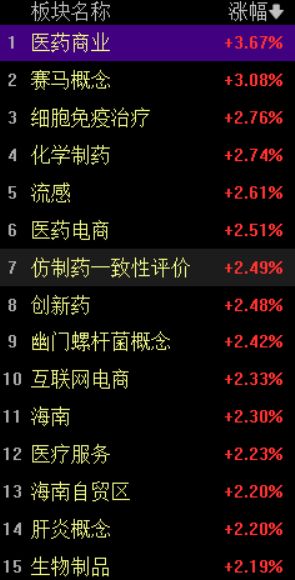
医药股,大涨
Di Yi Cai Jing Zi Xun· 2025-11-26 03:23
Core Viewpoint - The pharmaceutical sector has shown significant strength, with various sub-sectors such as pharmaceutical commerce, chemical pharmaceuticals, influenza, and innovative drugs leading the gains in the market [1][2]. Sector Performance - Pharmaceutical Commerce: Increased by 43.67% [2] - Cell Immunotherapy: Increased by 42.76% [2] - Chemical Pharmaceuticals: Increased by 2.74% [2] - Influenza: Increased by 2.61% [2] - Innovative Drugs: Increased by 2.48% [2] Notable Stocks - Huaren Health: Increased by 20.00%, with a total market value of 69.60 billion [3] - Haiwang Biological: Increased by 10.20%, with a total market value of 73.93 billion [3] - Ruikang Pharmaceutical: Increased by 10.00%, with a total market value of 48.00 billion [3] - Hainan Haiyao: Increased by 10.00%, with a total market value of 119.9 billion [3] Market Context - As of the report, the Shanghai Composite Index decreased by 0.03%, while the Shenzhen Component Index increased by 0.84% and the ChiNext Index increased by 1.52% [4][5]. - Over 2300 stocks in the market saw an increase, with nearly 60 stocks hitting the daily limit up [5]. Influenza Activity - There has been a rapid increase in influenza activity nationwide, with Beijing entering a high incidence period for respiratory infectious diseases [3]. - Sales of Oseltamivir surged by 237% in the past week, while sales of Favipiravir increased by 180% [3].


低利率下,居民财富如何增长→
Di Yi Cai Jing Zi Xun· 2025-11-26 02:57
Core Insights - The article discusses the shift in wealth management strategies in response to the declining interest rates, with a focus on how financial institutions are adapting to meet changing consumer needs [2][4][8] Group 1: Changes in Wealth Management Demand - The low interest rate environment is reshaping residents' wealth management needs and risk preferences, moving away from reliance on real estate and high-interest deposits to more diversified asset allocation strategies [4] - Three significant changes in client demands for wealth management are identified: a rational adjustment of return expectations, an increased demand for protection products, and a growing awareness of global asset allocation [4][6] - The insurance market reflects the trend of increasing demand for products that balance protection and returns, with a notable 20% year-on-year growth in insurance premiums through bancassurance channels [4][5] Group 2: Investment Strategies and Opportunities - Financial institutions are employing a "dual-track strategy" of "core assets + opportunity assets" to adapt to the low interest rate environment, focusing on dynamic adjustments based on market changes [6][7] - The "fixed income +" product category is highlighted as the fastest-growing fund type, with a net inflow of 460 billion in the third quarter, indicating a gradual increase in risk appetite among investors [5][6] - The article emphasizes the importance of diversified asset allocation, with a focus on technology innovation and undervalued high-dividend assets as key investment directions [7][8] Group 3: The Era of Asset Management - The article posits that China is entering a true asset management era, characterized by a shift towards equity assets as the core vehicle for future wealth growth [8][9] - International investors are increasingly optimistic about Chinese assets, particularly in sectors like artificial intelligence, new energy, and electric vehicles, which are seen as having global competitiveness [8][9] - The article concludes that financial institutions should focus on comprehensive planning that meets clients' risk, return, and liquidity needs, while emphasizing the importance of active management capabilities in fund companies [9]
第25届华创会在武汉开幕,现场签约82亿元
Di Yi Cai Jing Zi Xun· 2025-11-26 02:44
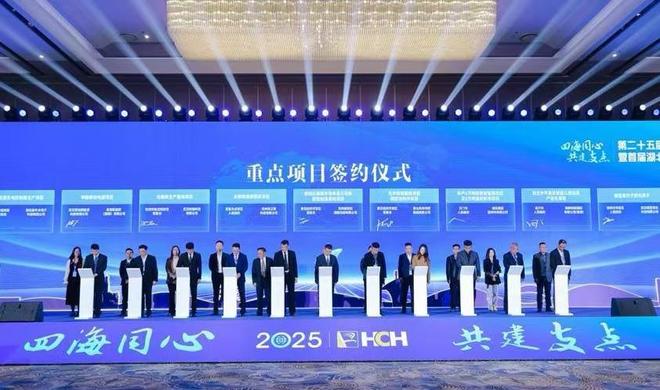
Core Insights - The 25th Overseas Chinese Entrepreneurs Development Conference and the First Hubei Provincial Overseas Chinese Community Friendship Conference opened in Wuhan, resulting in a signing amount of 8.2 billion yuan and the signing of 10 overseas high-level talent entrepreneurial projects [1][4] Group 1: Event Overview - Since its inception in 2001, the conference has invited over 20,000 overseas Chinese and business representatives from more than 100 countries and regions, facilitating nearly 3,000 project signings and attracting significant capital investment into Hubei [3] - The conference highlighted Hubei's regional advantages and market potential, particularly in green energy, biotechnology, technology, and artificial intelligence, with a commitment from the British Chinese Chamber of Commerce to promote more overseas high-end talent and quality projects in Hubei [3] Group 2: Entrepreneurial Success Stories - Yang Daichang, a representative of the "first generation" of returnees, founded He Yuan Biotechnology in 2006, which recently went public on the STAR Market with a market value exceeding 27 billion yuan, marking a significant milestone in the production of recombinant human albumin [4] - Ye Yi, representing the "middle generation," noted that his company, Fengmai Energy, grew from a 7-person team to over 200 employees since his return in 2009, achieving annual revenues in the hundreds of millions [4] - Sun Leimeng, who returned from Singapore in 2018, founded Huayinxin, focusing on vehicle lighting and special light sources, and developed China's first independently designed miniLED matrix light source module [4] Group 3: Project Signings and Competitions - The conference attracted nearly 50 projects to sign during the event, with a total signing amount of 8.2 billion yuan, including projects in advanced fields such as ultra-resolution DUV photoresist and targeted tumor industrialization technology [4][5] - An entrepreneurial competition was held, attracting over 170 overseas projects from 22 countries and regions, focusing on areas such as optoelectronic information, new energy, intelligent connected vehicles, life health, and high-end equipment, showcasing significant technological content and innovation [5]
周大福绩后跌超4%
Di Yi Cai Jing Zi Xun· 2025-11-26 02:18
11月26日,周大福绩后跌超4%,在截至2025年9月30日六个月内,公司共实现营业收入约389.86亿港 元,同比下降1.1%。 ...
A股低开,卫星互联网概念活跃
Di Yi Cai Jing Zi Xun· 2025-11-26 01:58
Group 1 - The satellite internet concept is active in the market, with companies like 雷科防务 (Leike Defense) achieving three consecutive trading limits, and 达华智能 (Dahua Intelligent) and 特发信息 (TeFa Information) rising over 7% [2] - The Ministry of Industry and Information Technology has announced the organization of commercial trials for satellite IoT services, which is driving interest in related stocks [2] - The gaming sector is experiencing a downturn, with 富川股份 (Fuchuan Co.) dropping over 4%, and other companies like 汤姆猫 (Tom Cat) and 星辉娱乐 (Star Shine Entertainment) also declining [2][3] Group 2 - The A-share market opened with all three major indices declining slightly, with the Shanghai Composite Index down 0.07% to 3867.43 points, the Shenzhen Component Index down 0.06% to 12769.93 points, and the ChiNext Index down 0.14% to 2976.70 points [3] - Energy metals, engineering machinery, and organic silicon concepts are performing well, while the 中船系 (China Shipbuilding System) sector is leading the decline [3] - The Hong Kong market opened positively, with the Hang Seng Index up 0.59% and the Hang Seng Tech Index up 0.67%, driven by a recovery in the lithium battery supply chain and pharmaceutical stocks [4]




港股锂电池概念大涨
Di Yi Cai Jing Zi Xun· 2025-11-26 01:52
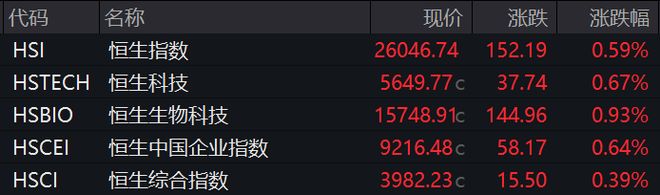
11月26日,香港恒生指数开盘涨0.59%,恒生科技指数涨0.67%。 | 代码 | 名称 | 现价 | 涨跌 | 涨跌幅 | | --- | --- | --- | --- | --- | | HSI | 恒生指数 | 26046.74 | 152.19 | 0.59% | | HSTECH 恒生科技 | | 5649.77c 37.74 | | 0.67% | | HSBIO | 恒生生物科技 | 15748.91c 144.96 | | 0.93% | | HSCEI | 恒生中国企业指数 | 9216.48c | 58.17 | 0.64% | | HSCI | 恒生综合指数 | 3982.23 c | 15.50 | 0.39% | 电气设备、有色金属、银行、医药生物等板块涨幅居前,半导体、国防军工等少数板块下跌。 锂电池概念大涨,赣锋锂业涨超3%,宁德时代涨逾2%。科网股走势分化,蔚来跌近7%,阿里巴巴跌超 2%;美团涨超4%,小鹏汽车涨超2%。小马智行-W涨超5%。 | 标准 | 成分 | 资讯 | 相关基金 | 月度收益 | | --- | --- | --- | --- | --- | | ...
英伟达“市值神话”被谷歌击穿
Di Yi Cai Jing Zi Xun· 2025-11-26 01:41
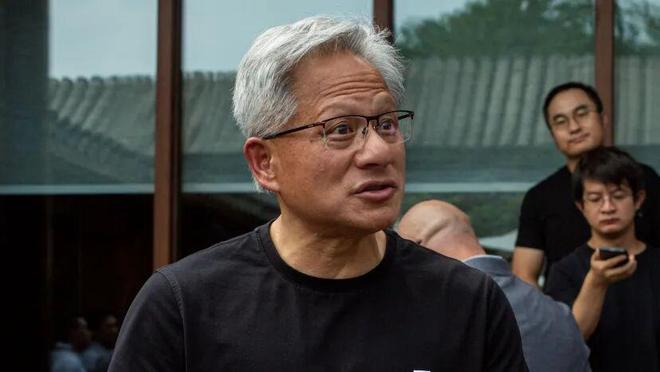
2025.11.26 本文字数:2411,阅读时长大约1分钟 作者 |第一财经 郑栩彤 在一周前的内部会议上,英伟达首席执行官黄仁勋坦言,尽管公司交出了"令人难以置信的"成绩单,但 市场对英伟达的预期已经高到令公司陷入某种"无赢局面"。他直言:"如果我们交出糟糕的季报,哪怕 只是差一点点,看起来有一点点不稳,整个世界就会崩溃。" 这样的预言正在成为现实。尽管交出了超出市场预期的财报,但在谷歌发布Gemini 3后,市场的风向开 始转变。谷歌的这一模型采用的是自研TPU进,而不是英伟达GPU,更重要的是,业内认为其已经"超 越"了OpenAI的GPT模型。 11月25日美股盘中,英伟达股价一度重挫逾7%,市值瞬间蒸发近3500亿美元,虽随后跌幅收窄,但最 终仍收跌2.59%,收盘价177.82美元,创两个多月收盘新低。英伟达曾在10月29日触及212美元/股的历 史高点,当时总市值达到5.15万亿美元,不过目前其股价较该历史高点已跌去约16%,市值蒸发超8000 亿美元。 英伟达紧急发声 当天,英伟达官方罕见对外发文,称该公司技术依然领先行业一代,是唯一能够运行所有人工智能 (AI)模型并应用于所有计算场景的平 ...

滚动更新丨A股三大指数集体低开,卫星互联网概念走强
Di Yi Cai Jing Zi Xun· 2025-11-26 01:39
Group 1 - Satellite internet concept stocks are active at the opening, with companies like Reco Defense achieving three consecutive trading limits, and Dahua Intelligent and TeFa Information rising over 7% [1] - The Ministry of Industry and Information Technology has announced the organization of commercial trials for satellite IoT services [1] - The gaming sector shows weakness at the opening, with Fuchuan Co. dropping over 4%, and other companies like Tom Cat, Xinghui Entertainment, and Sheng Tian Network also declining [1] Group 2 - A-shares opened lower across the board, with the Shanghai Composite Index down 0.07%, the Shenzhen Component Index down 0.06%, and the ChiNext Index down 0.14% [2] - Energy metals, engineering machinery, and organic silicon concepts are performing actively, while the shipbuilding sector leads the decline, with gaming stocks also experiencing significant drops [2] Group 3 - The Hong Kong stock market opened with the Hang Seng Index up 0.59% and the Hang Seng Tech Index up 0.67% [3] - The lithium battery supply chain shows signs of stabilization, with CATL opening up over 2%, and pharmaceutical stocks recovering, with Innovent Biologics rising over 3% [3] - Tech stocks are mixed, with NIO and Alibaba both opening lower post-earnings, while Meituan rises by 4% [3] Group 4 - The central bank conducted a 7-day reverse repurchase operation of 213.3 billion yuan at an interest rate of 1.40%, with 310.5 billion yuan of reverse repos maturing today [4] - The RMB to USD central parity rate is reported at 7.0796, an increase of 30 basis points from the previous trading day [5] - The shipping index for European futures has dropped over 8%, currently at 1373.1 points [5]

外交部:中美元首通话是美方发起的;特朗普:俄乌和平协议已“非常接近达成”
Di Yi Cai Jing Zi Xun· 2025-11-26 01:32
编辑 | 夏木 美股齐涨 美股主要股指周二继续走高,一系列经济数据强化了投资者对于美联储将在12月实施年内第三次降息的 预期。然而,科技板块表现疲弱,在一定程度上限制了纳斯达克指数的涨幅。 截至收盘,道指上涨664.18点,涨幅1.43%,报47112.45点;标普500指数上涨60.76点,涨0.91%,报 6765.88点;纳指上涨153.59点,涨0.67%,报23025.59点。 【热门股表现】 热门大型科技股涨跌互现。Meta上涨3.78%,微软上涨0.63%,亚马逊上涨1.50%,苹果上涨0.38%,特 斯拉上涨0.39%;英伟达下跌2.59%。此前有市场消息称,Meta正考虑未来数年在数据中心使用Alphabet 的人工智能芯片,并计划在明年之前在谷歌云租用芯片,推动Alphabet股价上涨1.53%并再创历史新 高。 零售板块走势强劲,Kohl's大涨42.53%,Abercrombie&Fitch飙升37.54%,均因上调全年盈利预期而走 高;Burlington Stores因第三季度营收不及预期大跌12.24%。 纳斯达克金龙中国指数收涨0.35%,报7753.25点。中概股中,小马智行 ...
