Di Yi Cai Jing Zi Xun

Search documents
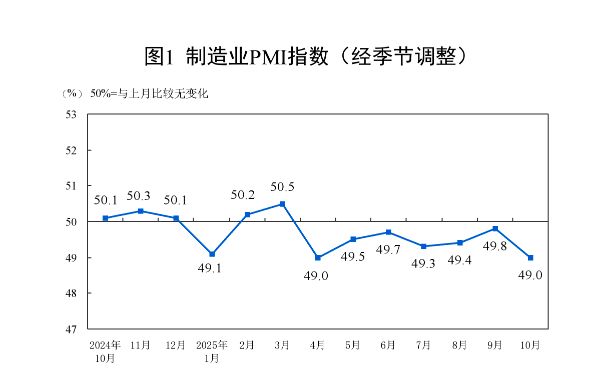
制造业PMI回落至49%,“反内卷”带动价格改善
Di Yi Cai Jing Zi Xun· 2025-10-31 03:10
Core Insights - The manufacturing PMI in October decreased to 49.0%, down 0.8 percentage points from the previous month, indicating a decline in manufacturing activity after two months of growth [1] - The non-manufacturing business activity index rose to 50.1%, up 0.1 percentage points, remaining in the expansion zone, driven by holiday effects [1] Manufacturing Sector - The manufacturing production index fell to 49.7%, a decrease of 2.2 percentage points, indicating a slight slowdown in production activities [4] - The new export orders index dropped to 45.9%, down 1.9 percentage points, marking the second-lowest point of the year, reflecting tightening export demand [5] - The procurement volume index decreased to 49%, down 2.6 percentage points, indicating a contraction in purchasing activities after two months of expansion [5] Business Performance by Company Size - Large enterprises' PMI fell to 49.9%, while medium-sized enterprises' PMI decreased to 48.7%, and small enterprises' PMI dropped to 47.1%, indicating pressure across all company sizes [6] - Despite the decline, large enterprises maintained stable supply and demand, while medium and small enterprises faced more significant challenges [6] Price Trends - The manufacturing sector experienced positive price changes, with the equipment manufacturing purchase price index and factory price index rising for three consecutive months [6] - The consumer goods manufacturing purchase price index fell to below 50%, while the factory price index increased, indicating reduced cost pressures and stabilized sales prices [7] Non-Manufacturing Sector - The non-manufacturing business activity index showed signs of recovery, with significant activity in sectors closely related to consumer travel, such as transportation and hospitality, driven by holiday effects [10] - The business activity expectation index remained high at 56.1%, indicating strong confidence among service sector enterprises regarding future development [10]

云业务增速创三年来最高,亚马逊预计遣散费达18亿美元
Di Yi Cai Jing Zi Xun· 2025-10-31 01:16
Core Insights - Amazon reported a 12% increase in net sales for Q3 2025, reaching $180.2 billion, with a net profit of $21.2 billion, up 38.6% year-over-year [1] - The company's North America sales growth was 11%, while international sales grew by 10% [1] - Amazon Web Services (AWS) achieved net sales of $30.9 billion in Q3, marking a 20% year-over-year increase, the highest growth rate since 2022 [1] - CEO Andy Jassy highlighted the strong overall business growth driven by advancements in artificial intelligence [1] - Amazon's stock price surged over 13% in after-hours trading following the earnings report [1] Financial Performance - Operating income for Q3 was $17.4 billion, consistent with Q3 2024 [1] - The reported operating income included special expenses of $2.5 billion related to a settlement with the Federal Trade Commission and $1.8 billion in expected severance costs due to layoffs [1] - Excluding these special expenses, operating income would have been $21.7 billion [1] Organizational Changes - Amazon announced a workforce reduction of 14,000 employees aimed at reducing bureaucracy and reallocating resources to critical projects [3] - The company is focusing on enhancing customer service and meeting current and future demands [3] Legal and Regulatory Issues - The Federal Trade Commission (FTC) imposed a $1 billion civil penalty on Amazon for misleading Prime membership practices, along with a $1.5 billion restitution to affected consumers [3] Future Outlook - Amazon anticipates a busy retail season in Q4, with a reported 11% year-over-year increase in global paid product sales for Q3 [3] - The company is investing heavily in artificial intelligence and logistics, with Q3 capital expenditures reaching $34.2 billion, totaling $89.9 billion for the year [4] - Projected capital expenditures for 2025 are expected to be around $125 billion, with further growth anticipated in 2026 [4]


苹果最新季度大中华区收入下滑,管理层预计下季度恢复增长
Di Yi Cai Jing Zi Xun· 2025-10-31 00:17
Core Insights - Apple's Q4 2025 revenue reached $102.466 billion, a year-over-year increase of 8%, with net profit at $27.466 billion, up 86.4% [1] - For the fiscal year 2025, Apple reported total revenue of $416.161 billion, a 6.4% increase, and net profit of $112.01 billion, up 19.5% [1] - The company achieved record revenue in both iPhone and services segments during the latest quarter [1] Revenue Breakdown - In Q4, iPhone revenue was $49.025 billion, up 6%, while Mac revenue was $8.726 billion, up 12.7% [3] - iPad and wearables, home, and accessories revenue were $6.952 billion and $9.013 billion, showing minimal growth and a slight decline, respectively [3] - For the fiscal year, iPhone revenue was $209.586 billion, a 4.2% increase, while wearables, home, and accessories revenue fell by 3.6% to $35.686 billion [3] Regional Performance - In Q4, revenue growth was observed in most markets, except for Greater China, which saw a decline of 3.6% to $14.493 billion [3][4] - Revenue from the Americas, Europe, Japan, and other Asia-Pacific markets grew by 6%, 15.2%, 12%, and 14.3%, respectively [3] - For the fiscal year, Greater China's revenue was $64.377 billion, down 3.8%, while other regions experienced growth [4] Management Insights - CEO Tim Cook attributed the growth in iPhone revenue to the iPhone 16 series [4] - The decline in Greater China was linked to supply constraints on the iPhone 17 series, with expectations for recovery in the next quarter [4] - Management noted that subsidies in China positively impacted sales across various product categories [4] AI Developments - Apple is building a private AI cloud and has begun production of servers to support Apple Intelligence [5] - The company is optimistic about AI's potential impact on sales but has not conducted in-depth investigations into its effects on iPhone sales [5] - Future operational expenditures are projected to be between $18.1 billion and $18.5 billion, with significant investments in AI [5] Stock Performance - As of October 30, Apple's stock rose by 0.63%, reaching a market capitalization of $4.03 trillion, marking a historical high [6]


科技股AI支出引发市场担忧!美股三大指数收跌
Di Yi Cai Jing Zi Xun· 2025-10-30 23:13
Group 1: Market Overview - The U.S. stock market experienced a collective decline, with technology stocks leading the drop due to concerns over increased capital expenditures from major companies like Meta and Microsoft [1][2] - The Dow Jones Industrial Average fell by 109.88 points to 47522.12, a decrease of 0.23%; the S&P 500 dropped by 68.25 points to 6822.34, down 0.99%; and the Nasdaq Composite fell by 377.33 points to 23581.14, a decline of 1.57% [1] - The Nasdaq China Golden Dragon Index decreased by 1.88%, with notable declines in stocks such as Bilibili (over 5%), NetEase (over 4%), Alibaba (over 3%), and JD.com (nearly 3%) [1] Group 2: Company-Specific Performance - Meta Platforms saw a significant drop of 11.3%, marking its largest single-day decline in three years, following concerns about a substantial increase in capital expenditures projected for 2026 [2] - Microsoft shares fell by 2.9% after reporting a capital expenditure of nearly $35 billion for the first fiscal quarter, with warnings of further increases throughout the year [2] - Amazon's stock surged by 11% after reporting Q3 earnings of $1.95 per share, exceeding expectations of $1.57, and revenue of $180.2 billion, surpassing the anticipated $177.9 billion [3] - Apple's Q4 revenue reached $102.47 billion, exceeding market expectations, with a forecast of double-digit growth in iPhone sales for the current quarter despite supply constraints [3] Group 3: Sector Performance - Among the 11 major sectors in the S&P 500, 7 sectors declined, with the consumer discretionary sector experiencing the largest drop of 2.6% [4] - The real estate sector was the only one to show positive performance, increasing by 0.7% [4] Group 4: Economic Indicators - The Federal Reserve lowered interest rates by 25 basis points, but uncertainty remains regarding future rate cuts, with the probability of a December cut dropping from over 90% to about 70% [3]


两融余额首破2.5万亿后,招商证券将两融业务规模提高1000亿元
Di Yi Cai Jing Zi Xun· 2025-10-30 23:13
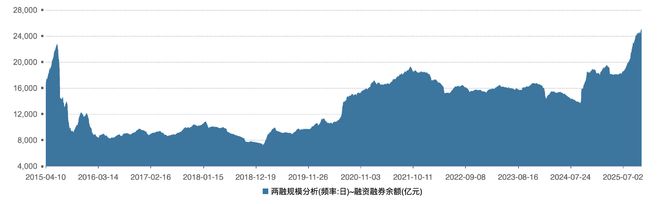
Core Viewpoint - The significant increase in the margin financing and securities lending business scale by China Merchants Securities is a response to the rising demand in the two-in-one market, reflecting the company's strategy to enhance customer service and expand market share [1][5]. Group 1: Company Actions - China Merchants Securities has raised its margin financing and securities lending business scale limit from 150 billion to 250 billion yuan, with the new addition accounting for approximately 13.41% of the company's total assets as of the end of Q3 [1][2]. - The company reported a 35.27% increase in funds lent, reaching 129.28 billion yuan by the end of Q3 compared to 95.57 billion yuan at the end of the previous year [2]. - The net cash flow from operating activities for the first three quarters was -16.34 billion yuan, a decrease of 121.38% year-on-year, primarily due to reduced cash inflows from lent funds and trading activities [2]. Group 2: Market Context - The total margin financing balance in the market has reached a historical high, surpassing 2.5 trillion yuan for the first time, indicating a robust demand for margin financing [2][5]. - The A-share market has shown strong performance this year, with the margin financing balance fluctuating between 1.7 trillion and 1.99 trillion yuan from January to July, and subsequently breaking through significant thresholds in August and September [5]. - Other securities firms have also adjusted their margin financing limits this year, indicating a broader trend in the industry to meet the increasing demand for margin financing [4][5].

全球第二盈利车企,遭遇五年来首次季度亏损
Di Yi Cai Jing Zi Xun· 2025-10-30 16:52
Core Insights - Volkswagen Group reported a Q3 revenue of €80.305 billion, a year-on-year increase of 2.3%, but faced a net loss of €1.072 billion, marking a 168.8% decline compared to a net profit of €1.558 billion in the same period last year, representing the first quarterly loss in five years [1] - The operating loss for Q3 was €1.299 billion, a significant drop from an operating profit of €2.833 billion in the previous year [1] - The total vehicle deliveries in Q3 reached 2.199 million units, a 1% increase year-on-year, while total sales for the first three quarters amounted to 6.518 million units, up 1.8% [1] - Volkswagen's net profit for the first three quarters fell sharply by 61.5% to €3.4 billion compared to the same period last year [1] Financial Performance - The profit margin for the first three quarters, excluding related costs, was 5.4%, while including costs, the profit margin was negative at -1.6% [2] - The company anticipates an annual pressure of up to €5 billion due to increased U.S. tariffs and the resulting decline in sales [2] - Volkswagen expects an operating profit margin between 2% and 3% for the current year, with revenue projected to remain flat compared to last year [3] Challenges and Strategic Adjustments - The decline in profitability is attributed to factors such as U.S. auto tariffs, the strategic restructuring of Porsche, and the transition to electric vehicles [1][2] - Porsche, once a significant profit contributor, reported its first quarterly loss since its IPO, with additional expenses from strategic restructuring amounting to €2.7 billion for the first three quarters of 2025 [2] - Volkswagen has set a cost-cutting plan to save €10 billion by 2026 and aims for an operating profit margin of 6.5% [2]
万科三季度亏损扩大,称“经营上仍面临阶段性压力”
Di Yi Cai Jing Zi Xun· 2025-10-30 13:44
Core Viewpoint - Vanke is facing significant operational pressure, with a substantial decline in revenue and a dramatic increase in losses in the third quarter of 2023 [1] Financial Performance - In Q3 2023, Vanke reported revenue of 56.07 billion yuan, a year-on-year decrease of 27.3% [1] - The net profit attributable to shareholders was -16.07 billion yuan, a year-on-year decline of 98.61%, with losses in this quarter exceeding the total losses of the first half of the year [1] - For the first three quarters, total revenue was 161.39 billion yuan, down 26.6% year-on-year, and net profit was approximately -28.02 billion yuan, a decline of 83% [1] Operational Challenges - The decline in revenue is attributed to reduced settlement scale in development business, low gross margins, increased inventory impairment provisions totaling 9.4 billion yuan, and asset disposals below book value [1] - The pre-tax gross margin for real estate development was 7.8%, and the post-tax gross margin was 2.0% during the reporting period [1] Sales Performance - In the first three quarters, Vanke achieved a contracted sales area of 7.751 million square meters and a contracted sales amount of 100.46 billion yuan, representing year-on-year declines of 41.8% and 44.6%, respectively [1] - Despite challenges, some new projects performed well, with an average sales absorption rate of nearly 70% for 11 newly launched projects [1] Funding and Debt Management - Vanke achieved a subscription amount of 4.77 billion yuan during the "Eleventh" holiday, exceeding the target completion rate of 137% [2] - The company has actively managed liquidity, optimizing and adding capacity worth 17.84 billion yuan and recovering 7.11 billion yuan through existing resources from January to September [2] - As of September 30, Vanke had a total construction area of approximately 29.781 million square meters and held cash of 65.68 billion yuan against interest-bearing liabilities of 362.93 billion yuan [2] Shareholder Support and Financing - The major shareholder, Shenzhen Metro Group, has provided liquidity support, with a total of 29.13 billion yuan in shareholder loans [3] - Vanke reported new financing and refinancing of approximately 26.5 billion yuan in the first three quarters, with a domestic financing cost of 3.44%, down 6 basis points from the previous year [3] Organizational Adjustments - Vanke has undertaken a large-scale organizational restructuring to enhance headquarters functions and streamline regional management levels [3] - The company continues to face significant operational pressures, with ongoing efforts to stabilize finances and operations amid declining sales [3]

A股两融余额创历史新高,这次与10年前有啥不同?
Di Yi Cai Jing Zi Xun· 2025-10-30 13:05
Core Points - The total margin balance has reached a historical high of 2.5066 trillion yuan, marking a significant milestone as it first surpassed 2.5 trillion yuan on October 29, coinciding with the Shanghai Composite Index crossing the 4000-point mark [1][2] - The current market environment is characterized by a more cautious use of leverage compared to 2015, with margin trading activity remaining within a reasonable range [4][5] - The flow of margin funds has shifted significantly towards the technology sector, contrasting with the previous focus on traditional industries such as finance and real estate in 2015 [5][6] Margin Balance and Market Comparison - The margin balance has increased from approximately 1.8 trillion yuan to 2.5 trillion yuan over nearly seven months, compared to a rapid increase from 1.1 trillion yuan to 1.65 trillion yuan in just two months in 2015 [4] - The current margin balance accounts for 2.53% of the A-share market's circulating market value, lower than the 3.89% seen in 2015, indicating a more prudent approach to leverage [4] - The trading volume of margin transactions represents 12.30% of the total A-share trading volume, significantly below the 17.36% recorded in 2015 [4] Investor Participation and Future Outlook - The number of new margin accounts opened has shown a steady increase, with September recording the highest number of new accounts at 205,400 [6] - As of October 29, the number of individual investors participating in margin trading was 7.7462 million, with institutional investors totaling 50,254 [6] - Analysts suggest that the future growth of margin balances is closely tied to market sentiment, with expectations of continued upward movement if market conditions remain favorable [7] Sector Focus - Recent margin fund inflows have favored sectors such as power equipment, banking, telecommunications, non-ferrous metals, and technology, while traditional sectors have seen net sell-offs [5] - Specific stocks like Sungrow Power Supply, Newyea, and Industrial Fulian have attracted significant net buying, while others like Zhongke Shuguang and Dongshan Precision have faced net selling [5] Investment Strategy - Analysts recommend a balanced investment approach, seeking opportunities in both technology growth and dividend value sectors, while also considering defensive strategies [8]
三季报透视跨境支付热潮:外资深潜、本土“出海”
Di Yi Cai Jing Zi Xun· 2025-10-30 12:40
Core Insights - The third quarter financial reports reveal a significant divergence among payment institutions, with cross-border payments emerging as a high-growth area amidst slowing growth in traditional sectors [1][2][4] Group 1: Cross-Border Payment Growth - Companies like Lakala, New Guodu, and Newland reported double to triple-digit growth in cross-border transaction volumes, merchant numbers, and overseas revenues [1][2] - Lakala's cross-border payment business saw a 71.91% increase in merchant scale and a 77.56% rise in transaction amounts, reaching 60.2 billion yuan [2] - New Guodu's cross-border brand PayKKa experienced a 169% increase in merchant numbers and a 272% rise in transaction volumes in Q2 2025 [2] Group 2: Foreign Investment and Market Entry - Foreign payment institutions are accelerating their entry into the Chinese market, with companies like Payoneer and SUNRATE acquiring payment licenses through mergers [1][7] - The trend of foreign institutions obtaining licenses is driven by the need for local compliance and cost savings in fund clearing [7] - Airwallex has significantly increased its annual transaction volume to over 200 billion USD after acquiring a local company [7] Group 3: Industry Challenges and Strategic Shifts - The domestic payment market is facing intense competition, leading to reduced profit margins and a shift towards cross-border payments as a survival strategy [4][5] - The total import and export volume in China reached 43 trillion yuan in 2024, with cross-border e-commerce accounting for 2.63 trillion yuan, indicating a growing demand for cross-border payment solutions [4] - Regulatory changes and the push for RMB internationalization are providing a supportive framework for cross-border payment growth [4][5] Group 4: Compliance and Risk Management - Compliance remains a significant challenge in the cross-border payment market, with several institutions facing penalties for inadequate anti-money laundering practices [8] - The macroeconomic environment, including tariff adjustments and geopolitical factors, may impact the growth rate of cross-border internet payment transactions [8] - The development of cross-border payments must balance compliance and risk control with the adoption of new technologies like digital currencies and AI [8]
中美经贸关系的未来依然是互利共赢|专家热评
Di Yi Cai Jing Zi Xun· 2025-10-30 10:57
Core Insights - The meeting between Chinese President Xi Jinping and U.S. President Donald Trump emphasizes the importance of U.S.-China economic relations as a stabilizing force for both nations and the global economy [1][3][4] - The bilateral trade volume has significantly increased from under $2.5 billion in 1979 to nearly $688.3 billion in 2024, showcasing the expanding scope and depth of economic cooperation [1] - The trade surplus is a result of structural issues in the U.S. economy and the comparative advantages of both countries, with China's current account surplus to GDP ratio decreasing from 9.9% in 2007 to 2.2% in 2024 [3] Economic Cooperation - The U.S.-China economic relationship has evolved beyond mere goods trade, incorporating service trade and local sales by domestic firms in each other's markets, indicating a more balanced economic interaction [3] - Both nations have expressed a commitment to mutual benefits in their economic relationship, with the U.S. publicly stating its intention not to decouple from China [3] - The strategic role of presidential diplomacy is highlighted as essential for providing political support to the economic relationship, facilitating crisis management and topic integration [3][4] Historical Context and Future Outlook - Historical experiences suggest that the highest form of great power competition is to establish new coexistence rules through institutional innovation, which is necessary for mutual prosperity [4] - Despite challenges such as technological competition and geopolitical tensions, the inherent motivation for economic cooperation between the two largest economies remains strong [4] - The healthy development of U.S.-China economic relations is not only in the fundamental interests of both nations but also serves as a crucial driver for global economic recovery [4]