
Zhong Guo Huan Jing Bao

Search documents
潍柴新品发布 加速核心部件国产化进程
Zhong Guo Huan Jing Bao· 2025-05-14 06:37
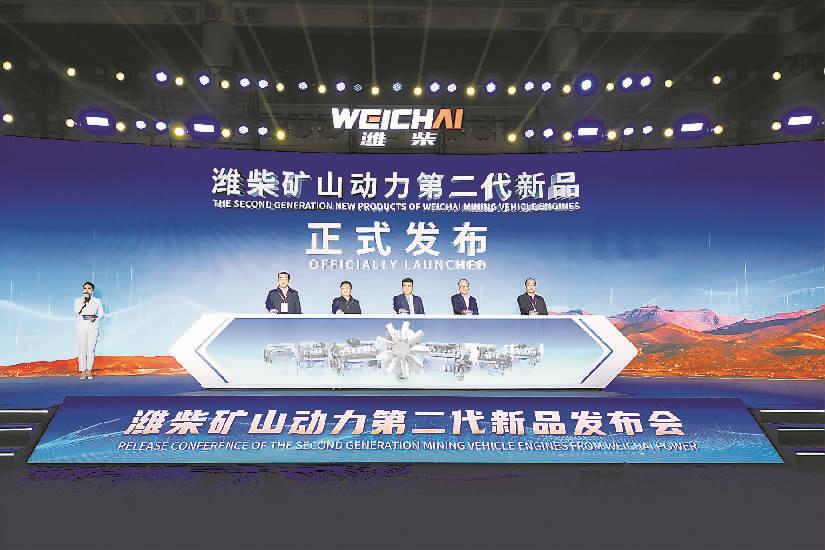
Core Viewpoint - The launch of the second generation of mining power products by Weichai Power marks a significant advancement in China's mining equipment industry, transitioning from a follower to a competitor on the global stage [1][3][4]. Product Development - Weichai Power has upgraded its mining power products, focusing on high reliability, low fuel consumption, and smart technology, with the new series including M series and H/T series products [5][6]. - The M series features 10 models with displacement ranging from 19.6L to 87.5L and power from 522kW to 2800kW, suitable for various large mining equipment [5]. - The H/T series includes models WP14T, WP15H, and WP17T, designed for wide-body dump trucks and excavators, achieving over 10% lower fuel consumption than the industry average [6]. Technological Innovation - The development of the WP17T methanol engine, which took 10 years and involved an investment of 120 million yuan, addresses several industry challenges and is the first of its kind for long-term reliable operation in wide-body dump trucks [9]. - Weichai's technological advancements are rooted in nearly 80 years of experience in internal combustion engine manufacturing, evolving from technology introduction to independent innovation [11][13]. Market Positioning - The introduction of the second generation of products is seen as a key step in establishing a complete independent innovation system in mining power, enhancing national resource security [1][3]. - Weichai's products have been recognized internationally, breaking the foreign technology monopoly in the large-tonnage mining equipment engine sector [13]. Service and Support - Weichai has established a mining service base to address common industry pain points such as slow parts response and high maintenance costs, offering comprehensive solutions [15][17]. - The company has built a professional mining expert team and a global parts supply network, ensuring timely support and a high level of service efficiency [17].

天津创新“执法+协会”普法模式
Zhong Guo Huan Jing Bao· 2025-05-14 06:00
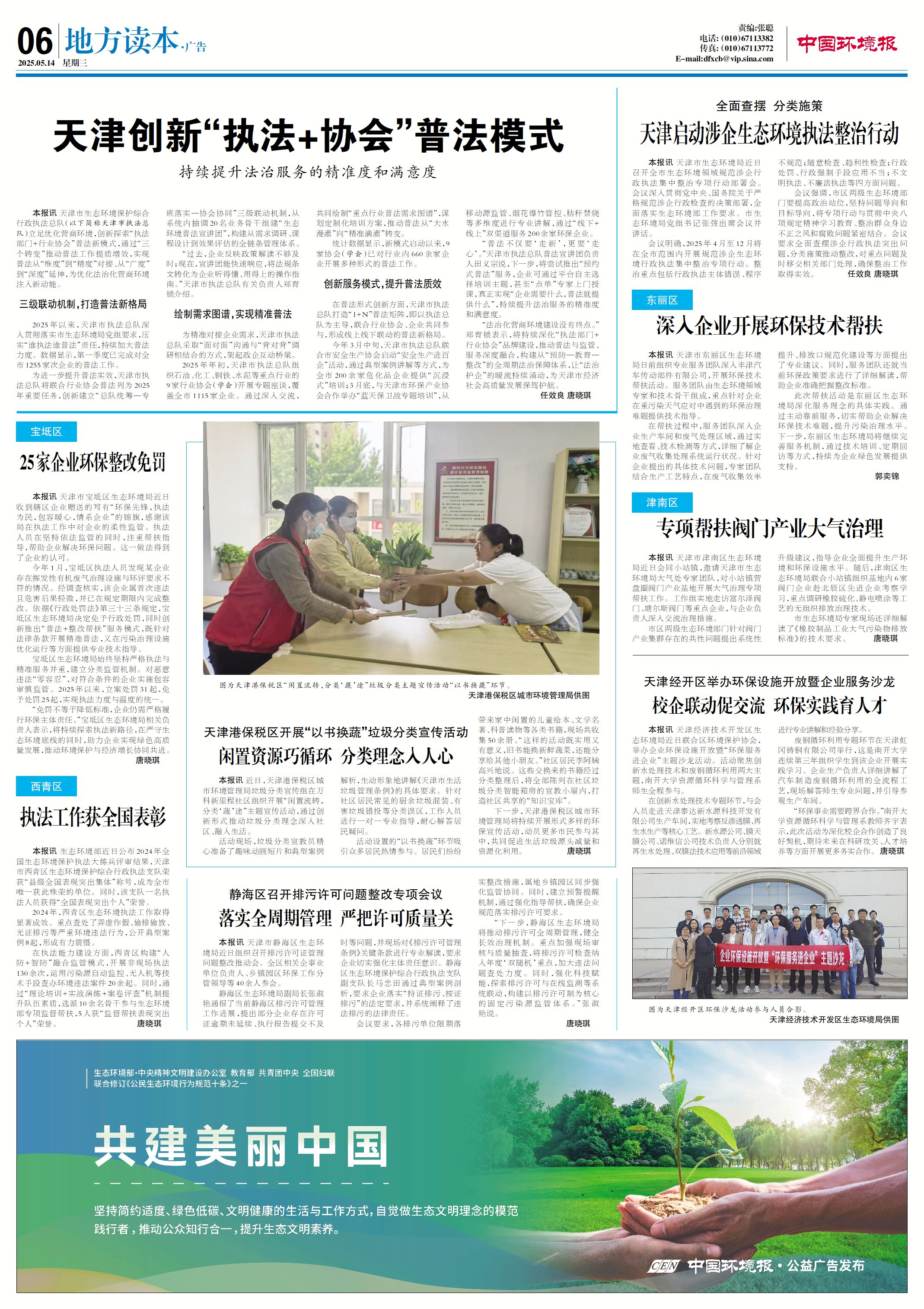
Core Viewpoint - Tianjin's ecological environment protection enforcement team is innovating a new model of legal education by integrating enforcement departments with industry associations to enhance the quality and effectiveness of legal education, thereby optimizing the legal business environment [2][11]. Group 1: Legal Education Model - The enforcement team has implemented a "three transformations" approach to improve legal education from "dimension" to "precision" and from "breadth" to "depth" [2][11]. - In the first quarter of 2025, the enforcement team completed legal education for 1,255 enterprises across the city [3][12]. Group 2: Collaborative Mechanism - A "three-level linkage mechanism" has been established, involving the enforcement team, specialized task forces, and industry associations to enhance legal education effectiveness [3][13]. - A dedicated "ecological environment legal education team" has been formed with 20 professionals to manage the entire process from demand research to course design and evaluation [3][13]. Group 3: Demand Mapping - The enforcement team has conducted face-to-face communications and back-to-back research with nine industry associations, covering 1,115 enterprises to create a "legal education demand map" [4][14]. - Since the launch of the new model, over 660 enterprises have received various forms of legal education from the nine associations [4][15]. Group 4: Innovative Service Models - The enforcement team has developed a "1+N" legal education matrix, combining online and offline methods to create a new legal education framework [5][16]. - Initiatives such as "Safety Production into Hundreds of Enterprises" and "Blue Sky Defense War Training" have been launched, providing immersive training to over 200 hazardous chemical enterprises [5][16]. - Future plans include offering "appointment-based legal education" services, allowing enterprises to select training topics and request expert visits, enhancing the precision and satisfaction of legal services [5][16].
农田退水如何实现“浊去清来”?南通如皋市的经验可供参考
Zhong Guo Huan Jing Bao· 2025-05-14 05:39
日前,在江苏省农业面源污染治理培训会上,南通如皋市分享的农田排灌系统生态化改造"农田退水治 理"项目经验成为全场焦点。如皋依据2023年度断面水质状况和水系特征,将汛期水质不能稳定达标的 重点国考省考断面及敏感水体周边农田作为试点,启动2024年度农田排灌系统生态化改造。项目覆盖8 个镇区,涉及两万余亩农田,已实现农田退水的高效治理与循环利用,为面源污染治理提供了可复制的 样板。 如皋经验的核心,在于精准把握"退水不直排、肥水不下河、养分再利用" 的治理原则。这一理念并非 简单的污染拦截,而是将农田退水视为可循环利用的资源。当地依托地形特点,将低洼地改造为肥水收 集调蓄池,构建起"雨季储水防污染、旱季灌溉再利用"的闭环系统。同时,在高标准农田建设中融入生 态化改造,通过生态塘对汛期过量退水进行分级净化,既减少污染物排放,又实现水资源的高效利用, 真正做到变废为宝。 两大关键举措直击农田退水治理要害。在秸秆处理上,如皋市以"四离一集中"原则划定秸秆离田区域, 通过建立秸秆收储运体系和综合利用产业链,将田间废弃物转化为生物质燃料、有机肥原料,从源头上 阻断秸秆腐烂对水体的污染。针对肥料使用,联合科研机构探索化肥减 ...
以文书标准化为抓手,推动行政检查规范化
Zhong Guo Huan Jing Bao· 2025-05-14 01:38
Group 1 - The core viewpoint of the news is the introduction of new regulations aimed at standardizing administrative inspections related to enterprises, ensuring they are conducted legally, fairly, and efficiently [1][2] - The new regulations emphasize the necessity of approval and notification for inspections, transitioning from arbitrary checks to a systematized approach that curtails impulsive inspections by local enforcement [1][2] - The regulations prohibit unauthorized entities from conducting inspections, ensuring that only legally designated bodies have the authority to perform such checks, thereby eliminating issues like "temporary workers conducting inspections" [1] Group 2 - The introduction of standardized documentation, including the inspection approval form and notification letter, aims to balance the power of inspections with the rights of enterprises, allowing companies to assert their rights during inspections [2][3] - The shift from "extensive management" to "refined governance" is highlighted, with clearer standards and documentation reducing opportunities for power abuse and enhancing transparency in the inspection process [2][3] - The implementation of a dynamic evaluation mechanism for documentation and the establishment of a case library for typical enforcement scenarios are intended to improve the efficiency and effectiveness of environmental inspections [3]
周晓猛:《国家方案》为推进消防行业绿色发展提供新契机|专家解读⑦
Zhong Guo Huan Jing Bao· 2025-05-14 00:11
Group 1 - The core viewpoint of the news is the release of the "National Plan for China's Implementation of the Montreal Protocol on Substances that Deplete the Ozone Layer (2025-2030)", which outlines actions for phasing out ozone-depleting substances (ODS) and hydrofluorocarbons (HFCs) in China over the next six years [1][2] - The plan aims to fulfill international environmental obligations and guide the development of a sustainable ecological civilization [1] - The fire protection industry in China has already made significant progress in phasing out high ODP fire extinguishing agents since 2010, showcasing the country's commitment to global environmental governance [1] Group 2 - With the full implementation of the Kigali Amendment, China will freeze HFCs production and usage at baseline values of 1.853 billion tons CO2 equivalent and 0.905 billion tons CO2 equivalent starting in 2024, with a target to reduce these values by 10% by 2029 [2] - The fire protection industry faces new challenges in HFCs reduction, and the National Plan sets clear compliance targets and lifecycle management measures to support green development [2][3] - There is a need to enhance research and development of new clean and efficient fire extinguishing technologies, as suitable alternatives to HFCs are currently lacking [3] Group 3 - Strict monitoring of halon and HFCs production and usage is essential, along with the development of recycling technologies [4] - Although halon is banned for controlled use, its recovery and regeneration are allowed, and HFCs will soon face production and usage controls [4] - The establishment of a recovery network for extinguishing agents and support for purification and regeneration processes are crucial for reducing costs and extending the use of existing stocks [4] Group 4 - The National Plan provides a policy framework, but further refinement of supporting rules and technical standards is necessary to promote the application of new clean and efficient fire extinguishing technologies [5] - The industry should develop a phased action plan for HFCs alternatives and provide policy incentives for units adopting environmentally friendly fire extinguishing systems [5] - Demonstration applications of new technologies in certain regions can create replicable models for the industry [5]
本报热评:将重型柴油货车作为监管治理重点,推动移动源污染治理升级
Zhong Guo Huan Jing Bao· 2025-05-13 23:22
Core Viewpoint - The Chinese government is intensifying regulations on vehicle emissions, particularly focusing on heavy-duty trucks, to combat air pollution and improve air quality, as these vehicles are significant contributors to PM2.5 levels in major cities [1][2]. Group 1: Regulatory Measures - The Ministry of Ecology and Environment and nine other departments have issued stricter regulations on vehicle emissions, particularly targeting heavy-duty trucks, by incorporating random inspections into daily regulatory plans [1]. - The new guidelines emphasize the need for compliance from manufacturers, owners, users, and service providers, promoting a collaborative approach to ensure environmental responsibilities are met [4]. Group 2: Emission Statistics - In 2023, nitrogen oxide emissions from trucks reached 3.872 million tons, accounting for 83.7% of total automotive emissions, with heavy-duty trucks alone contributing 3.5 million tons [1]. - Despite a 15% reduction in nitrogen oxide emissions from mobile sources since the implementation of pollution control measures, violations of emission standards remain prevalent among vehicle owners [2]. Group 3: Compliance Challenges - Many vehicle owners are circumventing regulations by tampering with emission control systems, leading to increased pollution and potential vehicle damage, as the costs of repairs can exceed the expenses of compliant operation [2]. - The inconsistency in enforcement across regions allows non-compliant vehicles to evade penalties, with some owners believing the likelihood of being caught is low, resulting in repeated violations [3]. Group 4: Enforcement and Incentives - The newly released inspection guidelines aim to standardize the inspection process for heavy-duty diesel and gas vehicles, enhancing the capacity of local enforcement agencies [4]. - A differentiated management approach will be trialed, allowing compliant heavy-duty trucks to be exempt from certain inspections, thereby encouraging adherence to environmental regulations [4].
建立“五共”机制,提升生态环境派驻监察效能
Zhong Guo Huan Jing Bao· 2025-05-13 08:22
资源共用。一是力量整合。横向上统筹监察、监测、执法等多部门力量,结合专项任务打阶段性"攻坚 战",如,优化调配生态环境系统内多方精干力量开展大气专项督导。纵向上统筹省、市派驻力量,联 合开展督导评估。二是人员聚合。结合"干部素质提升年",采取岗位跟学等方式,遴选片区市、县两级 生态环境部门中政治坚定、能力过硬的优秀青年充实生态环境监察力量,阶段性弥补派驻监察机构人手 不足的问题。 计划共商。省级生态环境保护派驻监察机构要加强与省生态环境厅联动,在不同时间节点、不同任务阶 段做好计划融合,既依托业务处室的政策水平和专业优势把控方向、发现问题,又发挥专员办的督察督 政职能,压实党委政府及部门生态环境责任。结合省厅年度工作要点、重点工作安排、措施清单等,充 分征求省厅各处室需重点督察事项。制定月度盯办、季度督导、年度评估等计划时,充分衔接省级、市 级推进机制工作月度和阶段性工作安排,做好计划融合。聚焦区域内某个领域、某个行业、某类点位存 在的突出问题,紧密衔接省厅相关处室适时组织开展重点领域、重点行业专项监察。 信息共享。省级出台的涉及生态环保类重要文件、调度通报、评估报告、问题清单等要及时抄送派驻监 察机构,方便 ...
科技绘就青山新卷 创新赋能生态振兴
Zhong Guo Huan Jing Bao· 2025-05-13 06:11
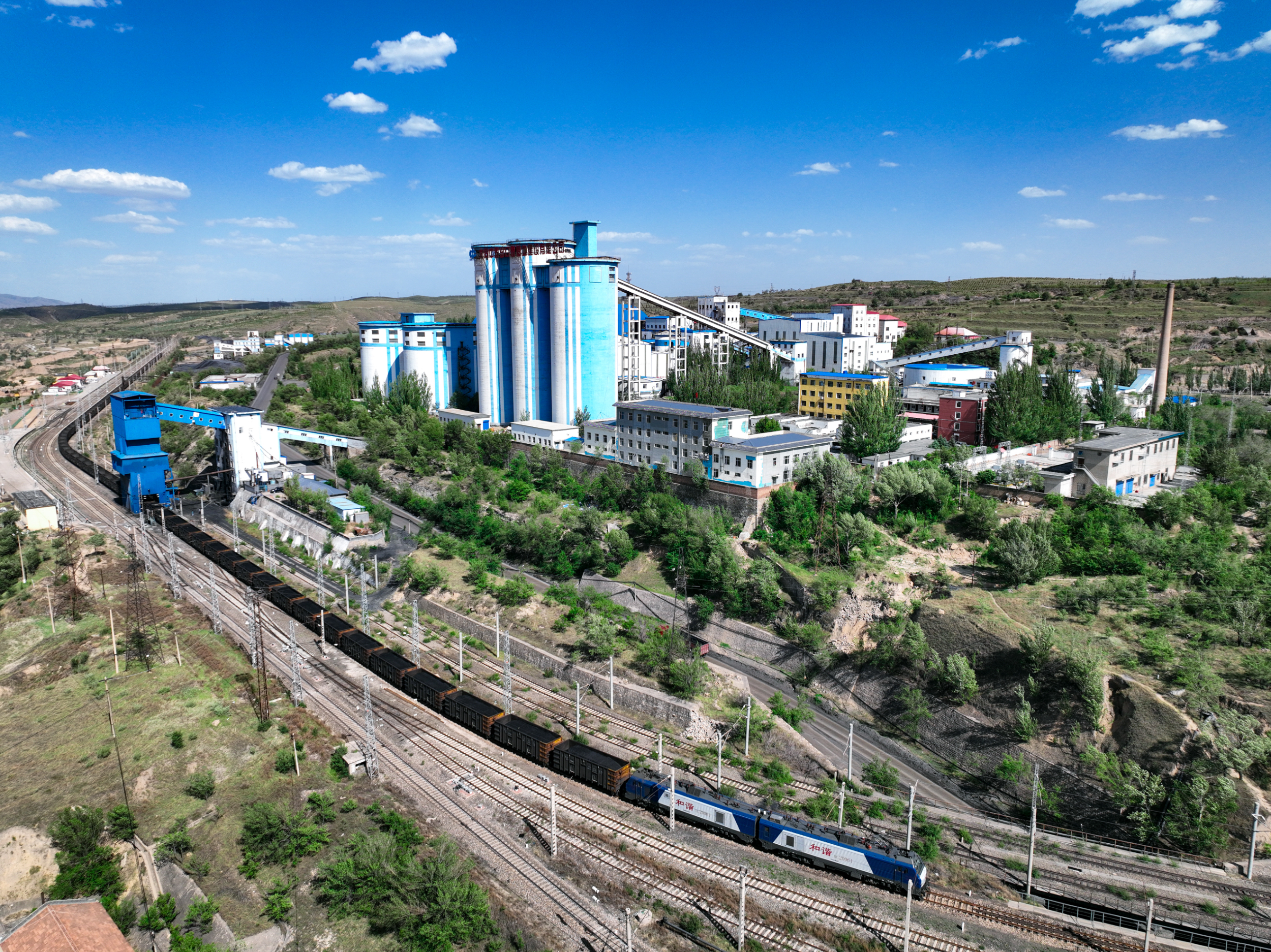
Core Viewpoint - The transformation of the Majiliang Mine represents a model for high-quality development in China's energy sector, emphasizing ecological restoration and technological innovation to achieve sustainable mining practices [3][4]. Group 1: Environmental Improvements - The Majiliang Mine has implemented comprehensive management of water, air, and solid waste, leading to continuous environmental quality improvement [4]. - The mine has replaced four coal-fired boilers with modular gas boilers and smart control systems, resulting in a 50% reduction in heating response time and a 15% increase in thermal efficiency, which translates to a reduction of 3,400 tons of standard coal consumption and over 8,900 tons of CO2 emissions annually [4]. - A water treatment facility with an 8,000 cubic meter daily capacity has been established, utilizing a three-step process to recycle mine water, saving millions of tons of new water resources each year [6]. - The mine has adopted an innovative approach to solid waste management, planting over 30,000 trees and increasing vegetation coverage by 40%, effectively mitigating dust issues from historical waste piles [6]. Group 2: Technological Innovations - The mine has embraced digital transformation, utilizing 5G technology to enhance the precision of coal mining operations, significantly improving coal recovery rates and operational efficiency [8]. - The introduction of a "zero-emission" transportation strategy, including the use of silent, battery-powered vehicles, is projected to reduce carbon emissions by 150 tons annually [8]. - The intelligent coal preparation plant has improved production efficiency and safety, reducing labor costs by 720,000 yuan and increasing the amount of washed coal by 20,000 tons [9]. Group 3: Employee Well-being and Community Engagement - Infrastructure improvements have led to a 95% satisfaction rate among employees, with enhanced facilities for health and recreation [11]. - The mine promotes green practices among employees, with initiatives like tree planting and paperless operations, contributing to significant reductions in resource consumption [11]. - The mine's management emphasizes that the coal industry can be a proponent of ecological development, aiming for harmony between mining operations and environmental sustainability [11].
如何改变恶臭异味“检测达标但投诉不断”的窘境?
Zhong Guo Huan Jing Bao· 2025-05-13 05:40
Core Viewpoint - The issue of odor pollution is increasingly prominent in China, affecting the quality of life for residents and requiring urgent governance measures [1][2]. Group 1: Current Situation - Significant progress has been made in ecological and environmental protection in China, with continuous improvement in environmental quality and increased public satisfaction [1]. - Odor complaints are consistently high in environmental feedback data, indicating the complexity and urgency of addressing this issue [1]. Group 2: Sources of Odor Pollution - Odor pollution originates from various sectors, including industrial production, municipal facilities, and agricultural activities, with key sources being chemical, petrochemical, pharmaceutical, paper, dyeing industries, waste treatment plants, and livestock farming [1]. - These pollutants can adversely affect human health and may pose disease risks, while prolonged exposure can lead to psychological issues such as anxiety and irritability [1]. Group 3: Challenges in Odor Pollution Control - Current detection methods can only identify about 2% of odor factors, making comprehensive monitoring difficult [2]. - The existing odor pollution discharge standards have not been updated for 30 years and require revision [2]. - The intermittent and sudden nature of odor pollution complicates source tracing and evidence collection [2]. - Different industries have unique pollution characteristics, necessitating tailored solutions, which contributes to the ongoing issue of "meeting detection standards but continuing complaints" [2]. Group 4: Solutions for Odor Pollution - A multi-faceted approach is needed to effectively address odor pollution, including the establishment of a comprehensive and stringent emission standard system and a tailored management plan [3]. - Strengthening technological support by developing a full-chain technical system for monitoring, early warning, source tracing, and governance, along with advanced treatment technologies [3]. - Innovating regulatory models by utilizing technologies such as aerial monitoring and drone inspections to enhance regulatory capabilities and efficiency [3]. - Encouraging public participation in monitoring and reporting odor issues, exemplified by initiatives like the "smell inspectors" in Jiaxing, Zhejiang Province [3]. - Promoting collaborative governance by enhancing inter-departmental coordination and encouraging enterprises to adopt cleaner production processes [3].
警惕!急需防范进口铜精矿砷污染风险!
Zhong Guo Huan Jing Bao· 2025-05-13 03:09
我国精炼铜的产能位居世界第一,但受资源禀赋限制,每年需要大量进口铜精矿。2022年我国精炼铜产 量1053.4万吨,占全球总量的41%,其中原生铜冶炼约占70%。当年进口铜精矿2532万吨,对外依存度 达80%。目前铜产量仍不能达到国内铜消费水平,铜冶炼产能会进一步扩张,铜精矿缺口将继续扩大。 为充分利用海外铜精矿资源,保障原料供应,促进我国铜冶炼降本提质,2019年以来,海关总署已先后 批准5家企业在港口保税区开展进口铜精矿混矿业务(即"保税混矿"),就是将来自海外的超标铜精矿 与洁净矿在保税区内进行物理混匀,混合达标再报关,经检验合格后输送至国内铜冶炼企业。 我国《关于公布进口铜精矿中有毒有害元素限量的公告》对进口铜精矿中砷(As)元素限量规定不得 大于0.5%,比国际上的限值标准(通常为0.2%,例如日本和美国)高0.3%。因此,扩大铜精矿的进口 存在一定的环境隐忧。 铜精矿中的砷在高温下挥发进入烟气、造渣进入炉渣,烟气中砷部分收集在白烟尘,剩余进入制酸系统 的污酸中,经中和处理进入产出的炉渣中。最终约0.06%的砷随废气排放,0.04%的砷进入成品硫酸, 99.9%进入含砷固废。砷污染物一旦进入环境, ...