
Zhong Guo Huan Jing Bao

Search documents
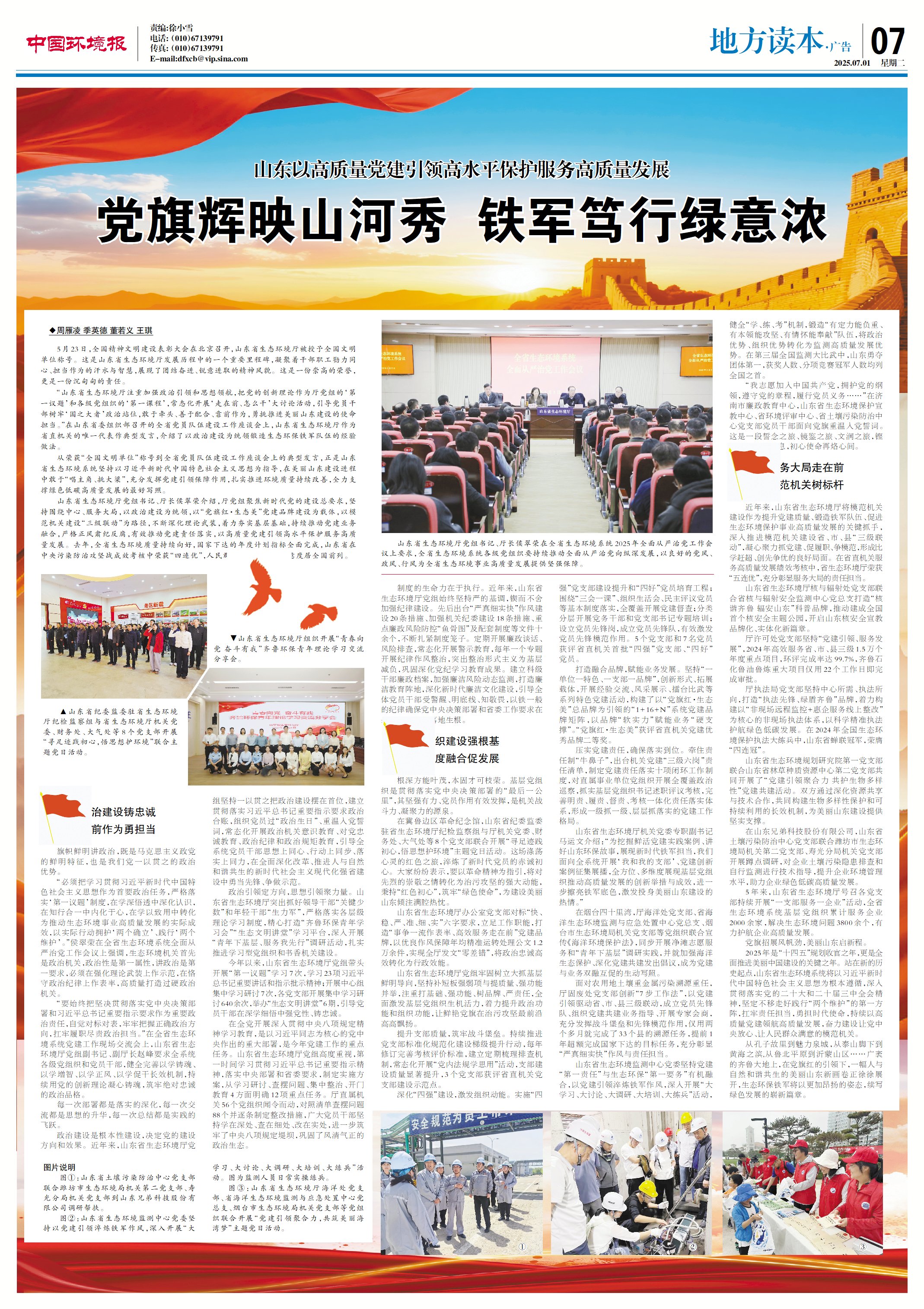
党旗辉映山河秀 铁军笃行绿意浓——山东以高质量党建引领高水平保护服务高质量发展
Zhong Guo Huan Jing Bao· 2025-07-01 01:30
Core Points - The Shandong Provincial Ecological Environment Department was awarded the title of National Civilized Unit at the National Spiritual Civilization Construction Commendation Conference, marking a significant milestone in its development and reflecting the collective efforts of its staff [2][17][18] - The department emphasizes political leadership and ideological guidance, integrating the Party's innovative theories into its core activities and discussions to enhance environmental quality and support green, low-carbon, high-quality development [3][18][21] Group 1 - The department's leadership focuses on high-quality Party building to drive high-level protection and service for quality development, achieving all national annual environmental quality targets and receiving top marks in pollution prevention assessments [3][18][20] - Continuous efforts are made to strengthen discipline and integrity within the department, implementing various measures to enhance accountability and reduce bureaucratic burdens [26][27] Group 2 - The department has established a robust framework for political education and training, conducting numerous learning sessions and discussions to deepen understanding of Party policies and enhance loyalty among its members [12][24][25] - Initiatives such as the "One Branch Serves One Enterprise" program have led to significant support for over 2,000 companies, addressing more than 3,800 environmental issues and promoting high-quality corporate development [37][35] Group 3 - The department's commitment to integrating Party building with ecological protection has resulted in innovative practices, such as the establishment of a nuclear safety theme park and efficient environmental assessment processes for major projects [34][36] - The focus on grassroots organization and community engagement has been pivotal in fostering a culture of environmental stewardship and accountability among staff and stakeholders [27][28]

如何培养生态价值观?要从实践着手
Zhong Guo Huan Jing Bao· 2025-07-01 00:17
Core Viewpoint - The recent guidance issued by the Ministry of Ecology and Environment, in collaboration with the Ministry of Culture and Tourism, emphasizes the establishment of an ecological culture system based on ecological values, aiming to enhance the internal motivation for ecological civilization construction [1] Group 1: Ecological Value Cultivation - The ecological value system prioritizes the overall interests of ecosystems, advocating for harmony between humans and nature, and recognizing the intrinsic value of nature beyond its utility to humans [1] - Practical experiences are essential for cultivating ecological values, as they allow individuals to deeply understand nature and ecosystems [1] Group 2: Ecological Education and Tourism - Ecological research activities combine nature exploration with knowledge learning, fostering ecological awareness and scientific thinking through diverse activities such as species observation and ecological culture experiences [2] - Ecotourism serves as a means to appreciate ecological values, promoting environmental protection and community development while enhancing understanding of the ecological system's logic [2][3] Group 3: Hands-on Practices - Practical activities, such as school gardening projects and urban balcony planting, enhance ecological values by allowing participants to engage directly with nature and understand ecological interdependencies [4] - Urban families practicing balcony gardening and community gardening contribute to resource recycling and sustainable living, reinforcing the concept of harmonious coexistence with nature [4] Group 4: Importance of Ecological Practices - Ecological practice activities are crucial for cultivating ecological values and promoting ecological culture, necessitating public participation to foster a societal consensus on respecting and protecting nature [5]
专家支招!美丽河湖保护与建设资金从哪里来?
Zhong Guo Huan Jing Bao· 2025-06-30 23:14
Core Viewpoint - The article discusses the comprehensive action plan for the protection and construction of beautiful rivers and lakes in China, emphasizing the need for a multi-faceted financing mechanism to support these initiatives, which require significant funding and systematic governance [1][9]. Funding Mechanisms - The Ministry of Finance and the Ministry of Ecology and Environment have issued a notice to support local governments in applying for central financial funds for river and lake protection projects through a competitive review process [2]. - Central financial support will focus on projects related to pollution control, watershed protection, and ecosystem restoration, with funding sourced from the special funds for water pollution prevention [2][3]. - Local governments are encouraged to utilize general public budgets and various types of bonds to support these projects, with a focus on those that can generate revenue [4]. Innovative Financing Strategies - The article suggests that while fiscal funds play a crucial role, the demand for funding in river and lake protection is substantial, necessitating the involvement of social capital and financial institutions [5][9]. - Proposed strategies include realizing the value of water ecological products, integrating ecological protection with urban development, and exploring regional financial support models for ecological projects [6][7]. - The establishment of water funds to attract social capital for ecological projects is also recommended, with examples of successful fund models already in practice [8]. Collaborative Funding Approach - A collaborative approach involving central, local, and social funding is essential to meet the financial needs of river and lake protection projects [9].
乐山“以优促优”打造营商“绿环境”
Zhong Guo Huan Jing Bao· 2025-06-30 01:57
Core Viewpoint - The Leshan Ecological Environment Bureau is actively implementing measures to optimize the business environment, focusing on reducing burdens for enterprises and enhancing support for high-quality economic development [2][9]. Group 1: Policy Measures - The Bureau has introduced six key measures to optimize the business environment, including improving project environmental impact assessment (EIA) efficiency and enhancing financial support for environmental projects [2]. - The Bureau is committed to dynamic updates of ecological environment zoning control to facilitate project implementation and industrial development [3]. Group 2: Approval Process Optimization - New projects, including long-term national debt projects, are now included in a "green channel" for expedited EIA approval, significantly reducing approval times [4]. - Over 70 EIA projects have been efficiently approved this year, involving investments exceeding 90 billion yuan, with average processing times reduced by 60% compared to the statutory 60 working days [4][5]. Group 3: Regulatory Improvements - The Bureau is enhancing environmental law enforcement efficiency and adopting a more flexible regulatory approach to support enterprise development [6]. - A non-intrusive regulatory system has been established, utilizing data analysis and remote monitoring technologies to minimize disruptions to businesses [6]. Group 4: Support Services - The Bureau is providing proactive services to enterprises, including on-site consultations and technical support tailored to individual company needs [8]. - A financing support mechanism has been established, helping enterprises secure over 200 million yuan in funding this year [9].
当传统产业遇到数智技术,会带来怎样的改变?
Zhong Guo Huan Jing Bao· 2025-06-30 00:21
Core Viewpoint - The transformation and upgrading of traditional industries are crucial for building a modern industrial system, and leveraging digital intelligence technology for green and low-carbon transformation is strategically significant for high-quality development [1] Group 1: Empowering Green Low-Carbon Production Scene Innovation - Digital intelligence technology enhances cross-industry integration, resource orchestration, and innovation capabilities, facilitating breakthroughs in green low-carbon production technologies [2] - Technologies such as big data and digital twins assist traditional industries in analyzing user demand characteristics, selecting green low-carbon materials, and designing lightweight energy-saving products [2] - As of March 2023, the digital R&D design tool penetration rate among industrial enterprises in China reached 83.5%, and the CNC rate for key processes was 66.2% [2] Group 2: Empowering Green Low-Carbon Multi-Value Creation - Digital intelligence technology promotes deep integration of social, physical, and digital spaces, enhancing resource integration, opportunity identification, and crisis response capabilities [3] - Intelligent transformation and modular integration of production equipment in traditional industries enable comprehensive monitoring of manufacturing processes and effective control of resource consumption [3] - The integration of big data, IoT, blockchain, and AI in traditional supply chains allows for carbon footprint measurement, tracing, dynamic pricing, and trading, creating new value through carbon asset management and green brand premium [3] Group 3: Empowering Green Low-Carbon Governance System Creation - The green low-carbon transformation of traditional industries is a complex governance process involving multiple stakeholders and factors [4] - Establishing a green low-carbon governance system requires digital regulation and intelligent services, with systems for carbon emission monitoring and data management forming a "digital neural network" [4] - As of 2024, 246 national green data centers have been established, and 251 green low-carbon public institutions have been selected, providing robust digital technology support for the transformation of traditional industries [4]
碳足迹背景数据库为什么重要?
Zhong Guo Huan Jing Bao· 2025-06-29 23:14
Core Viewpoint - The construction of a unified and standardized carbon footprint background database is crucial for the development of China's product carbon footprint management system and for enhancing international competitiveness in carbon data standards [1][4]. Group 1: Current Status of Carbon Footprint Background Database - China is placing significant emphasis on the establishment of carbon footprint background databases, as highlighted in the State Council's work plan for building a dual control system for carbon emissions [1]. - Despite some progress, the construction and application of carbon footprint background databases in China are still in the early stages, facing various misconceptions and bottlenecks [2][3]. Group 2: Challenges in Database Construction - There is a weak understanding of the database among market participants, leading to confusion between different types of databases and insufficient emphasis on real data quality control [2][3]. - The quality of data is inconsistent, with issues such as redundant and low-level construction, lack of unified standards, and transparency problems in existing databases [3]. - The promotion and application of carbon footprint background databases are inadequate, with limited recognition in international markets and a need for improved standards [3]. Group 3: Recommendations for Improvement - It is recommended to enhance planning and design for the national carbon footprint background database, ensuring a unified structure and avoiding redundant construction [4][5]. - Emphasis should be placed on research and development, fostering talent in carbon footprint data development, and utilizing digital technologies for better data accessibility and traceability [5][6]. - Expanding application scenarios through public awareness campaigns and competitions can help improve the market space for quality background databases [6][7]. Group 4: International Cooperation - Strengthening international collaboration is essential, including technical exchanges with global lifecycle data development organizations and promoting mutual recognition of carbon footprint data standards [7].
杭州临安的“党员先锋服务站”让我们少走了许多弯路
Zhong Guo Huan Jing Bao· 2025-06-28 10:13
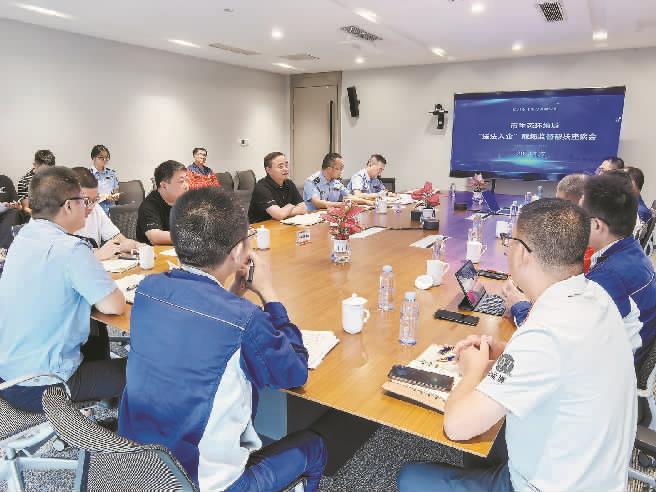
Core Points - The establishment of the "Green Alliance" framework agreement between the ecological environment bureau and the local party branch aims to enhance ecological protection and green development through collaboration [1] - The "Party Member Pioneer Service Station" has become a frontline service platform for enterprises and the community, providing comprehensive environmental services [2] - The service station has effectively addressed community concerns regarding environmental issues, demonstrating its role in maintaining a good living environment for residents [3] Group 1 - The "Green Alliance" initiative integrates resources and strengthens the role of grassroots party organizations in ecological protection [1] - The service station offers a "nanny-style" service, assisting a company in navigating complex environmental procedures, resulting in the completion of all necessary approvals within one month [2] - The service station has received high praise from both enterprises and residents for its efficient and professional support [2][3] Group 2 - The service station has conducted two river protection activities and resolved four existing hazards since the establishment of the "Green Alliance" in June 2025 [3] - It has organized one enterprise service activity, addressing ten issues in the industrial park and assisting five companies with pollution discharge registration [3] - The service station continues to uphold the principle of ensuring that every issue is addressed and feedback is provided, effectively connecting services to enterprises and the community [3]
充分发挥物业公司环境管理作用,从源头上减轻信访投诉压力
Zhong Guo Huan Jing Bao· 2025-06-27 07:23
Group 1 - The increasing demand for high-quality living environments is driven by rapid social development, particularly among residents in closed communities who are sensitive to environmental issues such as garbage accumulation, unpleasant odors, and noise pollution [1] - These environmental issues have become hot topics for complaints, directly affecting residents' quality of life, necessitating enhanced regulation and governance [1] - The resolution of these issues requires collaborative efforts from relevant authorities, local streets, and property management companies, with a focus on the proactive role of property companies in reducing complaint pressures [1] Group 2 - Property management companies should prioritize creating beautiful and livable environments as a key aspect of daily management and service quality improvement, taking a leading role in green maintenance and waste classification [2] - Property companies serve as a bridge for communication between residents and local government, understanding residents' needs and concerns, and should enhance communication and information transparency to gain residents' support [2] - There is an emphasis on the importance of legal knowledge related to ecological environment management, with property companies encouraged to engage in educational efforts to raise awareness about building harmonious and beautiful communities [2]
守护好中华白海豚眷恋的这片碧海
Zhong Guo Huan Jing Bao· 2025-06-27 01:47
究其原因,中华白海豚种群数量的减少与其乡恋情结密切相关。中华白海豚对特定河口、海湾环境有着 深厚依恋,这种依赖如同"妈妈的味道",是千万年自然选择的结果。研究发现,它们对环境适合度的执 着甚至超越了对干扰的规避,宁可回到熟悉但船舶活动较多的水域,也不愿迁至干扰少却与原来环境差 异较大的区域,这种依恋类似于人类的"乡土情怀"。 可见,保护中华白海豚的关键在于珍视并守护其世代栖居的家园。然而,中华白海豚偏爱的海岸环境, 往往也是经济活跃、发展迅速的地带。如何在推动海洋经济发展、建设海洋强国的同时,保护好这一珍 稀物种,是我们需要共同面对的课题。 不久前,福建泉州围头湾一港口项目炸礁作业被指影响中华白海豚,被官方叫停重新评估,这一事件再 次引发人们对中华白海豚生存状况的关注。 守护好中华白海豚眷恋的这片碧海,我们要进一步完善保护网络,力求涵盖其现有的重要分布区域,无 论是探索建立国家公园还是强化现有海豚 保护区,核心目标都是科学控制人类活动的影响。 我国是全球最重要的中华白海豚栖息地,珠江口水域(含香港、澳门)种群数量最多,超过2000头。然 而,受填海造地、航运活动、风电开发等人类活动影响,中华白海豚栖息地面积在 ...
“互换大气污染物总量指标”为区域高质量发展和高水平保护注入新动能
Zhong Guo Huan Jing Bao· 2025-06-27 00:14
Core Viewpoint - The recent agreement between Chengdu's Wenjiang District and Qingbaijiang District to exchange air pollutant emission quotas is a strategic move to optimize environmental capacity while supporting economic development and improving air quality [1][2]. Group 1: Agreement Details - Wenjiang District exchanged 90 tons of volatile organic compounds (VOCs) for 60 tons of nitrogen oxides (NOx) from Qingbaijiang District, facilitating the efficient matching of emission quotas with construction projects [1]. - The exchanged NOx quotas will support major projects with a total investment exceeding 3 billion yuan, while the VOC quotas will back projects totaling approximately 15 billion yuan [1]. Group 2: Mechanism and Benefits - The new "bulk exchange" mechanism, introduced by the recent regulations, allows districts meeting specific air quality standards to optimize their emission quotas based on actual development needs [1][2]. - This mechanism simplifies the process of securing necessary emission quotas, significantly accelerating the implementation of air-related construction projects [2]. Group 3: Regional Implications - The practice in Chengdu serves as a model for other regions facing environmental capacity constraints, encouraging them to explore similar quota exchange systems [2]. - Effective implementation of the exchange mechanism requires thorough preliminary research to assess the impact on local air quality, ensuring compliance with air quality standards [2][3]. Group 4: Governance and Oversight - Strengthening policy guidance and clear communication regarding the exchange process is essential for the successful operation of the quota exchange mechanism [3]. - There is a need for comprehensive monitoring and regulation to prevent fraudulent activities during the exchange process, ensuring the integrity of environmental quality improvements [3]. Group 5: Economic and Environmental Value - The quota exchange mechanism highlights the dual value of emission quotas, emphasizing the importance of proactive emission reduction efforts even in areas with surplus environmental capacity [3]. - This approach not only meets local development needs but also opens new economic growth opportunities through market transactions and regional exchanges [3].