3 6 Ke

Search documents
AI带热CPU销情?记者实探深圳华强北:业内预期分化
3 6 Ke· 2026-02-04 02:57
Core Viewpoint - The CPU market is experiencing structural differentiation rather than a uniform price increase, with consumer-grade CPUs remaining stable while server-grade CPUs may see short-term fluctuations due to demand from AI and high-performance computing applications [3][21]. Group 1: Price Trends - Recent reports indicate that major cloud service providers have significantly increased their purchases, leading Intel and AMD to plan a price increase of 10%-15% for server CPUs due to supply-demand imbalances [4][18]. - Despite rumors of price increases, consumer-grade CPU prices have remained largely unchanged since December, with some models only seeing minor increases [6][7]. - The price of server CPUs has shown variability, with different retailers offering different prices for the same model, such as the Intel Xeon 6530 processor, which is currently priced around 8300 yuan [8][9]. Group 2: Market Dynamics - The CPU market is currently characterized by a "differentiated" phase, with consumer-grade CPUs showing stable prices due to sufficient inventory and competitive market conditions [18]. - In contrast, server CPUs, particularly mid-to-high-end products, are experiencing longer delivery times and increased bargaining power for specific models, but this does not translate to widespread price increases [18][19]. - The demand for CPUs is expected to rise, particularly in the context of AI applications, with predictions of a potential price increase of around 15% in the near future [20][21]. Group 3: Industry Shifts - Many CPU vendors are shifting their focus to memory products due to the limited price changes in CPUs, indicating a trend towards higher profitability in the memory market [12][14][15]. - The overall market for storage products is currently very strong, with significant price increases reported for DRAM and NAND Flash, which may influence the CPU market indirectly [15]. - The role of CPUs is evolving in the AI era, transitioning from being mere computation providers to becoming central to system scheduling and general computing, with a focus on high concurrency and low latency products [21].


可控核聚变,又融5个亿
3 6 Ke· 2026-02-04 02:57
Core Insights - Zhongke Qingneng has completed nearly 500 million yuan in Pre-A++ financing, marking the largest financing in the deep low-temperature sector recently [1] - The company is backed by prominent investors including Dinghui Baifu, Guoxin Fund, and Kunpeng Capital, indicating strong institutional interest [1][2] - Zhongke Qingneng focuses on deep low-temperature technology, essential for both controllable nuclear fusion and green hydrogen energy [2][3] Company Overview - Zhongke Qingneng's controlling shareholder is a private equity fund supported by state-owned enterprises, including China General Nuclear Power Group [1][2] - The company’s core technology is derived from years of research at the Hefei Institute of Physical Science, focusing on magnetic confinement nuclear fusion [2] Technology and Products - The company has developed a 3kW@4.5K helium refrigerator, the largest of its kind in China's nuclear fusion sector, which has been deployed in the CRAFT facility [3] - Zhongke Qingneng plans to launch a 20kW@4.5K helium refrigerator by 2026, which will be the largest single-unit helium refrigeration equipment globally [3] Market Trends - The controllable nuclear fusion sector has become a hot spot for investment, with significant funding flowing into core components and subsystems [4] - The investment landscape is shifting from private fusion companies to midstream suppliers of critical components, indicating a maturation of the industry [4] Hydrogen Energy Initiatives - Zhongke Qingneng has successfully provided domestically produced liquid hydrogen fuel for the Long March 8 rocket, marking a milestone in China's space history [5] - The company is set to launch China's first commercial liquid hydrogen plant with a capacity of 5 tons per day by September 2026, alongside developing a 35 tons per day hydrogen liquefaction system [5] Funding Utilization - The recent financing will support the development of larger-scale liquid hydrogen systems, nuclear fusion refrigeration systems, and the establishment of a second manufacturing center [5]
任天堂,利润超预期
3 6 Ke· 2026-02-04 02:57
任天堂净利润为1599.3亿日元,高于预期的1473亿日元,同比增长24%。 当地时间周二(2月3日),日本电子游戏公司任天堂公布了第三财季(截至2025年12月31日,自然年第 四季度)的业绩。 在游戏软件方面,Switch 2平台上的《马力欧卡丁车:世界》(与Switch 2同步发售)销量约为1400万 套。据任天堂称,全球约有1.29亿人正在使用Switch平台进行游戏。 任天堂股价近几个月持续承压。Switch 2于去年6月上市后,公司股价在8月一度升至14000日元以上的 历史高位,但此后已回落超过30%。 在12月关键假日销售季到来前,市场一度担忧Switch 2销售乏力。 市场研究机构Circana上月表示,任天堂Switch 2是美国12月销量最高的游戏主机。 Kantan Games首席执行官Serkan Toto表示:"一些投资者预测的销量'崩塌'并未在假日季度发生。" 杰富瑞分析师Atul Goyal表示,有关Switch 2销量放缓的担忧被夸大了,其在Q4这一关键销售季表现强 劲。 财报显示,任天堂第三财季营收为8063.2亿日元(约52亿美元),低于预期的8477.3亿日元,同比增长 ...

有钱的福建,为何奥莱火不起来?
3 6 Ke· 2026-02-04 02:46
Core Insights - Fujian, a wealthy province in China, is struggling to develop a thriving outlet market despite strong consumer spending power and rising incomes [1][2] - The province currently has only 10 outlet projects, significantly fewer than other economically comparable provinces like Jiangsu and Guangdong [2][4] - The introduction of the Shanshan Outlet in Fuzhou is seen as a potential turning point for the region's outlet market [1][16] Economic Overview - Fujian's GDP for 2024 is projected at 5.78 trillion yuan, ranking 8th in the country with a year-on-year growth of 5.8% [2] - The per capita disposable income for urban residents is 51,200 yuan, placing it 6th nationally, and reflecting strong consumer purchasing power [2] Outlet Market Analysis - Fujian's 10 outlet projects total 978,900 square meters, ranking 14th in terms of commercial area, and significantly lower than Jiangsu (3.08 million m²) and Guangdong (2.83 million m²) [4] - The quality and tier structure of the existing outlet projects in Fujian are uneven, with only two projects rated as B-level, while others are C-level or lower [7][11] Consumer Behavior and Market Dynamics - The consumer awareness of outlets in Fujian is low, and existing projects have not effectively captured the high-end discount retail market [9][15] - The successful operation of Xiamen Shangbai Outlet has demonstrated the demand for outlet shopping in Fujian, achieving revenues of 590 million yuan in 2022 and 750 million yuan in 2023, marking a 27% increase [10] Challenges in Outlet Development - Structural issues in Fujian's commercial landscape, such as a multi-centered urban structure and a tendency for high-income residents to shop abroad, hinder the growth of large-scale outlet projects [13][12] - The local manufacturing industry does not naturally translate into successful high-end retail, leading to a mismatch between supply and demand in the outlet sector [15][16] Strategic Importance of Fuzhou - Fuzhou is positioned as a key market for outlet growth due to its status as a resource hub and its improving transportation network, which enhances its ability to attract cross-city traffic [16][19] - The city has a significant opportunity for outlet expansion, as it currently lacks high-profile outlet projects compared to other provincial capitals [20][22] Future Prospects - The planned introduction of Shanshan Outlet in Fuzhou is expected to fill the gap in high-end commercial offerings and enhance the overall outlet landscape in the region [24][22] - The strategic location of the proposed outlet in Cangshan District is aimed at leveraging Fuzhou's transportation advantages to attract a broader customer base [22][24]
中国万亿城市,扩容至29座
3 6 Ke· 2026-02-04 02:46
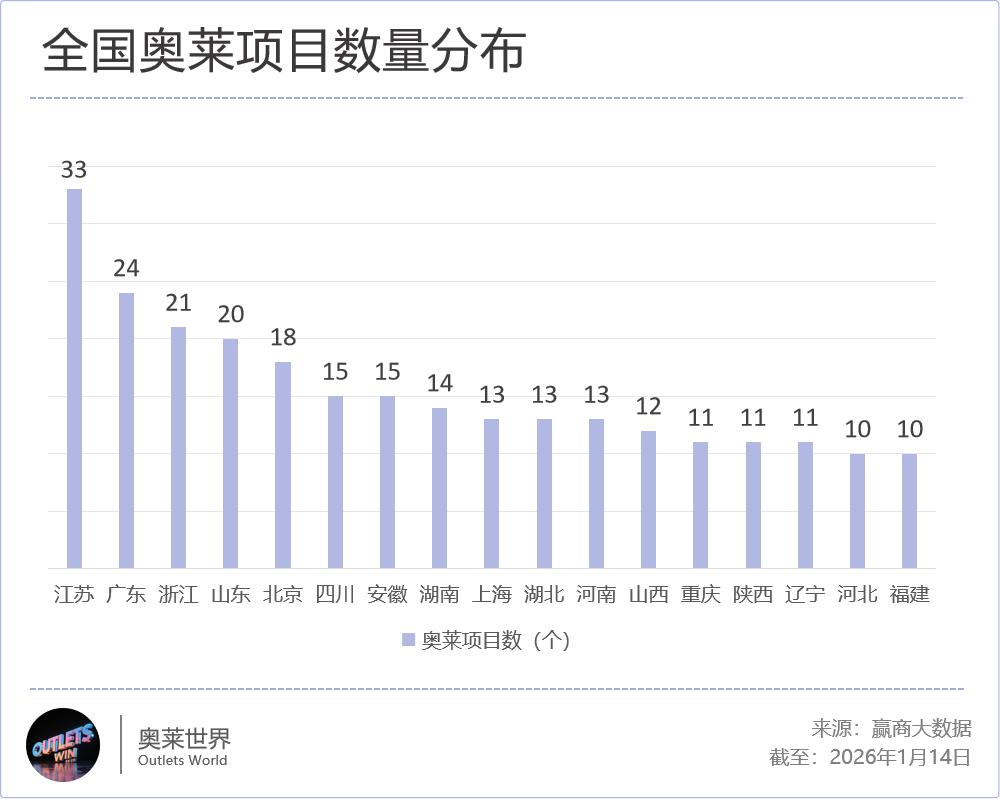
Group 1 - The core point of the article is that China now has 29 cities with a GDP exceeding 1 trillion yuan, marking a significant milestone for urban economic visibility on a national scale [1] - The new additions to the trillion-yuan GDP cities are Wenzhou and Dalian, with Wenzhou's GDP reaching 1,021.39 billion yuan in 2025, a growth of 6.1%, and Dalian's GDP reaching 1,000.21 billion yuan, a growth of 5.7% [1][5] - Xuzhou is close to becoming the next trillion-yuan city, with a GDP of 995.72 billion yuan in 2025, indicating a strong potential for future growth [5] Group 2 - The distribution of the 29 trillion-yuan cities shows that Jiangsu has the highest number with 5 cities, followed by Guangdong with 4 cities, and Shandong and Zhejiang each with 3 cities [8][9] - The article highlights the economic characteristics of these provinces, noting that Jiangsu's balanced regional development has led to all 13 of its prefecture-level cities being in the national top 100 [9] - The article also discusses the significance of Dalian as the first trillion-yuan city in Northeast China, which is expected to play a crucial role in revitalizing the region's economy [10] Group 3 - The article outlines the competitive landscape for future trillion-yuan cities, with Xuzhou, Shenyang, and Xiamen identified as potential candidates for the next round of growth [5][6] - It emphasizes the importance of regional centers and the differing strategies between coastal provinces, which tend to have multiple thriving cities, and inland provinces, which often focus on strengthening a single provincial capital [10][11] - The article concludes that there is no one-size-fits-all approach to regional development, and success depends on adapting strategies to local conditions [11]
终于有产品,打开了缺觉的日本人的钱袋子
3 6 Ke· 2026-02-04 02:46
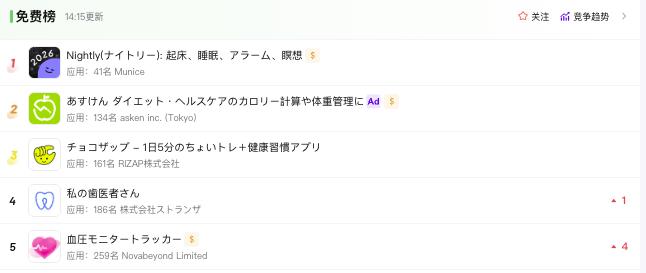
Core Insights - The app "Nightly: Wake Up, Sleep, Alarm, Meditation" has rapidly climbed to the top 50 of the Japan App Store and ranks first in the health and fitness download category, generating significant revenue of $312,000 in the last 30 days, with 96% of this revenue coming from the Japanese market [1][4][7]. Group 1: Market Performance - Nightly has achieved impressive results in the Japanese sleep aid market, which is characterized by a high demand for sleep solutions due to the country's sleep deprivation issues [2][4]. - The app's revenue performance is notable compared to other sleep apps, with the best-performing app, Sleep Cycle, generating only about $50,000 monthly in Japan [7]. - Nightly's revenue in Japan has surged, with the market accounting for approximately 96% of its total income, indicating a strong market presence [8]. Group 2: Product Features and Technology - Nightly employs a unique approach to sleep aid through "Brainwave Entrainment," which uses specific sound frequencies to synchronize with brain activity, promoting sleep [9][11]. - The app requires users to answer four questions about their current state before generating personalized audio tracks, enhancing user experience and effectiveness [13][16]. - Nightly provides a sleep analysis report post-wake-up, introducing the concept of "sleep debt" to help users monitor their sleep quality over time [16]. Group 3: Target Audience and Marketing Strategy - Nightly targets young adults and students in Japan who are struggling with sleep deprivation, using marketing strategies that resonate with their specific needs and concerns [19][20]. - The app's promotional materials focus on relatable experiences and the urgency of addressing sleep issues, rather than technical product details [20][25]. - The founder's personal experience with sleep difficulties and extensive user research contributed to the app's design, aligning it closely with the needs of the Japanese market [26][27]. Group 4: User Feedback and Challenges - User reviews indicate a polarized perception of the app's effectiveness, with some users reporting positive experiences while others find the sound frequencies ineffective or even disruptive [18][28]. - Concerns regarding the app's subscription model and pricing have also been highlighted, with some users feeling that the service does not justify its cost [18][28].
OpenAI现离职潮
3 6 Ke· 2026-02-04 02:46
Core Insights - OpenAI is shifting its focus from long-term foundational research to accelerating the development of ChatGPT, leading to the departure of several senior employees [1][2] - The company, valued at $500 billion, is adapting to increasing competition from rivals like Google and Anthropic [1] - OpenAI is reallocating resources to enhance its flagship chatbot, ChatGPT, while reducing experimental research funding [1][2] Group 1 - Several employees, including VP of Research Jerry Tworek and model policy researcher Andrea Vallone, have left due to dissatisfaction with the strategic shift [1][2] - Under CEO Sam Altman's leadership, OpenAI is transitioning from a research lab to one of Silicon Valley's largest tech companies, necessitating proof of revenue growth to justify its valuation [1][3] - OpenAI's Chief Researcher Mark Chen asserts that foundational research remains a core focus, with significant resources still allocated to long-term projects [1][3] Group 2 - Researchers not involved in large language model development have faced resource limitations, impacting their ability to validate research hypotheses [2] - Teams working on video and image generation models, such as Sora and DALL-E, feel neglected as resources are prioritized for ChatGPT [2] - The competitive landscape is intense, with companies striving to release the strongest models quarterly, leading to a resource concentration on the most promising directions [2][3] Group 3 - Tworek left OpenAI after seven years, seeking to explore research types that are difficult to pursue within the company, such as continual learning [3] - Vallone joined competitor Anthropic after being assigned a challenging task related to user mental health concerning ChatGPT [3] - Investors remain optimistic, believing OpenAI's true competitive advantage lies in its large user base of ChatGPT [3][4] Group 4 - The focus on whether OpenAI has the strongest model is deemed misguided; the company is converting its technological lead into a platform lock-in effect [4] - The competitive edge has shifted from research capabilities to user behavior, making it harder to disrupt [4]
28亿元北京拿地,字节跳动置业花费已超312亿元
3 6 Ke· 2026-02-04 02:40
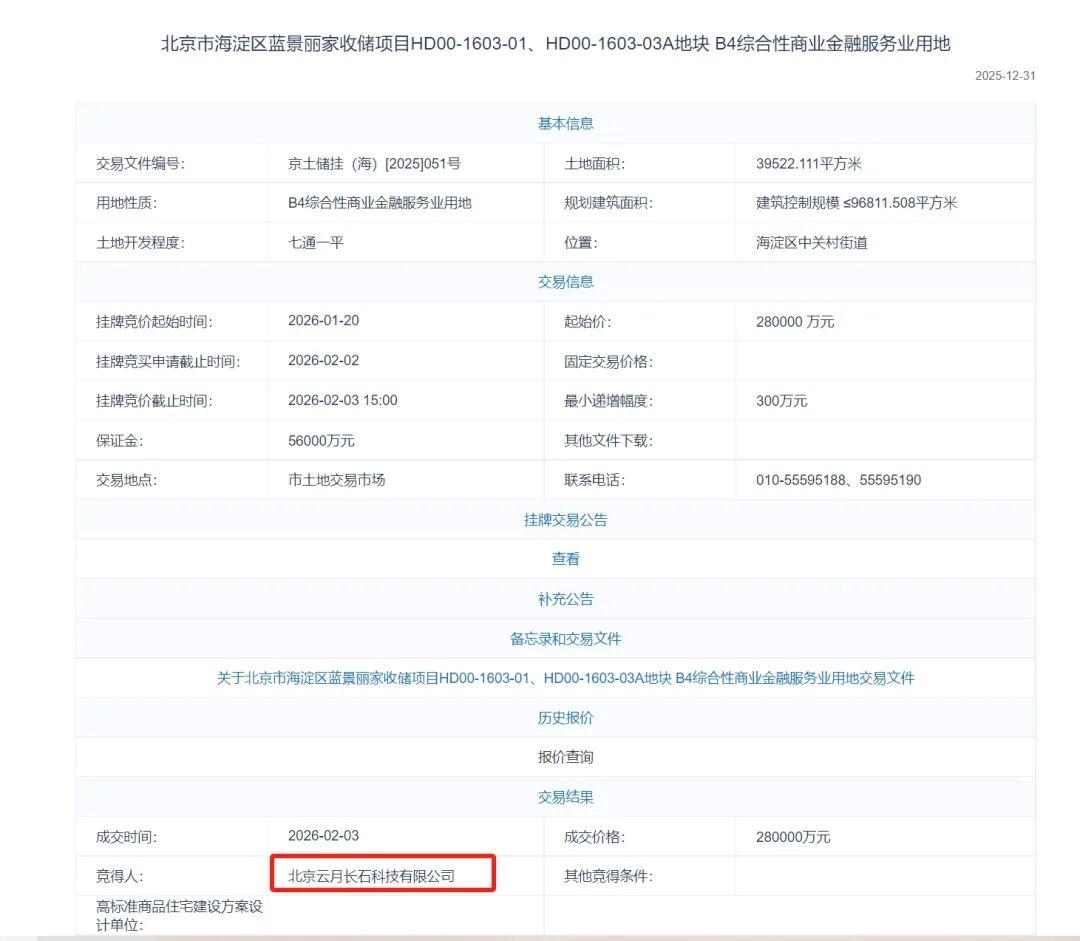
Core Viewpoint - A commercial land plot in Haidian, Beijing, was successfully sold for 2.8 billion yuan, acquired by Beijing Yunyu Changshi Technology Co., Ltd., which is fully controlled by Douyin Group (Hong Kong) Limited [1][2]. Group 1: Land Transaction Details - The land plot, named Haidian District Blue View Home Storage Project, covers an area of 39,522.111 square meters with a planned building area of 96,811.508 square meters [4]. - The land is designated for B4 comprehensive commercial financial service use and has a development status of "seven connections and one leveling" [2][4]. - The transaction took place on February 3, 2026, with a starting price of 2.8 billion yuan and a minimum bidding increment of 3 million yuan [2][4]. Group 2: Strategic Importance and Location - The plot is strategically located in the Zhongguancun area, adjacent to the North Third Ring Road and near the Dazhong Temple Station, which serves as a transfer station for subway lines 12 and 13 [6]. - This area is known for being a prominent office location for ByteDance, with nearby facilities housing teams from Douyin and Toutiao [6][7]. Group 3: Future Development Plans - The newly acquired land is expected to be developed into a high-end office area and hotel space, with plans for 4,200 workstations and 288 hotel rooms [8]. - The project aims to achieve "Green Building Three Stars" certification, focusing on creating a modern, high-end office and hotel space that integrates green, healthy, and intelligent features [8][13]. Group 4: ByteDance's Real Estate Strategy - Since its establishment in 2012, ByteDance has invested over 31.2 billion yuan in acquiring properties, with a total building area of approximately 1.57 million square meters [15]. - The company has shifted from leasing to owning properties, with significant acquisitions in Beijing, Shenzhen, Shanghai, and Hangzhou, indicating a strategic move to establish regional headquarters [15][17].
中国移动旗下基金、北京人工智能产投基金等入股因时机器人公司
3 6 Ke· 2026-02-04 02:36
36氪获悉,爱企查App显示,近日,北京因时机器人科技有限公司发生工商变更,新增中国移动旗下北 京中移数字新经济产业基金合伙企业(有限合伙)、北京市人工智能产业投资基金(有限合伙)等为股 东。该公司成立于2016年,法定代表人为蔡颖鹏,注册资本约148万元人民币,经营范围包括基础软件 服务、应用软件服务、计算机系统服务等。 ...

“千亿县”断档,这个中部大省要发力了
3 6 Ke· 2026-02-04 02:34
2月3日,湖南省十四届人大四次会议开幕。湖南省政府工作报告透露,2025年湖南省地区生产总值达5.53万亿元、稳居全国前十强,增长4.8%。 在部署2026年的重点工作时,湖南省政府工作报告提出,强化区域协调联动发展。深度融入国家重大战略,统筹推动区域共进,加快推进新型城镇化,大 力发展县域经济,着力营造区域共赢互利、县域各擅其长的蓬勃发展态势。其中还特别明确,要"提高县域经济占全省经济比重"。 作为中部经济大省,县域经济是湖南经济发展的基石,也日益成为其发展的一大"软肋"。 数据显示,湖南86个县市县域面积占全省超九成、承载七成常住人口、贡献超五成经济总量。 2024年,20个经济大县以湖南全省约四分之一的土地与人口,贡献了超过一半的县域经济总量,撑起"半壁江山"。长沙县、浏阳市、宁乡市作为湖南县域 经济"龙头",更多年稳居全国百强县前列。 不过,湖南近年也面临"原地踏步"的窘境—— 根据城市进化论此前研究,过去5年间,全国"千亿县"数量由2020年38个增至2025年至少74个,数量接近翻番;其中中西部贡献全国超三成增量,湖北五 年新增4个"千亿县",成为中西部最大"赢家"。 相比之下,湖南"千亿县"出现 ...