Xin Lang Ji Jin

Search documents
红利风向标 | 年末风格“高低切”,红利现金流策略或重回C位
Xin Lang Ji Jin· 2025-11-20 01:09
Core Insights - The article discusses various dividend-focused ETFs and their performance metrics, highlighting the latest dividend yields and index returns over different time frames [1][2]. Group 1: Dividend Yields and Performance - The latest dividend yield for the S&P Dividend ETF is reported at 4.92% [1]. - The Hong Kong Stock Connect Dividend ETF has a dividend yield of 5.54% [1]. - The performance of the S&P China A-Share Dividend Opportunity Index shows a one-year return of -0.39% and a year-to-date return of 12.27% [1]. - The S&P Hong Kong Stock Connect Low Volatility Dividend Index has a one-year return of -2.32% and a year-to-date return of 30.83% [2]. Group 2: Index Performance Metrics - The A500 Low Volatility Dividend ETF has a one-year return of -1.93% and a year-to-date return of 0.41% [2]. - The China A-Share 800 Low Volatility Dividend Index shows a one-year return of 2.24% and a year-to-date return of 0.41% [2]. - The annualized volatility for the S&P China A-Share Dividend Opportunity Index is reported at 3.97% [1].


小红日报 | 银行、石油板块震荡走强!标普红利ETF(562060)标的指数小幅收跌
Xin Lang Ji Jin· 2025-11-20 01:09
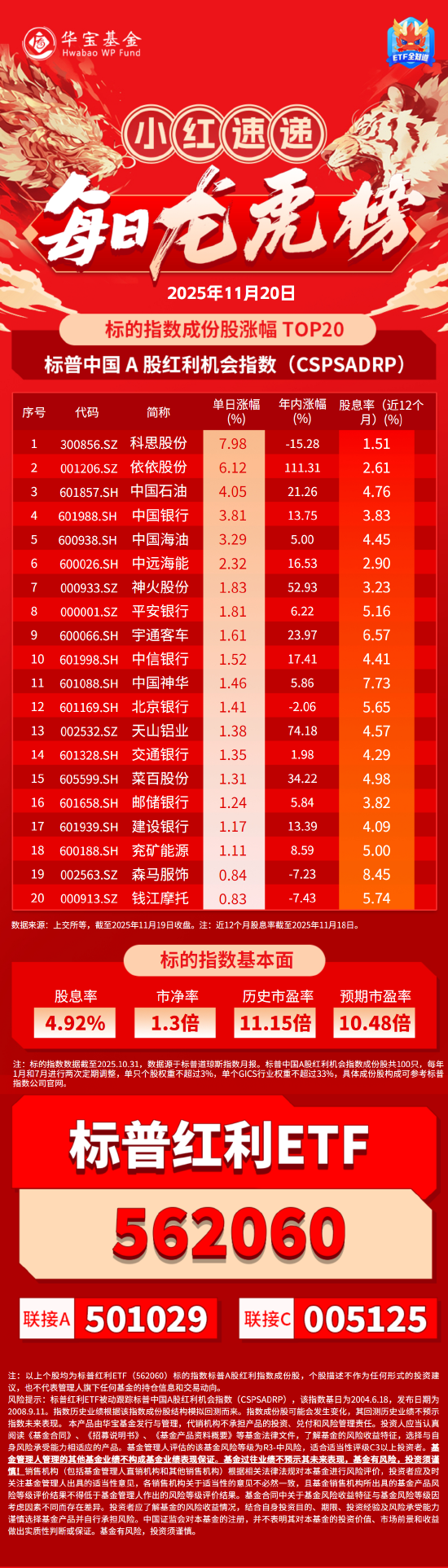
Core Insights - The article highlights the top-performing stocks in the S&P China A-Share Dividend Opportunity Index, showcasing significant price increases and dividend yields for various companies [1]. Group 1: Stock Performance - The top stock, Kesheng Co., Ltd. (300856.SZ), experienced a daily increase of 7.98% but has a year-to-date decline of 15.28% with a dividend yield of 1.51% [1]. - Yiyi Co., Ltd. (001206.SZ) showed a remarkable year-to-date increase of 111.31%, with a daily rise of 6.12% and a dividend yield of 2.61% [1]. - China Petroleum (601857.SH) reported a daily increase of 4.05% and a year-to-date increase of 21.26%, with a dividend yield of 4.76% [1]. Group 2: Dividend Yields - China Bank (601988.SH) has a dividend yield of 3.83%, with a daily increase of 3.81% and a year-to-date increase of 13.75% [1]. - China National Offshore Oil Corporation (600938.SH) offers a dividend yield of 4.45%, with a daily increase of 3.29% and a year-to-date increase of 5.00% [1]. - Postal Savings Bank of China (601658.SH) has a dividend yield of 3.82%, with a daily increase of 1.24% and a year-to-date increase of 5.84% [1].




重磅!又一家券业巨头诞生,中金公司拟换股吸收两家券商!顶流券商ETF(512000)近60日狂揽135亿元
Xin Lang Ji Jin· 2025-11-20 01:09
Core Viewpoint - The brokerage industry is experiencing significant positive developments with the announcement of major asset restructuring plans by China International Capital Corporation (CICC), Xinda Securities, and Dongxing Securities, which will lead to a merger creating a new brokerage giant with nearly 1 trillion yuan in total assets [1] Group 1: Industry Developments - The restructuring is a crucial step in consolidating securities licenses under Central Huijin and aligns with the financial power strategy to build a first-class investment bank [1] - Regulatory support for industry consolidation is evident, with mergers and acquisitions seen as effective means for brokerages to achieve external growth and enhance overall industry competitiveness [1] - The merger is expected to improve resource allocation and promote healthy market development, contributing to higher industry concentration and economies of scale [1] Group 2: Market Performance - Despite a recovering market and improving fundamentals, the brokerage sector's stock performance has lagged behind broader market indices, with the CSI Securities Company Index rising only 3.25% year-to-date compared to significant gains in other indices [1][2] - The disparity between performance and stock price has created a notable valuation gap, with expectations for a "Davis Double" in 2026 as the sector's valuation remains at historical lows [2] - Significant capital inflows have been observed, with the brokerage ETF (512000) seeing a net inflow of 13.521 billion yuan over the past 60 days [2] Group 3: Investment Tools - The brokerage ETF (512000) and its linked funds provide an efficient investment tool that tracks the CSI Securities Company Index, encompassing 49 listed brokerage stocks [4] - The ETF has reached a historical milestone with its fund size surpassing 40 billion yuan, indicating strong liquidity and interest in the sector [4]



ETF日报:从资产配置的角度,我们仍将债券视为股市风险的对冲器,可关注作为债市压舱石的十年国债ETF
Xin Lang Ji Jin· 2025-11-19 13:46
Market Overview - A-shares experienced fluctuations with the Shanghai Composite Index slightly up by 0.18% at 3946.74 points, while the Shenzhen Component remained flat and the ChiNext Index rose by 0.25% [1] - The trading volume in the Shanghai and Shenzhen markets was 1.73 trillion, a decrease of 200.2 billion from the previous trading day [1] - The overall market sentiment was weak, with over 4100 stocks declining, indicating a risk-averse environment [1] Investment Strategy - The current market pullback does not signify the end of the bull market, as excess liquidity continues to increase and optimistic sentiments remain, particularly in technology and export sectors [1][2] - Two key strategies are suggested: balancing between mainline and defensive stocks, and waiting for an uplift in income expectations [1][2] Sector Focus - The technology sector, particularly AI, and industries related to de-involution such as photovoltaic and lithium battery resources, remain key areas of focus [2] - Investors are encouraged to consider ETFs related to communication, chips, photovoltaic, and coal [2] Bond Market Insights - The bond market continues to show a consolidation trend, with the ten-year government bond ETF slightly down by 0.04% [3] - The central bank's cautious approach to monetary policy is leading to uncertainty in interest rates, with a focus on avoiding excessive liquidity [3] Lithium Market Dynamics - The lithium sector is experiencing a resurgence, with lithium carbonate futures rising by 5% to over 100,000 yuan per ton, driven by strong demand in downstream applications [4] - Investors are advised to monitor ETFs related to lithium mining and non-ferrous metals, as the sector is expected to benefit from ongoing demand [4] Gold Market Trends - Gold stocks ETF surged by 4.55%, with spot gold prices returning to 4100 USD per ounce, indicating a potential upward trend in the gold market [5][6] - The demand for gold as a safe-haven asset is increasing due to global uncertainties and the challenges facing the US dollar credit system [6] Future Outlook - The potential for gold prices to exceed 5000 USD per ounce next year is highlighted, contingent on ongoing macroeconomic conditions and central bank policies [6] - Investors are encouraged to explore gold ETFs that directly invest in physical gold and those that focus on gold mining stocks for greater volatility and potential returns [7]
多头险胜,沪指止跌向上!中国银行发力新高,有色龙头ETF(159876)逆市上探3%,光模块、军工引领科技升浪
Xin Lang Ji Jin· 2025-11-19 12:06
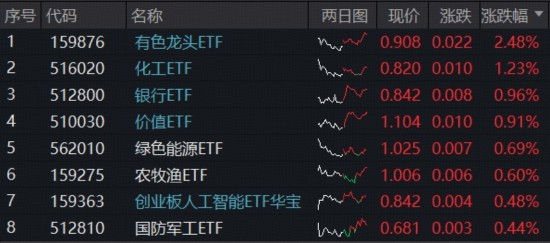
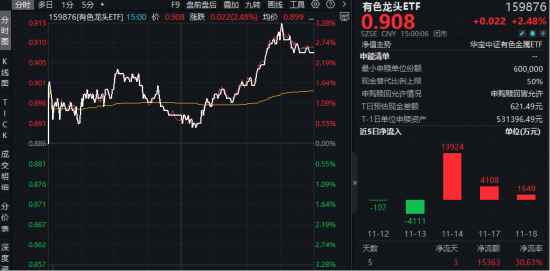
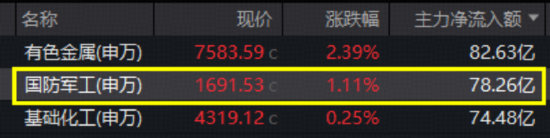
Market Overview - The three major indices experienced a rebound after three consecutive declines, with the Shanghai Composite Index and ChiNext Index slightly rising, while the Shenzhen Component Index remained flat. The total trading volume in the two markets was 1.73 trillion yuan, a decrease from the previous period, with nearly 4,200 stocks declining [1]. ETF Performance - The leading non-ferrous metal ETF (159876) saw an intraday increase of 3.27%, closing with a gain of 2.48%. The chemical ETF (516020) also rose by over 1%. The non-ferrous metal sector led the market, attracting significant capital inflow, with the leading non-ferrous metal ETF accumulating 1.96 billion yuan over three days [3][4]. - The largest bank ETF (512800) rose nearly 1%, recovering above all moving averages, indicating a strong medium to long-term trend [8][10]. Sector Highlights - The non-ferrous metal sector attracted over 8.2 billion yuan in net inflow, making it the top sector in terms of capital absorption among 31 primary industries. Key stocks in this sector, such as Zhongjin Gold and Tianqi Lithium, saw significant price increases, with Zhongjin Gold rising over 8% [6][7]. - The banking sector showed strong performance, with China Bank surging 3.81%, marking its largest single-day gain in a year and reaching a historical high. Other banks like Everbright Bank and Ping An Bank also saw gains of nearly 2% [8][9]. Future Outlook - Analysts suggest that the current market environment favors a "barbell strategy," balancing value and growth styles to capture excess returns in advantageous sectors. The non-ferrous metal sector is expected to perform well due to rising demand and supply constraints, with projections indicating a potential bull market in 2026 [3][7][12]. - The banking sector is benefiting from low valuations and high dividend yields, which are becoming increasingly attractive amid year-end risk aversion. The upcoming mid-term dividend distributions from banks are expected to further enhance their appeal to investors [11][13].
银行又走牛,中国银行猛攻3.8%,刷新历史新高!规模最大银行ETF(512800)涨近1%站上所有均线
Xin Lang Ji Jin· 2025-11-19 12:01
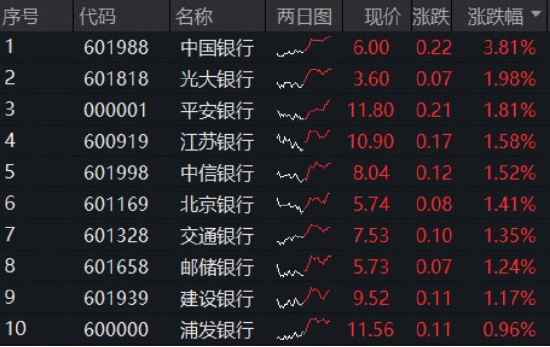
Core Viewpoint - The banking sector has shown a strong performance recently, with several banks reaching new highs in stock prices, indicating a resurgence in investor interest and confidence in the sector [1][5]. Group 1: Stock Performance - China Bank closed up 3.81%, marking its largest single-day gain in nearly a year and reaching a historical high [1]. - Other banks such as Everbright Bank and Ping An Bank also saw increases of nearly 2%, while six other banks rose over 1% [1][2]. - The China Securities Bank Index has accumulated a rise of over 8% since October, outperforming the broader market by 13 percentage points [3][4]. Group 2: ETF and Investment Trends - The largest bank ETF (512800) saw its price rise by 0.96%, recovering above key moving averages, indicating a strong medium to long-term trend [2][3]. - The bank ETF's scale reached a peak of 20.615 billion yuan, reflecting a significant increase in investor allocation [6]. - The high dividend yield and low valuation of bank stocks have made them attractive in the current low-interest-rate environment, enhancing their defensive appeal [5]. Group 3: Dividend Expectations - A total of 26 listed banks have announced a combined dividend amount of approximately 264.6 billion yuan for the 2025 fiscal year, with over 20 billion yuan still to be distributed [5]. - The upcoming mid-term dividend period is expected to sustain the buying momentum in bank stocks, as historical trends suggest a favorable market response during this time [5].
强者恒强!沪金午后直线拉升+碳酸锂突破10万大关!有色龙头ETF(159876)盘中上探3.27%,近3日狂揽1.96亿元
Xin Lang Ji Jin· 2025-11-19 11:46
Core Viewpoint - The non-ferrous metal sector is leading the market with a net inflow of over 8.2 billion yuan, indicating strong investor interest and confidence in the sector's future performance [1][2]. Group 1: Non-Ferrous Metal Sector Performance - The non-ferrous metal sector has attracted significant capital, ranking first among 31 primary industries in terms of capital inflow [1]. - The Non-Ferrous Metal Leader ETF (159876) showed strong activity, with an intraday increase of 3.27% and a closing rise of 2.48%, with a total trading volume of 39.9 million yuan [1]. - Over the past three days, the Non-Ferrous Metal Leader ETF has accumulated a total of 196 million yuan, reflecting bullish sentiment from large investors [1]. Group 2: Key Stocks Performance - Major gold stocks led the gains, with Zhongjin Gold rising by 8.76%, Chifeng Gold by 7.00%, and Shandong Gold by 5.98% [3]. - Lithium sector leaders also performed well, with Tianqi Lithium increasing by over 6%, and Ganfeng Lithium and Tibet Mining both rising by more than 3% [3]. Group 3: Market Outlook - In the gold market, the Shanghai gold futures contract surged over 1%, approaching 940 yuan per gram, with potential for gold prices to exceed 5,000 USD per ounce next year [1][2]. - In the lithium market, lithium carbonate futures broke through the 100,000 yuan mark, with predictions of prices potentially reaching 150,000 to 200,000 yuan per ton by 2026 due to demand growth [2]. - The outlook for basic metals like copper, aluminum, and tin is optimistic, with expectations of a strong performance in 2026 driven by emerging demands in AI, energy, and high-end manufacturing [2]. Group 4: Investment Strategy - A diversified investment approach through the Non-Ferrous Metal Leader ETF and its associated funds is recommended to capture the overall sector's performance while mitigating risks associated with individual metal investments [4].
大国利器接连上新,海陆空天全线躁动,人气股连收四板!国防军工板块布局时机到了?
Xin Lang Ji Jin· 2025-11-19 11:46
板块高人气国防军工ETF(512810)全面覆盖海陆空天核心资产,局部高温继续,天海防务飙升14.16% 创5年新高,航天发展再现一字涨停喜提四板,股价续创三年新高,中船防务首板! | 序号 | 代码 | 名称 | 估算权重 | 现价 | 涨跌幅 ▼ | 总市值 | | --- | --- | --- | --- | --- | --- | --- | | 1 | 300008 | 天海防务 | 0.71% | 7.82 | 14.16% | 135亿 | | 2 | 000547 | 航天发展 | 1.09% | 12.53 | 10.01% | 2004Z | | 3 | 600685 | 中船防务 | 0.78% | 28.93 | 10.00% | 320亿 | | 4 | 688543 | 国科军工 | 0.00% | 53.00 | 6.94% | 111亿 | | રે | 601606 | 长城军工 | 1.54% | 55.15 | 5.61% | 399亿 | | 6 | 600764 | 中国海防 | 0.44% | 31.04 | 5.18% | 221亿 | | 7 | 300775 ...
创业板人工智能ETF(159363)放量三连涨!英伟达财报公布在即,光模块CPO再迎催化?资金抢跑布局
Xin Lang Ji Jin· 2025-11-19 11:42
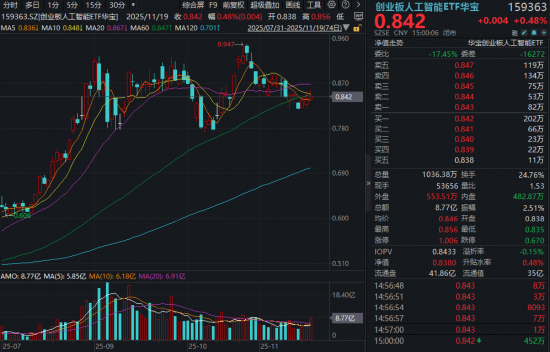
Group 1 - The core viewpoint of the articles highlights the strong performance of optical module companies and the AI sector in the face of a broader tech stock pullback, with significant gains in stocks like LianTe Technology and Zhongji Xuchuang [1][3] - The announcement of Anthropic's $30 billion investment in Microsoft's Azure cloud platform to expand its Claude AI model, supported by Nvidia, indicates a growing demand for AI and related technologies [3] - Predictions suggest that the global demand for 800G optical modules will reach 40 million units and 1.6T optical modules will exceed 7 million units by next year, driven by increased shipments of ASIC chips [3] Group 2 - The upcoming Nvidia earnings report is expected to validate the demand for computing power, which could catalyze the optical module sector in the A-share market [4] - Analysts recommend focusing on the first AI ETF tracking the ChiNext AI Index, which has over 54% exposure to optical modules, as a way to capture opportunities in the AI theme [4] - The ETF has seen significant inflows, with a net subscription of 92 million units in a single day, indicating strong investor interest [1][4]

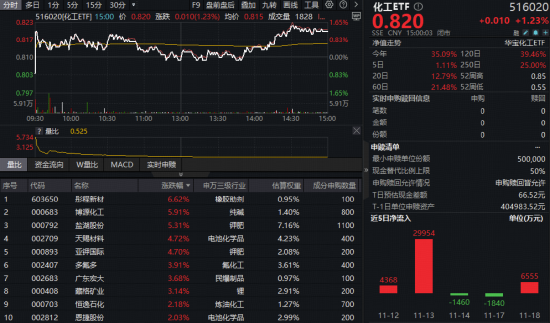
锂电材料价格持续上涨,化工板块V型反转!化工ETF(516020)摸高1.6%,近5日吸金超3.7亿元!
Xin Lang Ji Jin· 2025-11-19 11:42
Group 1 - The chemical sector showed a strong rebound on November 19, with the Chemical ETF (516020) experiencing fluctuations, reaching a maximum intraday increase of 1.6% and closing up by 1.23% [1][2] - Key stocks in the sector included rubber additives, soda ash, lithium batteries, and potash fertilizers, with notable gains from Tongcheng New Materials (up 6.62%), Boyuan Chemical, and Salt Lake Co. (both up over 5%) [1][2] - The basic chemical sector attracted significant capital inflow, with a net inflow of 8.675 billion yuan for the day and a total of 24.828 billion yuan over the past five trading days, leading among 30 sectors [1][3] Group 2 - The Chemical ETF (516020) has seen substantial net subscriptions, with over 370 million yuan in net inflows across three of the last five trading days [3][4] - The price of lithium hexafluorophosphate, a key raw material for electrolytes, has surged to 160,000 yuan per ton, more than tripling since the price bottomed out in July 2025 [3][4] - The supply of lithium hexafluorophosphate is expected to remain tight until 2026 due to production constraints among smaller firms, despite leading companies operating at full capacity [4] Group 3 - The chemical sector is anticipated to benefit from a rebound as the industry moves away from a prolonged bottoming phase, with signs of economic improvement reflected in rising PPI and CPI [5] - The chemical expansion cycle is nearing its end, with various industries, including glyphosate and PTA, beginning to experience upward profitability trends [5] - The Chemical ETF (516020) tracks the CSI sub-sector chemical industry index, with nearly 50% of its holdings in large-cap stocks, providing investors with exposure to leading companies in the sector [5]