水皮More

Search documents
鸡犬升天 | 谈股论金
水皮More· 2025-08-11 09:56
Core Viewpoint - The A-share market experienced a collective rise, with the Shanghai Composite Index reaching a new high for the year, indicating a positive market sentiment and potential investment opportunities in various sectors [2][3]. Market Performance - The Shanghai Composite Index rose by 0.34% to close at 3647.55 points, while the Shenzhen Component Index increased by 1.46% to 11291.43 points, and the ChiNext Index saw a rise of 1.96% to 2379.82 points [2]. - The total trading volume in the Shanghai and Shenzhen markets reached 1.827 trillion yuan, an increase of 116.7 billion yuan compared to the previous Friday [2]. Sector Analysis - The energy and metals sector led the gains, with an increase of nearly 6%, driven by the impact of lithium mine production halts by CATL, which caused lithium carbonate futures prices to surge [3]. - The real estate sector also benefited from policy changes, such as the lifting of purchase restrictions outside the Fifth Ring Road in Beijing, leading to a new high for the sector index [4]. Regulatory Environment - Recent statements from the China Securities Regulatory Commission (CSRC) emphasized the commitment to high-quality opening-up and the intention to avoid large-scale IPOs, which is aimed at stabilizing market expectations and enhancing the attractiveness of the domestic capital market [5]. Individual Stock Movements - Notable stock movements included Kweichow Moutai rising by 1.69% and Wuliangye increasing by 1.41%, indicating a rebound in previously underperforming stocks [5]. - ST Tianmao saw a trading halt due to its voluntary delisting, while companies like China Shipbuilding and China Shipbuilding Heavy Industry experienced declines of 2.2% to 2.85% due to upcoming trading suspensions [6]. Economic Indicators - Recent macroeconomic data indicated a PPI of -3.6%, suggesting deflationary pressures and reflecting a cautious economic outlook, which may influence market sentiment and investment strategies [6].


击鼓传花 | 谈股论金
水皮More· 2025-08-08 10:35
Market Overview - The A-share market experienced a slight pullback today, with the Shanghai Composite Index down 0.12% closing at 3635.13 points, the Shenzhen Component down 0.26% at 11128.67 points, and the ChiNext Index down 0.38% at 2333.96 points [2][3] - The total trading volume in the Shanghai and Shenzhen markets was 171.02 billion yuan, a decrease of 115.3 billion yuan compared to the previous day [2][3] Sector Performance - The market showed a stable sentiment despite the overall decline, with individual stocks experiencing mixed performance. The cement and building materials sector led the gains with an increase of 2.83%, followed by transportation equipment at 2.81%, engineering machinery at 2.13%, and engineering construction at 1.70% [3] - The Yajiang concept stocks rose overall by 2.69%, with notable performers including Shanhai Intelligent, which hit the daily limit up with a gain of approximately 10% [4] Yajiang Concept Analysis - The Yajiang concept index started at 1240 points, peaked at 1354 points, dropped to 1230 points yesterday, and rebounded by 30 points today to close at 1263 points. This indicates that investors in this concept were largely trapped before today's rebound [4] - The trading volume for the Yajiang sector was about 52.2 billion yuan, an increase from 41.5 billion yuan the previous day, but still less than half of the volume during previous highs [4][5] Weighting Stocks Impact - Major weighted stocks, particularly in the banking and insurance sectors, contributed to the index's decline. Notably, companies like BYD, Dongfang Caifu, and Luxshare Precision collectively dragged down the Shenzhen Component by 10.37 points [5] AI Sector Reaction - Following the announcement of new AI models by OpenAI and Google, related stocks in the A-share market did not see an increase but instead experienced a collective decline, indicating market fatigue towards AI concepts [6] Speculative Stocks - Speculative stocks, referred to as "妖股," showed varied performance, with some like Shangwei New Materials dropping by 5.5% and others like Changcheng Military Industry fluctuating in price. The term "击鼓传花" was used to describe the current speculative behavior in the market, suggesting a potential for increased regulatory scrutiny [7]






证监会最新表态
水皮More· 2025-08-08 10:35
Core Viewpoint - The China Securities Regulatory Commission (CSRC) aims to enhance the attractiveness and inclusiveness of the capital market through steady reforms and high-level institutional opening [2][3]. Group 1: Capital Market Opening - The CSRC will continue to promote high-level institutional opening of the capital market, focusing on reform and development, and will systematically study the overall layout and implementation paths for foreign capital market opening [3]. - There will be a coordinated development between onshore and offshore markets, with efforts to deepen all-around market, product, and institutional opening, while expanding cross-border cooperation to attract more international capital [3]. Group 2: IPO Regulation - The CSRC will maintain strict control over the IPO entry, ensuring that there will not be a large-scale expansion of listings, addressing concerns about increased inclusiveness leading to excessive IPOs [4]. - The global market is adapting to technological trends and enhancing institutional innovation, which in turn promotes the vitality and strength of the secondary market [4]. Group 3: Long-term Capital Development - The CSRC will focus on cultivating and strengthening long-term and patient capital, advancing comprehensive reforms to enhance the attractiveness and inclusiveness of the domestic capital market [5]. - There will be an emphasis on developing a policy system that supports long-term investments, promoting the entry of medium- and long-term funds into the market, and reforming public funds [5]. - The CSRC aims to deepen reforms in the Science and Technology Innovation Board and the Growth Enterprise Market, focusing on diverse equity financing and improving the service system for various enterprises throughout their lifecycle [5][6].
仙人指路 | 谈股论金
水皮More· 2025-08-07 10:16
Market Overview - The A-share market showed mixed performance with the Shanghai Composite Index reaching a new high for the year, closing up 0.16% at 3639.67 points, while the Shenzhen Component Index fell 0.18% to 11157.94 points, and the ChiNext Index dropped 0.68% to 2342.86 points [2][3] - The total trading volume in the Shanghai and Shenzhen markets reached 1.8255 trillion yuan, an increase of 91.4 billion yuan compared to the previous day [2][3] Investor Sentiment - Despite the rise in the Shanghai Composite Index, most investors experienced losses, with around 3000 stocks declining compared to just over 2000 stocks rising [3] - The significant contribution to the index's rise came from the six major banks, which added 5.70 points to the index, indicating that the overall market strength is not broad-based [3] Sector Performance - Strong sectors included banking and semiconductors, with news of potential 100% tariffs on imported chips from the U.S. prompting a focus on domestic self-sufficiency [4] - Weak sectors included insurance, pharmaceuticals, solar energy, batteries, steel, and coal, which have seen significant prior speculation and are now experiencing a downturn [4] Stock Movements - Individual stocks like Upwind New Materials saw a rise of 3.93%, closing at 91.85 yuan per share, indicating ongoing speculative trading [4] - Chinese shipbuilding and heavy industry stocks experienced volatility, with both companies involved in a merger showing mixed performance [5] Foreign Investment Trends - Morgan Stanley reported a significant net inflow of foreign capital into the Chinese stock market in July, with passive funds contributing 3.9 billion USD and active funds seeing a net outflow of 1.2 billion USD [7] - The net inflow for July reached 2.7 billion USD, more than double that of June, highlighting a strong capital-driven market trend [7] Key Takeaways - The market is currently in a phase where it is not seeing significant downward movement, suggesting potential for upward momentum if it can stabilize [6] - The focus on bank stocks and the impact of foreign investment indicate a market driven by specific sectors rather than a broad-based rally [7]

强者恒强 | 谈股论金
水皮More· 2025-08-06 09:20
Core Viewpoint - The A-share market shows resilience and upward momentum, with the Shanghai Composite Index reaching a new closing high, indicating a strong market despite some underlying weaknesses in individual stocks [2][3][4]. Market Performance - All three major A-share indices rose today, with the Shanghai Composite Index up 0.45% to close at 3633.99 points, the Shenzhen Component Index up 0.64% to 11177.78 points, and the ChiNext Index up 0.66% to 2358.95 points [2]. - The trading volume in the Shanghai and Shenzhen markets reached 1.73 trillion yuan, an increase of 138 billion yuan compared to the previous day [2][3]. Market Dynamics - The recent index highs are characterized by a higher number of advancing stocks compared to declining ones, contrasting with previous highs where more stocks were down [3]. - Despite the overall index rise, many investors feel they are "making money on the index but not on their investments," indicating a disconnect between index performance and individual stock gains [4]. Sector Analysis - The military industry sector performed strongly, partly due to the upcoming "September 3" commemorative day, with stocks like China Shipbuilding Group seeing short-term speculation [5]. - The rapid rotation of sectors is evident, with strong performances in robotics and pharmaceuticals, but also significant volatility, as seen with stocks like Upwind New Materials [5][6]. Investor Sentiment - Investors are advised to maintain a cautious approach, as the market's upward trend can lead to rapid changes in sector performance, making it crucial to act quickly to capitalize on opportunities [5][6]. - The market has seen a decline in the number of stocks advancing to the second board, reflecting regulatory measures aimed at cooling speculative trading [7]. Notable Records - The market recorded a financing balance exceeding 2 trillion yuan, the highest in a decade, and Agricultural Bank of China reached a market capitalization of 2.11 trillion yuan, surpassing Industrial and Commercial Bank of China [7].



有恃无恐 | 谈股论金
水皮More· 2025-08-05 09:44
Core Viewpoint - The A-share market shows a collective rise in major indices, with the Shanghai Composite Index returning above 3600 points, indicating a potential recovery driven by financial stocks [2][3][4]. Market Performance - The Shanghai Composite Index rose by 0.96% to close at 3617.60 points, while the Shenzhen Component Index increased by 0.59% to 11106.96 points, and the ChiNext Index gained 0.39% to 2343.38 points [2]. - The total trading volume in the Shanghai and Shenzhen markets reached 1.596 trillion, an increase of 97.5 billion compared to the previous day [2]. Sector Analysis - Financial stocks led the market rally, with bank stocks rising by 1.75% and insurance stocks by 1.97%, contributing significantly to the index's performance [3]. - The performance of the Shenzhen Component was weaker, with major stocks like Ningde Times and BYD showing declines, which negatively impacted the ChiNext Index [3]. Individual Stock Focus - The stock of Shangwei New Materials, which had previously surged tenfold, resumed trading after a suspension and reported a mid-term performance decline of over 30%. Despite an initial drop, it closed at the daily limit with a price of 110.48 yuan per share [5]. - Concerns are raised regarding the speculative trading of Shangwei New Materials, which may attract regulatory scrutiny and complicate its restructuring process [5]. External Market Influences - The U.S. stock market saw significant gains influenced by the potential for early interest rate cuts by the Federal Reserve, which positively affects the valuation of Chinese assets [6].

各自为战 | 谈股论金
水皮More· 2025-08-01 10:10
Core Viewpoint - The article discusses the recent performance of the A-share market, highlighting the mixed results of major indices and the influence of key sectors and stocks on market movements [2][3][5]. Market Performance - The three major A-share indices experienced slight declines, with the Shanghai Composite Index down 0.37% to 3559.95 points, the Shenzhen Component down 0.17% to 10991.32 points, and the ChiNext down 0.24% to 2322.63 points [2]. - The trading volume in the Shanghai and Shenzhen markets was 1.5984 trillion yuan, a significant decrease of 337.7 billion yuan compared to the previous day [2][5]. Key Influencers - The "Big Four" banks played a crucial role in stabilizing the market, with Agricultural Bank of China reaching a closing high for three consecutive days, and Industrial and Commercial Bank of China also rising for three days [3]. - In contrast, the "two oil giants" (Sinopec and PetroChina) negatively impacted the market due to a 30% decline in their half-year earnings, with Sinopec dropping 5.69% and PetroChina falling 4.08% [3]. Sector Performance - The photovoltaic sector showed relative strength, driven by industry news regarding "anti-involution" [6]. - The insurance sector performed poorly, with significant declines in the afternoon, leading to concerns about its impact on the overall market [6]. Individual Stock Movements - Notable individual stock movements included Tibet Tourism, which saw a 135% increase over the past 10 days but faced volatility, and Southern Road and Bridge, which had eight consecutive daily gains [6]. - The article warns of potential regulatory measures targeting speculative stocks, advising caution for retail investors [6]. International Market Influence - The Dow Jones index fell approximately 0.7% due to the Federal Reserve's decision not to cut interest rates, which negatively affected Asian markets, with Japan's Nikkei down 0.6% and South Korea's market down 3.88% due to increased capital gains tax [6][7]. - European markets also experienced declines, with the Stoxx index down around 1.75% and major European indices falling between 1.65% and 1.8% [7].



晴天霹雳 | 谈股论金
水皮More· 2025-07-31 10:37
Market Overview - The A-share market experienced a collective decline today, with the Shanghai Composite Index falling by 1.18% to close at 3573.21 points, the Shenzhen Component Index down by 1.73% to 11009.77 points, and the ChiNext Index decreasing by 1.66% to 2328.31 points [2][3][4] - This marks the largest single-day decline since April 7, with a total trading volume of 19.36 trillion yuan, an increase of 91.8 billion yuan compared to the previous day [4][12] Index Performance - The CSI 300 Index, which represents major stocks in the Shanghai and Shenzhen markets, saw a larger drop of 1.82%, indicating significant contributions from heavyweight stocks to the overall market decline [5] - Out of 4274 stocks in the two markets, only 1060 stocks rose, highlighting a broad-based sell-off [5] Sector Analysis - Only six sectors showed positive performance, primarily driven by pharmaceutical stocks due to ongoing speculation in innovative drugs, and sectors related to information technology [6] - The sectors with the largest declines included coal and non-ferrous metals, with steel and photovoltaic equipment also experiencing drops of over 2.63% [6] Individual Stock Impact - Major negative contributors to the Shanghai Composite Index included China Life, Ping An Insurance, Kweichow Moutai, Yangtze Power, and China Mobile [7] - For the Shenzhen Component Index, CATL, BYD, Midea Group, Wuliangye, and Dongfang Caifu had the most significant negative impacts, with CATL experiencing a 4.45% drop following disappointing revenue expectations [7][8] Market Sentiment and Future Outlook - The market's sudden downturn occurred shortly after a political bureau meeting emphasized stabilizing the capital market, leading to concerns about irrational panic selling [9][10] - Despite the overall market decline, major banks showed resilience, with Agricultural Bank of China, China Construction Bank, Industrial and Commercial Bank of China, and Bank of China all posting slight gains [11] - The recent speculative trading behavior, particularly in stocks like Weiwei New Materials, which surged 1200% in a month, has raised concerns about regulatory scrutiny and potential repercussions for the broader market [11][12]

二季度政治局会议传递积极信号
水皮More· 2025-07-31 10:37
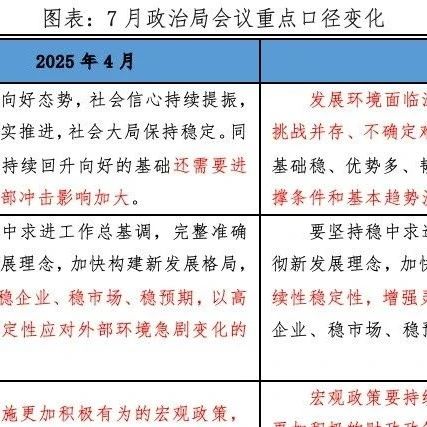
Core Viewpoint - The article emphasizes the continuation of a stable yet progressive macroeconomic policy, focusing on maintaining policy stability while enhancing flexibility and timely adjustments to stimulate economic recovery [1][3]. Fiscal Policy - The fiscal policy aims for detailed implementation, emphasizing structural optimization, with a focus on enhancing social welfare and targeted spending for specific groups [4]. - The government plans to accelerate the issuance of long-term special bonds, with net financing reaching 7.66 trillion yuan in the first half of 2025 [4]. Monetary Policy - A moderately loose monetary policy is anticipated, with potential interest rate cuts to lower overall financing costs for society [5]. - The central bank has already implemented a 10 basis point interest rate cut and a 50 basis point reserve requirement ratio reduction, with further easing expected [5]. Industry Policy - The industry policy focuses on fostering technological innovation and promoting healthy competition, with an emphasis on emerging industries and strategic sectors [6][8]. - Key areas for support include quantum computing, artificial intelligence, and biotechnology, with a push for collaboration between research institutions and enterprises [6]. Real Estate Policy - The real estate policy highlights the importance of high-quality urban renewal and managing local government debt risks, with a focus on stabilizing the housing market [9]. - Recent data shows a decline in property sales, with June's sales area and revenue down by 5.5% and 10.8% year-on-year, respectively [9]. Domestic Demand Expansion - The strategy for expanding domestic demand involves enhancing both consumption scenarios and consumer capacity, with potential policies to optimize social security contributions and tax structures [11][12]. - Recent retail sales data indicates a 4.8% year-on-year growth, but a decline in consumer confidence remains a concern [11]. Employment and Social Welfare - The employment policy prioritizes job creation for key demographics, including recent graduates and migrant workers, while ensuring social safety nets are in place [13]. - The approach combines development with safety nets to stabilize society and rebuild consumer confidence [13]. Capital Market - The capital market is encouraged to enhance its attractiveness and inclusivity, with recent positive performance in A-shares and Hong Kong stocks [14]. - The government has introduced various supportive measures to stabilize and invigorate the capital market, including optimizing monetary policy tools [14]. High-Level Opening Up - The policy aims to maintain a stable foundation for foreign trade and investment, with measures to support foreign trade enterprises and promote integrated development of domestic and foreign trade [15]. - The focus is on enhancing the resilience of enterprises and the support capabilities of open platforms in a complex external environment [15].
房地产企业今年集体赖账,最后谁来买单?
水皮More· 2025-07-30 09:40
Core Viewpoint - The article discusses the severe debt crisis facing China's real estate sector, highlighting the significant amount of bad debt and the implications for the broader economy [1][4]. Group 1: Debt Restructuring - Many private real estate companies in China are undergoing debt restructuring, which is essentially a way to default on debts, with creditors often receiving only a fraction of what they are owed [1][2]. - For example, a company may offer four options for debt repayment, including cash, stock swaps, asset exchanges, and debt extensions, but the actual value received by creditors is significantly lower than the original debt [2]. Group 2: Scale of Debt - The total domestic debt of Chinese real estate companies is approximately 6.5 trillion yuan, with an additional 3.5 trillion yuan owed internationally, peaking in maturity this year and next [2]. - The banking sector is exposed to around 50 trillion yuan in loans to real estate, with conservative estimates suggesting banks could face losses of over 30% due to declining land values [2]. - Other liabilities include 15-20 trillion yuan in trust and wealth management products, and 5-8 trillion yuan in debts owed to suppliers, leading to an estimated 50 trillion yuan in bad debts from the real estate bubble [2]. Group 3: Economic Impact - The 50 trillion yuan in bad debts represents a significant financial burden, equating to ten years of land sale revenues or three times the annual tax revenue [2]. - The ultimate burden of these bad debts will likely be transferred to the general public, either through bank failures or inflation caused by central bank interventions [2][5]. Group 4: Historical Context - The article draws a parallel with Japan's real estate crisis in the 1990s, where the total real estate debt was 450-550 trillion yen, approximately 220% of GDP, and took over 20 years to resolve [4]. - The ongoing debt crisis in China's real estate sector suggests that the repercussions may last for many years, with the societal costs just beginning to surface [5].