雷峰网

Search documents
创始人因股比纠纷擅自罢免联创,资方启动仲裁;科技大厂核心业务一分为二内部赛马;出海硬件巨头项目盈利仍被砍丨鲸犀情报局Vol.24
雷峰网· 2025-12-31 11:41
Group 1 - A smart hardware brand faces internal conflict as founder A unilaterally dismisses co-founder B over equity disputes, leading to arbitration initiated by investors [1] - A major hardware company employs strict management practices, including public announcements of employee mistakes and frequent organizational restructuring, creating a high-pressure work environment [2] - A 3D printing company previously sought a $10 billion valuation but faced rejection from investors; now, a tech giant is interested in investing at the same valuation but negotiations have stalled [3] Group 2 - A well-known tech company has split its core business into two independent brands, resulting in intense internal competition that surpasses external market rivalry [4][5] - A smart cleaning company struggles with marketing due to inexperienced leadership, leading to high costs and a shift away from its original user experience focus [6] - A pool robot company is considering relocating its R&D center to attract talent, but internal resistance to change poses challenges [7] Group 3 - A lawnmower company has shifted its focus from building its own brand to survival through OEM production, adjusting its goals to "survive first" amid declining expectations [8] - An overseas hardware giant is cutting profitable projects if they do not meet cost expectations, emphasizing supply chain security by diversifying suppliers [9] - An AI glasses company has achieved significant sales, selling over 30,000 units at an average price of $800, leading to a substantial increase in valuation following multiple funding rounds [10]


独家丨前美团光年之外产品负责人谢青池创业,切入AI健身教练赛道
雷峰网· 2025-12-31 03:44
Group 1 - The core viewpoint of the article is that Xie Qingchi, a serial entrepreneur and former product head at Meituan's "Light Year Beyond," has ventured into the AI fitness coach market, focusing on the fitness industry [2][3]. - Xie Qingchi has a background in computer applications and has accumulated extensive entrepreneurial experience in O2O and consumer sectors, having co-founded companies like Xiaomai Gongshe and Yijian Home [2]. - During his tenure at "Light Year Beyond," Xie Qingchi enhanced his skills in AI, reportedly reviewing nearly 300 AI papers in 2024 to explore AI boundaries and drive product innovation [2]. Group 2 - "Light Year Beyond" was established in 2018 and received $230 million in Series A funding in 2023, achieving a valuation exceeding $600 million. It was fully acquired by Meituan in July 2023 [3]. - Following the acquisition, the legal representative of "Light Year Beyond" changed to Liu Yaping, indicating a complete integration into Meituan [3]. - Xie Qingchi has begun assembling a core team for his new venture, which includes a hardware lead with 10 years of experience at DJI and a software lead with a background at Meta and Apple, suggesting a strong potential for future financing [3].

车企孵化的智能化公司,为何多数都难善终?
雷峰网· 2025-12-31 03:44
Core Viewpoint - The article discusses the challenges faced by automotive companies in their pursuit of smart driving technology, highlighting the high expectations and subsequent failures of many startups in this sector, often resulting in a rapid rise and fall [2][3]. Group 1: Challenges in Smart Driving Startups - Two notable events in 2025 marked a downturn in the smart driving industry, with major companies like Maomao Zhixing and Dazhuo Intelligent facing significant operational challenges [2]. - The decline of these companies reflects broader issues within the automotive industry's approach to smart technology, including unclear positioning, resource misallocation, and cultural clashes between traditional automotive and tech talent [2][4]. Group 2: Equity Structure Issues - Many smart driving companies established by traditional automakers suffer from problematic equity structures, often leading to conflicts in decision-making and operational inefficiencies [5][6]. - For instance, Maomao Zhixing is over 53% controlled by Great Wall Motors, which has led to a lack of decision-making power for its management team, ultimately contributing to its struggles [6][10]. - Dazhuo Intelligent's structure, with 80% ownership by Chery, similarly restricts its founder's ability to drive technological innovation due to a lack of authority [10][11]. Group 3: Strategic Positioning Confusion - The strategic positioning of many smart driving companies remains ambiguous, often serving as mere suppliers to their parent companies rather than independent market players [17][18]. - Maomao Zhixing's initial focus was to provide smart driving solutions exclusively for Great Wall Motors, which tied its success to the parent company's market performance [18][19]. - This dependency on a single client has led to operational difficulties, especially when Great Wall Motors sought alternative suppliers for smart driving technology [19][20]. Group 4: Cultural Conflicts - The cultural clash between traditional automotive companies and tech startups creates significant barriers to innovation and talent retention [29][30]. - Traditional automotive firms often have rigid hierarchical structures and lengthy approval processes, which hinder the agility required in the fast-paced tech environment of smart driving [29][30]. - This cultural mismatch has resulted in missed opportunities for smart driving companies to attract top talent and respond swiftly to market changes [30][31]. Group 5: Competitive Pressures - The emergence of tech giants like Huawei and Baidu has intensified competition, as they offer comprehensive solutions that outpace the capabilities of traditional automaker startups [38][39]. - Huawei's substantial investment in smart driving technology, exceeding 10 billion annually, has positioned it as a market leader, further squeezing the viability of smaller, automaker-affiliated startups [39][40]. - As traditional automakers enhance their own R&D capabilities, the original purpose of these smart driving companies—to fill technological gaps—has diminished, leading to their integration or dissolution [40][41].




2026年国补继续!购车补贴2万封顶;又一中资半导体企业被强制出售股权;广汽多名高管被带走,反腐风暴席卷整车、合资、零部件全链条
雷峰网· 2025-12-31 00:37
Key Points - GAC Group is facing a corruption investigation involving multiple executives, including Vice President Zheng Heng and former executives from GAC Honda and GAC Parts, amid a challenging performance environment with losses exceeding 4.3 billion yuan in the first three quarters of 2025 and a sales decline of over 10% year-on-year [4][5] - The investigation is seen as a response to the company's poor performance and potential "gray costs" in procurement, which could erode profits by billions [5] - The Chinese semiconductor company, Jiangguang Asset Management, is being forced to sell its 80.2% stake in UK-based FTDI due to national security concerns raised by the UK government, following a strategic acquisition made in December 2021 for $414 million [7][8] - The 2026 national subsidy policy for vehicle purchases has been announced, with 625 billion yuan allocated, maintaining a cap of 20,000 yuan for car purchase subsidies, while expanding support for household appliances and smart products [10][11] - Meta has acquired AI company Butterfly Effect, which includes the Manus product, with the core team relocating to Singapore, indicating a significant shift in the AI landscape [12][13] - MiniMax, an AI startup, is set to go public with an estimated valuation of over 46 billion HKD, aiming to raise over $600 million, highlighting the competitive nature of the AI sector in China [17][18] - Xiaopeng Motors' chairman, He Xiaopeng, predicts that true fully autonomous driving will be achieved by 2026, transitioning directly from L2 to L4 capabilities [21][22] - Longxin Technology has applied for an IPO on the Sci-Tech Innovation Board, seeking to raise 29.5 billion yuan, positioning itself as a leading DRAM manufacturer in China [35][36] - The global automotive market is witnessing a decline in Porsche's sales, with a reported 28% drop in the Chinese market, leading to multiple dealership closures [41][42] - TSMC is accelerating its 3nm production plans in Arizona to meet the demands of major clients like Apple and NVIDIA, amid increasing competition in the semiconductor industry [45]


华为轮值董事长孟晚舟新年致辞:追风赶月莫停留,平芜尽处是春山
雷峰网· 2025-12-31 00:37
Core Viewpoint - The company emphasizes resilience in overcoming challenges and professionalism in creating value, highlighting significant achievements and future strategic opportunities in the context of technological advancements and industry transformation [2][5][8]. Group 1: Achievements in 2025 - The company has made substantial progress in various fields, including providing 5G-A network services to 60 million users and enhancing the HarmonyOS ecosystem, with over 36 million devices running Harmony 5.0 and above [3]. - Collaborations with automotive partners have led to the installation of smart systems in over 1.4 million vehicles, contributing to nearly 7 billion kilometers of assisted driving mileage [3]. - The company has developed a robust partner network, with over 6,800 partners and 3.8 million developers for the Kunpeng platform, and over 3,000 partners and 4 million developers for the Ascend platform [3]. Group 2: Future Strategic Opportunities - The company identifies the ongoing wave of intelligent transformation as a long-term strategic opportunity, focusing on vertical industry applications and the integration of AI with core business processes [5][6]. - Plans include building an open-source ecosystem for Kunpeng and Ascend, enabling partners to develop products that meet diverse industry needs and enhancing AI computing capabilities [7]. - The company aims to enhance consumer experiences through the Harmony ecosystem and improve AI integration in communication networks, transitioning from connectivity to intelligent connectivity [7]. Group 3: Challenges and Commitment - The path to success is acknowledged to be fraught with challenges, but the company is committed to facing these difficulties head-on, emphasizing the importance of strategic focus and organizational strength [8]. - The company believes that past successes do not guarantee future outcomes, and it is dedicated to continuous improvement and innovation in the face of uncertainty [8].

对话光帆科技董红光:Manus 让 Agent 走红,但真正的 AI 载体不只有手机
雷峰网· 2025-12-30 10:10
Core Viewpoint - The article discusses the potential of AI hardware, particularly focusing on the innovative AI headphones developed by Guangfan Technology, which aims to redefine user interaction in the AI era [2][4][28]. Group 1: Company Overview - Guangfan Technology, founded by Dong Hongguang, has achieved a valuation of over 1 billion yuan and recently launched the world's first AI headphones with visual perception capabilities [4][28]. - The company aims to create a complete system with the headphones, a dedicated smartwatch, and a charging case that includes 4G connectivity and a large battery [4][10]. Group 2: Market Opportunity - The AI hardware market is currently in a "window period," where early-stage companies can establish themselves before larger players dominate the market [11][28]. - Dong believes that the AI headphone market is not just about competing with existing TWS headphones but creating a new category of "AI wearable devices" [23][28]. Group 3: Product Design and Features - The headphones are designed to be user-friendly, integrating AI capabilities into a device that people already use daily, thus enhancing the user experience [10][11]. - The charging case serves as a "physical extension" of the headphones, housing essential components like a 4G eSIM and a 2020mAh battery to support continuous AI functionality [13][15]. Group 4: Software and Operating System - Guangfan Technology is developing its own operating system tailored for AI interactions, which differs significantly from Android by focusing on voice and multimodal interactions rather than graphical interfaces [17][19]. - The company emphasizes the importance of a lightweight system on the device side and a complex cloud system for managing multiple AI models [17][19]. Group 5: Competitive Landscape - The AI hardware market is divided into two camps: those focusing on specialized hardware and those pursuing general-purpose devices. Dong argues that general-purpose devices have greater long-term potential [22][23]. - The company welcomes competition from larger firms, believing that the hardware market is not easily monopolized and that their unique operating system and AI capabilities provide a competitive edge [27][28]. Group 6: Future Plans and Challenges - The company plans to refine its product and expand its ecosystem, focusing on user engagement and developer participation to foster a robust application environment [34][41]. - Dong acknowledges the challenges of transitioning from a resource-rich environment in large companies to the resource constraints of a startup, emphasizing the need for rapid decision-making and adaptability [37][39].
长虹佳华:作为WPS 365民企市场唯一分销总代,过去一年交出了怎样的答卷?
雷峰网· 2025-12-30 03:34
Core Viewpoint - The current period is seen as an optimal window for agencies to represent WPS 365, especially as the domestic market shifts towards localization and the SaaS model gains traction in the enterprise sector [1][2]. Group 1: Market Dynamics - The cloud business growth is slowing, leading many channel vendors to hesitate in entering the SaaS market due to perceived low payment willingness and thin customer pricing [2]. - The domestic software market has seen a significant shift towards localization, particularly in the private enterprise sector, with increasing adoption of WPS formats as a compliance trend [4][5]. Group 2: Strategic Moves - Kingsoft Office's revenue for 2024 was reported at 5.121 billion yuan, with 3.283 billion yuan coming from individual business (To C) and only 1.703 billion yuan from To B (SaaS subscriptions and licensing) [6]. - The company aims to enhance its market share in the private enterprise sector, which requires a shift from policy-driven to value-driven competition [7]. Group 3: Partnership Development - Longzhong Jiahua was selected as the exclusive distributor for Kingsoft Office in the private enterprise market, marking a strategic partnership aimed at building a self-sustaining channel ecosystem [3][8]. - The collaboration is based on shared values and business philosophies, with both parties recognizing the need for a robust channel network to penetrate the B-end market effectively [11][12]. Group 4: SaaS Market Insights - Longzhong Jiahua emphasizes the importance of adapting SaaS products to the Chinese market rather than directly copying foreign models, advocating for diverse product forms to meet local needs [13][14]. - The company believes in focusing on depth rather than breadth in market penetration, targeting key industry leaders to establish benchmark cases that can facilitate broader market acceptance [15]. Group 5: Channel Strategy - The channel network is being built with a focus on deep partnerships, aiming to empower partners with the necessary skills and resources to effectively market and support WPS 365 [24]. - Longzhong Jiahua is actively seeking partnerships in the manufacturing sector, particularly high-end manufacturing, to leverage existing relationships and expertise for rapid market entry [25][31]. Group 6: Future Growth Potential - The enterprise-level AI capabilities of WPS are seen as a significant growth area, with the potential to enhance data intelligence and operational efficiency for businesses [32][36]. - The transition from traditional project-based revenue to a sustainable SaaS model is highlighted as a key strategy for long-term profitability and market stability [29].


突发!Meta官宣收购Manus,肖弘将出任Meta副总裁;中芯国际:拟406亿元购买中芯北方49%股权;1月1日起,我国调整部分商品关税税率税目
雷峰网· 2025-12-30 00:25
Group 1 - Meta has announced the acquisition of Manus, a Singapore-based AI company, for several billion dollars, marking its third-largest acquisition to date [4][5] - Manus is known for its general-purpose AI agent product, which has shown a 23.7% improvement in complex task handling and achieved an accuracy rate of 86.5% in GAIA benchmark tests [4] - The acquisition is expected to enhance Meta's AI capabilities and integrate Manus's technology into its product lines, with Manus founder Xiaohong becoming Meta's VP [5] Group 2 - SMIC plans to acquire a 49% stake in SMIC North for 40.6 billion yuan, which will make SMIC North a wholly-owned subsidiary [7][8] - This acquisition aims to improve asset quality and business synergy for SMIC, with no changes to its main business operations expected [7] - SMIC reported a revenue of 49.51 billion yuan for the first three quarters of 2025, a year-on-year increase of 18.2%, with a net profit of 3.81 billion yuan, up 41.1% [8] Group 3 - One of the major developments is the adjustment of import tariffs on 935 items starting January 1, 2026, aimed at enhancing domestic and international market synergy [9] - The adjustments include lowering tariffs on key components and advanced materials to promote technological self-reliance and support economic development [9][10] Group 4 - A major investment of 3.74 billion yuan from FAW Group into Leap Motor is set to strengthen the latter's market position and brand recognition [12][13] - The investment will be allocated for R&D, operational funding, and expanding sales and service networks [13] Group 5 - NVIDIA has completed a $5 billion acquisition of Intel shares, making it a significant shareholder and paving the way for collaboration on AI platforms and integrated GPU solutions [38][39] - This partnership is expected to reshape the market landscape, particularly with the anticipated release of integrated RTX GPU processors [39] Group 6 - Fujitsu is joining a collaborative project led by SoftBank and Intel to develop HBM memory alternatives, aiming for commercial production with enhanced capacity and reduced power consumption [45][46] - The project plans to invest 8 billion yen by the fiscal year 2027, with contributions from various partners [46]






中关村科金总裁喻友平:为何有些Agent企业一试用就没了下文?
雷峰网· 2025-12-30 00:25
Core Viewpoint - The only correct strategy for To B platform companies is to focus on a core track, invest sufficient resources to achieve excellence, and rely on ecosystem collaboration for other parts [2]. Group 1: AI and Intelligent Agents - The essence of large models is to address the issues of intelligent and scalable service processes, but not all problems require intelligent agents [3][6]. - The application of intelligent agents is focused on enhancing collaboration and productivity in marketing, customer service, and sales [6][9]. - The commercial model for AI agents is still in a state of exploration, with various billing methods being tested, but the priority should be on delivering value to clients [11][12]. Group 2: Industry Positioning and Strategy - The core mission of the company is to integrate past experiences and product matrices with new AI technologies to find a unique ecological position in the industry [4][26]. - The company emphasizes the importance of deep integration with existing business processes and the need for continuous effect tuning based on industry experience [7][8]. - The company has launched the "Super Connection" global ecosystem partnership plan, collaborating with major cloud and computing companies to enhance its service offerings [15][26]. Group 3: Market Trends and Client Needs - The demand from clients varies by sector, with state-owned enterprises focusing on efficiency and innovation, while private enterprises prioritize revenue growth and cost reduction [14][20]. - The future trend is expected to shift towards "everyone having an agent," facilitating direct communication and collaboration between personal and business agents [9][10]. - The company aims to create a comprehensive marketing service platform that integrates various customer interaction points, enhancing the overall customer experience [23][24][25]. Group 4: Product Development and Ecosystem - The company has developed a product matrix that includes various platforms and applications to support the deployment of intelligent agents across different industries [26][27]. - The focus is on ensuring that the intelligent agent platforms can effectively support business scenarios and provide measurable value [29]. - The company believes that the biggest opportunity in the AI industry lies in the chip sector, anticipating that chips will become standardized products, thus enabling broader application opportunities [28].

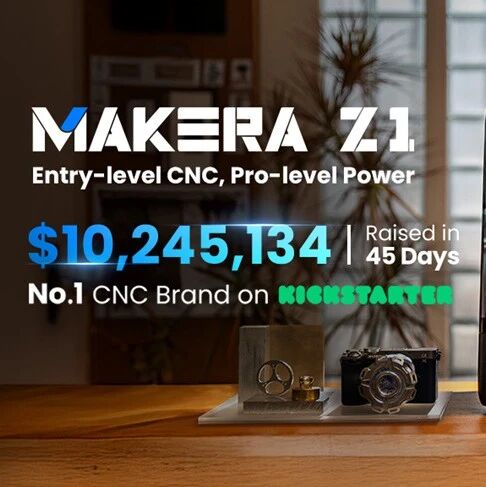
造物时代45天众筹超7200万元,桌面CNC爆发了
雷峰网· 2025-12-29 11:18
Core Viewpoint - The article highlights the significant success of Makera's latest product, the Makera Z1 desktop CNC device, which has raised nearly $10.25 million in crowdfunding, marking a pivotal moment for the desktop CNC market as it transitions from a niche tool to a more mainstream product [3][15]. Group 1: Product Overview - The Makera Z1 is positioned as an entry-level desktop CNC device with professional-grade processing capabilities, achieving a precision of 0.02 mm, which is comparable to professional equipment [4][6]. - The device features user-friendly innovations such as quick tool changes, automatic leveling, and one-click tool calibration, significantly lowering the barriers to entry for users [6][12]. - Makera Z1's crowdfunding success reflects a growing trust in the brand, with its products already being utilized by over a thousand global companies, including major corporations like Apple and NASA [8]. Group 2: Market Position and Strategy - Makera, founded in 2019, has established a competitive edge by addressing industry pain points such as high costs and complexity associated with traditional CNC devices [11]. - The company has developed a comprehensive ecosystem that includes hardware, software, and community content, facilitating a more accessible and collaborative environment for creators [14]. - The upcoming entry into the Chinese market in 2026 is anticipated to further expand the reach of the Makera brand, providing more opportunities for domestic makers and manufacturing enthusiasts [15].