GEELY AUTO(00175)

Search documents
Chinese EVs inch closer to the US as Canada slashes tariffs
TechCrunch· 2026-01-16 16:04
Group 1 - Canada will reduce its 100% import tax on Chinese electric vehicles (EVs) to 6.1%, allowing companies like Geely, BYD, and Xiaomi to enter the North American market [1] - The initial cap on annual imports of Chinese EVs will be set at 49,000 vehicles, increasing to approximately 70,000 over five years [1] - This policy shift aligns with China's strategy to boost EV exports, particularly as the European Union considers lowering its tariffs on these vehicles [2] Group 2 - Chinese automakers, including Geely, are actively seeking to enter the U.S. market, with plans to announce their entry within the next two to three years [3] - Despite the lower prices of Chinese EVs compared to the average U.S. car, the previous 100% tariff has hindered their export potential to the U.S. market [5] - The U.S. has been working to distance itself from China's EV supply chain for national security reasons, which presents additional challenges for Chinese automakers [6]





超20款车光速调价,丰田“自杀式”反击,2026价格战再升级
3 6 Ke· 2026-01-16 12:53
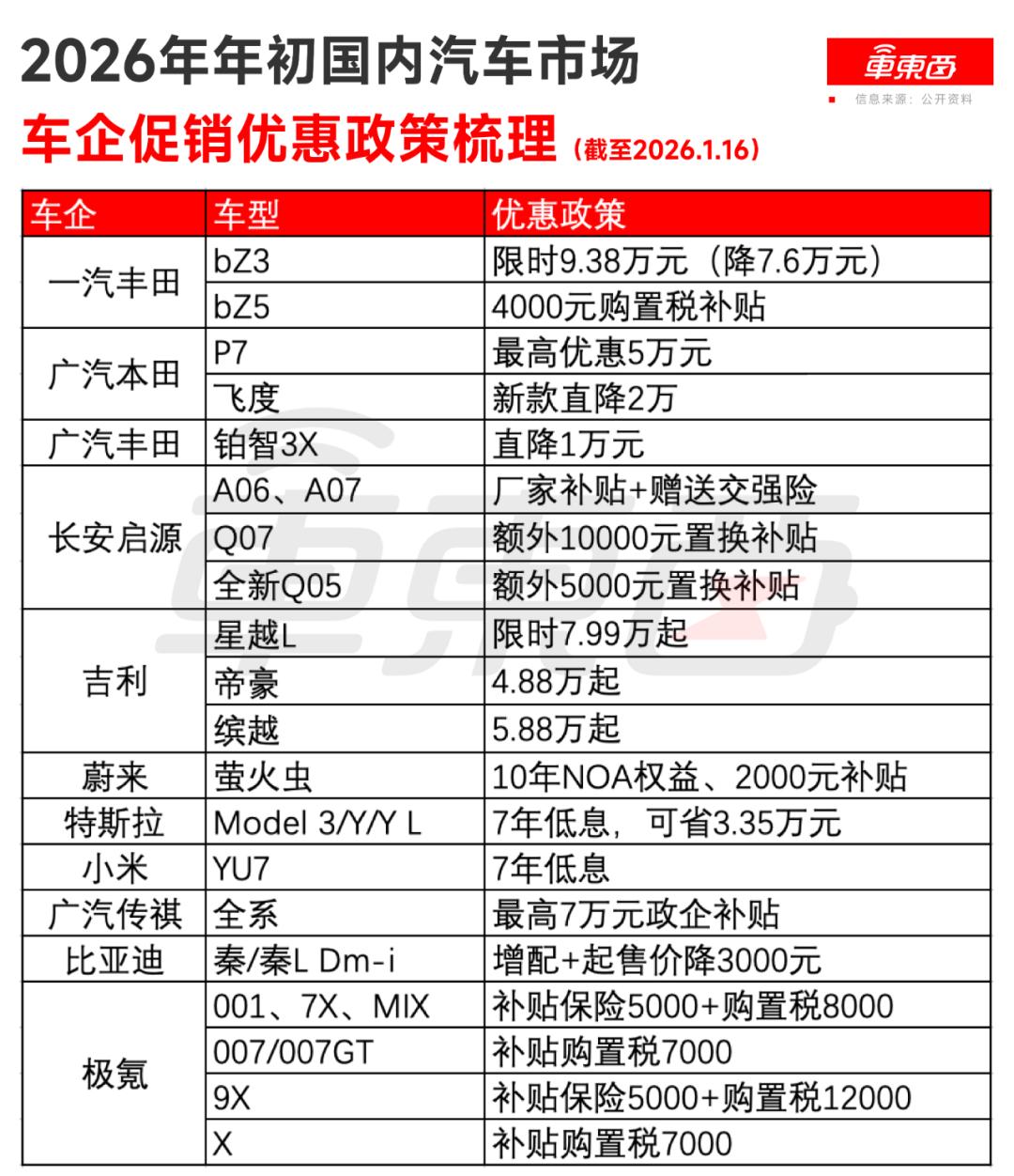
Core Viewpoint - The automotive industry is experiencing an intense price war initiated by luxury brands, leading to significant price reductions across various models from multiple manufacturers, creating a new wave of discounts in the market [1][6]. Group 1: Price Reductions and Promotions - BMW has initiated a price drop of up to 300,000 yuan, prompting over 10 automakers to follow suit with more than 20 mainstream models participating in the price reduction trend [1]. - Geely's Emgrand is now priced at 48,800 yuan, while the new Honda Fit has seen a price cut of 20,000 yuan, setting a new low at 66,800 yuan [1][13]. - Toyota's bZ3 electric sedan has been drastically reduced to 93,800 yuan, a decrease of 76,000 yuan, representing a nearly 45% drop from its previous price [9]. Group 2: Competitive Strategies - The competition has escalated with joint efforts from joint venture brands, particularly Japanese automakers, who are adopting aggressive pricing strategies to reclaim market share [7]. - Various automakers are employing a combination of subsidies, enhanced features, and financing options to attract buyers, rather than relying solely on price cuts [20][30]. - NIO's Firefly brand is offering cash subsidies along with a 10-year NOA (Navigation on Autopilot) free usage right, showcasing a strategic approach to enhance customer value [32]. Group 3: Market Dynamics and Consumer Impact - The price war has led to a significant reduction in the entry price for electric vehicles, making them more accessible to consumers [9][19]. - The automotive market is witnessing a shift where companies are not just competing on price but also on the value offered through financing and additional features, which may lead to a more sustainable competitive environment [37]. - The ongoing promotions and price adjustments are expected to drive sales ahead of the Chinese New Year, indicating a strategic push by manufacturers to maximize order volumes during this peak season [37].




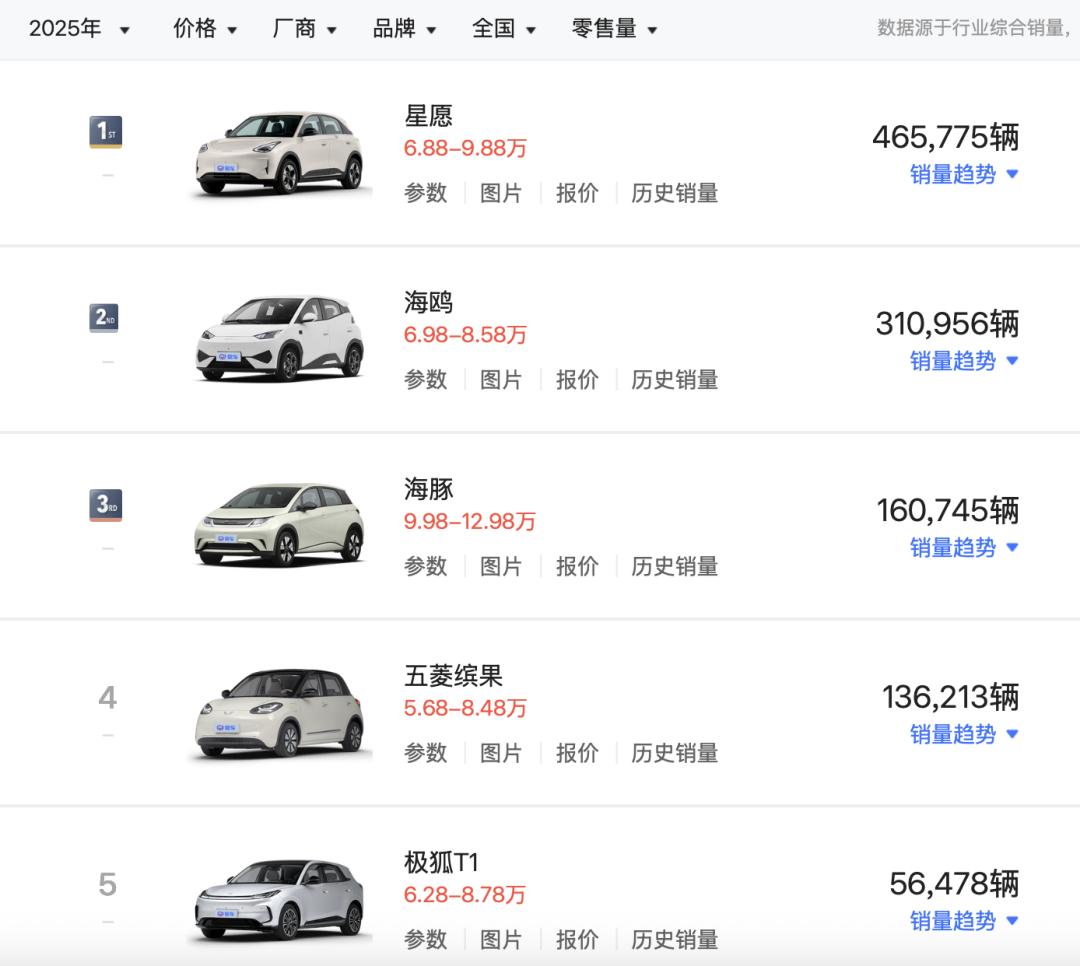
小型车市场火热,星愿年销46.58万辆霸榜
3 6 Ke· 2026-01-16 11:20
Group 1 - GAC Honda has officially launched the new model of the Fit at a price of 66,800 yuan, with a limited production of 3,000 units. The new model features upgrades in color, headlights, bumpers, and an addition of a smart screen in the interior [1][9] - The Fit was once regarded as a "legendary car" in the fuel vehicle era, achieving annual sales of over 100,000 units from 2015 to 2019 due to its competitive pricing and fuel efficiency. However, its sales have declined significantly in recent years due to the rise of electric vehicles [1][2] - In the A0 segment, the market has seen a shift towards electric vehicles, with brands like BYD and Geely capturing significant market share. By 2025, the top-selling small cars will be electric models, with the Fit and Polo projected to sell only 2,695 and 1,069 units, respectively [1][3][5] Group 2 - The A0 sedan market is experiencing significant growth, with wholesale numbers reaching 1.6564 million units in 2025, a year-on-year increase of 57%. Retail sales also saw a 59% increase, totaling 1.13 million units [2][3] - The trend towards full electrification in the A0 sedan market is evident, with a lack of strong fuel vehicle products, highlighting the advantages of pure electric offerings from domestic brands [3][8] - The competitive landscape in the small car market is intensifying, with new electric models being introduced frequently. The price sensitivity of A0 users is leading to fierce competition among manufacturers [5][10]
2025中国企业ESG“金责奖”评选结果揭晓 共筑可持续发展新生态
新浪财经· 2026-01-16 10:15
Core Viewpoint - By 2025, China's ESG development has transitioned from "setting standards" to "strengthening regulations," with ESG performance becoming a compliance requirement and a crucial link between commercial and social value [2] Group 1: ESG Awards Overview - The 2025 China Enterprise ESG "Golden Responsibility Award" was launched by Sina Finance to recognize companies and institutions that have made outstanding contributions to ESG [2] - The awards include ten categories: Best Environmental Responsibility Award, Best Social Responsibility Award, Best Corporate Governance Responsibility Award, Best Responsibility Initiative Award, Annual Sustainable Development Award, Best Responsible Investment Bank Award, Best Responsible Investment Securities Company Award, Best Responsible Investment Insurance Company Award, Best Responsible Investment Fund Company Award, and Best Responsible Investment Asset Management Institution Award [2] Group 2: Award Winners - Best Environmental Responsibility Award winners include: Sungrow Power Supply, Industrial Fulian, Kweichow Moutai, Geely Automobile, Haier Smart Home, Hisense Visual, Linyang Electronics, Tongwei Co., Weichai Power, and Luxshare Precision [11] - Best Social Responsibility Award winners include: China Shenhua, China General Nuclear Power, China Resources Sanjiu, Sinopec, Shougang Group, Wuliangye, Yangtze Power, China Telecom, China Oilfield Services, and LONGi Green Energy [12] - Best Corporate Governance Responsibility Award winners include: Zijin Mining, SF Holding, ZTE Corporation, Industrial Fulian, JA Solar, SANY Heavy Industry, Nanjing Steel, Bright Dairy, TCL Zhonghuan, and Fuyao Glass [14] - Best Responsibility Initiative Award winners include: FiberHome Technologies, Wens Foodstuff, Haitian Flavoring, Aier Eye Hospital, Yunnan Baiyao, Anke Innovation, and Kingfa Sci. & Tech. [15] - Annual Sustainable Development Award winners include: China General Nuclear Power, Sungrow Power Supply, Kweichow Moutai, Contemporary Amperex Technology, Zijin Mining, Hikvision, Yili Group, Baosteel, Zhejiang Chint Electrics, and China Mobile [15] - Best Responsible Investment Bank Award winners include: Agricultural Bank of China, Industrial and Commercial Bank of China, China Construction Bank, China Merchants Bank, Industrial Bank, and Bank of China [16] - Best Responsible Investment Securities Company Award winners include: Huatai Securities, CICC, Dongfang Securities, CITIC Securities, Guotai Junan, and Haitong Securities [17] - Best Responsible Investment Insurance Company Award winners include: China Life Insurance, Ping An Insurance, China Pacific Insurance, China Re, Sunshine Insurance, and China Life [18] - Best Responsible Investment Fund Company Award winners include: Bosera Funds, Southern Funds, Huaxia Funds, Penghua Funds, Huitianfu Funds, and E Fund [19] - Best Responsible Investment Asset Management Institution Award winners include: China Life Asset Management, Huaxia Wealth, Xingyin Wealth, Taikang Asset, Taiping Asset, and Galaxy Investment [20] Group 3: Outstanding Awards - Outstanding Environmental Responsibility Award winners include: Great Wall Motors, Hikvision, Goldwind, Trina Solar, Midea Group, Tianqi Lithium, Luzhou Laojiao, CIMC, Sinopec, and China Resources Sanjiu [32] - Outstanding Social Responsibility Award winners include: FiberHome Technologies, ZTE Corporation, Contemporary Amperex Technology, Yili Group, Lijun Group, CNOOC Development, State Grid Nanjing, China Railway, Weichai Power, and China National Petroleum [33] - Outstanding Corporate Governance Responsibility Award winners include: Sinopec, China Resources Sanjiu, Hikvision, WuXi AppTec, China Railway Construction, BOE Technology, West Mining, Tongwei Co., Huaxi Bio, and Goldwind [34] - Outstanding Responsibility Initiative Award winners include: ZTE Corporation, Sungrow Power Supply, Hisense Visual, China Merchants Port, Industrial and Commercial Bank of China, Zijin Mining, Shanghai Petrochemical, Lead Intelligent, Inspur Information, and Wuliangye [35] - Outstanding Sustainable Development Award winners include: Wanhu Chemical, Bank of China, Sinopec, ZTE Corporation, Muyuan Foods, Industrial and Commercial Bank of China, Agricultural Bank of China, Weichai Power, Golden Dragon Fish, and JD Logistics [36] - Outstanding Responsible Investment Bank Award winners include: CITIC Bank, Minsheng Bank, Bank of Communications, Pudong Development Bank, Ping An Bank, and Postal Savings Bank [37] - Outstanding Responsible Investment Securities Company Award winners include: Shenwan Hongyuan, Cinda Securities, Galaxy Securities, China Merchants Securities, GF Securities, and Tianfeng Securities [38] - Outstanding Responsible Investment Insurance Company Award winners include: New China Life, AIA, Taikang Insurance, China Pacific Insurance, Industrial and Commercial Bank of China, and China Life Insurance [39] - Outstanding Responsible Investment Fund Company Award winners include: Xingquan Fund, Invesco Great Wall Fund, Chuangjin Hexin Fund, China Merchants Fund, Yinhua Fund, and Industrial Fund [40] - Outstanding Responsible Investment Asset Management Institution Award winners include: Ping An Asset Management, Sunshine Asset, Great Wall Wealth Insurance Asset Management, Agricultural Bank of China Wealth Management, China Life Asset Management, and Jianxin Wealth [41] Group 4: Future Outlook - The committee encourages more Chinese enterprises to integrate ESG concepts into every aspect of production, operation, supply chain collaboration, and strategic planning, emphasizing the importance of sustainable development models that balance commercial and social value [42]





质量责任如何科学界定?困扰欣旺达等企业的电池安全归因话题受关注
Zhong Guo Jin Rong Xin Xi Wang· 2026-01-16 09:27
Core Viewpoint - A lawsuit involving the quality of battery cells supplied by Xinwanda Power to Geely's subsidiary, Weirui Electric, has raised concerns about the long-standing issue of defining quality responsibility within the electric vehicle supply chain [1][2]. Group 1: Lawsuit Details - Xinwanda announced that it is being sued for 2.314 billion yuan due to alleged quality issues with battery cells delivered between June 2021 and December 2023 [2]. - Weirui Electric, a subsidiary of Geely, is involved in the lawsuit and is a key player in the high-end electric vehicle market [2]. - The lawsuit highlights the complexity of battery safety, which cannot be solely attributed to the battery cells, as it involves multiple components and systems [3]. Group 2: Quality Responsibility - The safety of power batteries is recognized as a complex system that includes battery pack design, battery management systems, and vehicle integration [3]. - Xinwanda asserts that similar battery cells supplied to other clients have not experienced quality issues, suggesting that the problem may not lie solely with the battery cells [3]. - The industry is urged to avoid one-sided blame and to analyze the complexities of automotive batteries to foster healthy development [3]. Group 3: Supply Chain and Responsibility - The recall of Volvo's EX30 vehicles, which reportedly used battery cells from Xinwanda, has further complicated the situation, with Xinwanda clarifying that it is not directly involved in the battery system sold to Volvo [4]. - The incidents are seen as critical examples for examining quality, responsibility, and risk within the electric vehicle supply chain, impacting corporate survival and industry ecology [4]. - There is a call for establishing a fair responsibility-sharing mechanism within the supply chain to enhance resilience and competitiveness in the global market [4][5].

吉利汽车(00175) - 翌日披露报表
2026-01-16 08:28
FF305 翌日披露報表 (股份發行人 ── 已發行股份或庫存股份變動、股份購回及/或在場内出售庫存股份) 表格類別: 股票 狀態: 新提交 公司名稱: 吉利汽車控股有限公司 呈交日期: 2026年1月16日 如上市發行人的已發行股份或庫存股份出現變動而須根據《香港聯合交易所有限公司(「香港聯交所」)證券上市規則》(「《主板上市規則》」)第13.25A條 / 《香港聯合交易所有限公司GEM證券 上市規則》(「《GEM上市規則》」)第17.27A條作出披露,必須填妥第一章節 。 | 第一章節 | | | | | | | | | --- | --- | --- | --- | --- | --- | --- | --- | | 1. 股份分類 | 普通股 | 股份類別 | 不適用 | | 於香港聯交所上市 | 是 | | | 證券代號 (如上市) | 00175 | 說明 | | | | | | | 多櫃檯證券代號 | 80175 | RMB 說明 | | | | | | | A. 已發行股份或庫存股份變動 | | | | | | | | | | | | 已發行股份(不包括庫存股份)變動 | | 庫存股份變動 | ...
去年中国车市销量2093.6万辆创新高,TOP5车企拿下半个市场
21世纪经济报道· 2026-01-16 08:24
Core Viewpoint - In 2025, China's automotive market is expected to achieve structural growth, with production and sales reaching 34.53 million and 34.40 million units respectively, marking a year-on-year increase of 10.4% and 9.4%, maintaining its position as the world's largest market for 17 consecutive years [1][2]. Group 1: Market Performance - The significant growth in the automotive sector is driven by the rise of new energy vehicles (NEVs), with domestic sales projected to reach 13.88 million units in 2025, a year-on-year increase of 19.8%, resulting in a penetration rate of 54% for new energy passenger cars [1][2]. - Chinese brands are a core engine of growth, with sales of domestic passenger cars expected to reach 20.94 million units, a 16.5% increase, raising market share to 69.5%, the highest since 2018 [1][2]. Group 2: Market Dynamics - The automotive industry has shifted away from aggressive price wars, with only 156 new models seeing price reductions in the first ten months of 2025, indicating a more rational market order [2]. - Growth is primarily fueled by government policies such as "trade-in" programs that effectively stimulate demand for vehicle upgrades [2]. Group 3: Profitability and Competition - Despite the expansion in sales, the automotive industry's profitability remains under pressure, with revenues exceeding 10 trillion yuan and profits reaching 440.3 billion yuan, a 7.5% increase, but with a profit margin of 4.4%, below the average of 6% for downstream industrial enterprises [2]. - The competition landscape is increasingly concentrated, with the top three companies—BYD, SAIC, and Geely—accounting for 36.6% of the market share, while the top 15 companies collectively hold 92.3% of total sales [10][12]. Group 4: New Energy Vehicle Trends - In 2025, the sales of new energy passenger vehicles are projected to reach 13.01 million units, a 17.7% increase, while traditional fuel vehicles are expected to decline to 11.06 million units, a decrease of 4.3% [4][6]. - The mainstream market for new energy vehicles is concentrated in the price range of 100,000 to 200,000 yuan, with sales in this segment expected to reach 6.94 million units, a 24% increase, representing half of the total new energy vehicle sales [4][6]. Group 5: Brand Strategies - BYD continues to dominate the 100,000 to 200,000 yuan market segment, with significant sales from its Dynasty and Ocean series, while Geely's Galaxy brand has seen a 150% increase in sales, enhancing its market penetration [6][13]. - New entrants like Leap Motor and Xpeng are also making significant strides, with Leap Motor achieving a 104.7% year-on-year growth, focusing on cost control and technology [14][19]. Group 6: Future Outlook - For 2026, the automotive market is expected to see a modest growth of 1%, with total sales projected at 34.75 million units, while new energy vehicles are anticipated to grow by 15.2% to 1.9 million units [16][17]. - The competitive landscape is expected to intensify, with traditional automakers setting ambitious sales targets, while new entrants aim for aggressive growth, indicating a fierce battle for market share [19].
特朗普底特律喊话:欢迎中国车企来美建厂
Di Yi Cai Jing· 2026-01-16 07:52
Group 1 - The core topic of discussion at the Detroit Auto Show was the potential entry of Chinese automakers into the U.S. market, with companies like Geely and Great Wall Motors showcasing their electric vehicles [1] - President Trump expressed a welcoming attitude towards Chinese manufacturers entering the U.S. market, provided they build factories and create jobs locally [1] - Despite the welcoming remarks, Trump reiterated the continuation of high tariffs on imported vehicles to ensure that cars sold in the U.S. are produced domestically [1] Group 2 - The U.S. currently imposes a 25% tariff on imported vehicles, effective from April 3, 2025, which applies to all countries, including China [2] - Starting in 2024, tariffs on Chinese electric vehicles will increase from 25% to 100%, aimed at forcing the automotive supply chain back to the U.S. [2] - In 2025, the value of U.S. imports of passenger cars from China is expected to drop significantly, with a reported 52% year-on-year decline in the first ten months, totaling approximately $1.31 billion [2] - Analysts suggest that Trump's recent comments may indicate new opportunities for Chinese automakers in the U.S. market, with the entry of these companies seen as a matter of time [2] - Geely is considering expanding into the U.S. market and may announce plans within the next 2-3 years, with potential brands for introduction including Zeekr and Lynk & Co [2] - Geely is also exploring the possibility of utilizing its subsidiary Volvo's factory in South Carolina for production, which has an annual capacity of 150,000 vehicles [2]
比亚迪登陆美国之日
日经中文网· 2026-01-16 03:05
(资料图) 在1月14日在美国底特律开幕的车展上,纯电动汽车消失,很多美国企业让非电动汽车成为主角,但在 车展上热门话题不是特朗普,而是"中国厂商何时登陆美国"。考虑进入美国市场的中国车企正在摸索三 种方式…… 在1月14日在美国中西部密歇根州底特律开幕的车展上。美国总统特朗普也在车展前亲临现场,强调其 成果称,"我前所未有地一直支持美国的汽车工人"。 总部设在底特律的通用汽车(GM)等"底特律概念股"并没有欢迎的氛围。截至上周,宣布由于特朗普 政策的影响,纯电动汽车 (EV) 的损失扩大,这一消息产生明显影响,从特朗普访问前至15日的股价来 看,通用汽车下跌3%,福特汽车下跌4%,斯特兰蒂斯下跌11%。 在车展的会场,热门话题不是特朗普,而是"中国厂商何时登陆美国"。 契机是车展前一周在美国拉斯维加斯举行的科技博览会"CES"上发生的事情。 生产自动驾驶传感器的中国速腾聚创(RoboSense)北美市场总裁赵培培表示,考虑进入美国市场的中 国车企正在摸索三种方式,一是提高质量,赢得美国客户的青睐,二是利用与美国企业的合作,三是作 为与中国完全分离的企业进入。 尽管进入美国市场的时间无法确定,但"实惠的价格" ...

2026年销量目标现分化: 传统车企稳健推进 新势力冲刺高增长
Zhong Guo Zheng Quan Bao· 2026-01-15 21:12
Core Insights - The automotive market in 2026 is characterized by significant differentiation in sales targets among major car manufacturers, with a total target exceeding 21.55 million units, approximately 63% of the 2025 domestic sales volume [1] - Traditional automakers are focusing on stable growth rates of 10% to 30%, while new entrants and cross-industry brands are setting aggressive targets of 34% to 67.5%, indicating a strong push for market share [1] Summary by Company - **Geely**: Set a sales target of 3.45 million units for 2026, a 14% increase from 2025, with a focus on 2.22 million units of new energy vehicles (NEVs), achieving a penetration rate of 64.3% [1] - **Chery**: Aims for 3.2 million units, a 14.03% increase from 2025's 2.81 million units, with plans to launch 17 key models [2] - **Dongfeng Group**: Targets 3.25 million units, a 30% increase from 2025, with 1.7 million NEVs and 600,000 units for export [2] - **Great Wall Motors**: Sets a more conservative target of 1.8 million units, a 36% increase from 2025's 1.32 million units [2] - **Leap Motor**: Aims for 1 million units, a 67.5% increase from 2025's 596,600 units, leveraging core technology and a competitive parts system [2] - **Xiaomi**: Targets 550,000 units, a 34% increase from 2025's 410,000 units, emphasizing a stable expansion strategy [3] - **NIO**: Plans for a sales range of 456,000 to 489,000 units, maintaining a growth rate of 40% to 50% [3] - **GAC Toyota**: Sets a conservative target of 800,000 units, a 3.6% increase from 2025 [3] - **SAIC Volkswagen**: Aims for 1 million units, maintaining 2025 levels, with plans for 7 new NEV models [3] Market Dynamics - The automotive industry is shifting from incremental expansion to competition within existing market shares, with varying growth rates reflecting companies' strategies and market conditions [4] - Traditional automakers are generally targeting growth rates between 13% and 30%, with NEV sales growth rates significantly higher, indicating a consensus on NEVs as the main growth driver [4] - New energy vehicle sales targets are notably higher than overall sales targets, with Geely and Changan targeting 32% and 26.2% growth rates respectively [4] Strategic Considerations - The high growth targets set by new entrants are driven by the need for scale to improve cash flow and profitability, but achieving these targets will require strong organizational capabilities [5] - Key factors influencing the achievement of sales targets include the rollout of new energy products, success in overseas markets, and the overall capability of the companies [6] - The industry is expected to see a 4.3% growth in exports, with companies like BYD targeting 1.5 to 1.6 million units for overseas sales [6]