GEELY AUTO(00175)

Search documents
吉利汽车1月12日斥资1.51亿港元回购900.7万股
Zhi Tong Cai Jing· 2026-01-12 08:40
吉利汽车(00175)发布公告,于2026年1月12日,该公司斥资1.51亿港元回购900.7万股股份,每股回购价 格为16.63-17.15港元;于2026年1月12日因集团雇员根据认股权计划(于2023年4月28日获采纳)行使认股权 而发行3万股普通股股份。 ...
吉利汽车(00175.HK)1月12日耗资1.51亿港元回购900.7万股
Ge Long Hui· 2026-01-12 08:40
格隆汇1月12日丨吉利汽车(00175.HK)发布公告,2026年1月12日耗资1.51亿港元回购900.7万股,回购价 格每股16.63-17.15港元。 ...
吉利汽车(00175)1月12日斥资1.51亿港元回购900.7万股
智通财经网· 2026-01-12 08:35
智通财经APP讯,吉利汽车(00175)发布公告,于2026年1月12日,该公司斥资1.51亿港元回购900.7万股 股份,每股回购价格为16.63-17.15港元;于2026年1月12日因集团雇员根据认股权计划(于2023年4月28日 获采纳)行使认股权而发行3万股普通股股份。 ...
吉利汽车(00175) - 翌日披露报表
2026-01-12 08:31
FF305 翌日披露報表 (股份發行人 ── 已發行股份或庫存股份變動、股份購回及/或在場内出售庫存股份) 表格類別: 股票 狀態: 新提交 公司名稱: 吉利汽車控股有限公司 呈交日期: 2026年1月12日 如上市發行人的已發行股份或庫存股份出現變動而須根據《香港聯合交易所有限公司(「香港聯交所」)證券上市規則》(「《主板上市規則》」)第13.25A條 / 《香港聯合交易所有限公司GEM證券 上市規則》(「《GEM上市規則》」)第17.27A條作出披露,必須填妥第一章節 。 | 第一章節 | | | | | | | | | | --- | --- | --- | --- | --- | --- | --- | --- | --- | | 1. 股份分類 | 普通股 | | 股份類別 不適用 | | 於香港聯交所上市 | 是 | | | | 證券代號 (如上市) | 00175 | | 說明 | | | | | | | 多櫃檯證券代號 | 80175 | RMB 說明 | | | | | | | | A. 已發行股份或庫存股份變動 | | | | | | | | | | | | | 已發行股份(不包括庫存股份 ...
2025车企生存法则:对内做整合,在外找盟友
3 6 Ke· 2026-01-12 05:55
Core Insights - The Chinese automotive market is undergoing a significant consolidation wave in 2025, with major players like Geely and Changan actively restructuring to enhance efficiency and competitiveness [1][2][3] - New energy vehicles (NEVs) have reached a milestone, with sales hitting 1.715 million units in October 2025, achieving a penetration rate of 51.6%, indicating a deep market shift from traditional fuel vehicles [1] - The competition among automakers has evolved from price wars to a comprehensive battle over technology, configuration, and service, highlighting a growing disparity among companies [1][4] Internal Integration - Geely has initiated a series of internal integrations, including the merger of its Geometry brand into the Galaxy series and the strategic consolidation of Zeekr and Lynk & Co under the Zeekr Technology Group [2] - Changan and Dongfeng have also made strategic adjustments, with Changan's chairman emphasizing the need for restructuring to enhance competitiveness [3] - NIO and Li Auto have undertaken organizational changes to streamline operations and improve efficiency, aligning with their profitability goals for 2025 [4] External Collaborations - Huawei has emerged as a key player in the automotive ecosystem, expanding its partnerships with automakers like GAC and Dongfeng to create new brands and models [5][6] - The collaboration models with Huawei include standardized parts sales, full-stack smart vehicle solutions, and deep involvement in product design and sales networks [5][7] - As of now, Huawei has partnered with over 20 automotive brands, indicating its significant influence in the industry [8] Market Trends - The overall retail sales of narrow passenger vehicles in December 2025 were approximately 2.262 million units, reflecting a 14% year-on-year decline, attributed to policy changes and consumer sentiment [9] - For the entire year of 2025, cumulative retail sales reached about 23.744 million units, a 3.8% increase from the previous year, signaling a shift towards a more rational and high-quality development phase in the market [10] - The automotive industry's profit margin was around 4.4% in the first eleven months of 2025, indicating competitive pressures and the need for cost reduction strategies among automakers [10][11] Industry Consensus - The automotive industry is increasingly focused on cost reduction and efficiency improvements, with companies consolidating brands and integrating operations to enhance profitability [11] - The rise of core suppliers like CATL and Huawei has shifted the dynamics of the supply chain, prompting automakers to seek deeper collaborations rather than traditional procurement relationships [11][12] - Future competition will hinge not only on brand and product differentiation but also on the ability to collaborate within the ecosystem [12]

2026,卖车更难了
创业邦· 2026-01-12 03:27
Core Viewpoint - The automotive market in 2025 is characterized by intense competition, price wars, and a shift in consumer behavior towards value-driven purchases, leading to significant challenges for manufacturers [5][39]. Group 1: Market Dynamics - BYD, Geely, and Tesla dominated the sales rankings, with BYD maintaining a significant lead in the new energy vehicle sector, selling 4.545 million vehicles in 2025 [7][12]. - The overall sales of new energy vehicles in China reached 14.78 million units, a year-on-year increase of 31.2%, but BYD's growth rate was only 11% [11][12]. - Consumers are increasingly price-sensitive, often comparing prices across cities, which has benefited brands that offer high value for lower prices [7][10]. Group 2: Competitive Landscape - Geely has adopted aggressive pricing strategies, successfully positioning its models against BYD's offerings, resulting in a total of 1.687 million new energy vehicles sold in 2025 [13][14]. - New entrants like Leap Motor have carved out a niche in the budget segment, achieving sales of 596,600 units, and have become profitable, contrasting with many competitors still struggling [16][17]. - Xiaomi's foray into the automotive market has been successful, with its vehicles achieving significant sales and profitability, highlighting the potential for tech companies to disrupt traditional automotive players [21][22]. Group 3: Challenges and Future Outlook - The automotive industry is facing a bottleneck, with many companies struggling to innovate and maintain profitability amid ongoing price wars [39][40]. - The market is expected to become more challenging in 2026, with changes in tax policies and increased competition from established players like Xiaomi and Tesla [45][46]. - Companies are focusing on cost control and operational efficiency as key strategies to survive in a tightening market [41][39].







汽车股继续走低,元旦以来超20家车企降价促销
Ge Long Hui· 2026-01-12 02:25
Group 1 - The core viewpoint of the article highlights the ongoing weakness in Hong Kong's automotive stocks, with significant declines observed in companies such as Geely Auto and Li Auto, among others [1] - As of January 12, 2026, over 20 automotive companies have launched promotional activities for more than 75 models, employing various strategies such as cash subsidies and interest-free financing [1] - The Secretary-General of the National Passenger Car Market Information Association, Cui Dongshu, suggests that the current price reductions by car manufacturers are a rational return to pricing rather than a price war, although the trend of price cuts is expected to continue into 2026 [1] Group 2 - Analysts predict that the promotional activities may stimulate sales, potentially leading to a strong start for the automotive market in January 2026, but these promotions are likely to compress profit margins for companies and create significant operational pressure for dealers [1] - It is widely anticipated that the number of automotive companies will decrease by 2026, with market concentration (CR5) expected to rise from 65% to 80%, indicating that brands lacking core competitiveness may face elimination or consolidation [1]

2026年第5期:晨会纪要-20260112
Guohai Securities· 2026-01-12 02:23
Group 1: Geely Automobile - Geely Automobile achieved a total sales volume of 3.025 million vehicles in 2025, a year-on-year increase of 39%, exceeding its annual target [3] - The sales target for 2026 is set at 3.45 million vehicles, with brand-specific targets of 2.75 million for Geely (including Galaxy), 300,000 for Zeekr, and 400,000 for Lynk & Co [3] - The Galaxy brand significantly contributed to growth, with December 2025 sales exceeding 100,000 units, a 45% year-on-year increase, and total annual wholesale of 1.236 million units, up 149.9% [3][4] - Geely's export volume remained stable at 420,000 vehicles in 2025, with entry into 13 new markets and local production advancements in Egypt and Indonesia [5] Group 2: OSL Group - OSL Group completed the strategic acquisition of Banxa Holdings, enhancing its compliance and global payment capabilities [7] - Banxa serves as a bridge between traditional finance and digital assets, focusing on B2B payment solutions and compliance systems [8] - The acquisition is expected to significantly increase OSL's payment business revenue, with Banxa's revenue for the first half of 2025 projected at 53.93 million HKD [9] Group 3: Royal Technology - Royal Technology announced an employee stock ownership plan (ESOP) involving 48 core employees, representing 6.41% of the workforce, aimed at enhancing employee engagement and retention [13][15] - The ESOP includes performance targets for 2026, requiring a minimum of 12% growth in sales or net profit compared to 2025 [14][16] - The company is a leading producer of specialty surfactants, with a focus on customized products to meet diverse customer needs [17][18] Group 4: Huijia Times - Huijia Times reported a revenue of 1.868 billion CNY in the first three quarters of 2025, a 1.2% year-on-year increase, with a net profit of 80 million CNY, up 60.1% [20] - The company is implementing a self-reform strategy inspired by the "Pang Donglai" model, which has significantly boosted sales [21] - The company is also exploring low-altitude economy opportunities, integrating technology, logistics, and tourism for long-term growth [21] Group 5: Industry Trends - The photovoltaic industry is experiencing price increases, with polysilicon prices rising by approximately 10% week-on-week [33] - The wind power sector is seeing a surge in project approvals, with significant increases in both offshore and onshore wind projects expected in 2026 [34][35] - The energy storage market is expanding, with nearly 60 GWh of storage systems and equipment contracts awarded in December 2025 [36]


1月9日港股回购一览
Zheng Quan Shi Bao Wang· 2026-01-12 01:53
Group 1 - On January 9, 41 Hong Kong-listed companies conducted share buybacks, totaling 21.7961 million shares and an amount of HKD 923 million [1] - Tencent Holdings repurchased 1.039 million shares for HKD 636 million, with a year-to-date total of HKD 38.14 billion [1] - Xiaomi Group-W repurchased 4 million shares for HKD 151 million, with a year-to-date total of HKD 7.90 billion [1] Group 2 - The highest buyback amount on January 9 was from Tencent Holdings at HKD 636 million, followed by Xiaomi Group-W at HKD 151 million [1] - In terms of share quantity, Xiaomi Group-W had the highest buyback with 4 million shares, followed by Baoshan International and Jieli Trading with 3.85 million and 2 million shares respectively [1] - Other notable companies in the buyback list include Sunny Optical Technology and Geely Automobile, with significant buyback amounts and quantities [1] Group 3 - The buyback data includes various companies with their respective buyback shares, amounts, highest and lowest prices, and year-to-date totals [2] - Companies like Geely Automobile and Juzhi Biotechnology also participated in the buyback activity, contributing to the overall market trend [2] - The buyback activity reflects a strategic move by these companies to enhance shareholder value amidst market conditions [1][2]


【读财报】港股12月回购透视:合计回购超219亿港元 吉利汽车等年内首度回购
Xin Hua Cai Jing· 2026-01-11 23:31
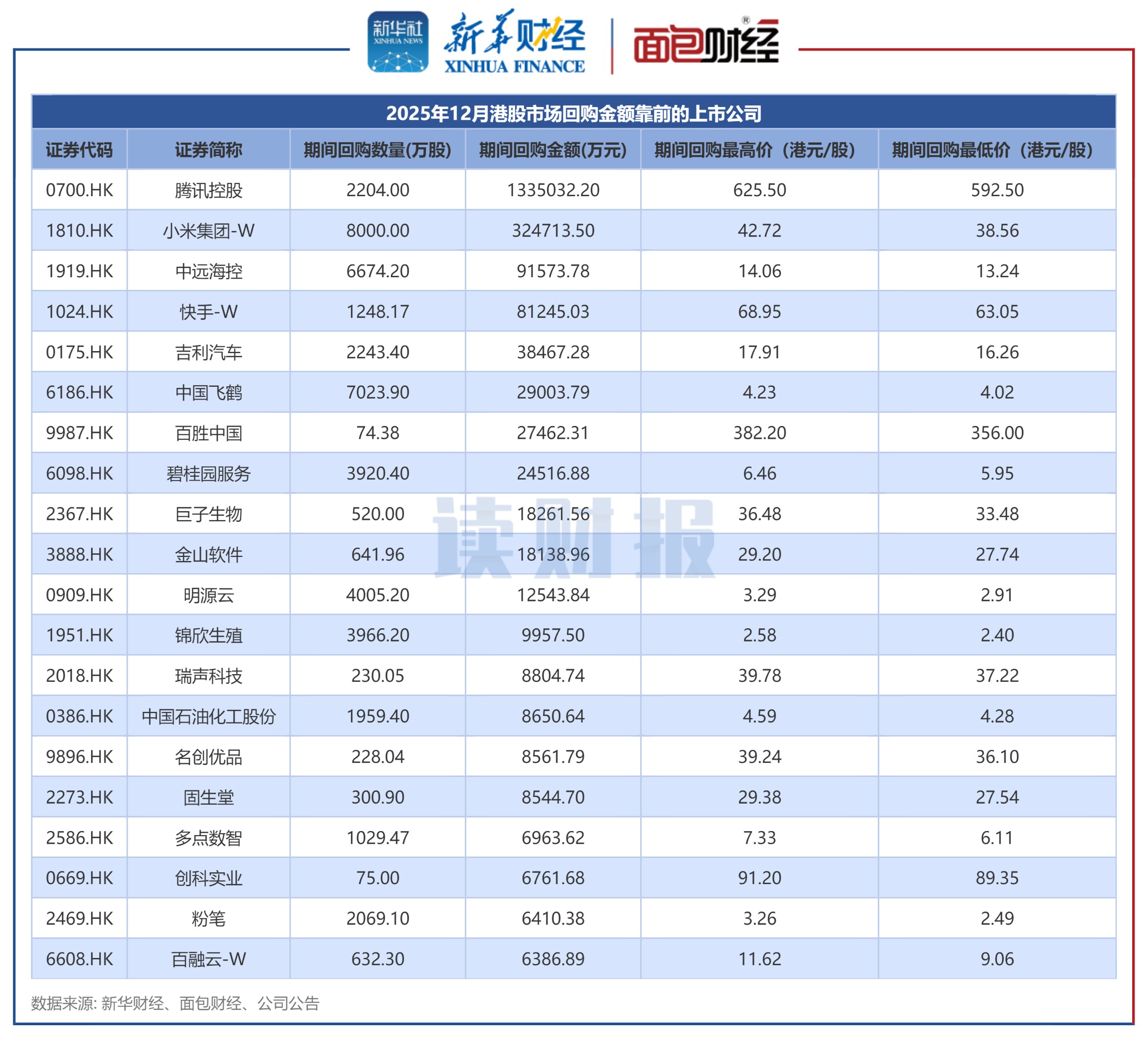
Summary of Key Points Core Viewpoint - In December 2025, a total of 122 Hong Kong-listed companies initiated share buybacks, repurchasing 786 million shares for a total amount of 21.93 billion HKD, representing a 2.63% decrease from 22.52 billion HKD in the same period last year [1][2]. Company-Specific Insights - Tencent Holdings, Xiaomi Group, and China COSCO Shipping were among the top companies in terms of buyback amounts in December [2]. - Xiaomi Group repurchased shares worth 3.25 billion HKD, acquiring 80 million shares at prices ranging from 38.56 HKD to 42.72 HKD per share, and has repurchased a total of 6.28 billion HKD in 2025 [5]. - Geely Automobile conducted its first buyback of the year in December, repurchasing shares worth 385 million HKD, totaling 22.43 million shares at prices between 16.26 HKD and 17.91 HKD [6]. Industry Insights - The majority of buybacks in December 2025 were concentrated in the software services and other healthcare sectors [7]. - The software services industry led in both buyback amounts and the number of companies participating, with a total buyback amount of 138.81 billion HKD from 19 companies, including companies like Multi-Point Intelligence and BaiRong Cloud [8]. - The other healthcare sector had 16 companies participating in buybacks, with notable companies like Giant Bio conducting their first buyback of the year, amounting to 183 million HKD [11].