DONGFENG GROUP(00489)

Search documents
汽车股,被坑惨了
Ge Long Hui· 2025-06-11 02:23
Group 1 - The core issue in the Chinese automotive market is the ongoing "price war," which is causing significant harm to the industry and its supply chain, leading to a decline in overall profit margins [2][4] - The Ministry of Commerce and the Ministry of Industry and Information Technology, along with relevant industry associations, have expressed intentions to intervene in the excessive competition within the automotive sector [2][4] - Despite a generally positive stock market performance, automotive stocks have underperformed, with an average price decline of 0.19%, although the total market capitalization increased by approximately 115.4 billion to 8.96 trillion [6][4] Group 2 - The automotive sector is experiencing a significant downturn, with many traditional car manufacturers facing stagnant or declining sales, which is a contributing factor to the ongoing price war [14][12] - Specific companies have reported substantial stock price fluctuations, with notable declines such as Xiaoma Zhixing and Dongfeng Group, which saw drops of 27.67% and 20.92% respectively [9][12] - In contrast, companies like Youjia Innovation have seen stock price increases, attributed to strategic partnerships, such as becoming a key supplier for Changan Automobile [7][10]



新华财经早报:6月11日
Xin Hua Cai Jing· 2025-06-10 23:44
Group 1: Policy and Regulatory Developments - The Central Committee and State Council issued a document to promote the Shenzhen comprehensive reform pilot, supporting innovations in artificial intelligence-assisted medical devices and unmanned aerial vehicle flight management [1] - The State Administration for Market Regulation released a draft regulation to strengthen the supervision of live e-commerce, emphasizing the responsibility of live stream operators to avoid false or misleading commercial promotions [1] - The Ministry of Commerce announced a delay in the anti-dumping investigation of imported pork and pork products from the EU, extending the investigation period to December 16, 2025 [1] Group 2: Corporate Actions and Financial Developments - Several automotive companies, including China FAW, Dongfeng, and Geely, announced a unified payment term of 60 days for suppliers, reflecting a commitment to sustainable supply chain development [1] - Tencent Music plans to acquire Ximalaya for a total of $1.26 billion in cash and stock [1] - The National Taxation Administration reported a significant increase in tax refund applications for departing tourists, with a 116% year-on-year increase in the number of applications processed [1] Group 3: Economic Indicators and Market Trends - The World Bank downgraded its global economic growth forecast for 2025 from 2.7% to 2.3%, with nearly 70% of economies experiencing downward revisions [3] - The unemployment rate in the UK rose to 4.6%, the highest level in nearly four years, influenced by increased employer national insurance tax rates and minimum wage hikes [3] - The EIA maintained its forecast for Brent crude oil prices at $66 per barrel for 2025, while adjusting the 2026 forecast down to $59 per barrel [3]





凌晨,比亚迪重大宣布!
证券时报· 2025-06-10 23:07
6月11日凌晨1时28分,比亚迪汽车通过官方微信宣布,将供应商支付账期统一至60天内。 比亚迪表示,此举是为落实国家及相关部委就保障产业链供应链稳定、促进汽车产业高质量发展作出的一 系列部署要求,以及助力中小企业健康发展,以切实行动推动中国汽车产业高质量发展。"未来,比亚迪 汽车将继续通过技术创新与管理优化,携手上下游伙伴共同推动中国汽车产业行稳致远。" 同一天,广汽集团发布关于供应商账期的郑重承诺称:"供应链体系的健康发展是保障产品高安全、高品质的 基础。为此,广汽集团将一如既往,坚持以不超过60天的供应商账期,保障供应链资金高效周转,携手上下 游伙伴,共同促进行业高质量发展。" 6月10日晚上,多家车企先后对外发声表态。 东风汽车集团有限公司宣布,将支付账期统一至60天内, 此举旨在以切实行动推动上下游资金高效流转,助力产业链良好协同发展。 赛力斯亦发布相关倡议。 中国一汽也发文表示,要明确付款期限和支付方式,将"60天付款"作为所属单位付款期限要求,加强资金监 督和过程管理。此外,中国一汽还将优化流程,提升效率。加强采购、财务等部门内部协同,进一步精简审批 环节,确保付款流程畅通无阻。同时,中国一汽将通 ...


车圈大事件!多家车企宣布→
Zheng Quan Shi Bao· 2025-06-10 14:49
Core Viewpoint - Multiple automotive companies in China have committed to standardizing payment terms to within 60 days to enhance cash flow efficiency and support the healthy development of the supply chain [1][3][4]. Group 1: Company Commitments - Dongfeng Motor Group announced a unified payment term of 60 days to promote efficient cash flow and collaboration within the industry [1]. - GAC Group emphasized the importance of a healthy supply chain for high-quality products and committed to maintaining supplier payment terms within 60 days [3]. - China FAW Group stated it would enforce a 60-day payment term and improve internal processes to ensure timely payments, utilizing digital tools for real-time monitoring [4]. - Seres also issued a related initiative to support the 60-day payment commitment [6]. Group 2: Industry Context - The implementation of the "Regulations on Ensuring Payment to Small and Medium Enterprises" on June 1 mandates that payments for goods and services from small and medium enterprises should be made within 30 days, or up to 60 days as per contract [8]. - The automotive industry in China faces challenges with long payment cycles, often exceeding 120 days, compared to 60 to 90 days in mature markets like Europe and the US [8]. Group 3: Payment Cycle Data - BYD's average payment cycle to suppliers is 127 days, with accounts payable representing 31% of revenue [9]. - SAIC's average payment cycle is 164 days, while Geely and Great Wall Motors have cycles of 127 days and 163 days, respectively [9]. - Changan's payment cycle is 205 days, and Li Auto and NIO have cycles of 165 days and 195 days, respectively [9]. Group 4: Industry Aspirations - Guo Chuan, chairman of Zhejiang Konghui Automotive Technology, expressed a vision for timely payments within one month post-invoice, emphasizing mutual respect and collaboration in the industry [9]. - The automotive industry is called to improve its image and ecosystem to foster a promising future for companies and the sector as a whole [9]. Group 5: Market Position - Konghui Technology leads the domestic air suspension market with a 41.3% market share, having delivered 335,470 units in 2024 [10].
车圈大事件!多家车企宣布→
证券时报· 2025-06-10 14:44
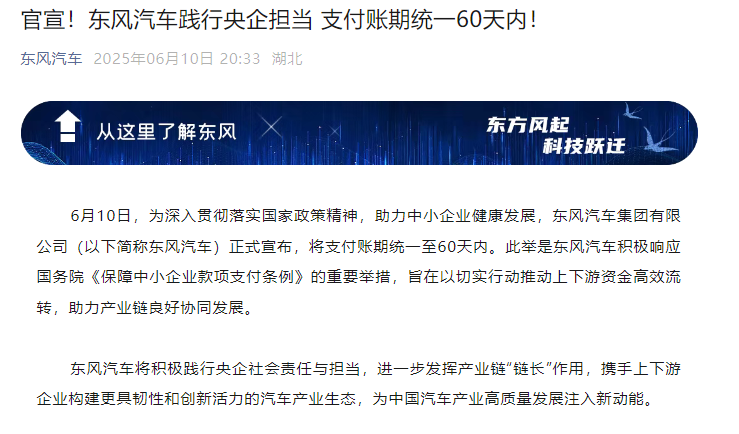
6月10日,东风汽车集团有限公司宣布,将支付账期统一至60天内,此举旨在以切实行动推动上下游资金高效流 转,助力产业链良好协同发展。 同一天,广汽集团发布关于供应商账期的郑重承诺称:"供应链体系的健康发展是保障产品高安全、高品质的基 础。为此,广汽集团将一如既往,坚持以不超过60天的供应商账期,保障供应链资金高效周转,携手上下游伙伴, 共同促进行业高质量发展。" 中国一汽也发文表示,要明确付款期限和支付方式,将"60天付款"作为所属单位付款期限要求,加强资金监督和过 程管理。此外,中国一汽还将优化流程,提升效率。加强采购、财务等部门内部协同,进一步精简审批环节,确保 付款流程畅通无阻。同时,中国一汽将通过技术赋能,精准管控。充分利用数字化云工作台,实现对合同执行、发 票匹配、付款申请等全流程节点的实时监控,确保每一笔应付款项按期支付。 多家车企公开承诺,将支付账期统一到60天以内。 据了解,6月1日《保障中小企业款项支付条例》正式实施,其中第九条提到:机关、事业单位从中小企业采购货 物、工程、服务,应当自货物、工程、服务交付之日起30日内支付款项;合同另有约定的,从其约定,但付款期限 最长不得超过60日。 赛 ...

【东风汽车:支付账期统一60天内】6月10日电,东风汽车集团有限公司宣布,将支付账期统一至60天内。

news flash· 2025-06-10 12:41
智通财经6月10日电,东风汽车集团有限公司宣布,将支付账期统一至60天内。 ...
解放狂签大单 福田/东风等属地化布局 上半年卡车出口有多活跃?| 头条
第一商用车网· 2025-06-10 06:24
Core Viewpoint - The domestic commercial vehicle market in China has entered a stage of stock competition, prompting companies to focus on overseas markets for growth opportunities. Major truck manufacturers are accelerating their international strategies, particularly with significant developments expected by 2025 [1][2]. Group 1: Company Strategies and Achievements - FAW Jiefang aims to achieve global sales of over 500,000 units by 2030, with 180,000 units from overseas markets, representing over one-third of total sales [2][4]. - In 2025, FAW Jiefang has made significant progress in overseas markets, including signing contracts for 500 units in Vietnam and 10,000 units in the Philippines [4][6]. - China National Heavy Duty Truck Group (CNHTC) has maintained its position as the top exporter of heavy trucks in China for 20 consecutive years, with a record export of 135,000 heavy trucks in 2024 [7][9]. - Foton Motor has launched a localized manufacturing project in Brazil, with an annual production capacity of 5,000 units, and reported a 180% year-on-year increase in sales in Brazil in Q1 2025 [12][13]. - Dongfeng Group plans to establish a company in Indonesia and aims to export 40,000 commercial vehicles by 2025, focusing on localized operations and market penetration [18][19]. Group 2: New Entrants and Market Expansion - New entrants like DeepWay, SuBao, Proton, and WeiDu are also prioritizing overseas market expansion, with significant investments and partnerships established in various regions [25][26]. - SuBao is investing 350 million yuan in an overseas manufacturing base, expected to be operational by the end of 2025, to provide localized solutions for Europe and the Middle East [26]. - WeiDu Technology secured a 36 million CAD order for long-range electric heavy trucks in Canada, marking its entry into a new international market [28]. - Proton Automotive has initiated its first exports of hydrogen fuel heavy trucks to Australia, expanding its footprint in the renewable energy vehicle sector [30]. - DeepWay has made strides in Southeast Asia, signing multiple dealer agreements and securing orders in Singapore, Thailand, and Malaysia [32][34]. Group 3: Market Trends and Future Outlook - The ongoing globalization trend presents both opportunities and challenges for Chinese truck manufacturers, emphasizing the importance of overseas market strategies for future growth [26][35]. - The competitive landscape is expected to evolve, with Chinese companies likely to feature prominently in the global truck manufacturing sector by 2030 [36].



长安东风重组变局:长安汽车升格独立央企 重组暂停
Xi Niu Cai Jing· 2025-06-09 08:20
Group 1 - Changan Automobile and Dongfeng Motor Group announced the latest developments in the restructuring of the central enterprise automotive sector, involving three major military central enterprises with total assets exceeding 1 trillion yuan [2] - The restructuring is a result of the separation of Changan's indirect controlling shareholder, China Weapon Equipment Group, which will now have its automotive business as an independent central enterprise under the supervision of the State-owned Assets Supervision and Administration Commission (SASAC) [4] - This change in Changan's status is expected to provide it with more independent policy support and resource allocation, particularly in the global new energy sector [4] Group 2 - The restructuring process can be traced back to the State Council's reform initiatives launched in 2017, which aimed to enhance the efficiency of state-owned enterprises [4] - The SASAC has emphasized the need for strategic restructuring of major automotive central enterprises by March 2025, aiming to create world-class automotive groups [4] - The new automotive central enterprise will focus on technological integration, including investments in solid-state battery production lines and partnerships with companies like CATL and Huawei for smart connected vehicle innovation [4] Group 3 - The restructuring adopts an innovative model of "central brain + local limbs," retaining manufacturing bases in Wuhan and Chongqing, which is expected to reduce resource misallocation by approximately 21 billion yuan annually [5] - Although Dongfeng has stated it will not be involved in the current restructuring, the overall direction of the restructuring remains unchanged, as it aims to maximize the efficiency of state capital by eliminating resource duplication [6] - The integration of the central enterprise automotive sector is significant for the future of the Chinese automotive industry, transitioning from a traditional model of "scale expansion" to a new path of "value creation" [6]

两大汽车央企合并再起悬念,独立的长安汽车重掌主动权
Xin Lang Cai Jing· 2025-06-06 11:35
Core Viewpoint - The merger and restructuring of Changan Automobile and Dongfeng Motor has been put on hold due to the announcement of the separation of their parent company, the Equipment Group, which will create a new central enterprise for its automotive business [1][4]. Group 1: Merger and Restructuring Details - Changan Automobile announced that its parent company, the Equipment Group, will implement a separation, leading to the establishment of an independent central enterprise for its automotive business [1]. - The restructuring plan between Dongfeng Motor and Changan Automobile was initially confirmed to be "basically completed" by Changan's chairman, but recent developments have paused the process [3][4]. - Dongfeng Motor clarified that it will not involve related asset and business restructuring at this time, effectively halting the merger discussions [1][3]. Group 2: Strategic Implications - The separation of the Equipment Group aims to completely separate its military and civilian business sectors, which may enhance Changan Automobile's strategic autonomy and resource support [5][6]. - The new automotive central enterprise is expected to focus on the automotive industry, potentially leading to a more market-oriented and efficient operation for Changan Automobile [6]. - The establishment of the new central enterprise is anticipated to be completed within 2 to 3 months, according to reports [6]. Group 3: Market Reactions and Performance - Following the announcement, shares of companies under the Equipment Group's automotive business saw significant increases, indicating positive market sentiment towards the new central enterprise [6]. - Changan Automobile's domestic retail sales have declined by 10.6% year-on-year, with total sales of 418,000 vehicles in the first four months of 2025 [6]. - Dongfeng Motor's total sales also experienced a decline of 23.3%, totaling 651,000 vehicles during the same period [6]. Group 4: Industry Context and Future Outlook - The restructuring of Changan Automobile and Dongfeng Motor reflects a broader trend of consolidation within the Chinese automotive industry, driven by market saturation and declining profits [7][8]. - Analysts suggest that further mergers and acquisitions among major state-owned enterprises in the automotive sector are likely as the industry matures [7][8]. - The ongoing transformation towards electric vehicles presents both challenges and opportunities for both companies as they navigate their respective restructuring processes [4][7].

汽车“国家队”合并风云突变
Hua Er Jie Jian Wen· 2025-06-06 09:10
Core Viewpoint - The restructuring of Dongfeng and Changan, two major automotive "national teams," has reached a turning point, with Changan announcing a separation of its automotive business into a new central enterprise under direct supervision of the State-owned Assets Supervision and Administration Commission (SASAC) [2][4]. Group 1: Restructuring Developments - The previously announced "Dongfeng + Changan" restructuring plan has been temporarily shelved, as Dongfeng's controlling shareholder has stated it will not involve related asset and business restructuring for now [3][4]. - The initial expectation was that the merger would create a super automotive group with annual sales exceeding 5 million vehicles, potentially surpassing BYD as the largest car manufacturer in China [4]. Group 2: Challenges in Integration - Key challenges in the integration include the issue of "voice" post-restructuring, with concerns that Dongfeng would dominate while Changan would be integrated, given Dongfeng's higher administrative level and market perception [4][5]. - Dongfeng has long relied on joint ventures for revenue, with over 60% of profits coming from partnerships like Dongfeng Nissan and Dongfeng Honda, while Changan has focused on independent brands, achieving an 82% revenue share from its own brands last year [5]. Group 3: Strategic Implications - The current pause in restructuring is viewed as a strategic adjustment rather than a termination, as the SASAC aims to create globally competitive automotive groups through resource integration [5][6]. - The automotive industry is experiencing a wave of mergers and acquisitions as a natural progression towards maturity, with the need for strategic flexibility highlighted amid changing market conditions [6][8]. Group 4: Historical Context and Future Outlook - Successful historical mergers, such as General Motors' acquisitions, demonstrate the potential benefits of strategic consolidation, while failures like the Renault-Nissan-Mitsubishi alliance serve as cautionary tales [7][8]. - The future of the automotive market in China is expected to see a shift from "wild growth" to "integrated efforts," emphasizing the importance of collaboration among national teams to enhance competitiveness [8].