
DONGFENG GROUP(00489)

Search documents
丰田董事长年薪曝光!中国车企掌门人薪酬普遍不足其零头;小米卢伟冰:未来与美的海尔一起做家电头部;MiniMax考虑赴港IPO
雷峰网· 2025-06-20 00:33
Key Points - Toyota's chairman Akio Toyoda's annual salary is revealed to be 1.949 billion yen (approximately 96.58 million RMB), marking a 20% increase year-on-year and a historical high for four consecutive years [4] - In contrast, the salaries of Chinese automotive executives are significantly lower, with Geely's Li Shufu earning only 376,000 RMB, which is equivalent to just 1.5 days of Toyoda's income [4][5] - The highest-paid individuals in Chinese car companies are often not the CEOs, as seen in Geely where CEO Gui Shengyue earns 32.01 million RMB, while Li Shufu's salary ranks much lower [5][6] Domestic News - Xiaomi's president Lu Weibing stated that Xiaomi does not engage in price wars and aims to collaborate with leading companies like Midea and Haier to advance the home appliance industry [8][9] - The domestic GPU company Moore Threads has completed its IPO counseling, potentially becoming the first GPU stock in China [9][10] - Bilibili reported that its monthly revenue from animated short dramas reached over 10 million RMB in Q1 2025, a 50-fold increase from the previous year [30] International News - OpenAI's CEO announced that GPT-5 is expected to be released this summer, promising significant advancements in AI capabilities [36][37] - Samsung is facing a crisis with reports of data falsification and employee turnover due to poor working conditions, leading to a decline in its semiconductor business [34][35] - Volvo plans to increase prices of its models in the US by up to 6% next year, which could result in price hikes of several thousand dollars for certain models [42][43]






汽车早餐 | 尊界S800批量投产;零跑累计交付突破80万辆;特斯拉将再次暂停得州工厂生产
Zhong Guo Qi Che Bao Wang· 2025-06-19 01:42
Group 1: Domestic News - Shanghai is enhancing research and development in key technologies such as artificial intelligence and 6G to promote industrial intelligence [2] - Fujian Province has released a long-term plan for hydrogen energy development, aiming to establish 50 hydrogen stations and produce 6,000 fuel cell vehicles annually by 2025 [3] - Shenzhen's old-for-new policy has led to over 70,000 car sales, generating sales revenue of 17.6 billion yuan [4] - The promotion of fuel cell vehicles in China is expanding, with a cumulative total of over 28,000 vehicles expected by the end of 2024 [5] - Leapmotor has announced that its cumulative delivery volume has surpassed 800,000 vehicles, with several models currently available [12] - The ZunJie S800 has entered mass production, achieving over 5,000 pre-orders within 19 days of its launch [13] - Huawei's rotating chairman stated that the proportion of 5G-connected vehicles in China's passenger car sales is expected to rise to 95% by 2030 [14] - A new mining company has been established with a registered capital of 500 million yuan, co-owned by Ningde Times and Sichuan Tianqi Lithium [15] Group 2: International News - Volkswagen Group's subsidiary MOIA has launched its first mass-produced fully autonomous vehicle, ID. Buzz AD, with plans for large-scale deployment in Europe and the U.S. starting in 2026 [6] - Volvo Group and Daimler Truck have officially formed a joint venture, Coretura AB, to revolutionize the commercial vehicle industry through a new software-defined vehicle platform [7] - Mitsubishi Motors announced an average price increase of 2.1% for its vehicles sold in the U.S. market [8] - Tesla plans to suspend production at its Texas factory for the second time in two months, affecting the production of Model Y and Cybertruck [9] - The Chinese ambassador to the U.S. met with the CEO of Aptiv to discuss global economic and Sino-U.S. trade relations [10] - Dongfeng Motor Group's former deputy general manager is under investigation for serious violations of discipline and law [11]





长安汽车“因祸得福”
Hu Xiu· 2025-06-18 23:22
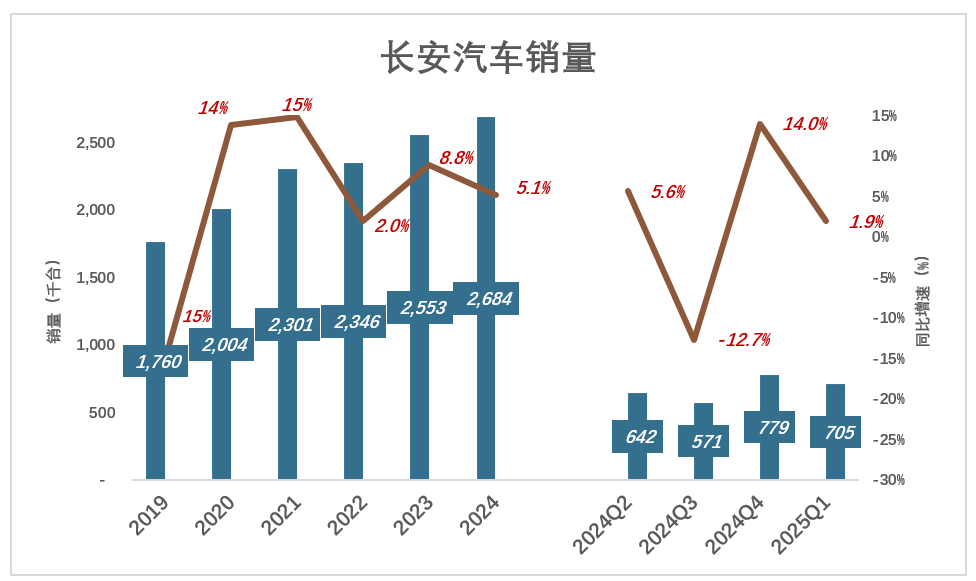
Group 1 - The core viewpoint of the article is that Changan Automobile has gained an opportunity for independent development due to the failure of its joint ventures, which has ultimately led to its elevation to a first-tier state-owned enterprise, avoiding a merger with Dongfeng Motor Group [2][3][31] - In 2024, Changan's sales reached 2.684 million units, while Dongfeng's sales were 1.896 million units, indicating a 41.6% lead for Changan [1] - Changan's revenue in 2024 was 159.7 billion, compared to Dongfeng's 106.2 billion, marking a 50.4% advantage for Changan [1] Group 2 - Changan's net profit in 2024 was 2.59 billion, while Dongfeng reported a net loss of 690 million [1] - In the new energy vehicle sector, Changan sold 735,000 units in 2024, accounting for 27.4% of its total sales, while Dongfeng sold 395,000 units, representing 20.8% [1] - Changan's self-owned brand sales reached 2.226 million units in 2024, making up 93% of its total sales, a significant increase from 75% in 2020 [6][9] Group 3 - Changan's joint ventures, particularly with Ford, have seen a significant decline in performance, with investment income from Changan Ford turning negative in recent years [16][19] - The cash dividends from joint ventures have drastically decreased, with Changan receiving only 134 million in 2024, a mere 11.4% of what it received in 2016 [19][21] - The article highlights that Changan's early shift to focus on self-owned brands has allowed it to avoid the pitfalls faced by other automakers reliant on joint ventures [30][31] Group 4 - The article discusses the competitive landscape, noting that traditional automakers like SAIC and GAC are also facing challenges as the market shifts towards electric vehicles [32][35] - It emphasizes the importance of adapting to market changes, particularly in the context of price wars in the electric vehicle sector, which could further impact the profitability of joint ventures [32][34] - The government stance on maintaining fair competition while opposing disorderly price wars is also mentioned, indicating a complex regulatory environment for automakers [34][36]

最新通报!唐腾被查
Zhong Guo Ji Jin Bao· 2025-06-18 06:01
Group 1 - Dongfeng Motor Corporation's former Deputy General Manager of Strategic Planning Department, Tang Teng, is under disciplinary review and investigation for serious violations of discipline and law [1][3] - Tang Teng has a long career at Dongfeng, starting in 1984, and has held various significant positions, including General Manager of the Xiamen Sales and Service Branch of Shenlong Automobile Co., Ltd. [3] - In 2020, Tang Teng represented Dongfeng at the Global Future Mobility Conference, highlighting his role in strategic planning and development within the company [3] Group 2 - Dongfeng Motor Corporation has been actively pursuing anti-corruption efforts this year, with multiple officials under investigation, indicating a strong stance against corruption within the organization [4] - The company has implemented measures to enhance supervision and accountability, particularly focusing on the management of key personnel to prevent corruption [4] - Dongfeng Motor Corporation is a major state-owned enterprise in China, involved in various sectors including manufacturing, sales, and service of vehicles, with operations spread across more than 20 cities [5]
最新通报!唐腾被查
中国基金报· 2025-06-18 05:43
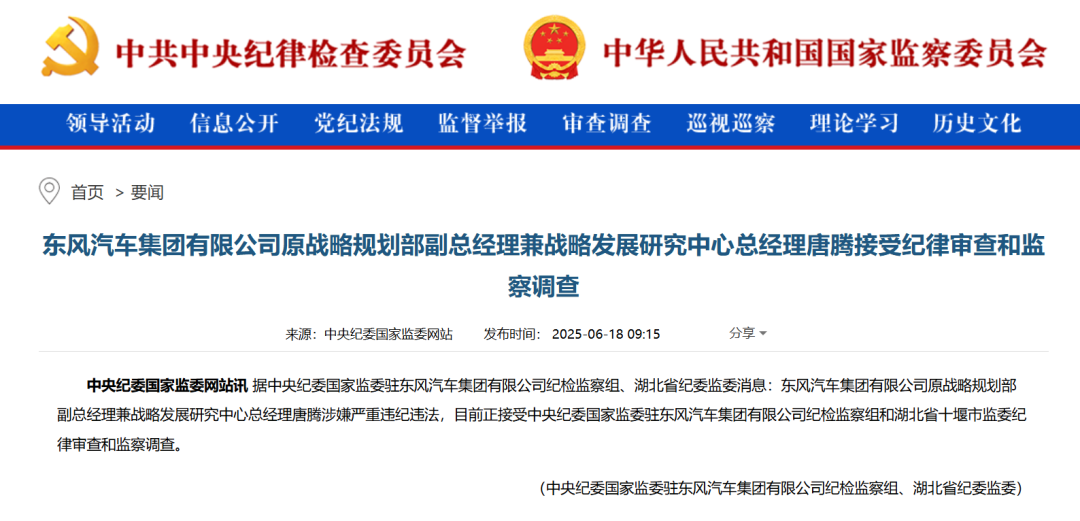
据了解,东风畅行科技股份有限公司成立于2019年,是东风汽车集团股份有限公司控股的出 行科技服务企业。天眼查信息显示,唐腾于2023年10月卸任该公司相关任职。 【导读】东风汽车集团有限公司原战略规划部副总经理兼战略发展研究中心总经理唐腾接受 纪律审查和监察调查 中国基金报记者 晨曦 最新反腐通报来了! 6月18日,中央纪委国家监委官网通报:东风汽车集团有限公司原战略规划部副总经理兼战略 发展研究中心总经理唐腾涉嫌严重违纪违法,目前正接受中央纪委国家监委驻东风汽车集团 有限公司纪检监察组和湖北省十堰市监委纪律审查和监察调查。 公开信息显示,唐腾出生于1963年,中共党员,高级工程师,毕业于武汉工学院(现武汉理 工大学)机械制造专业。 唐腾于1984年进入东风汽车公司,在底盘零件厂工作;1993年任职神龙汽车有限公司商务部 售后服务分部;1996年出任神龙汽车有限公司厦门销售服务分公司总经理。1999年,唐腾出 任神龙汽车有限公司北京商务代表处首席代表;2002年任神龙汽车有限公司总经理助理兼东 风标致项目负责人;2003年任神龙汽车有限公司东风标致商务部副总经理。 2009年,唐腾转任神龙公司战略规划部部长兼 ...

东风汽车集团有限公司原战略规划部副总经理兼战略发展研究中心总经理唐腾接受纪律审查和监察调查
news flash· 2025-06-18 01:20
东风汽车集团有限公司原战略规划部副总经理兼战略发展研究中心总经理唐腾接受纪律审查和监察调查 智通财经6月18日电,据中央纪委国家监委驻东风汽车集团有限公司纪检监察组、湖北省纪委监委消 息:东风汽车集团有限公司原战略规划部副总经理兼战略发展研究中心总经理唐腾涉嫌严重违纪违法, 目前正接受中央纪委国家监委驻东风汽车集团有限公司纪检监察组和湖北省十堰市监委纪律审查和监察 调查。 ...

观车 · 论势 || 果断停止重组是尊重实际的务实表现
Zhong Guo Qi Che Bao Wang· 2025-06-12 02:07
Core Viewpoint - The decision to halt the merger between Dongfeng and Changan reflects a pragmatic approach to respect the actual circumstances and allows both companies to continue their strategic development independently [1][3][5]. Group 1: Company Performance - Dongfeng's new energy vehicle sales are projected to reach 860,000 units in 2024, representing a year-on-year growth of 64.4% [1]. - From January to May 2024, Dongfeng's cumulative sales of new energy vehicles reached 299,000 units, a staggering increase of 118.1% year-on-year [1]. - Changan's cumulative sales in 2024 are expected to hit 2.684 million units, marking a 5.1% year-on-year increase, the highest in nearly seven years [2]. - Changan's new energy vehicle sales reached 735,000 units in 2024, reflecting a year-on-year growth of 52.8% [2]. - In May 2024, Changan's single-month sales of new energy vehicles surpassed 94,800 units, with a year-on-year increase of 70% [2]. Group 2: Strategic Development - The cessation of the merger allows both Dongfeng and Changan to maintain their strategic stability and focus on their respective market demands and innovation [4]. - The restructuring of Changan's controlling shareholder to an independent central enterprise enhances decision-making efficiency and resource allocation flexibility [4]. - Both companies are positioned to explore collaborative opportunities in technology innovation and market expansion, particularly in new energy technology development and international market penetration [4][5]. Group 3: Industry Context - The automotive industry is undergoing significant transformation towards new energy and intelligent technology, necessitating companies to respond swiftly to market changes [3]. - The decision to stop the merger aligns with the trend of "professional integration" in the industry, as the State-owned Assets Supervision and Administration Commission (SASAC) emphasizes focusing on core responsibilities [3].
多家车企迅速跟进:账期不超60天!汽车零部件板块多股涨停
Nan Fang Du Shi Bao· 2025-06-11 06:19
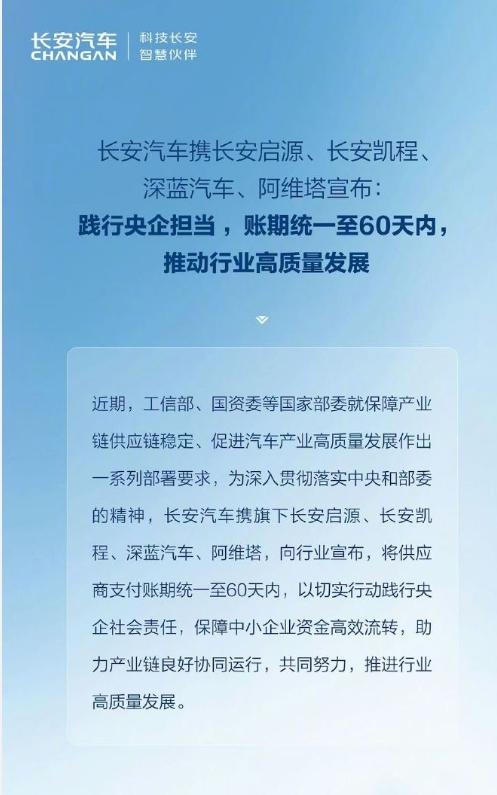
Core Viewpoint - The automotive industry is witnessing a significant shift as multiple companies commit to controlling supplier payment terms within 60 days, responding to government regulations aimed at stabilizing the supply chain and promoting high-quality development in the sector [1][10]. Group 1: Company Commitments - GAC Group, FAW Group, Dongfeng Motor Group, and Seres were the first to announce their commitment to keeping supplier payment terms within 60 days [2]. - Following this, companies such as Geely, Changan Automobile, BYD, and Chery also declared their adherence to the 60-day payment term, emphasizing the importance of efficient cash flow and supply chain stability [2][3][7]. - Great Wall Motors has also pledged to unify payment terms to 60 days, contributing to the healthy development of the entire industry chain [4]. Group 2: Industry Response - The automotive supply chain is expected to benefit from these commitments, as they are seen as a positive signal for suppliers and may help reshape the upstream and downstream ecosystem [10]. - The stock market reacted positively, with the automotive parts sector experiencing a surge, leading to multiple stocks hitting the daily limit up [10]. Group 3: Government Regulations - The "Regulations on Ensuring Payment to Small and Medium Enterprises" was revised and approved by the State Council, set to take effect on June 1, 2025, further supporting the push for timely payments in the industry [10].



汽车“反内卷”进行时:“60天账期承诺”成落地第一枪
Di Yi Cai Jing· 2025-06-11 04:57
Group 1 - Major automotive companies have committed to standardizing supplier payment terms to within 60 days, responding to the revised "Regulations on Ensuring Payment to Small and Medium-sized Enterprises" issued by the State Council [2][4] - Companies such as China FAW, Dongfeng Motor Group, Changan Automobile, and GAC Group have publicly announced their commitment to this payment term [2] - BYD, amidst public scrutiny, also pledged to unify supplier payment terms to 60 days to support the healthy development of small and medium enterprises [2][4] Group 2 - SAIC Motor Group not only committed to the 60-day payment term but also stated it would not use commercial acceptance bills to avoid increasing financial pressure on suppliers [3] - The revised regulations, effective from June 1, 2023, specify that large enterprises must pay small and medium enterprises within 60 days of delivery [4] - Suppliers have expressed the need for clarity on the payment process, specifically how the 60-day period is calculated, to avoid complications [4] Group 3 - The automotive supply chain financial platforms, such as BYD's DiChain and Great Wall's Great Wall Chain, are prevalent among major automotive companies, providing financing options for upstream and downstream partners [5] - Analysts highlight that the existence of these financial platforms raises concerns about whether companies are intentionally extending payment terms to shift financial burdens onto suppliers [5] - The automotive parts industry has seen an increase in accounts receivable turnover days, indicating potential cash flow issues for suppliers [6]


作出“支付账期不超过60天”承诺的车企不断扩围,比亚迪、小米等跟进
Xin Lang Cai Jing· 2025-06-11 03:02
Group 1 - Several automotive companies, including BYD, Chery, Xiaomi, and Changan, have committed to a payment term of no more than 60 days for suppliers to enhance supply chain stability and support the healthy development of small and medium-sized enterprises [1][2] - The commitment to shorten payment terms is in response to directives from national ministries aimed at promoting high-quality development in the automotive industry and ensuring the stability of the supply chain [1][2] - The reduction in payment terms is expected to accelerate cash flow for suppliers, allowing them to reinvest in raw materials, equipment upgrades, and production expansion, thereby improving production stability and reducing risks associated with cash flow constraints [2] Group 2 - The "Regulations on Ensuring Payment to Small and Medium-sized Enterprises" will take effect on June 1, 2025, mandating a 60-day payment period and prohibiting forced acceptance of non-cash payment methods [3] - The regulations aim to address issues of delayed payments to small and medium-sized enterprises and optimize the business environment, requiring large enterprises to pay within 60 days of delivery [3] - Concerns have been raised regarding some automotive companies using supply chain finance platforms to delay payments to upstream suppliers, thereby increasing financial pressure on those suppliers [3]