XIABUXIABU(00520)

Search documents
食饮吾见 | 一周消费大事件(7.14-7.18)
Cai Jing Wang· 2025-07-19 05:49
Group 1: Water Well Square - The company expects a 14.54% increase in sales volume for the first half of 2025, but anticipates a 12.84% decline in revenue to 1.498 billion yuan [1] - The net profit attributable to shareholders is projected to be 105 million yuan, a decrease of 56.52% compared to the same period last year [1] - The second quarter faced pressure from traditional consumption scenarios such as business banquets, leading to a slowdown in the recovery of shipments [1] Group 2: PepsiCo - PepsiCo reported Q2 2025 net sales of 22.726 billion USD (approximately 164.887 billion yuan) with an operating profit of 1.789 billion USD (approximately 12.98 billion yuan) [2] - The company achieved an organic sales growth of 2.1% [2] - New products such as "Milk Naked Rice Cake" and "Dragon Fruit Dried Fruit" have been introduced in the Chinese market, with the latter quickly entering the top 10 dried fruit list at Sam's Club [2] Group 3: Good Products Shop - The company announced the introduction of Wuhan State-owned Assets as a strategic investor, aiming to enhance global supply chain collaboration and food ecosystem development [3] - This change in control is seen as a strategic upgrade to better respond to the new phase of industry development [3] - The partnership will focus on creating a comprehensive industrial ecosystem through supply chain, brand, and channel collaboration [3] Group 4: KKR Acquisition - KKR's acquisition of Vista International Inc. was completed on July 4, 2025, granting KKR indirect control of 85% of the company [4] - Vista International primarily operates in the beverage sector within China [4] - The company was previously fully owned by an individual before the acquisition [4] Group 5: Starbucks and Fast Food Chains - Starbucks China, Yum China, and McDonald's China participated in the third China International Supply Chain Promotion Expo [5][6] - Starbucks showcased sustainable development innovations, while Yum China launched a development plan focusing on food safety and environmental concerns [6] - McDonald's emphasized its local supply chain partnerships and plans for global expansion [6] Group 6: Zhou Black Duck - The company expects total revenue for the first half of 2025 to be between 1.2 billion and 1.24 billion yuan, reflecting a year-on-year decline of approximately 1.5% to 4.7% [7] - Profit is projected to grow by 55.2% to 94.8%, driven by improved store management and reduced raw material costs [7] Group 7: Xiaobai Xiaobai - The company launched a partner program aimed at retaining and attracting talent by allowing top-performing employees to become store partners [8] - The plan aims to add 50 to 100 partner stores annually [8] - The first batch of 21 partners has already signed agreements, with five stores currently in operation [8] Group 8: BreadTalk - The company clarified that the closure of 11 stores in Chengdu was due to the expiration of franchise agreements, not a broader business failure [9] - The company is working on refunding customers with unspent gift cards and plans to open over 40 new stores [9] Group 9: Quanjude - The company expects a net profit of 11 to 14 million yuan for the first half of 2025, a decline of 52.28% to 62.51% year-on-year [10] - The restaurant industry continues to face significant market pressure, affecting customer traffic and revenue [10] Group 10: Yonghui Supermarket - The company anticipates a net loss of 240 million yuan for the first half of 2025, marking a shift from profit to loss [13] - The loss is attributed to a strategic transformation and the closure of 227 underperforming stores [13] - The company is undergoing significant supply chain reforms to establish a "quality retail" mindset [13]


呷哺呷哺选择先在内部“开放加盟”
3 6 Ke· 2025-07-18 08:17
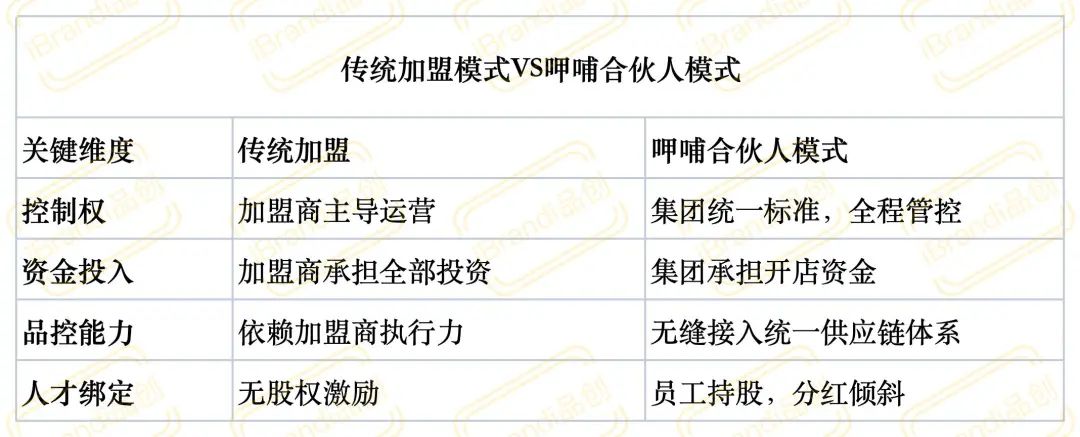
Core Viewpoint - The company is facing significant challenges, including a 97% stock price drop, a cumulative loss of 1.2 billion, and the closure of 219 stores in one year, prompting the launch of the "Feng Huan Chao" partner program to empower employees as store partners [1][11][12] Group 1: "Feng Huan Chao" Partner Program - The "Feng Huan Chao" program aims to incentivize frontline employees, with the first batch of 21 core employees becoming partners, focusing on operational managers and store managers [5][7] - The partnership model involves a tripartite shareholding structure among partners, the company, and executives, allowing partners to focus on store performance while the company provides funding and brand support [5][6] - This internal partnership approach is designed to bind talent and activate the organization, transforming employees from executors to decision-makers, thereby enhancing responsibility and loyalty [7][8] Group 2: Market Challenges and Strategic Shifts - The company is navigating a rapidly changing hot pot market, facing challenges from competitors and internal struggles, including a significant decline in the performance of its high-end brand, Coucou [3][10][14] - The company has accumulated losses of 1.183 billion from 2021 to 2024, with a peak loss of 401 million in 2024, largely attributed to the underperformance of Coucou [11] - The company is shifting focus away from the high-end market, which has seen competitors like Haidilao and Banu gaining traction, while it struggles to maintain its customer base [17][18] Group 3: Food Safety and Quality Control - The partner program mandates that all partner stores must integrate into a global supply chain and management system to ensure food safety and service standards, mitigating risks commonly associated with traditional franchise models [12] - Recent complaints about food safety issues highlight the need for stringent quality control measures, reinforcing the importance of the new management structure [12][20] Group 4: Market Position and Future Outlook - The hot pot market is projected to grow, with a significant increase in small hot pot establishments, but the company faces challenges in positioning itself within this competitive landscape [18][19] - The company must prioritize quality and value to regain market share, as competitors are increasingly encroaching on its target demographic with lower-priced offerings [20][21]

呷哺集团推出“凤还巢”合伙人计划 餐饮行业加速人才战略升级
Zheng Quan Ri Bao· 2025-07-17 14:15
Core Viewpoint - The company, Xiaobu Group, has launched the "Feng Huan Chao" partner program aimed at retaining and attracting talent in the restaurant industry through profit-sharing with employees [2][3] Group 1: Partner Program Details - The initial phase of the program includes 21 partners, with 5 partner stores already operational, and plans to add approximately 50 to 100 new partner stores annually [2] - The core model of the "Feng Huan Chao" program is a "three-party co-ownership," linking store profits closely with partners, thereby enhancing their motivation and initiative [2] - The program is designed for internal employees, allowing them to focus solely on optimizing operational metrics without worrying about startup costs or brand management [3] Group 2: Support and Standards - Xiaobu Group will provide comprehensive support, including brand authorization, supply chain assurance, and strict management standards, ensuring consistency in brand image and service quality [3] - A dedicated service team will assist partners throughout the entire process, from site evaluation to operational guidance and marketing planning [3] Group 3: Industry Context - The initiative reflects a broader trend in the restaurant industry, where leading brands are adopting partner or franchise models to accelerate expansion [4] - Other companies, such as Haidilao and Jiumaojiu, are also implementing similar models to enhance operational efficiency and reduce costs [5] - The partner model is seen as a way to better align employee interests with business outcomes, potentially leading to rapid expansion and increased market share [4][5]
呷哺呷哺出新招:推内部合伙人计划拓店
Hua Er Jie Jian Wen· 2025-07-17 10:32
Core Viewpoint - The company, Xiaobai Hotpot, has launched a new "Feng Huan Chao" partner program aimed at recruiting internal employees and industry talents as new store partners to enhance operational efficiency and profitability [1][3]. Group 1: Partner Program Details - The partner program allows partners to share equity and profits with the company, creating a strong alignment of interests between the company and the partners [2]. - Unlike traditional franchising, this program emphasizes risk-sharing and profit-sharing through equity and dividend mechanisms, with a focus on frontline employees [3]. - The company will provide comprehensive support, including site evaluation, personnel training, and operational supervision, allowing partners to focus on store management [3][4]. Group 2: Financial Performance and Challenges - Xiaobai Hotpot has faced significant financial difficulties, reporting continuous losses since 2021, with a cumulative loss of 1.246 billion yuan [5]. - Despite attempts to boost performance through various strategies, including launching a sub-brand and implementing a membership system, these efforts have not effectively increased customer traffic [5][7]. - The average customer spending has decreased, with a 10% reduction in brand package prices leading to a drop in average spending per customer to 54.8 yuan [6]. Group 3: Operational Metrics - The brand's table turnover rate has declined from 2.6 times per day in 2023 to 2.5 times in 2024, with same-store sales dropping by 23.3% [8]. - The company has closed a total of 73 and 60 stores for the Xiaobai and Coucou brands, respectively, marking the first time the total number of restaurants has fallen below 1,000 since 2019 [9]. - Despite current challenges, Xiaobai Hotpot plans to open at least 95 new restaurants by 2025, with a target turnover rate of at least 3 [10]. Group 4: Future Plans - Currently, five partner stores are operational, with plans to steadily add approximately 50 to 100 partner stores each year [11].
计划每年新增超50家合伙门店,呷哺呷哺启动合伙人计划
Xin Jing Bao· 2025-07-17 01:30
Core Insights - Major hot pot brands are actively expanding their business models, with Haidilao continuing to incubate sub-brands and Banu submitting an IPO application to become the "third hot pot stock" [1] - Xiaobuxiang, the "first hot pot stock," has launched the "Feng Huan Chao" partner program aimed at outstanding internal employees and industry talents, with plans to open 50 to 100 new partner stores annually [1][2] Company Initiatives - The "Feng Huan Chao" partner program incentivizes frontline employees who contribute significantly to store growth, allowing them to share in store profits through a partnership model [1][2] - The first batch of 21 partners has signed contracts, with 5 partner stores already operational [1] - Xiaobuxiang will provide comprehensive support to partners, including brand authorization, supply chain assurance, and management standards, ensuring consistency in brand image and service quality [2] Industry Trends - The trend of opening franchise and partnership models is growing among leading restaurant brands, with Haidilao and Jiumaojiu also adopting similar strategies [3] - The increasing chain rate in China's restaurant industry, along with improved brand management and supply chain standardization, is driving the shift from direct operation to franchise models [3] - The internal partnership model is becoming popular, transforming employees from traditional roles into partners who share risks and profits, enhancing their engagement and performance [3]
员工摇身一变成老板 呷哺呷哺推出合伙人制
Bei Jing Shang Bao· 2025-07-16 12:49
Core Viewpoint - The company has launched the "Feng Huan Chao" partner program to incentivize frontline employees and attract experienced talent in the restaurant industry, aiming to enhance store performance and brand competitiveness [1][3][5] Group 1: Partner Program Details - The "Feng Huan Chao" partner program targets frontline employees who contribute significantly to store growth, with 21 initial partners already signed, primarily from operational managers and store managers [3][4] - Partners will hold shares alongside the company, aligning their interests with store profitability and encouraging proactive engagement [3][4] - The program offers a higher profit-sharing ratio to frontline employees, ensuring they receive the maximum benefits [3][4] Group 2: Support and Standards - The company will provide comprehensive support to partners, including brand authorization, supply chain assurance, and standardized management practices, to alleviate operational concerns [3][4] - All partner stores must adhere to strict global management standards and food safety protocols to maintain brand integrity and service quality [4] - A dedicated service team will assist partners throughout the entire process, from site evaluation to operational supervision [4] Group 3: Market Context and Strategy - The restaurant industry, particularly the hot pot sector, is highly competitive, with many local brands emerging, putting pressure on the company [4][5] - The partner program aims to retain top internal talent while attracting external industry experts to accelerate brand expansion and adapt to market changes [5] - The company anticipates adding approximately 50 to 100 partner stores annually, enhancing both the quality and quantity of its outlets [4]

呷哺呷哺推出重磅合伙人计划,21位“打工人”变身“当家人”
Huan Qiu Wang· 2025-07-16 11:22
Core Viewpoint - The "Feng Huan Chao" partnership program launched by Xiaobu Group aims to transform outstanding employees and talented individuals in the restaurant industry from "workers" to "partners," enhancing talent retention and driving the sustainable development of the brand [1][3][4]. Group 1: Partnership Program Details - The program is designed for high-performing internal employees and talented individuals from the restaurant industry, providing a dedicated pathway for new store partnerships [1][3]. - The first batch of 21 partners has been selected from core positions such as operation managers and store managers, indicating a successful implementation of the program [3][5]. - Xiaobu Group will establish a dedicated service team to offer comprehensive support, including site evaluation, construction assistance, personnel training, operational supervision, and marketing planning [3][5][6]. Group 2: Strategic Importance - The "Feng Huan Chao" program is viewed as a significant adjustment to the company's talent strategy, aiming to create a cohesive and powerful team ecosystem to maintain and expand its competitive advantage in a volatile market [1][3]. - The program emphasizes profit-sharing between the company and employees, reflecting the company's commitment to long-term investment in talent [1][4]. Group 3: Operational Support and Standards - Xiaobu Group will provide extensive support to partners, including brand authorization, supply chain assurance, strict management standards, and startup funding, allowing partners to focus on store operations [4][5]. - All partner stores must adhere to the company's rigorous management standards and food safety systems, ensuring consistency in brand image and service quality [5][6]. Group 4: Future Expansion Plans - Currently, five partner stores are operational, with plans to steadily add approximately 50 to 100 new partner stores each year [5][6]. - The program aims to attract more talented individuals to join or return to Xiaobu Group, fostering a culture of shared growth and success [8].

呷哺集团推出“凤还巢”合伙人计划 首批签约21人
Sou Hu Cai Jing· 2025-07-16 07:58
Core Points - The core initiative of the company is the launch of the "Feng Huan Chao" partner program aimed at outstanding internal employees and talented individuals in the restaurant industry [1][3] - The first batch of 21 partners has officially signed with the company, marking the successful implementation of the program [1][3] Group 1 - The first batch of partners mainly consists of excellent internal employees from key positions such as operation managers and store managers across various regions [3] - Partners will engage in a shareholding model with the company, aligning store profits closely with the partners to enhance their motivation and initiative [3] - The company emphasizes that the program is designed to support partners without requiring them to consider opening funds or brand management costs, allowing them to focus on optimizing operational metrics [3] Group 2 - The company commits to providing comprehensive support to partners, including brand authorization, supply chain assurance, and strict management standards, ensuring a win-win development for both the brand and partners [3][4] - All partner stores must adhere to the company's stringent management standards and food safety systems to maintain brand image and service quality consistency [3][4] - The company plans to establish a dedicated service team to support partners throughout the entire process, from site evaluation to operational guidance and marketing planning [3][4] Group 3 - The "Feng Huan Chao" program aims to encourage frontline employees, with a focus on providing the highest profit-sharing ratio to them [4] - The program is rooted in the company's core value of sharing results with those who strive [4] - Currently, there are 5 partner stores in operation, with plans to steadily add approximately 50 to 100 partner stores each year in the future [4]

“连锁火锅第一股”呷哺呷哺宣布推行“凤还巢”合伙人计划
Mei Ri Jing Ji Xin Wen· 2025-07-16 06:40
Group 1: Company Initiatives - The company launched the "Feng Huan Chao" partner program aimed at retaining and attracting top talent in the restaurant industry by sharing profits with employees [1] - The program primarily targets frontline staff who contribute significantly to store growth, allowing them to hold shares and bind store profits with the company [1] - The first batch of partners consists of outstanding internal employees from key positions such as operation managers and store managers across the country [1] Group 2: Industry Overview - The hot pot market in China is projected to reach a scale of 650 billion yuan by 2025, with a year-on-year growth of 5.6% expected in 2024 [2] - The number of hot pot stores is anticipated to peak at over 520,000 by November 2024, while the number of related enterprises is expected to decline slightly [2] - Competitors like Haidilao are also adapting by establishing a franchise division, with 13 franchise stores reported by the end of 2024 [2]
中国餐饮“出海”迈入新阶段
Zheng Quan Ri Bao· 2025-07-08 15:46
Core Insights - Chinese dining brands are rapidly expanding globally, transitioning from individual store trials to systematic and large-scale international operations, driven by domestic market competition and policy support [1][3][4] - The "going global" trend is not merely about store expansion but involves deep localization of supply chains and cultural integration [1][4] Industry Overview - The overseas Chinese community has historically contributed to the spread of Chinese cuisine, with brands like Quanjude and Donglaishun leading the way post-reform [2] - The hot pot segment is a pioneer in this expansion, with Haidilao operating over 120 international locations, while other brands focus on Southeast Asia with differentiated offerings [2] - The new tea beverage sector is emerging as a significant player, with Mixue Ice Cream and Tea opening over 5,000 stores across 12 countries since 2018 [2] Market Dynamics - The domestic restaurant market is experiencing intense competition, with 1.347 million new registrations and 1.056 million closures in the first half of 2024, indicating a saturated environment [3] - Policy support, including the "Belt and Road" initiative, is facilitating the internationalization of Chinese dining brands [3] Global Demand - The overseas market for Chinese cuisine is expanding, driven by a growing Chinese diaspora and a global trend towards culinary experience [4] - The demand for Chinese dining is supported by local supply chain innovations, such as the "central kitchen + local procurement" model [4] Challenges - Cultural differences, supply chain construction, and regulatory barriers remain significant challenges for Chinese dining brands venturing abroad [4][5] - Localizing flavors while maintaining core brand identity is crucial for success in foreign markets [5][6] Supply Chain Issues - The complexity of international supply chains poses challenges, with many brands relying on domestic sourcing for core ingredients while facing local procurement difficulties [6][7] - Regulatory compliance varies by country, complicating the entry process for Chinese dining brands [7] Strategic Recommendations - Building a robust supply chain and understanding local regulations are essential for successful international expansion [8][9] - Collaboration across the entire industry chain is necessary to achieve economies of scale and ensure consistent quality [9][10] Innovation and Adaptation - New tea brands are exploring innovative supply chain solutions, such as local partnerships and self-developed products, to address supply challenges [10] - Digital platforms are enhancing the international presence of Chinese dining brands, with initiatives like Meituan's global restaurant guide [10][11] Cultural Integration - Successful internationalization requires a deep understanding of local cultures and consumer preferences, transforming dining experiences into cultural exchanges [11][12] - The evolution from "water and soil incompatibility" to "local coexistence" reflects the ongoing adaptation of Chinese dining brands in global markets [12]