
TENCENT(00700)

Search documents
AI红包你抢到多少?元宝:全网抽奖36亿次,完成AI创作10亿次
Guang Zhou Ri Bao· 2026-02-18 04:53
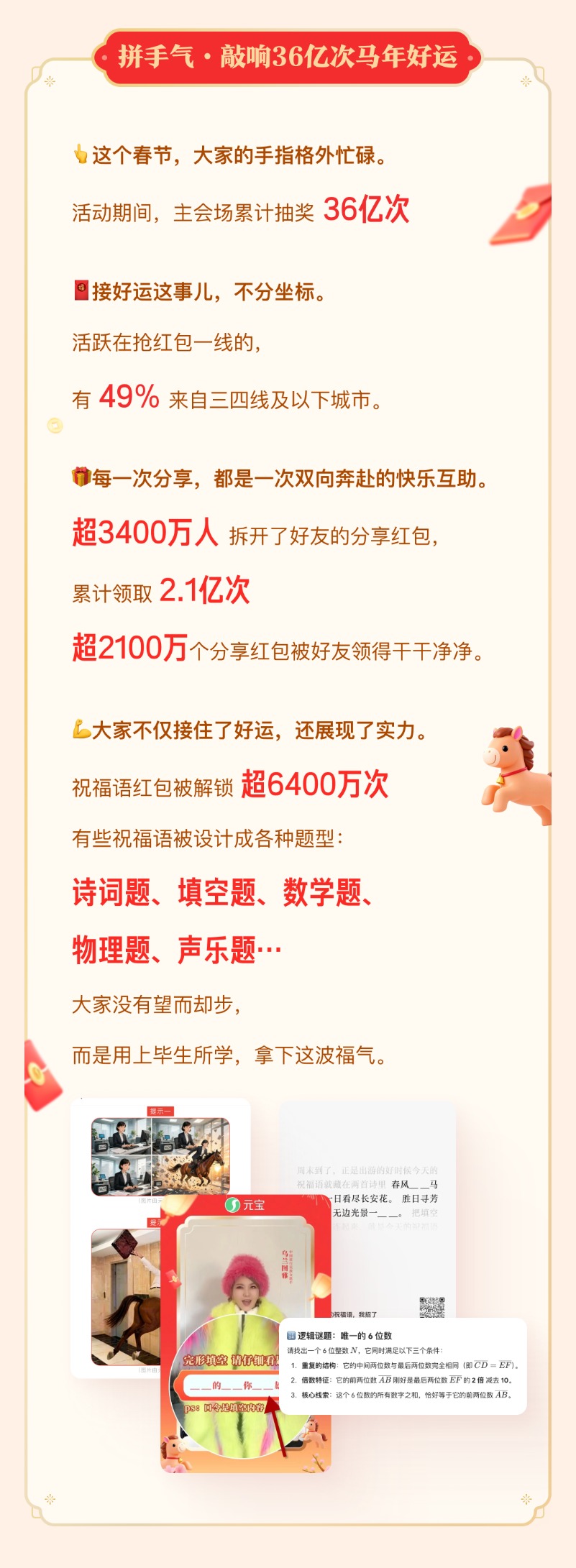
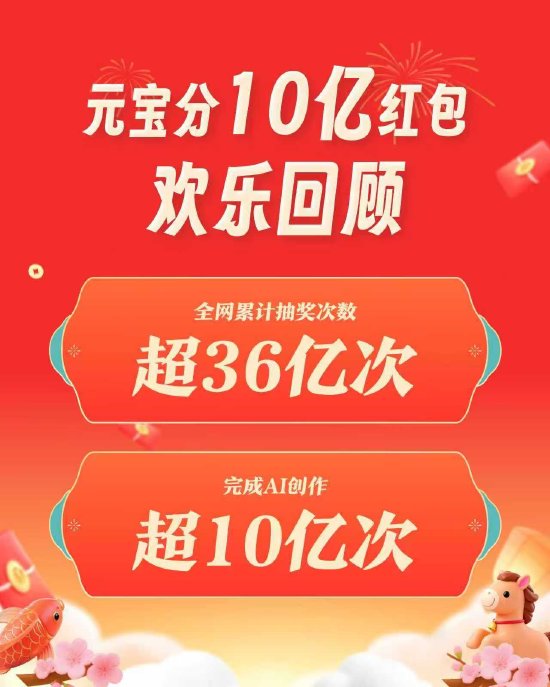
据了解,在元宝"创作"栏,AI创作超10亿次,网友们玩出了属于自己的过年仪式感。其中,20岁以下的年轻朋友最爱 用"灵感"和"趣味二创"创作天马行空的图片,斗图成了他们的拜年新姿势;30~40岁的朋友最爱用"拜年朋友圈",金色 的朋友圈或许是成年人的过年"排面"。在元宝所有创作模板中,"有钱满袋"受到了所有年龄层喜爱,成为大家最爱用 的模板,紧随其后的"春节福字小马"和"该用户正在发财"位列第二和第三,果然搞钱才是大家最朴素的默契。 2月18日,腾讯发布分10亿元现金红包活动报告。报告显示,自2月1日活动开启到17日零时结束,主会场累计抽奖次数 超36亿次,用户通过"创作"栏完成AI任务超10亿次。 报告显示,活跃在抢红包一线的,有49%用户来自三四线及以下城市;红包抢得最快的时间是每天的凌晨0点,网友们 不着急入睡,一起掐点蹲守新一天的红包。独乐乐不如众乐乐,超3400万人领取过别人的分享红包,分享红包一共被 领取超2.1亿次,超2100万个分享红包被好友领得干干净净。"今天你互了吗?"成为网友在社交平台上的流行语。稀有 的万元小马卡引发全网"集马气",2月1日0时0分44秒,全网第一张小马卡被翻牌。除夕夜 ...

腾讯发布元宝10亿红包活动报告:全网抽奖36亿次,完成AI创作10亿次;摩尔线程:完成对Qwen3.5模型全面适配丨AIGC日报
创业邦· 2026-02-18 01:08
Group 1 - Tencent's cash red envelope activity report shows that from February 1 to February 17, there were over 3.6 billion lottery draws and users completed AI tasks over 1 billion times, with 49% of users coming from third and fourth-tier cities [2] - Netflix's co-CEO Ted Sarandos stated that generative AI will assist creators by speeding up production times rather than harming job prospects, emphasizing that AI tools can enhance storytelling capabilities [2] - Alphabet announced that the Google I/O developer conference will be held from May 19 to 20, where updates on the Gemini large model and other AI products are expected, along with the potential launch of smart glasses [2] Group 2 - Moore Threads announced full adaptation of Alibaba's latest large model Qwen3.5 on its flagship AI training and inference GPU MTT S5000, showcasing the maturity of the MUSA ecosystem [3] - The adaptation process validated two core capabilities of the MUSA ecosystem: native MUSA C support for kernel development and deep compatibility with Triton-MUSA for high-performance operator writing [3]

2025年中国移动互联网AIGC赛道流量报告
艾瑞咨询· 2026-02-18 00:05
Core Insights - The AIGC sector in China has entered a phase of large-scale application, with a user base of 483 million and a market penetration rate exceeding 30% as of October 2025 [1][8]. User Demographics - The primary user group for AIGC applications consists of young white-collar workers under 35 years old, predominantly located in high-tier cities, characterized by strong purchasing power and a desire for social sharing [2][10][11]. Segment Analysis - **Language Models**: The Doubao APP leads in traffic within the language model segment, while Tencent Yuanbao has shown significant growth [3][13]. - **Intelligent Chat**: The industry is experiencing sluggish growth, but the Xingye APP has achieved positive user growth [4][22]. - **Intelligent Tools**: This segment remains stable, with user traffic closely tied to platform devices [5][17]. - **Image Processing**: Jimeng AI holds a dominant position in the image processing sector [6][20]. Growth Rankings - As of October, Jimeng AI, Tencent Yuanbao, and Doubao are among the top apps with leading user growth rates over the past ten months [7][27]. Overall Traffic Trends - The AIGC sector's monthly independent device count increased from 318 million to 483 million from January to October 2025, with penetration rising from 22.1% to 33.2%, indicating a shift from novelty to mainstream application [8]. User Characteristics - The user base is balanced in gender, with a significant presence of young individuals, particularly those under 35, making up nearly 50% of users, and white-collar workers accounting for 30% [11]. Segment-Specific Traffic Insights - **Language Models**: Leading apps like Doubao and Tencent Yuanbao have monthly independent device counts exceeding 50 million, while smaller apps struggle to grow [13]. - **Intelligent Tools**: User numbers remain stable above 20 million, with Huawei's tools leading the segment [17]. - **Image Processing**: Jimeng AI dominates with over 95% market share in user metrics, while smaller apps may need to focus on niche markets [20]. - **Intelligent Chat**: The segment shows declining user engagement, with only Xingye APP experiencing growth [22].

智通港股通资金流向统计(T+2)|2月18日



Xin Lang Cai Jing· 2026-02-17 23:49
2月11日,腾讯控股(00700)、盈富基金(02800)、山东黄金(01787)南向资金净流入金额位列市场 前三,分别净流入7.36 亿、4.23 亿、3.93 亿 阿里巴巴-W(09988)、中芯国际(00981)、华虹半导体(01347)南向资金净流出金额位列市场前 三,分别净流出-5.24 亿、-3.91 亿、-1.99 亿 在净流入比方面,南华期货股份(02691)、南方东西精选(03441)、豪威集团(00501)以70.54%、 59.14%、56.33%位列市场前三。 在净流出比方面,郑州银行(06196)、中国能源建设(03996)、弘业期货(03678) 以-50.51%、-49.70%、-48.03%位列市场前三。 前10大资金净流入榜 | 股票名称 | 净流入(元)↓ | 净流入比 | 收盘价 | | --- | --- | --- | --- | | 腾讯控股(00700) | 7.36 亿 | 5.67% | 548.000(-0.54%) | | 盈富基金(02800) | 4.23 亿 | 5.13% | 27.480(+0.37%) | | 山东黄金(01787) | 3.9 ...
芝麻AI速递:昨夜今晨财经热点要闻|2026年2月18日
Sou Hu Cai Jing· 2026-02-17 22:17
Group 1 - The robot industry is at a critical turning point for mass production and commercialization, with companies like Yushu Technology and Magic Atom investing heavily in marketing during the 2026 Spring Festival Gala [2] - The electric grid investment in China is expected to reach approximately 4 trillion yuan during the "14th Five-Year Plan" period, with a 40% increase compared to the previous plan, focusing on new power system construction and high-voltage transmission [3] - Major technology stocks have seen a market value decline of over $1.3 trillion since January 2026, leading investors to focus more on short-term financial transparency [3] Group 2 - The AI competition between Alibaba and ByteDance has intensified, with Alibaba launching Qwen3.5-Plus and ByteDance introducing Seedance 2.0, marking a new phase in China's AI landscape [3] - The gold and silver prices experienced significant fluctuations due to various market factors, including reduced expectations for Federal Reserve interest rate cuts [4] - The film market during the Spring Festival saw record-breaking performance, with total box office exceeding 1 billion yuan, led by "Fast and Furious 3" [5]




首场活动对接校友企业超100家
Xin Lang Cai Jing· 2026-02-17 18:40
Group 1 - The "Rong Inertia" alumni investment initiative was officially launched, with the first event connecting over 100 alumni enterprises [1] - The event attracted over 100 distinguished alumni and industry investors from fields such as artificial intelligence, integrated circuits, biomedicine, and new energy [1] - Chengdu's investment promotion bureau presented the investment environment for the artificial intelligence industry, and notable alumni shared insights on topics like technology transfer and financing support [1] Group 2 - Chengdu plans to conduct a series of "1+3+N" activities this year, including a launch ceremony and specialized events focused on technology transfer and alumni enterprise discussions [2] - The initiative aims to leverage the talent resources from Chengdu's 66 universities and 152 national-level innovation platforms to enhance industrial development [1] - A new model of "alumni recommending businesses and businesses attracting businesses" is being established through the creation of a key alumni enterprise database and regular communication mechanisms [1]

腾讯公布元宝10亿红包活动数据:全网抽奖36亿次,完成AI创作10亿
Xin Lang Ke Ji· 2026-02-17 14:00
Group 1 - Tencent launched a cash red envelope activity that attracted over 3.6 billion lottery draws and more than 1 billion AI tasks completed by users from February 1 to February 17 [1] - 49% of users participating in the red envelope activity came from third- and fourth-tier cities, indicating strong engagement from lower-tier markets [1] - The fastest time to grab a red envelope was at midnight, with over 34 million users having claimed others' shared red envelopes, totaling over 210 million claims [1] Group 2 - In the AI social gameplay "Yuanbao," over 11 million luck-based red envelopes were dropped, with 47% of participants also from third- and fourth-tier cities [2] - Users engaged in creative tasks, with over 1 billion AI creations, showcasing a variety of cultural expressions during the New Year [2] - The most popular creation template across all age groups was "Money in Abundance," reflecting a common desire for financial prosperity during the festive season [2]
腾讯取得通信方法及装置专利
Jin Rong Jie· 2026-02-17 08:43
Group 1 - The core point of the article is that Tencent Technology (Shenzhen) Co., Ltd. has obtained a patent for a communication method, device, computer-readable medium, and electronic equipment, with the patent announcement number CN116074972B and an application date of July 2019 [1] Group 2 - Tencent Technology (Shenzhen) Co., Ltd. was established in 2000 and is located in Shenzhen, primarily engaged in software and information technology services [1] - The company has a registered capital of 2 million USD [1] - According to data analysis from Tianyancha, Tencent Technology has invested in 15 companies, participated in 282 bidding projects, and has 5,000 trademark records and 5,000 patent records [1] - Additionally, the company holds 574 administrative licenses [1]
Kimi估值突破100亿美元,阿里腾讯等领投超7亿美元融资
Cai Jing Wang· 2026-02-17 08:40
Group 1 - Kimi is set to complete a new financing round of over $700 million, following a previous $500 million round just over a month ago [1] - The latest financing round is led by existing shareholders including Alibaba, Tencent, Wuyuan, and Jiua [1] - Kimi's valuation has doubled to exceed $10 billion, with the total amount raised in the last two rounds reaching over $1.2 billion, marking the highest financing amount in the large model industry in the past year [1]

腾讯取得内容分享方法专利
Jin Rong Jie· 2026-02-17 08:23
Group 1 - The core point of the article is that Tencent Technology (Shenzhen) Co., Ltd. has obtained a patent for a "content sharing method, device, computer equipment, and storage medium," with the authorization announcement number CN115373867B, and the application date was May 2021 [1] Group 2 - Tencent Technology (Shenzhen) Co., Ltd. was established in 2000 and is located in Shenzhen, primarily engaged in software and information technology services [1] - The registered capital of Tencent Technology (Shenzhen) Co., Ltd. is 2 million USD [1] - According to data analysis from Tianyancha, Tencent Technology (Shenzhen) Co., Ltd. has invested in 15 companies, participated in 282 bidding projects, has 5000 trademark information entries, 5000 patent information entries, and holds 574 administrative licenses [1]