
CHINA UNICOM(00762)

Search documents
破局中国制造业转型痛点 产业界聚焦开放自动化
Zhong Guo Jing Ying Bao· 2025-10-13 10:05
Core Insights - The article highlights the critical transformation of China's manufacturing industry towards intelligent automation, driven by the dual waves of Industry 4.0 and AI, with 93% of manufacturing enterprises recognizing the core value of digital technologies in building competitive advantages [1] - Despite the promising statistics, the industry faces significant challenges such as data silos and fragmented communication protocols, which hinder the interconnectivity of devices [1][5] - The Chinese government has introduced policies like the "Smart Factory Gradient Cultivation Action Plan" and the "5G + Industrial Internet" initiative to address these challenges and promote the development of open automation technologies [1][10] Group 1: Industry Challenges - Many manufacturing enterprises are struggling with data isolation and inconsistent formats, which complicate the transition to intelligent automation [1] - The existence of various non-standard industrial communication protocols creates barriers to device interconnectivity, making it difficult for traditional PLCs and hardware to adapt to flexible production line upgrades [1][5] - The report emphasizes that the fragmentation of industrial communication protocols severely impacts the interoperability of devices and the efficiency of cross-layer data transmission [5] Group 2: Technological Advancements - The implementation of open automation platforms is essential for overcoming the challenges faced by the industry, as they provide a unified standard and a widely compatible architecture [6] - Schneider Electric's EAE platform exemplifies the integration of IT and OT, offering systematic solutions for various operational challenges in smart factories [6][7] - The collaboration between Schneider Electric and China Unicom has led to significant technological breakthroughs, such as reducing network latency to under 4 milliseconds and achieving 99.999% stability [4] Group 3: Ecosystem Collaboration - The article discusses the importance of ecosystem collaboration in driving the large-scale adoption of open automation, with industrial software service providers playing a crucial role [8] - Companies like Lantu Shujie and Beijing Huasheng Ruiying Technology are focusing on addressing data and computing challenges in manufacturing through innovative solutions [9] - Schneider Electric's "Winning Plan" and the establishment of the Open Automation Organization (UAO) are pivotal in fostering collaboration among over 500 global members to support the scaling of open automation [9][10] Group 4: Policy Support - The Chinese government's supportive policies, including the recent guidelines for industrial upgrades and advanced manufacturing, provide a strong foundation for the rapid development of open automation [10] - The Ministry of Industry and Information Technology has prioritized the research and development of open automation technologies, further solidifying their role in the manufacturing sector's transformation [10][11] Group 5: Empowering SMEs - Schneider Electric aims to assist small and medium-sized enterprises (SMEs) in overcoming barriers to intelligent transformation through modular technology and agile deployment [12] - The company offers standardized modular solutions that simplify the application of open automation technologies, significantly lowering the technical barriers for SMEs [12] - By leveraging local resources and collaborating with various stakeholders, Schneider Electric is enhancing support for SMEs in the manufacturing sector [12][13]

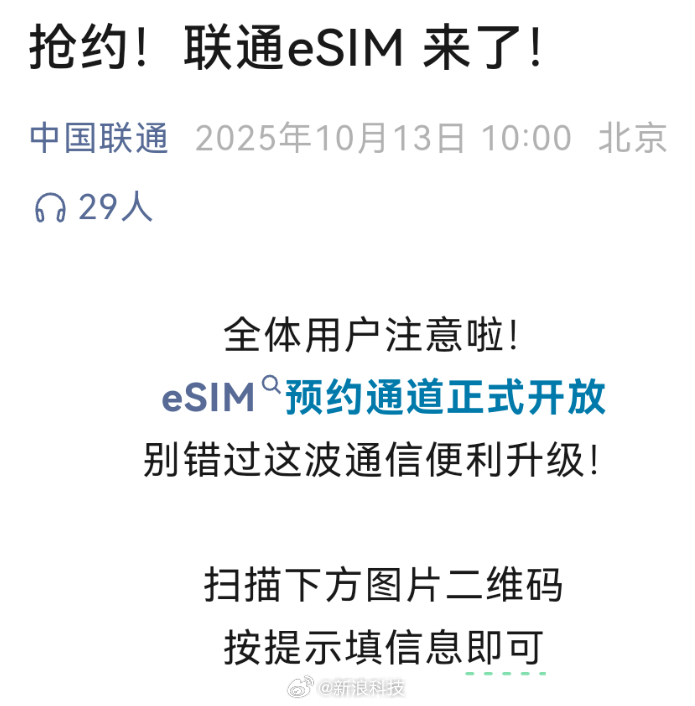
联通开放eSIM预约,国行iPhoneAir上市在即
Xin Lang Ke Ji· 2025-10-13 06:16
Core Points - China Unicom has officially opened the eSIM reservation channel, following China Mobile's launch of its eSIM business reservation portal [1] - China Telecom has also announced that its eSIM mobile services are fully prepared and will soon be available to users after receiving official approval from the Ministry of Industry and Information Technology [1] - The launch of eSIM services indicates that the iPhone Air, which was released on September 10, may soon be available in the Chinese market [1] - The absence of the iPhone Air in the domestic market at the time of the iPhone 17 series launch was primarily due to the lack of support for eSIM by domestic operators [1]



“人工智能+”行动深入实施 业界加速推进智能体落地
Yang Shi Xin Wen· 2025-10-12 17:23
Group 1 - The core viewpoint of the articles highlights the Chinese government's initiative to integrate artificial intelligence (AI) into various sectors, aiming for over 90% application penetration of new intelligent terminals and agents by 2030 [1] - China Mobile announced an upgraded "AI+" action plan, intending to double its investment in AI over the next three years and expand its intelligent agent user base to over 200 million [2] - Various telecom operators, including China Unicom and China Telecom, are launching their own intelligent agent platforms, indicating a growing trend in the AI sector [2] Group 2 - The implementation of intelligent agents in hospitality is showcased, where AI assistants can handle customer inquiries and manage smart devices, enhancing the guest experience and operational efficiency for small hotels [1] - A multi-modal intelligent agent has been developed that can assist users in creating content, such as images and videos, significantly reducing the complexity and time required for creative tasks [3] - The collaborative nature of intelligent agents is emphasized, where multiple "sub-agents" work together to execute specific tasks, showcasing the advanced capabilities of AI in practical applications [2][3]


加速推进!智能体成新风口三大运营商布局智能体
Xin Lang Cai Jing· 2025-10-12 15:30
Core Viewpoint - The Chinese government is accelerating the integration of artificial intelligence (AI) into various sectors, aiming for over 90% application penetration of new intelligent terminals and agents by 2030 [1] Group 1: Government Initiatives - In August, the State Council issued an opinion to promote the deep integration of AI with the economy and society [1] - The goal is to achieve a penetration rate exceeding 90% for new generation intelligent terminals and agents by 2030 [1] Group 2: Company Developments - China Mobile announced an upgraded "AI+" action plan, aiming to double its overall investment in AI over the next three years and to expand its intelligent agent user base to over 200 million [1] - China Unicom launched an open-source intelligent agent development platform that supports the integration of hundreds of large models [1] - China Telecom introduced a super intelligent agent capable of executing complex tasks autonomously [1] Group 3: Market Trends - Multiple large model companies in China are also launching intelligent agent services [1] - The demand for AI capabilities is shifting from simple "content Q&A" to solving "practical tasks," positioning intelligent agents as a key focus for industry players [1] - Industry forecasts predict that the enterprise-level intelligent agent application market in China will exceed $27 billion by 2028 and grow to $47.1 billion by 2030 [1]
盈利提速,算力板块表现亮眼





Haitong Securities International· 2025-10-12 10:32
Investment Rating - The report suggests to continue focusing on investment opportunities within the communication industry [2] Core Insights - The communication industry showed steady revenue growth and accelerated profitability in H1 2025, with total revenue reaching 1785.003 billion yuan, a year-on-year increase of 10.07%, and net profit attributable to shareholders at 160.432 billion yuan, up 11.26% year-on-year [4][7] - The AI computing industry chain is expected to continue accelerating its development in 2025, benefiting the communication industry [17][19] Summary by Sections H1 2025 Performance Overview - The communication industry achieved a total revenue of 1785.003 billion yuan in H1 2025, with a year-on-year growth of 10.07%, and a net profit of 160.432 billion yuan, reflecting an 11.26% increase [4][7] Segment Performance Changes - In H1 2025, the optical module and device segment reported revenue of 47.988 billion yuan, a year-on-year increase of 64.88%, and net profit of 10.876 billion yuan, up 111.99% [25] - The communication PCB segment achieved revenue of 57.249 billion yuan, a year-on-year increase of 37.66%, and net profit of 8.058 billion yuan, up 80.79% [31] - The network equipment segment generated revenue of 507.111 billion yuan, a year-on-year increase of 28.86%, with net profit of 19.184 billion yuan, up 19.57% [37] AI Industry Chain Investment - Major overseas cloud companies are expected to maintain optimistic growth in capital expenditures, with a total of 95 billion USD in Q2 2025, reflecting an 82.96% year-on-year increase [17] - Companies like Oracle and Nvidia are showing strong growth prospects in their AI-related businesses, with Oracle's unfulfilled revenue reaching 455 billion USD, a year-on-year increase of 359% [22][19]
又拿“国家安全”当借口打压,美政府声称已强制电商平台下架数百万件中国电子产品
Guan Cha Zhe Wang· 2025-10-12 08:19
Core Viewpoint - The FCC has mandated the removal of millions of Chinese electronic products from major e-commerce platforms in the U.S. due to alleged national security risks, particularly concerning surveillance capabilities [1][5]. Group 1: FCC Actions - The FCC has announced a new national security notice, warning companies about banned products, including video surveillance equipment that could allow China to monitor Americans [3]. - The FCC plans to tighten restrictions on telecommunications equipment manufactured by Chinese companies deemed to pose national security risks [5]. - A vote scheduled for October 28 aims to ban devices containing components from a "covered list" and may prohibit the sale of previously authorized devices under certain conditions [6]. Group 2: Impact on E-commerce - Major e-commerce platforms have already removed millions of so-called "prohibited" Chinese electronic products, including those from companies like Huawei, Hikvision, ZTE, and Dahua Technology [1][6]. - Searches for Huawei products on Amazon within the U.S. show that these items are no longer available, while they can still be found when searching from outside the U.S. [3]. Group 3: Broader Context - This action is part of a series of measures taken by the U.S. government against Chinese technology firms across various sectors, including telecommunications, semiconductors, and automotive industries, citing national security concerns [6]. - The Chinese government has criticized the U.S. for politicizing economic and technological issues, claiming that such actions disrupt global supply chains and harm the interests of both countries [6].





芜湖算力“突围”,如何改写安徽AI产业机遇?
AI研究所· 2025-10-11 11:33
Core Viewpoint - Wuhu, a city in the Yangtze River Delta, is emerging as a global technology hub with the establishment of the "China Digital Island," a key part of the national "East Data West Computing" project, which aims to enhance AI computing capabilities [1][2]. Group 1: Industrial Strength Supporting Computing Infrastructure - The "China Digital Island" is backed by Wuhu's long-standing industrial strength, particularly in the low-altitude economy, where it has developed a complete industrial ecosystem over 12 years [4][5]. - By 2025, Wuhu has gathered nearly 200 companies in the low-altitude economy sector, achieving a revenue of 46.38 billion yuan in 2024, reflecting a year-on-year growth of 15.95% [6]. - Wuhu's low-altitude equipment has entered international markets, exemplified by a $1 billion procurement agreement with UAE's Autocraft for 350 eVTOL air taxis, positioning Wuhu as a global production center for low-altitude equipment [9]. - The automotive industry, led by Chery, provides a solid demand foundation for computing development, with smart vehicles driving the need for low-latency data processing [10]. Group 2: Opportunities for AI Industry in Anhui - The large-scale construction of the "China Digital Island" is set to transform Anhui's computing distribution, enabling local demand to be met locally and creating a surplus of computing resources [13]. - Wuhu's centralized scheduling platform for computing resources is the only provincial-level platform, enhancing efficiency and preventing redundant investments in other cities [16]. - The presence of major companies like Huawei and China Telecom in Wuhu is fostering the growth of supporting industries, creating a "leading enterprise + local support" model for AI hardware manufacturing [16]. - The integration of computing infrastructure with local industries is expected to enhance the application of AI technologies in smart manufacturing and urban governance [17]. Group 3: Future Prospects - Wuhu is on a transformative path from an industrial hub to a computing city, positioning itself as a strategic point for the rise of the AI industry in Anhui [20]. - The convergence of low-altitude economy, smart vehicles, and computing capabilities may establish Wuhu as a benchmark for computing economy and AI innovation in the Yangtze River Delta and nationwide [20][21].

通信行业2025年三季报业绩前瞻:算力景气,红利稳健,战力将起
ZHESHANG SECURITIES· 2025-10-11 07:44
Investment Rating - The industry investment rating is "Positive" [4][19] Core Views - The telecommunications industry is benefiting from the ongoing Digital China strategy, leading to stable growth in overall business for operators, with innovative services experiencing higher growth rates and increasing proportions [2] - The AI computing power sector continues to thrive globally, with significant investments from major companies, indicating a rapid growth period for domestic computing power targets [4] - New growth drivers such as satellite internet are injecting new momentum into the industry, providing additional performance elasticity [4] Summary by Relevant Sections Telecom Operators - China Mobile is expected to report Q3 revenue of CNY 245.1 billion to CNY 246 billion, a year-on-year growth of 0.2% to 0.5%, with net profit of CNY 32.1 billion to CNY 32.4 billion, a growth of 4.6% to 5.6% [2][16] - China Telecom is projected to achieve Q3 revenue of CNY 127.2 billion to CNY 128.5 billion, a growth of 1% to 2%, with net profit of CNY 7.75 billion to CNY 8.05 billion, a growth of 3.5% to 7.5% [2][16] - China Unicom's Q3 revenue is expected to be CNY 93.7 billion to CNY 94.6 billion, with a growth of 1% to 2%, and net profit of CNY 2.41 billion to CNY 2.49 billion, a growth of 4.8% to 8.3% [3][16] - China Tower is anticipated to report Q3 revenue of CNY 24.9 billion to CNY 25.2 billion, a growth of 2.9% to 4.1%, with net profit of CNY 2.97 billion to CNY 3.05 billion, a growth of 5.2% to 8% [3][16] AI and Network Connectivity - The AI optical module sector is experiencing significant growth, with companies like Zhongji Xuchuang expected to report Q3 revenue of CNY 8.9 billion to CNY 9.6 billion, a growth of 37% to 47%, and net profit of CNY 2.9 billion to CNY 3.2 billion, a growth of 108% to 130% [4][16] - Tianfu Communication is projected to achieve Q3 revenue of CNY 1.8 billion to CNY 2.1 billion, a growth of 115% to 150%, with net profit of CNY 650 million to CNY 750 million, a growth of 102% to 133% [5][16] AI Applications and Data Centers - AI server demand is rapidly increasing, with ZTE expected to report Q3 revenue of CNY 31 billion to CNY 32 billion, a growth of 12% to 16%, and net profit of CNY 1.95 billion to CNY 2.1 billion, a decrease of 3% to 10% [7][16] - The AIDC sector is also growing, with Keda Data expected to report Q3 revenue of CNY 24 billion to CNY 27 billion, a growth of 44% to 62%, and net profit of CNY 180 million to CNY 230 million, a growth of 1347% to 1748% [8][16] Satellite Internet and Military Communication - The military communication sector is expected to see increased investment due to regional tensions, with companies like Zhenlei Technology projected to report Q3 revenue of CNY 150 million to CNY 160 million, a growth of 125% to 141%, and net profit of CNY 45 million to CNY 50 million, a growth of 409% to 466% [10][16]


中国对高通启动反垄断调查;张一鸣公开亮相!字节宣布新的员工补贴政策;滴滴自动驾驶获得D轮20亿元融资
Sou Hu Cai Jing· 2025-10-11 05:15
Group 1: Qualcomm Antitrust Investigation - China has initiated an antitrust investigation against Qualcomm for failing to legally declare its acquisition of Autotalks, potentially violating the Anti-Monopoly Law of the People's Republic of China [4] Group 2: ByteDance Developments - ByteDance founder Zhang Yiming made his first public appearance in years, launching the Shanghai Xuhui Zhichun Innovation Center aimed at nurturing talent in computer science and artificial intelligence [5] - ByteDance announced a new employee subsidy policy providing additional transitional support for formally laid-off employees in mainland China, with a maximum subsidy of 72,000 yuan [6] Group 3: Didi Autonomous Driving Financing - Didi Autonomous Driving secured 2 billion yuan in D-round financing, with funds allocated for increasing AI research and development and advancing L4 autonomous driving applications [8] Group 4: Intel Chip Production - Intel's new factory in Arizona has begun mass production of its most advanced chips, aiming to compete with TSMC and demonstrating the feasibility of manufacturing advanced chips in the U.S. [12] Group 5: OpenAI Data Center Project - OpenAI signed a letter of intent with Sur Energy for a data center project in Argentina, with a potential investment of up to 25 billion dollars, which would be one of the largest tech and energy infrastructure projects in the country [14] Group 6: Global PC Market Growth - The global PC market saw a year-on-year shipment increase of 9.4% in Q3 2025, with Lenovo leading the market share at 25.5%, followed by HP at 19.8%, Dell at 13.3%, Apple at 9%, and Asus at 7.8% [16]






中国联通(00762.HK)拟10月22日举行董事会会议批准季度业绩
Ge Long Hui· 2025-10-10 09:21
格隆汇10月10日丨中国联通(00762.HK)发布公告,公司将于2025年10月22日(星期三)举行董事会会议, 旨在(其中包括)批准本公司及其附属公司截至2025年9月30日止九个月期间的财务业绩。 ...