
SMIC(00981)

Search documents
北水动向|北水成交净卖出34.27亿 芯片股再度分化 泡泡玛特(09992)获7亿港元加仓
智通财经网· 2026-01-28 10:05
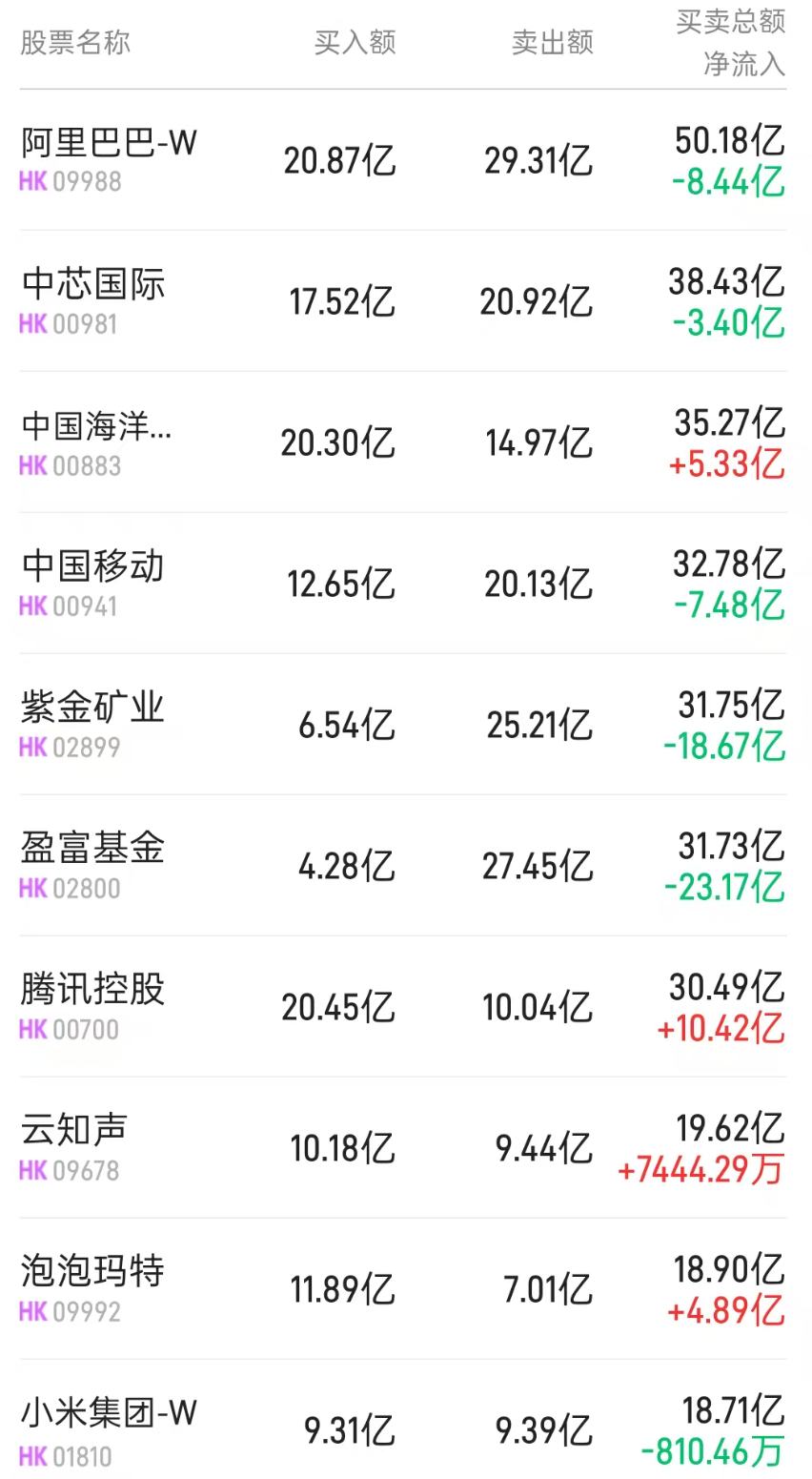
Core Viewpoint - The Hong Kong stock market experienced a net sell-off of 34.27 billion HKD from northbound trading, with significant movements in individual stocks, indicating investor sentiment and market dynamics. Group 1: Northbound Trading Summary - Northbound trading saw a net sell of 34.27 billion HKD, with the Shanghai Stock Connect contributing a net sell of 47.72 billion HKD and the Shenzhen Stock Connect a net buy of 13.45 billion HKD [1] - The most bought stocks included Tencent (00700), Pop Mart (09992), and Yangtze Optical Fibre and Cable (06869) [1] - The most sold stocks included the Tracker Fund of Hong Kong (02800), Alibaba-W (09988), and Zijin Mining (02899) [1] Group 2: Individual Stock Performance - Alibaba-W (09988) had a buy amount of 20.87 billion HKD and a sell amount of 29.31 billion HKD, resulting in a net outflow of 8.44 billion HKD [2] - Tencent (00700) recorded a net buy of 12.09 billion HKD, supported by the announcement of a cash red envelope event worth up to 1 billion HKD [4] - Pop Mart (09992) saw a net buy of 7.33 billion HKD, with plans for expansion into North American shopping centers [5] - Yangtze Optical Fibre and Cable (06869) had a net buy of 2.97 billion HKD, benefiting from a long-term supply agreement with Meta for fiber optic cables [5] - The Tracker Fund of Hong Kong (02800) faced a net sell of 23.16 billion HKD, influenced by market sentiment regarding the US dollar [7] - Other notable net sells included China Mobile (00941) with 7.48 billion HKD, Zijin Mining (02899) with 8.54 billion HKD, and Alibaba-W (09988) with 9.44 billion HKD [8]






中芯国际(688981)披露发行股份购买中芯北方49%股权事项,1月28日股价上涨3.63%
Sou Hu Cai Jing· 2026-01-28 09:41
Core Viewpoint - Semiconductor Manufacturing International Corporation (SMIC) is planning to acquire a 49% stake in SMIC North from various state-backed entities for a total consideration of 40.60091 billion RMB, which will be paid through the issuance of new shares at a price of 74.20 RMB per share [1] Group 1 - As of January 28, 2026, SMIC's stock closed at 128.55 RMB, up 3.63% from the previous trading day, with a total market capitalization of 1,028.46 billion RMB [1] - The stock opened at 124.99 RMB, reached a high of 128.99 RMB, and a low of 124.99 RMB, with a trading volume of 12.644 billion RMB and a turnover rate of 4.97% [1] - The transaction to acquire the stake in SMIC North is classified as a related party transaction and will require approval at the upcoming temporary shareholders' meeting [1] Group 2 - The independent board committee and independent financial advisor have deemed the terms of the transaction to be fair and reasonable, aligning with the overall interests of the company and its shareholders [1]


行情依旧“指数涨,个股跌”!赚钱效应遇冷,还有哪些投资机会?
Sou Hu Cai Jing· 2026-01-28 07:57
Group 1 - The A-share profit cycle may have reached a turning point, with a significant probability of profit indicators rebounding, indicating a gradual stabilization at the bottom of A-share profits [1] - Key profit indicators across the A-share market are showing signs of recovery, with a narrowing year-on-year decline in EPS and clear signs of ROE stabilization and rebound [1] - The main sectors with net inflows include non-ferrous metals, semiconductors, and automotive chips, indicating strong investor interest in these areas [1] Group 2 - The announcement to adjust export tax rebate policies for photovoltaic products will lower the VAT export rebate rate for battery products from 9% to 6% starting April 1, 2026, and eliminate it entirely from January 1, 2027, which may lead to a short-term surge in exports [3] - The aluminum market is expected to see a decline in demand for photovoltaic aluminum, while demand for electrolytic aluminum is projected to grow, supported by high demand in the power grid and automotive sectors [3] - Citic Securities forecasts that the average aluminum price will reach 23,000 yuan/ton in 2026, indicating a bullish outlook for the aluminum sector [3] Group 3 - The Chinese technology sector is expected to experience a significant profit growth turning point in 2026, potentially surpassing the profitability of the "seven giants" in the US stock market for the first time since 2022 [5] - The coal industry is anticipated to maintain a weak supply-demand balance in 2026, but with supportive policies, coal prices may perform better than in 2025, improving profit and dividend expectations for listed companies [5] - The TMT and consumer sectors are expected to show resilience in growth rates, while public utilities and transportation may face greater earnings pressure [11]




产业经济周报:BD出海加速,AI应用竞赛升级
Tebon Securities· 2026-01-28 07:25
Market Performance - The market showed mixed performance from January 19 to January 23, with the Shanghai Composite Index rising by 0.84% and the Shenzhen Component Index increasing by 1.11%[5] - The average daily trading volume was 2.80 trillion yuan, a decrease compared to the previous week[5] Healthcare Sector - At the JPM 2026 conference, over 20 Chinese innovative pharmaceutical companies showcased their products, with significant business development (BD) transactions announced[16] - In 2025, the value of China's innovative drug patent licensing transactions reached approximately $135.7 billion, a 143% increase year-on-year, with 157 total transactions[20] Consumer Sector - The Qianwen APP integrated with Alibaba's ecosystem, achieving over 100 million monthly active users within two months of launch, marking its entry into the "billion-level club"[25] - This integration allows for a seamless process from search to decision-making and payment, establishing a comprehensive AI application ecosystem[26] Hard Technology Sector - The supply of storage and logic chips remains tight, leading to widespread price increases across the industry[32] - The price of enterprise SSDs continues to rise, with a projected increase of 33-38% for NAND Flash products due to supply constraints[36] High-end Manufacturing - The State Grid announced a total fixed asset investment of 4 trillion yuan for the 14th Five-Year Plan period (2026-2030), a 40% increase from the previous period, averaging 800 billion yuan annually[42] - The goal is to achieve a 30% share of renewable energy in total power generation by 2030, indicating significant growth potential for the solar and wind energy sectors[46]



连MCU都开始涨价了!(附最新涨价函汇总)
芯世相· 2026-01-28 07:07
Core Viewpoint - The semiconductor industry is experiencing a widespread price increase, affecting various segments including memory, passive components, and main control chips, driven by rising raw material costs and strong demand, particularly in AI applications [2][3][35]. Price Increases in Semiconductor Components - Companies like Zhongwei Semiconductor announced price hikes of 15%-50% for MCU and NOR Flash products starting January 2026 [2][60]. - Major memory manufacturers such as Samsung and SK Hynix have also raised prices significantly, with Samsung increasing NAND Flash prices by over 100% in Q1 2026 [20][22]. - Micron has reported a general price increase of approximately 20% across its product lines [23][24]. Price Increases in Raw Materials and PCB - Resonac announced a 30% price increase for copper-clad laminates and adhesive films starting March 1, 2026, due to tight supply and rising costs [8]. - Nanya Plastics raised prices for all CCL and PP products by 8% due to increases in raw material costs [12]. - Taisil has implemented price increases of 5%-10% for its copper-clad laminates in response to rising material costs [9]. Price Increases in Wafer Foundries - TSMC has informed clients of price increases for advanced nodes (5nm, 4nm, 3nm, 2nm) over four consecutive years, with expected increases of 8%-10% for 5nm and up to 50% for 2nm [15]. - SMIC has also raised prices by approximately 10% for certain capacities [16]. - TrendForce predicts that the average capacity utilization rate for 8-inch wafer foundries will rise to 85%-90% in 2026, prompting price increases of 5%-20% across the board [14]. Price Increases in Passive Components - Companies like Yageo and Walsin have announced price increases for tantalum capacitors and resistors, with Yageo raising prices by 15%-20% for certain resistor products [33][34]. - Other passive component manufacturers are also adjusting prices due to rising raw material costs, with increases ranging from 5% to 30% [32][40]. General Market Trends - The semiconductor market is seeing a significant increase in demand driven by AI applications, leading to widespread price adjustments across various sectors [35][58]. - Many companies are experiencing full order books, prompting them to consider further price increases in the near future [19][20].



ETF盘中资讯|港股芯片午后急涨!华虹半导体、中芯国际双双大涨,港股信息技术ETF(159131)劲涨1.85%
Jin Rong Jie· 2026-01-28 07:04
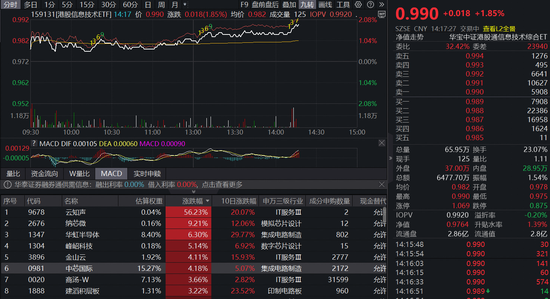
Core Viewpoint - The Hong Kong stock market is experiencing a surge in the hard technology sector, particularly in the semiconductor industry, with significant gains in stocks like Yunzhisheng and Naxinwei, and the launch of the first ETF focused on the Hong Kong chip industry [1][3]. Group 1: Market Performance - Yunzhisheng's stock price surged by 56%, while Naxinwei increased by over 9%, Huahong Semiconductor rose by over 6%, and SMIC gained over 4% [1]. - The newly launched Hong Kong Information Technology ETF (159131) saw a price increase of 1.85%, with a real-time transaction volume exceeding 64.77 million CNY [1][2]. Group 2: ETF Details - The Hong Kong Information Technology ETF (159131) is the first ETF focusing on the "Hong Kong chip" industry chain, with a composition of 70% hardware and 30% software, covering 42 hard technology companies [3]. - Key holdings in the ETF include SMIC with a weight of 15.26%, Xiaomi Group-W at 11.95%, and Huahong Semiconductor at 8.40% [3]. Group 3: Semiconductor Market Insights - According to SIA data, global semiconductor sales are projected to reach 75.28 billion USD by November 2025, marking 25 consecutive months of year-on-year growth [1]. - China's semiconductor sales are expected to be 20.23 billion USD, reflecting a year-on-year increase of 22.9% and a month-on-month increase of 3.9% [1].
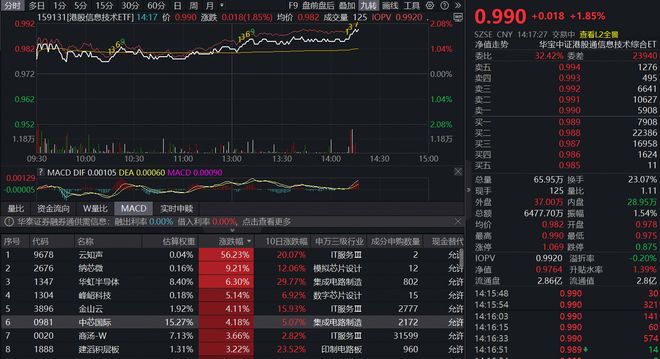
港股芯片午后急涨!华虹半导体、中芯国际双双大涨,港股信息技术ETF(159131)劲涨1.85%
Xin Lang Cai Jing· 2026-01-28 06:46
Core Viewpoint - The Hong Kong stock market's hard technology sector is experiencing a significant rally, with notable increases in stock prices for companies like Yunzhisheng and Naxinwei, alongside the launch of the first ETF focused on the Hong Kong chip industry [1][5]. Group 1: Market Performance - Yunzhisheng's stock surged by 56%, Naxinwei increased by over 9%, Huahong Semiconductor rose by over 6%, and SMIC gained over 4% [1][5]. - The Hong Kong Information Technology ETF (159131), which focuses on the chip industry, saw its price rise by 1.85%, with a trading volume exceeding 64.77 million yuan [1][5]. Group 2: ETF Details - The ETF is the first in the market to focus on the Hong Kong chip industry, with a composition of 70% hardware and 30% software, covering 42 hard technology companies [3][7]. - Key holdings in the ETF include SMIC with a weight of 15.26%, Xiaomi Group-W at 11.95%, and Huahong Semiconductor at 8.40% [3][7]. - The ETF excludes major internet companies like Alibaba, Tencent, and Meituan, allowing for a sharper focus on the AI hard technology sector [3][7]. Group 3: Semiconductor Market Insights - According to SIA data, global semiconductor sales are projected to reach $75.28 billion by November 2025, marking 25 consecutive months of year-on-year growth [6][8]. - China's semiconductor sales are expected to be $20.23 billion, reflecting a year-on-year increase of 22.9% and a month-on-month increase of 3.9% [6][8]. - In the storage segment, both DRAM and NAND Flash contract prices rose in November, with DRAM spot prices continuing to increase in December [6][8].
异动盘点0128 | 内房股多数上涨,芯片股表现强势;医疗保险股盘前集体大跌,热门中概股盘前走高
贝塔投资智库· 2026-01-28 04:01
Group 1: Hong Kong Stock Market Performance - Most property stocks in Hong Kong rose, with China Jinmao (00817) up 7.95%, Greentown China (03900) up 5.79%, and China Overseas Macro Yang Group (00081) up 4.62%. Vanke Enterprises (02202) also saw a gain of 2.49% following significant progress in debt resolution, with the extension proposals for two medium-term notes totaling 5.7 billion yuan approved [1][1]. - Pop Mart (09992) increased by over 4.8%, reflecting confidence in its development as it recently repurchased shares for the first time since early 2024, which is expected to attract more investors [1][1]. - Nanshan Aluminum International (02610) rose over 4.7% after announcing plans to invest approximately 4.37 billion USD (about 30.56 billion yuan) in a new aluminum project in Indonesia [1][1]. Group 2: Notable Company Announcements - Alibaba Health (00241) rose over 3.3% after launching a new feature for its AI medical application "Hydrogen Ion" [2][2]. - GCL Global (GCL.US) increased by 9.91% ahead of its earnings call scheduled for January 30, 2026 [5][5]. - Ericsson (ERIC.US) continued its upward trend with a 4.03% increase after reporting a strong Q4 2025 financial performance, with adjusted EBITA rising 24% year-on-year [5][5]. Group 3: Market Trends and Price Adjustments - The gold market saw a significant rise, with spot gold prices surpassing 5200 USD, leading to a 7.38% increase in the shares of Wan Guo Gold Group (03939) [2][2]. - The semiconductor sector showed strong performance, with stocks like Naxin Micro (02676) up 10.62% and a price adjustment announcement from Zhongwei Semiconductor indicating a price increase of 15% to 50% due to supply-demand pressures [3][4]. - The storage sector also experienced a pre-market surge, with Micron Technology (MU.US) up 5.44% as price increases spread across the storage market [7][7].



债市早报:2025年全国规模以上工业企业利润实现增长;资金面有所改善,债市震荡调整
Jin Rong Jie· 2026-01-28 03:42
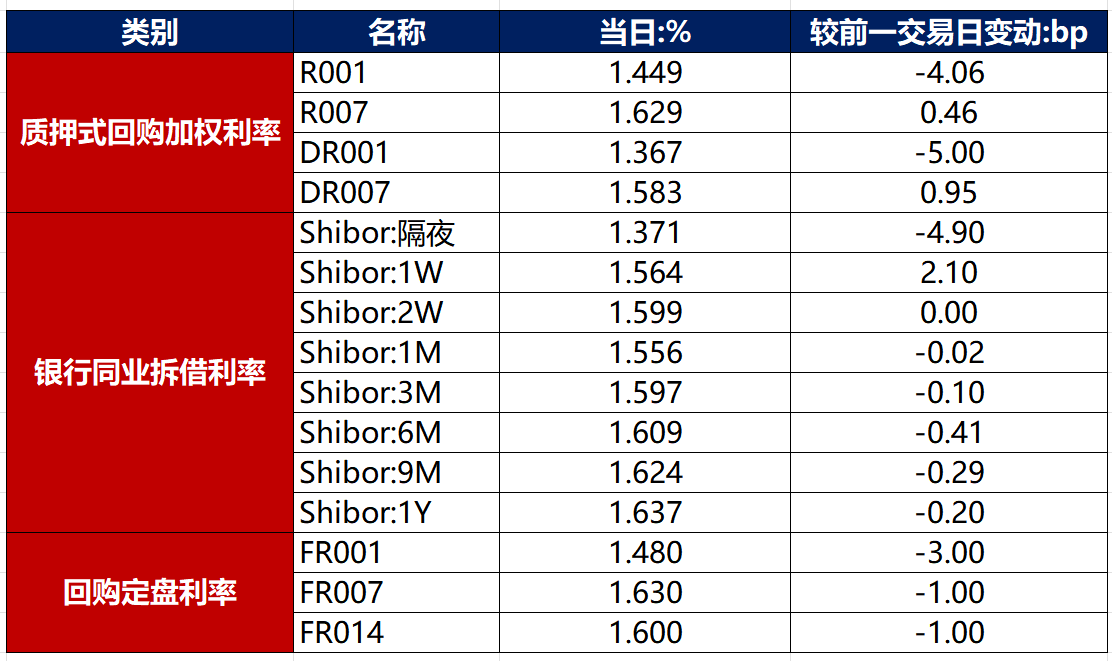
Group 1: Domestic News - The UK Prime Minister Starmer will visit China from January 28 to 31, marking the first visit by a UK Prime Minister in eight years, with discussions on trade and investment cooperation expected [2] - The Ministry of Human Resources and Social Security plans to expand the scale of entrusted investment of the basic pension insurance fund, with the total income of three social insurance funds reaching 9.1 trillion yuan and total expenditure at 8.1 trillion yuan by the end of 2025 [2] - By the end of 2025, the loan acquisition rate for technology-based small and medium-sized enterprises reached 50.2%, an increase of 2 percentage points from the previous year [3] Group 2: Economic Indicators - The profits of industrial enterprises above designated size in China increased by 0.6% year-on-year in 2025, reversing a three-year decline, with significant contributions from equipment manufacturing and high-tech industries [3] - Jilin Province has successfully exited the list of key local debt provinces, achieving the standards set in its 14th Five-Year Plan [4] Group 3: International News - The Federal Reserve is expected to pause interest rate cuts for the first time since September, maintaining the benchmark rate between 3.5% and 3.75% [5] - India and the EU have finalized a historic free trade agreement, with India agreeing to eliminate tariffs on over 90% of EU goods, marking a significant shift in trade relations [6] Group 4: Market Dynamics - The bond market showed fluctuations with the stock market's performance, as the yield on the 10-year government bond rose by 0.70 basis points to 1.8320% [11] - The convertible bond market saw a collective increase in major indices, although most individual convertible bonds experienced declines, with 162 bonds rising and 207 falling [14] Group 5: Commodity Prices - International crude oil prices increased, with WTI crude rising by 2.90% to $62.39 per barrel, while natural gas prices saw a slight decline [7] Group 6: Financial Operations - The central bank conducted a reverse repurchase operation of 402 billion yuan at a fixed rate, resulting in a net injection of 78 billion yuan into the market [8] - The money market showed improvement with the DR001 rate decreasing by 5.00 basis points to 1.367% [9]


港股异动 | 芯片股表现强势 AI驱动半导体产业链价格全线调涨 两家半导体企业官宣涨价
智通财经网· 2026-01-28 02:28
Group 1 - Semiconductor stocks are performing strongly, with notable increases in share prices: Naxin Micro up 14.45% to HKD 161.6, Zhaoyi Innovation up 9.84% to HKD 352.6, Huahong Semiconductor up 5.87% to HKD 120.9, and SMIC up 3% to HKD 78.9 [1] - On January 27, 2023, Zhongwei Semiconductor announced a price increase for MCU and Norflash products due to severe supply-demand conditions and significant cost pressures, with price adjustments ranging from 15% to 50% [1] - Guokai Micro also issued a price increase notice, with KGD products seeing price hikes of 40% for 512Mb, 60% for 1Gb, and 80% for 2Gb, while prices for external DDR products will be announced separately [1] Group 2 - Dongguan Securities believes that the AI-driven semiconductor industry is experiencing widespread price increases, which may exert cost pressure on downstream consumer electronics (such as smartphones and computers), potentially affecting terminal shipments [1] - The investment in AI facilities is expected to increase steadily until 2026, which is considered a certain event, suggesting investment opportunities in advanced semiconductor packaging, related equipment, and CPUs [1]