
XIAOMI(01810)

Search documents
小米集团-W(01810.HK)订25亿港元自动股份购回计划
Ge Long Hui· 2026-01-22 10:29
格隆汇1月22日丨小米集团-W(01810.HK)宣布,公司于2026年1月22日与一家独立经纪商订立协议,据 此,经纪商将根据经纪协议所载之预定参数于香港联合交易所有限公司购回不超过25亿港元之公司B类 普通股(「股份」)(「自动股份购回计划」)。 ...
小米集团-W(01810)1月22日斥资2.01亿港元回购571.38万股
Zhi Tong Cai Jing· 2026-01-22 10:29
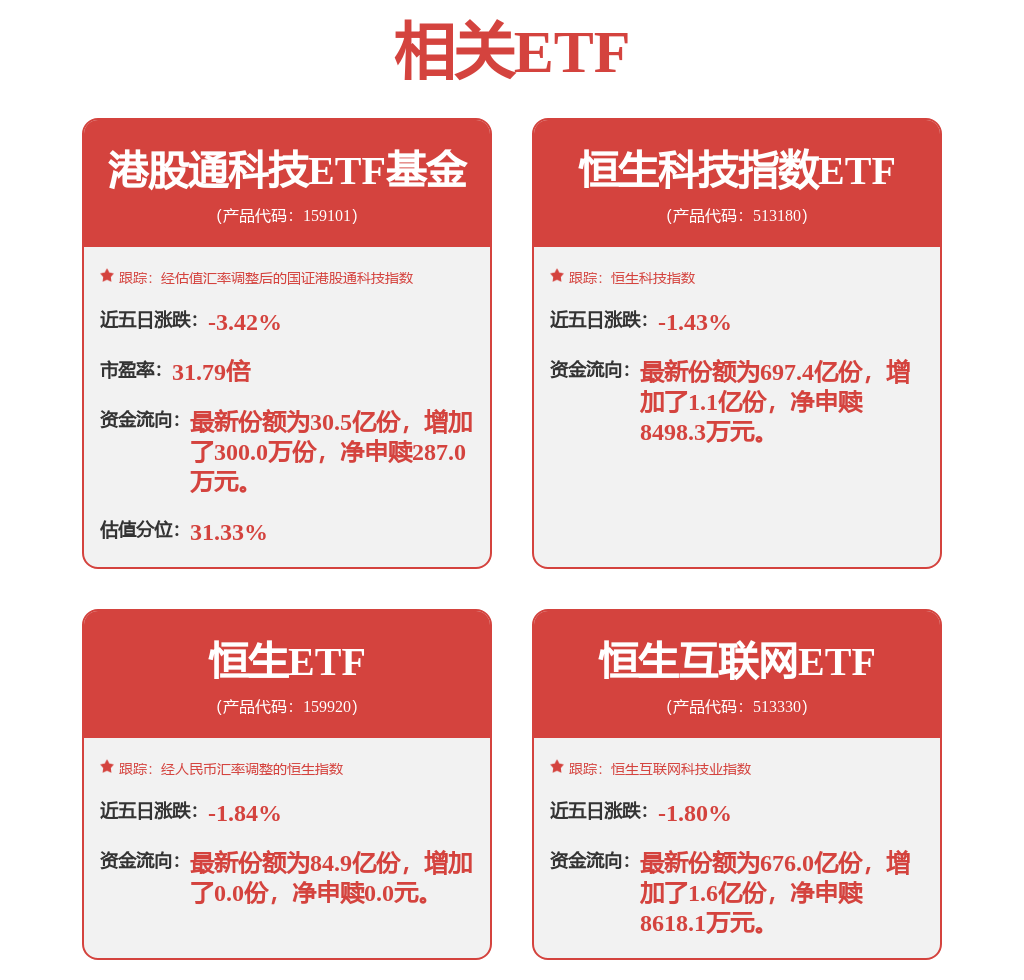
(原标题:小米集团-W(01810)1月22日斥资2.01亿港元回购571.38万股) 智通财经APP讯,小米集团-W(01810)发布公告,于2026年1月22日,该公司斥资2.01亿港元回购571.38万股股份,每股回购价34.92-35.24港元。 于同日,公司根据股份计划发行42.62万股股份。 | 港股通科技ETF基金 | | --- | | (产品代码:159101) | | ★ 跟踪:经估值汇率调整后的国证港股通科技指数 | | 近五日涨跌: -3.42% | | 市盈率:31.79倍 | | 资金流向: 最新份额为30.5亿份,增加 了300.0万份,净申赎287.0 厅元。 | | 估值分位:31.33% | ...

小米集团-W拟购回不超过25亿港元的公司B类普通股
Zhi Tong Cai Jing· 2026-01-22 10:23
Core Viewpoint - Xiaomi Group-W (01810) has entered into an agreement with an independent broker to repurchase up to HKD 2.5 billion of its Class B ordinary shares, demonstrating confidence in its business outlook and aligning with the best interests of the company and its shareholders [1] Group 1 - The repurchase agreement is set to take place on January 22, 2026, and will be executed on the Hong Kong Stock Exchange [1] - The company plans to cancel the shares repurchased under this automatic share buyback program [1]
法巴天星保险开业 将围绕新能源汽车生态深耕专属车险产品
2 1 Shi Ji Jing Ji Bao Dao· 2026-01-22 10:20
Group 1 - Beijing Fabaa Tianxing Property Insurance Co., Ltd. officially announced its opening on January 22, three months after receiving approval to commence operations, marking its entry into the Chinese property insurance market [1] - The establishment of Fabaa Tianxing Insurance was approved by the National Financial Regulatory Administration on October 17, 2024, with a requirement to complete the setup within one year, which was successfully achieved [1] - The company received approval to commence operations on October 17, 2025, after completing its setup [1] Group 2 - Fabaa Tianxing Insurance's business scope includes motor insurance, enterprise/home property insurance, engineering insurance (excluding special risk insurance), liability insurance, marine/cargo insurance, short-term health/accident insurance, reinsurance for the aforementioned businesses, and other insurance fund utilization businesses permitted by laws and regulations [3] - The registered capital of Fabaa Tianxing Insurance is 1 billion RMB, with shareholders including the globally recognized insurance group, France Paris Insurance Group (49% stake), Volkswagen Financial Services Overseas (18% stake), and Sichuan Yinmi Technology Co., Ltd. (33% stake), which is a member of Xiaomi Group [3][4] - Fabaa Tianxing Insurance aims to focus on the rapidly growing new energy vehicle insurance sector, leveraging synergies with its shareholders' businesses, and will continuously optimize claims processes to enhance service experiences for new energy vehicle owners [4]
小米集团-W1月22日斥资2.01亿港元回购571.38万股
Zhi Tong Cai Jing· 2026-01-22 10:17
小米集团-W(01810)发布公告,于2026年1月22日,该公司斥资2.01亿港元回购571.38万股股份,每股回 购价34.92-35.24港元。 于同日,公司根据股份计划发行42.62万股股份。 ...
小米集团(01810) - 自动股份购回计划公告
2026-01-22 10:16
香港交易及結算所有限公司及香港聯合交易所有限公司對本公告的內容概不負責,對其準確性或完整性亦不發表 任何聲明,並明確表示,概不對因本公告全部或任何部份內容而產生或因倚賴該等內容而引致的任何損失承擔任 何責任。 XIAOMI CORPORATION 小米集團 (於開曼群島註冊成立以不同投票權控制的有限公司) 股份代號:1810(港幣櫃台)及81810(人民幣櫃台) 自動股份購回計劃公告 自動股份購回計劃 小米集團(「本公司」)董事會(「董事會」)欣然宣佈,本公司於2026年1月22日與一家獨立 經紀商(「經紀商」)訂立協議(「經紀協議」),據此,經紀商將根據經紀協議所載之預定參 數於香港聯合交易所有限公司(「聯交所」)購回不超過25億港元之本公司B類普通股(「股 份」)(「自動股份購回計劃」)。 自動股份購回計劃將受限於(其中包括)香港聯合交易所有限公司證券上市規則(「上市 規則」)第10.06(2)(a)條及聯交所指引信117-23(「指引信117-23」)所載交易限制。自動股份 購回計劃將於2026年1月23日開始實施,並將在以下最早日期結束:(i)本公司將於緊接 2026年舉行的股東週年大會日期之前一日; ...
2025年中国智能手机市场再洗牌:华为重返榜首,苹果、vivo并列第二
Guo Ji Jin Rong Bao· 2026-01-22 10:15
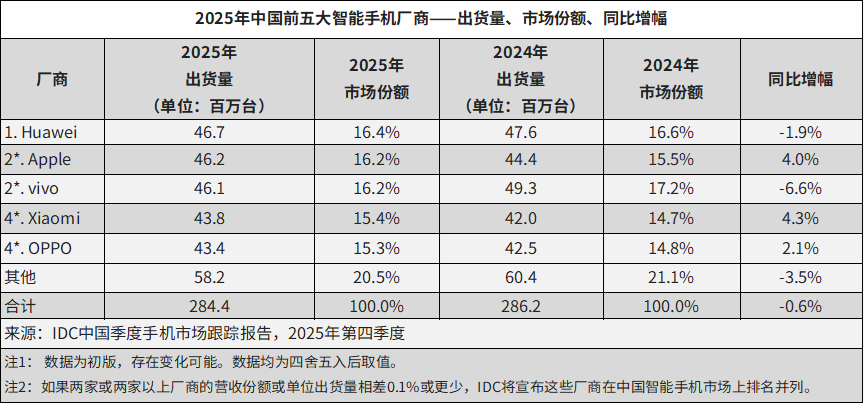
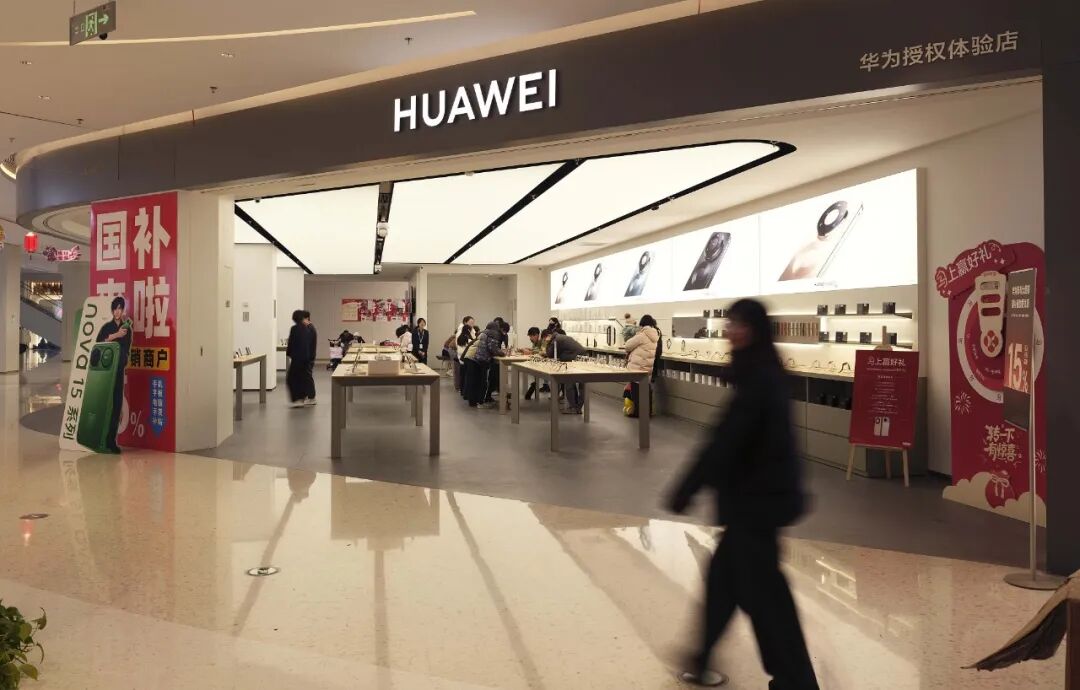
Core Viewpoint - The Chinese smartphone market is projected to see a slight decline in shipments in 2025, with a total of approximately 284 million units, representing a year-on-year decrease of 0.6% [1][2]. Market Overview - The first half of 2025 experienced growth due to the "national subsidy" and the Spring Festival sales peak, but the market showed weakness in the second half due to early demand release, depletion of subsidy funds, and rising costs [1]. - IDC forecasts a more significant decline in shipments for 2026, driven by ongoing cost pressures, particularly from expected increases in storage prices [1]. Market Share and Rankings - Huawei regained the top position in the Chinese smartphone market with shipments of 46.7 million units and a market share of 16.4%, marking its return to the number one spot for the first time since 2020 [1][2]. - Apple and Vivo are tied for second place, with shipments of 46.2 million and 46.1 million units, respectively, both holding a market share of 16.2% [2]. - Xiaomi and OPPO follow in fourth and fifth places, with shipments of approximately 43.8 million and 43.4 million units, respectively, both exceeding 15% market share [1][2]. Year-on-Year Changes - Huawei's shipments decreased by 1.9% compared to 2024, while Vivo experienced a more significant decline of 6.6%, placing it at the bottom among the top manufacturers [3]. - In contrast, Apple, Xiaomi, and OPPO saw slight increases in their shipment volumes, with Apple ending a three-year decline in shipments [3]. - The iPhone 17 Pro Max emerged as the best-selling model, enhancing Apple's position in the high-end market segment [3]. - Xiaomi's strategy to penetrate the high-end market with models like the Xiaomi 17 Pro and Pro Max has resulted in a doubling of its market share in the segment above $600, while maintaining a strong position in the sub-$200 market [3].

小米集团-W(01810.HK)1月22日耗资2亿港元回购571.4万股
Ge Long Hui· 2026-01-22 10:12
格隆汇1月22日丨小米集团-W(01810.HK)公告,1月22日耗资2亿港元回购571.4万股。 ...
2025手机销量迷局:华为到底是第一还是第五? | 深网
Xin Lang Cai Jing· 2026-01-22 10:08
Core Viewpoint - The competition in the Chinese smartphone market is extremely fierce, with slight differences in market positions among leading brands, as highlighted by the activation volume rankings for 2025 [2][4]. Market Rankings - The top five brands in terms of activation volume for 2025 are: 1. Vivo (including IQOO) with 46.36 million units and a market share of 16.77%, showing a decrease of 2.58% from 2024 2. Xiaomi (including REDMI) with 45.88 million units and a market share of 16.60%, increasing by 5.41% from 2024 3. Apple with 45.21 million units and a market share of 16.35%, increasing by 9.34% from 2024 4. OPPO (including OnePlus and realme) with 43.99 million units and a market share of 15.91%, increasing by 7.63% from 2024 5. Huawei with 43.40 million units and a market share of 15.70%, decreasing by 0.96% from 2024 [3][15]. Discrepancies in Data - There is a notable discrepancy between the activation volume and shipment data, with Huawei ranking first in shipment volume according to major research firms, while it ranks fifth in activation volume [5][17]. - The difference in rankings has raised questions about the accuracy of the data, particularly why Huawei's shipment figures exceed its activation numbers by over 300,000 units [20]. Sales Channels - The majority of smartphone sales in China occur through offline channels, which account for approximately 70% of total sales, while Xiaomi has historically leaned towards online sales [6][18]. - The sales process involves multiple stages: Sell In (SI), Sell Through (ST), and Sell Out (SO), with most research firms reporting on SI data, while actual user activation (SO) remains confidential [19]. Xiaomi's Strategy - Xiaomi's activation volume surpasses its reported shipment volume by approximately 200,000 units, attributed to its direct online sales model, which shortens the time from shipment to activation [10][21]. - During the 2025 Double Eleven shopping festival, Xiaomi reported total sales exceeding 29 billion yuan, highlighting the effectiveness of its online sales strategy [22]. High-End Market Focus - Xiaomi has been focusing on high-end market penetration since implementing its dual-brand strategy in 2019, investing around 105 billion yuan in R&D over the past five years [11][22]. - The company aims to compete directly with Apple and Huawei in the high-end segment, where it currently holds a market share of only 7.4% compared to Apple's 48% and Huawei's 33.4% [12][22]. Technological Investments - Xiaomi is investing in self-developed SoC chips to enhance its competitive edge in the high-end smartphone market, indicating a long-term commitment to building a strong brand presence [23].
小米集团(01810) - 翌日披露报表
2026-01-22 10:07
翌日披露報表 (股份發行人 ── 已發行股份或庫存股份變動、股份購回及/或在場内出售庫存股份) 表格類別: 股票 狀態: 新提交 FF305 公司名稱: 小米集团 (於開曼群島註冊成立以不同投票權控制的有限公司) 呈交日期: 2026年1月22日 如上市發行人的已發行股份或庫存股份出現變動而須根據《香港聯合交易所有限公司(「香港聯交所」)證券上市規則》(「《主板上市規則》」)第13.25A條 / 《香港聯合交易所有限公司GEM證券 上市規則》(「《GEM上市規則》」)第17.27A條作出披露,必須填妥第一章節 。 | 第一章節 | | | | | | | | | | --- | --- | --- | --- | --- | --- | --- | --- | --- | | 1. 股份分類 | 不同投票權架構公司普通股 | | 股份類別 B | | 於香港聯交所上市 | 是 | | | | 證券代號 (如上市) | 01810 | 說明 | | | | | | | | 多櫃檯證券代號 | 81810 | RMB 說明 | | | | | | | | A. 已發行股份或庫存股份變動 | | | | | | | ...