
XIAOMI(01810)

Search documents
小米集团拟回购不超25亿港元股份
Zheng Quan Ri Bao Zhi Sheng· 2026-01-22 16:39
Group 1 - Xiaomi Group announced a share repurchase agreement with an independent broker to buy back up to HKD 2.5 billion of its Class B ordinary shares, starting January 23 [1] - The company has spent a total of HKD 2.25 billion on share repurchases since the beginning of 2026, reflecting confidence in its business outlook [1] - Xiaomi's Q3 2025 earnings report showed revenue of CNY 113.12 billion, a year-on-year increase of 22.3%, and an adjusted net profit of CNY 11.31 billion, up 80.9% year-on-year [1] Group 2 - Xiaomi's CEO Lei Jun emphasized the importance of building a strong team in the smart driving sector, with over 1,800 personnel and R&D centers in Beijing, Shanghai, and Wuhan [2] - Analysts noted that the share buyback initiative demonstrates the company's confidence in its future development and suggests that the current stock price may be undervalued [2] - The trend of share buybacks among Hong Kong-listed companies, including Geely and Pop Mart, is driven by economic uncertainties and the desire to stabilize investor confidence [2][3]

港股公告掘金 | 优必选拟出资3亿元成立合伙企业在智能机器人产业链领域开展投资
Zhi Tong Cai Jing· 2026-01-22 15:19
Major Events - UBTECH (09880) plans to invest 300 million yuan to establish a partnership for investments in the smart robotics industry chain [1] - Tian Ge Interactive (01980) received a 1.41% discount from Sina Hong Kong for a partial tender offer to acquire 32.5 million shares, with trading resuming on January 22 [1] - Fosun Pharma (02196) received approval for the drug registration application of heavy tartrate norepinephrine injection [1] - Valiant (09887) received orphan drug designation (ODD) from the European Commission for Valiant™ for the treatment of extra-pulmonary neuroendocrine carcinoma [1] - GCL-Poly Energy (01050) secured orders for AI giant server enclosures, accelerating ASIC business production, and commenced construction of a new base in Thailand [1] - China Rare Earth Holdings (03788) plans to raise approximately 783 million HKD to support the development of the Mt Bundy gold mine project [1] - Nanshan Aluminum International (02610) plans to place 31 million shares, aiming to raise approximately 1.9868 billion HKD [1] - Qiming Medical-B (02500) reported a patent infringement lawsuit against Edwards by Cardiovalve Ltd. and MTH IP, L.P. regarding US Patent No. 385 [1] - Minmetals Resources (01208) expects total copper production of 506,900 tons in 2025, a year-on-year increase of 27% [1] - Prudential (02378) invested approximately 375 million USD to increase its stake in PAMB to 70% [1] - Nocoda Technology (00519) successfully implemented innovative smart handling robots in Hong Kong public housing estates [1] - Idali Holdings (00720) B-ON Global S.àr.l. plans to acquire 1.3 billion shares of the company, becoming the major shareholder [1] Bonds and Notes - China Shipbuilding Leasing (03877) subsidiary plans to issue 2.338 billion HKD convertible bonds [2] Buybacks/Reductions - China Communications Construction (01800) repurchased 1.06837 million HKD worth of 1.2588 million A-shares on January 22 [2] - Kuaishou-W (01024) spent approximately 29.9714 million HKD to repurchase 380,000 shares on January 22 [2] - Xiaomi Group-W (01810) repurchased shares worth 201 million HKD, acquiring 5.7138 million shares on January 22 [2] - Xiaomi Group-W (01810) plans to repurchase up to 2.5 billion HKD of Class B ordinary shares [2] - Sanhua Intelligent Control (02050) controlling shareholders, directors, and executives plan to collectively reduce their holdings by up to approximately 10.2037 million A-shares [2] Operating Performance - AsiaInfo Technologies (01675) expects to turn cash flow positive by 2025, driven by rapid growth in AI business [2] - Zhaoyi Innovation (03986) issued a profit warning, expecting a net profit of approximately 1.61 billion yuan in 2025, a year-on-year increase of about 46% [2] - MicroPort Medical (00853) issued a profit warning, expecting a net profit of no less than 20 million USD in 2025, turning profitable year-on-year [2]

1月22日重要资讯一览
Zheng Quan Shi Bao Wang· 2026-01-22 15:19
Group 1 - The People's Bank of China will continue to implement a moderately loose monetary policy in 2026, focusing on promoting stable economic growth and reasonable price recovery [1] - The central bank plans to conduct a 900 billion yuan MLF operation on January 23, 2026, to maintain liquidity in the banking system [1] Group 2 - The State Council's Food Safety Office is drafting national standards for prepared dishes to protect consumer rights and promote high-quality industry development [2] - Major banks in China, including ICBC and ABC, have announced the implementation of personal consumption loan interest subsidy policies [2] Group 3 - Beijing plans to increase computing power supply, aiming to build a total computing power scale of around 200,000 P by 2027 [2] Group 4 - Xiaomi Group has initiated a share repurchase plan of up to 2.5 billion HKD [5] - Hengyi Petrochemical plans to repurchase shares worth 500 million to 1 billion yuan [5] - Yunyi Electric plans to repurchase shares worth 100 million to 150 million yuan [5] Group 5 - Xidong Pharmaceutical plans to repurchase shares worth 25 million to 50 million yuan [6] - Several companies, including Haikang Information and Huitian Ruisheng, have announced plans for shareholder reductions [6] - Notable profit forecasts for 2025 include a projected net profit increase of 241.55% to 339.13% for Te Yi Pharmaceutical and 137.73% to 201.74% for Qingsong Co. [6]


小米集团-W(01810.HK)1月22日回购571.38万股,耗资2.01亿港元
Zheng Quan Shi Bao Wang· 2026-01-22 14:20
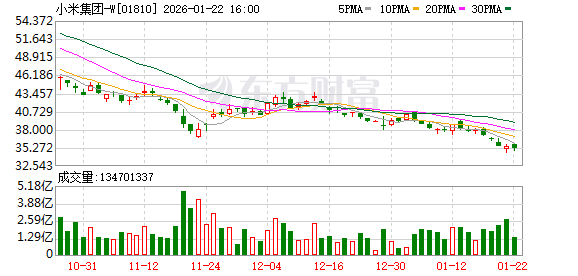
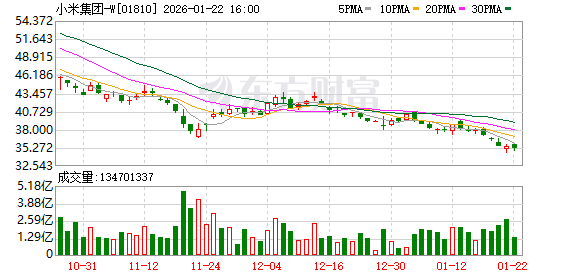
证券时报·数据宝统计,小米集团-W在港交所公告显示,1月22日以每股34.920港元至35.240港元的价格 回购571.38万股,回购金额达2.01亿港元。该股当日收盘价35.240港元,下跌0.51%,全天成交额47.19 亿港元。 自1月13日以来公司已连续8日进行回购,合计回购4001.38万股,累计回购金额14.60亿港元。 其间该股 累计下跌9.03%。 小米集团-W回购明细 | 日期 | 回购股数(万股) | 回购最高价(港元) | 回购最低价(港元) | 回购金额(万港元) | | --- | --- | --- | --- | --- | | 2026.01.22 | 571.38 | 35.240 | 34.920 | 20073.39 | | 2026.01.21 | 700.00 | 35.480 | 35.220 | 24772.29 | | 2026.01.20 | 550.00 | 35.860 | 35.460 | 19607.97 | | 2026.01.19 | 400.00 | 36.520 | 36.360 | 14582.26 | | 2026.01.16 | 590 ...

小米回购计划公布:最高25亿港元!
Zheng Quan Shi Bao· 2026-01-22 14:02
1月22日,小米集团在港交所公告称,拟购回不超过25亿港元的公司B类普通股。 公告称,购回计划将自1月23日起,持续至2026年股东周年大会前一日、购回总额达25亿港元或协议提前终 止三者中最早发生之日。 小米集团认为,实施自动股份购回计划可展示本公司对自身业务前景充满信心,符合公司及股东的整体最 佳利益。公司其后将注销自动股份购回计划下购回的股份。 (文章来源:证券时报) ...
净买入逾52亿港元 加仓阿里及小米流出中移动
Xin Lang Cai Jing· 2026-01-22 11:55
Core Viewpoint - Southbound capital continues to flow into Hong Kong stocks, with a net inflow of approximately 52.39 billion HKD today, marking the fifth consecutive trading day of inflows [2][3]. Group 1: Market Overview - Today's southbound trading volume was about 931.59 billion HKD, a decrease of approximately 158 billion HKD from the previous day, accounting for 39.68% of the total turnover of the Hang Seng Index, falling below 40% [2]. - The Hong Kong stock market exhibited a mixed performance, with the three major indices showing varied results [2]. Group 2: Stock Performance - Significant net buying by southbound capital included: - Alibaba-W (09988.HK): 14.13 billion HKD - China National Offshore Oil Corporation (00883.HK): 5.92 billion HKD - Kuaishou-W (01024.HK): 4.79 billion HKD - China Life (02628.HK): 4.45 billion HKD - Pop Mart (09992.HK): 3.74 billion HKD - Xiaomi Group-W (01810.HK): 4.47 billion HKD [3]. - Major net outflows included: - China Mobile (00941.HK): 8.74 billion HKD - Tencent Holdings (0700.HK): 6.69 billion HKD - Horizon Robotics-W (09660.HK): 1.21 billion HKD [3]. Group 3: Individual Stock Insights - Alibaba-W increased by 0.98%, with a net accumulation of 2.042 million shares over the past five days, indicating a short-term focus on inflows [4]. - China National Offshore Oil Corporation rose by 2.52%, but saw a reduction of 836,000 shares over the past five days, suggesting a prevailing trend of outflows [5]. - Kuaishou-W experienced a slight increase of 0.38%, with a reduction of 401,000 shares over the past five days, indicating a slowdown in outflows [5]. - China Life decreased by 3.82%, with a net accumulation of 3.234 million shares over the past five days, showing a trend of inflows [5]. - Pop Mart surged by 5.97%, with a net accumulation of 196,000 shares over the past five days, indicating sustained inflows [5]. - Xiaomi Group-W fell by 0.51%, with a net accumulation of 917,000 shares over the past five days, continuing the trend of inflows [5]. - China Mobile declined by 0.25%, with a reduction of 4.235 million shares over the past five days, indicating a continued trend of outflows [5]. - Tencent Holdings dropped by 0.83%, with a net accumulation of 470,000 shares over the past five days, suggesting a slowdown in inflows [5]. - Horizon Robotics-W fell by 4.31%, with a reduction of 1.004 million shares over the past five days, indicating a signal of outflows [5].







小米集团宣布最高25亿港元股份回购计划
Mei Ri Jing Ji Xin Wen· 2026-01-22 11:43
【#小米集团宣布最高25亿港元股份回购计划#】1月22日,小米集团在港交所公告称,公司于2026年1月 22日与一家独立经纪商订立协议,据此,经纪商将根据经纪协议所载之预定参数于香港联合交易所有限 公司购回不超过25亿港元之本公司B类普通股。公司认为,实施自动股份购回计划可展示本公司对自身 业务前景充满信心,符合公司及股东的整体最佳利益。公司其后将注销自动股份购回计划下购回的股 份。(每经,德塔) ...
【财闻联播】小米集团宣布最高25亿港元的自动股份回购计划!公用事业领域企业并购首次被亮红牌
Zheng Quan Shi Bao Wang· 2026-01-22 11:08
Macro Dynamics - The General Administration of Customs has issued a consumption alert to immediately stop the use of French Picot infant formula due to potential contamination with Bacillus cereus toxin, with Lactalis recalling multiple batches in 18 countries, including China [2] - The People's Bank of China will conduct a 900 billion MLF operation on January 23, 2026, to maintain ample liquidity in the banking system [2] - Qiu Heng, CMO of Zhiyuan Robotics, has become China's first commercial astronaut after purchasing a ticket for suborbital flight, with the first manned flight expected in 2028 [2] Market Regulation - The State Administration for Market Regulation has prohibited the establishment of a joint venture between two gas companies in Foshan, marking the first ban on mergers in the public utility sector since the implementation of the Anti-Monopoly Law [3] Scientific Research - Researchers at Fudan University have successfully developed "fiber chips," achieving large-scale integrated circuit fabrication within flexible polymer fibers, with a transistor density of 100,000 per cm [4] Financial Institutions - Goldman Sachs has raised its gold price forecast for December 2026 to $5,400 per ounce, up from $4,900, predicting a 17% increase from the average price since January [5] Company Dynamics - CICC announced management changes, with Xu Yicheng stepping down as financial head and Wang Shuguang taking over, while Sun Nan has also left his positions [6] - Xiaomi Group has announced a share buyback plan of up to HKD 2.5 billion, reflecting confidence in its business outlook [10] - ShenNan Electric A expects a net profit of 150 to 180 million yuan for 2025, a year-on-year increase of 584.66% to 721.59%, driven by asset disposals [11] - Geely Holding Group aims to exceed 6.5 million global sales by 2030, with 75% from new energy vehicles and over one-third from overseas markets [11] Market Data - The ChiNext Index rose by 1.01%, with strong performance in the commercial aerospace sector, while the total margin balance in the two markets increased by 11.479 billion yuan [7][8] - The Hang Seng Index increased by 0.17%, with notable gains in stocks like Pop Mart and Baidu, while gold stocks experienced declines [9]
小米集团-W(01810)拟购回不超过25亿港元的公司B类普通股
Zhi Tong Cai Jing· 2026-01-22 10:37
Core Viewpoint - Xiaomi Group-W (01810) has announced a share buyback plan, indicating confidence in its business outlook and aligning with the best interests of the company and its shareholders [1] Group 1 - The company has entered into an agreement with an independent broker to repurchase up to HKD 2.5 billion of its Class B ordinary shares on the Hong Kong Stock Exchange [1] - The shares repurchased under the automatic buyback plan will be subsequently canceled by the company [1] - The implementation of the buyback plan is seen as a demonstration of the company's confidence in its future prospects [1]
小米集团:拟购回不超过25亿港元的公司B类普通股
Mei Ri Jing Ji Xin Wen· 2026-01-22 10:36
每经AI快讯,1月22日,小米集团-W公告,公司于2026年1月22日与一家独立经纪商订立协议,据此, 经纪商将根据经纪协议所载的预定参数于香港联合交易所有限公司购回不超过25亿港元的公司B类普通 股。 ...