CMBC(01988)

Search documents
14家银行“牵手”许昌!未来将提供5500亿元融资支持
Sou Hu Cai Jing· 2025-05-28 12:59
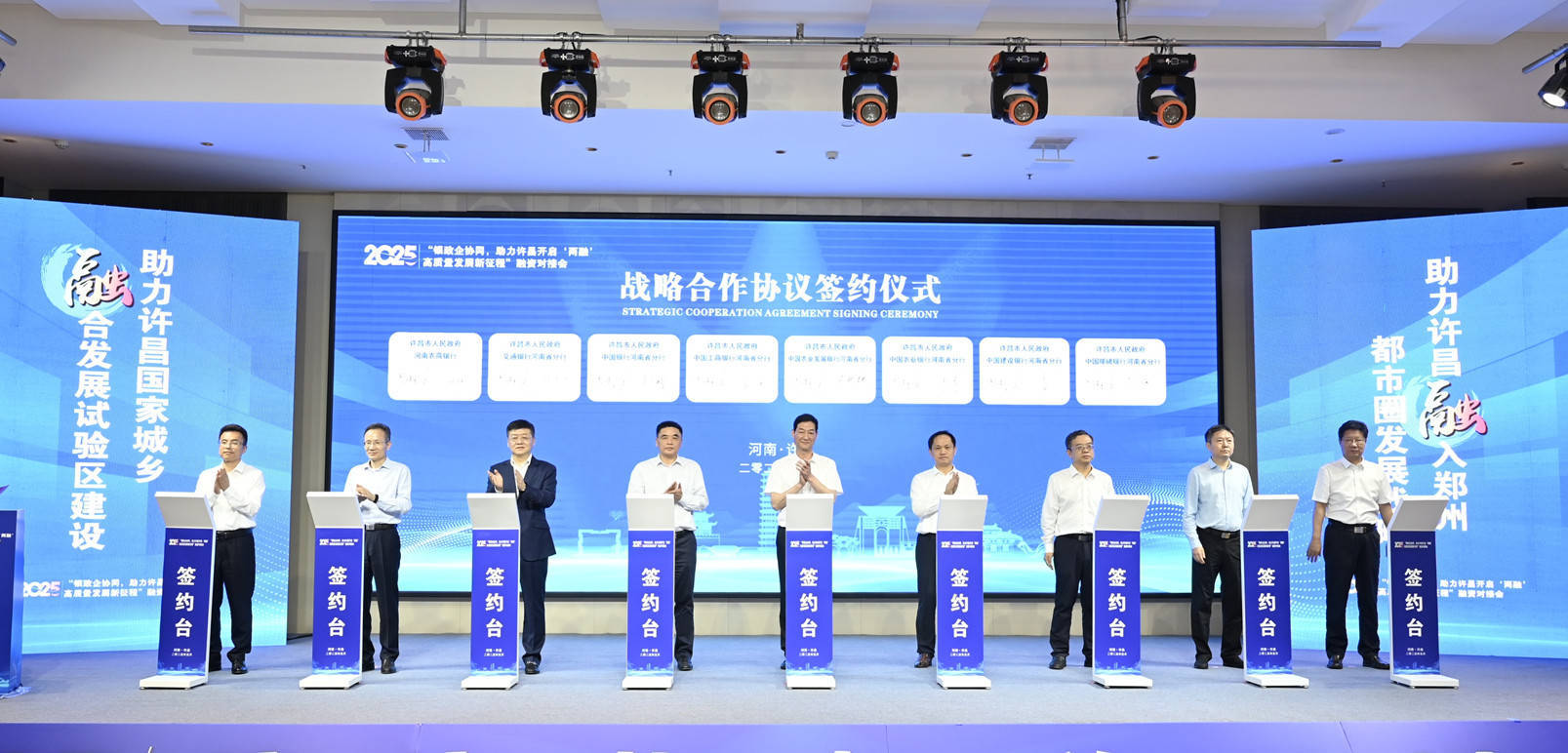
Core Viewpoint - The financing matchmaking event in Xuchang marks a significant advancement in the collaboration between banks, government, and enterprises, aiming to support the high-quality development of the "two financing" model in the region [1][3]. Group 1: Strategic Cooperation - The Xuchang Municipal Government has established deep cooperation intentions with 14 banks, signing strategic cooperation agreements [1]. - The participating banks include major institutions such as Agricultural Development Bank, Industrial and Commercial Bank, Agricultural Bank, Bank of China, and several others [1]. Group 2: Financial Support - Over the next 3 to 5 years, the banks are set to provide approximately 550 billion yuan in financing support to Xuchang, enhancing the financial momentum for the city's "two financing" high-quality development [3]. - The collaboration aims to broaden the channels for bank-enterprise cooperation, with 196 enterprises reaching cooperation intentions with the banks, totaling 56.35 billion yuan [3]. Group 3: Signing Achievements - At the event, 30 enterprises completed on-site agreements with banks, amounting to 20.31 billion yuan [3]. - The successful signing activities reflect the confidence and support of financial institutions in the economic development of Xuchang, providing tangible financing opportunities for local enterprises [3].





首家直销银行即将退场 多家银行对旗下直销银行App进行整合或关停
Mei Ri Jing Ji Xin Wen· 2025-05-27 15:37
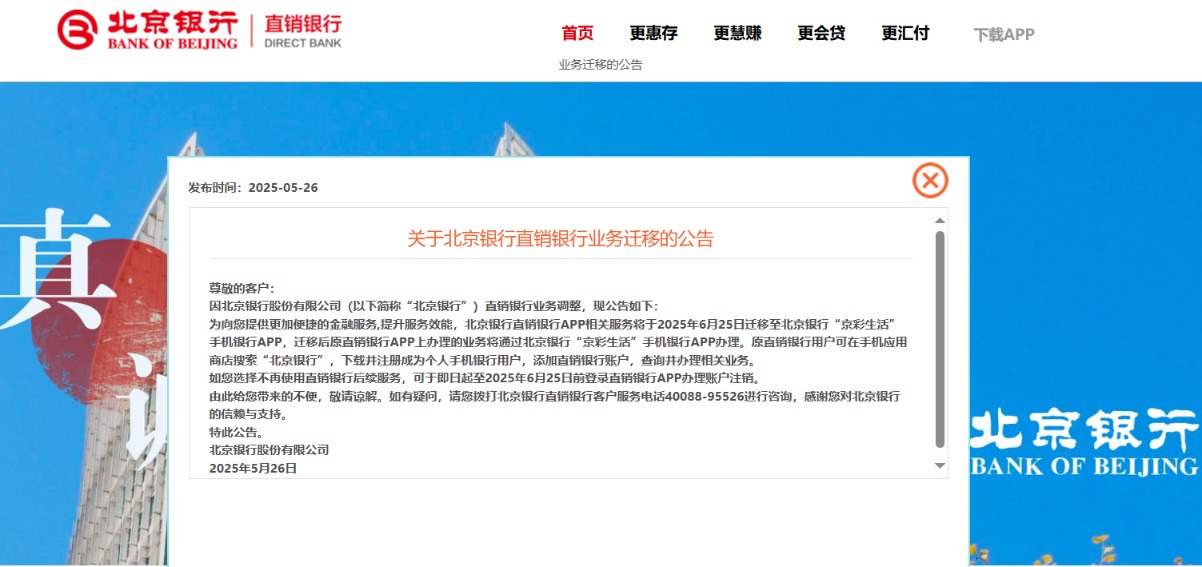
Core Viewpoint - The announcement by Beijing Bank regarding the migration of its direct banking app to its mobile banking platform marks the exit of the first direct bank in China, reflecting a broader trend of at least 19 banks shutting down or integrating their direct banking services since 2023, indicating a decline in the once-promising direct banking model after a decade of rapid growth [1][2]. Group 1: Industry Trends - The number of direct banks in China grew from 22 in 2014 to a peak of 135 by 2017, with city commercial banks accounting for 53.3% of this total [1]. - Major banks like Shanghai Pudong Development Bank and Nanjing Bank began integrating direct banking functions into their mobile banking platforms starting in 2020, leading to a significant reduction in the number of operational direct banking apps [2]. Group 2: Challenges Faced by Direct Banks - Direct banks face fundamental challenges such as unclear positioning, resource wastage, and technological shortcomings, which have made the direct banking model unsustainable [2][3]. - The overlap in functionality between direct banks and mobile banking has led to direct banks being viewed as redundant channels, diminishing their competitive edge [2][3]. - Many direct banks operate under a "departmental system," lacking independent decision-making authority, which hampers their ability to innovate and compete effectively [3][4]. Group 3: Financial Viability - Direct banks have high operational costs but low revenue generation, leading to an imbalance in investment returns [5]. - The regulatory environment poses challenges for banks attempting to establish direct banks as independent entities, further complicating their operational viability [5][6]. Group 4: Future Outlook - The decline of direct banks signifies a shift in the banking industry from "channel expansion" to "ecosystem cultivation," emphasizing the need for banks to leverage technology to enhance service delivery and user value [6][7]. - For banks that continue to operate direct banking services, finding a clear market position and exploring differentiated development strategies will be crucial for survival in a competitive landscape [7].


民生银行北京分行助力民营航天企业飞天逐梦
Cai Jing Wang· 2025-05-27 07:26
Core Viewpoint - The successful launch of the Zhuque-2 rocket by Blue Arrow Aerospace represents a significant achievement for China's private space industry, showcasing the support from Minsheng Bank in fostering technological innovation and development in this sector [1][3][6]. Company Overview - Blue Arrow Aerospace, established in 2015, is one of the earliest private companies in China engaged in the development of launch vehicles, completing a commercialized closed loop in design, research, production, testing, and launching [3]. - The Zhuque series rockets, particularly the Zhuque-2 liquid rocket, exemplify the highest technological standards of China's private aerospace sector and hold a significant position in the global aerospace arena [3]. Financial Support and Collaboration - Since the partnership began in 2021, Minsheng Bank has provided comprehensive financial services to Blue Arrow Aerospace, including financing services, integrated financial systems, and asset management, addressing the company's funding needs at various development stages [3][6]. - Minsheng Bank's support has been crucial during challenging times, such as the failed test flight of the Zhuque-1 rocket in December 2022, where both parties remained committed to the long-term vision of technological advancement [4]. Recent Achievements - On July 12, 2023, the Zhuque-2 rocket successfully launched, marking it as the world's first liquid oxygen-methane rocket to reach orbit, a historic milestone for both Blue Arrow Aerospace and Minsheng Bank [6]. - Minsheng Bank has become the main settlement bank for Blue Arrow Aerospace and has facilitated a fixed asset loan for the construction of the Jiuquan launch site, further solidifying Blue Arrow's leading position in the private aerospace sector [6]. Technological Financial Services - Minsheng Bank has positioned itself as a key player in the technology finance sector, aligning with national innovation strategies and providing tailored financial products to support technology-driven enterprises [7][9]. - The bank has developed a multi-tiered service system and innovative financial product matrix, aiming to create a sustainable ecosystem that integrates technology, industry, and finance [7][8]. Future Outlook - Minsheng Bank aims to continue its commitment to supporting technology enterprises, enhancing their growth potential through open ecosystems and agile services, thereby contributing to the development of new productive forces in China [9].

存银行,还不如买银行股?
第一财经· 2025-05-26 01:26
Core Viewpoint - The decline in domestic deposit rates has diminished the attractiveness of traditional savings, leading to a "substitution effect" where bank stocks are favored over deposits, resulting in strong performance in the banking sector [1][3][10]. Summary by Sections Deposit Rate Decline - Since 2025, domestic deposit rates have been continuously decreasing, with the one-year fixed deposit rate falling below 1%, marking a historical low [3]. - The diminishing returns from traditional savings have reignited discussions around the benefits of investing in bank stocks instead of saving [3]. Dividend Yield Comparison - As of May 23, 2025, among 42 A-share listed banks, 31 banks have a dividend yield exceeding 4%, with some banks like Ping An Bank and Minsheng Bank surpassing 8% [3]. - The significant yield difference has prompted a "substitution effect," where investors see greater returns from bank stocks compared to deposits [3]. Strong Performance of Bank Stocks - The banking sector has shown robust performance, with a year-to-date increase of 7.66%, outperforming the Shanghai and Shenzhen 300 Index, which has declined by 1.34% [3][4]. - Investors, including insurance funds and public funds, have increased their holdings in bank stocks significantly [4][5]. Insurance and Public Fund Involvement - Insurance funds have been the primary players in increasing bank stock holdings, with a 27.2% holding ratio as of Q1 2025, up 4.3 percentage points from the end of 2023 [5]. - Public funds have also increased their allocation to bank stocks, with the proportion rising from 1.2% to 2.5% by the end of Q1 2025 [5]. Sector Performance Disparity - There is a noticeable divergence in performance within the banking sector, with regional banks like Qingdao Bank and Chongqing Rural Commercial Bank showing strong gains, while some larger banks have underperformed [7]. - As of Q1 2025, state-owned banks experienced a 1.5% decline in revenue, while city commercial banks saw a 3% increase [8]. Asset Quality and Non-Performing Loans - The non-performing loan generation rate for large banks has increased, while it has decreased for joint-stock and rural commercial banks [9]. - Regional banks, benefiting from local economic support, maintain lower non-performing loan ratios compared to national banks [9]. Future Outlook - Analysts believe that high dividend strategies will continue to drive bank stock prices in the short term, while net interest margins and asset quality will be critical for long-term performance [11][12]. - The banking sector is facing challenges from asymmetric interest rate cuts, which may pressure net interest margins but could also lower funding costs in the long run [12].




最新!又有多家银行宣布:下调!
天天基金网· 2025-05-22 05:26
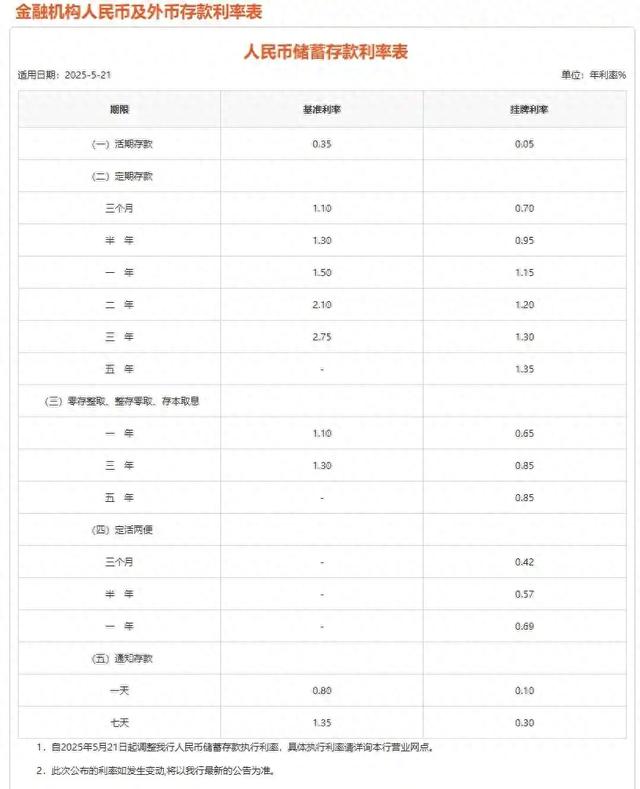
Core Viewpoint - The recent reduction in deposit rates by multiple banks, including state-owned and joint-stock banks, aligns with market expectations and aims to stabilize net interest margins while supporting the real economy [1][5][6]. Group 1: Deposit Rate Adjustments - Nine out of twelve joint-stock banks have announced reductions in deposit rates, with significant cuts in medium to long-term deposit rates, particularly a 25 basis points (BP) decrease for 3-year and 5-year fixed deposits [1][2][3]. - Specific banks like Ping An Bank and Minsheng Bank have adjusted their deposit rates, with Ping An Bank's rates for various terms now at 0.70%, 0.95%, 1.15%, 1.20%, and 1.30%, reflecting reductions of 15 BP for most terms and 25 BP for longer terms [2][3]. - The speed of these adjustments is seen as necessary for banks to manage their liabilities effectively and maintain competitiveness in the current economic environment [5][6]. Group 2: Market Reactions and Expectations - Investors have anticipated the decline in deposit rates, with no significant rush to lock in rates observed at bank branches, indicating a broader acceptance of a long-term downward trend in deposit rates [3][5]. - Experts believe that the synchronized reduction in deposit rates by banks is crucial for reducing financing costs for the real economy and stabilizing net interest margins [5][6]. Group 3: Implications for Banking Sector - The current trend of deposit rate reductions is expected to create more room for lowering financing costs in the future, which is essential for improving banks' profitability and sustainability in serving the real economy [6][7]. - The recent adjustments have seen deposit rate cuts that exceed the reductions in the Loan Prime Rate (LPR), indicating a strategic move by banks to manage their interest expenses more effectively [6][7].




又有多家银行宣布:下调!
新华网财经· 2025-05-22 02:41
Core Viewpoint - The recent reduction in deposit rates by nine joint-stock banks follows the lead of the six major state-owned banks, indicating a broader trend in the banking sector to lower interest rates in response to the central bank's monetary policy adjustments [1][4]. Group 1: Deposit Rate Adjustments - On May 21, seven joint-stock banks announced a reduction in their deposit rates, with a decrease of 15 basis points for 3-month, 6-month, 1-year, and 2-year fixed deposits, and a 25 basis points reduction for 3-year and 5-year fixed deposits [1][2]. - The new deposit rates for various terms at China Merchants Bank are set at 0.95% for 1-year, 1.05% for 2-year, 1.25% for 3-year, and 1.30% for 5-year deposits, while other banks have slightly different rates [1][2]. Group 2: LPR and Monetary Policy - The Loan Prime Rate (LPR) was also adjusted downwards, with the 5-year LPR at 3.5% and the 1-year LPR at 3%, both down by 10 basis points [4]. - Analysts suggest that the central bank is establishing a transmission mechanism from policy rates to LPR and deposit rates, indicating a coordinated approach to monetary policy [4][6]. Group 3: Implications for the Financial Market - The reduction in deposit rates is expected to lower the cost of liabilities for financial institutions and enhance the attractiveness of bond assets compared to loan assets, potentially leading to increased investment in the bond market [4][6]. - The average reduction in deposit rates is greater than that of the LPR, which reflects a strategy to protect bank interest margins while supporting the real economy [6].


活期存款利率已接近0 !7家银行同日发布公告下调存款利率
Guan Cha Zhe Wang· 2025-05-22 00:57
Group 1 - The core viewpoint of the article is that several banks in China have announced a reduction in RMB deposit rates, following a trend initiated by major state-owned banks, which is linked to the recent decrease in the Loan Prime Rate (LPR) [1][4][5] Group 2 - On May 20, six state-owned banks and several others, including China Merchants Bank and China Everbright Bank, announced a reduction in RMB deposit rates, with the adjustment range being 5 to 25 basis points [1] - Following this, on May 21, seven additional banks, including Ping An Bank and CITIC Bank, also announced similar reductions, with the new rates for demand deposits set at 0.05% and various fixed-term deposit rates adjusted accordingly [1][2] - The new fixed-term deposit rates for three months, six months, one year, two years, three years, and five years are 0.7%, 0.95%, 1.15%, 1.20%, 1.30%, and 1.35% respectively [1] - The recent LPR adjustments include a decrease in the 5-year LPR to 3.5% and the 1-year LPR to 3%, both down by 0.1% from the previous month [4] - The reduction in deposit rates is expected to lead to an overall decrease in deposit rates by approximately 0.11 to 0.13 percentage points, which may help stabilize banks' net interest margins [4][5] - As of the first quarter of 2025, the net interest margin for commercial banks was reported at 1.43%, a decrease of 0.09 percentage points, marking a historical low [5]


多家银行跟进,下调存款利率
新浪财经· 2025-05-22 00:43
Core Viewpoint - The recent reduction in deposit rates by nine joint-stock banks follows the earlier actions of the six major state-owned banks, indicating a broader trend in the banking sector to lower interest rates in response to the People's Bank of China's (PBOC) adjustments to the Loan Prime Rate (LPR) [1][3][6] Group 1: Deposit Rate Adjustments - On May 21, seven joint-stock banks announced a reduction in their deposit rates, with a decrease of 15 basis points for 3-month, 6-month, 1-year, and 2-year fixed deposits, and a reduction of 25 basis points for 3-year and 5-year fixed deposits [1][2] - Specific rates for China Merchants Bank were adjusted to 0.95% for 1-year, 1.05% for 2-year, 1.25% for 3-year, and 1.30% for 5-year deposits, while other banks set their rates at 1.15%, 1.20%, 1.30%, and 1.35% respectively for similar terms [1][2] Group 2: LPR and Monetary Policy - The PBOC announced a decrease in the LPR, with the 1-year LPR at 3% and the 5-year LPR at 3.5%, both down by 10 basis points [3] - Analysts suggest that the PBOC is establishing a transmission mechanism from policy rates to LPR and deposit rates, indicating a coordinated approach to monetary policy [3][4] Group 3: Market Implications - The reduction in deposit rates is expected to enhance the attractiveness of bond assets by lowering the yield advantage of loan assets, thereby improving the configuration value of bonds [3][4] - The larger reduction in deposit rates compared to LPR is seen as a measure to protect bank interest margins while encouraging credit growth [6]



跟进!多家股份行下调存款利率
Zhong Guo Jing Ying Bao· 2025-05-22 00:16
中经记者 慈玉鹏 北京报道 继5月20日国有六大行以及招商银行、光大银行宣布下调存款利率后,《中国经营报》记者统计发现,5 月21日又有七家股份行再次跟进下调存款利率,其中长期存款利率下调幅度大于短期。 记者注意到,截至目前,九家股份制银行普遍对六个月、一年期、二年期定存挂牌利率下调15个基点, 三年期、五年期定存挂牌利率普遍下调25个基点。其中长期存款利率下调幅度更大。 同时,除招商银行与五大行保持一致外,其余8家股份制银行整存整取一年期、三年期、五年期挂牌利 率分别降至1.15%、1.3%、1.35%。 或推动"存款搬家" 东方金诚首席宏观分析师王青表示:"截至2025年4月末,活期存款占比34.5%,此次六大行下调存款利 率并带动其他商业银行跟进调整后,或将带动整体存款利率下调0.11—0.13个百分点左右,基本能够覆 盖本次LPR报价下调带动各类贷款利率下行对银行资产端收益的影响,稳定银行净息差。" 从影响看,王青表示,最新数据显示,2025年一季度商业银行净息差为1.43%,较上季度下行0.09个百 分点,再创历史新低,且已明显低于1.8%的警戒水平。本次LPR报价下调带动银行存款利率同步下调, 在 ...
南财早新闻|第21届文博会今日开幕;八部门:支持小微企业融资
2 1 Shi Ji Jing Ji Bao Dao· 2025-05-21 23:40
Group 1 - The 21st China (Shenzhen) International Cultural Industries Fair will be held from May 22 to 26, with a significant "policy package" to support six key areas for high-quality cultural industry development [2] - The European Union plans to impose handling fees on small packages entering the EU, with China's Ministry of Foreign Affairs advocating for a fair and transparent business environment for Chinese enterprises [2] - China and the ten ASEAN countries have completed negotiations for the China-ASEAN Free Trade Area 3.0, adding nine new chapters including digital economy and green economy [2] Group 2 - International gold prices rebounded on May 21, with domestic gold jewelry prices surpassing 1,000 yuan per gram, with notable increases from major retailers [3] - Several banks, including Ping An Bank and CITIC Bank, have lowered deposit rates, particularly for medium- and long-term deposits, with some banks suspending five-year term deposits [3] - A surge in A-share buyback and increase plans has been observed, with 394 companies announcing such plans since the second quarter of 2025, a rise of over 60% compared to the first quarter [3] Group 3 - The Hong Kong Hang Seng Index closed up 0.62%, with BYD shares rising over 4% to a new historical high, and southbound funds net buying exceeding 1.4 billion HKD [4] - UBS noted a growing international interest in Chinese assets, highlighting the strategic importance of the Chinese stock market for global investors seeking excess returns [4] Group 4 - Baidu reported Q1 revenue of 32.452 billion yuan, a 3% year-on-year increase, with a notable 42% growth in Baidu Smart Cloud [5] - Xpeng Motors achieved Q1 revenue of 15.81 billion yuan, a 141.5% year-on-year increase, with a projected delivery volume of 102,000 to 108,000 units in Q2 [5] - Weibo's Q1 revenue remained stable at 396.9 million USD, with a 12% year-on-year increase in adjusted net profit [5] Group 5 - The stock price for Naxin Microelectronics was set at 163.15 yuan per share, with a subscription rate of 1.29 times from institutional investors [6] - The U.S. stock market saw declines across major indices, with significant drops in Chinese concept stocks such as iQIYI and Baidu [6]