
MEITUAN(03690)

Search documents
北水成交净买入9.52亿 科网及芯片股明显分化 内资抛售盈富基金超37亿港元
Zhi Tong Cai Jing· 2026-02-03 11:15
Core Viewpoint - The Hong Kong stock market experienced significant net buying and selling activities, with notable movements in major stocks such as Tencent, Alibaba, and China Mobile, reflecting investor sentiment and market dynamics [1][5][6]. Group 1: Net Buying and Selling Activities - Northbound trading recorded a net buying of HKD 9.52 billion, with the Shanghai Stock Connect contributing HKD 17.33 billion in net buying, while the Shenzhen Stock Connect saw a net selling of HKD 7.81 billion [1]. - Tencent (00700) led the net buying with HKD 22.02 billion, followed by Southbound Hang Seng Technology (03033) with HKD 6.69 billion, and China Mobile (00941) with HKD 4.07 billion [1][5]. - The most significant net selling was observed in the Yingfu Fund (02800) with HKD 25.58 billion, followed by Semiconductor Manufacturing International Corporation (00981) with HKD 8.06 billion, and Alibaba-W (09988) with HKD 5.87 billion [1][5]. Group 2: Stock Performance and Market Sentiment - The technology sector showed a clear divergence, with Tencent and Meituan-W (03690) experiencing net buying, while Alibaba-W faced substantial net selling due to market rumors regarding potential tax rate adjustments [5][6]. - China Mobile's net buying was supported by Morgan Stanley's analysis, suggesting that the company would be less impacted by potential VAT rate increases due to its higher profit margins [5]. - Xiaomi Group-W (01810) reported a net buying of HKD 3.29 billion, attributed to strong electric vehicle deliveries and ongoing investments in AI and robotics [6]. Group 3: Industry Trends and Future Outlook - The semiconductor industry is experiencing price increases, with domestic chip manufacturers announcing price hikes of up to 80%, indicating a continuing trend into the first half of 2026 [6]. - The overall market sentiment is influenced by external factors, including global risk asset movements, which have led to liquidity pressures and a decline in Asian stock markets [7].


美团:为卖课造谣“外卖商家集体下架平台”,主播张某被行拘
Xin Lang Cai Jing· 2026-02-03 10:32
Core Viewpoint - The recent misinformation regarding "Ningbo delivery merchants collectively exiting delivery platforms" has been debunked by authorities, confirming that the delivery business in Ningbo has been operating normally without any collective withdrawal by merchants [1][2]. Group 1 - The public concern was triggered by a false report that spread widely among merchants and delivery personnel [1][2]. - Authorities confirmed that there have been no issues leading to merchants voluntarily exiting the platform in Ningbo since last year [1][2]. - The misinformation was attributed to an individual, Zhang (female, 45 years old), who fabricated the story to gain attention and promote her commercial courses [1][2]. Group 2 - The dissemination of false information has disrupted the order of the online space, prompting legal action against the individual responsible [1][2].
南向资金追踪|净买入超9亿港元 大举加仓腾讯减持中芯国际和阿里
Xin Lang Cai Jing· 2026-02-03 10:32
Core Viewpoint - Southbound funds in Hong Kong experienced a decrease in trading volume, with a total of approximately HKD 126.4 billion, down by HKD 11.9 billion from the previous day, representing 37.72% of the total turnover of the Hang Seng Index, marking a short-term low [2]. Group 1: Southbound Fund Flow - Southbound funds recorded a net inflow of approximately HKD 0.952 billion today, with the Shanghai-Hong Kong Stock Connect seeing a net inflow of about HKD 1.733 billion, while the Shenzhen-Hong Kong Stock Connect had a net outflow of HKD 0.781 billion [2]. - The largest ETF, the Tracker Fund of Hong Kong (盈富基金), faced a net sell-off of HKD 3.762 billion, indicating continued outflows from certain funds [2]. Group 2: Individual Stock Performance - Tencent Holdings (0700.HK) saw a significant net buy of HKD 1.955 billion, despite a price drop of 2.92% [2][4]. - China Mobile (00941.HK) experienced a net buy of HKD 0.408 billion, with a slight price increase of 0.38% [2][4]. - Meituan-W (03690.HK) had a net buy of HKD 0.241 billion, with a price decline of 1.74% [2][4]. - Notable net outflows included Semiconductor Manufacturing International Corporation (00981.HK) at HKD 1.577 billion, Alibaba-W (09988.HK) at HKD 1.199 billion, and Kuaishou-W (01024.HK) at HKD 0.368 billion [2][4]. Group 3: Recent Trading Trends - Over the past five trading days, Tencent Holdings saw an increase of 663,000 shares, indicating continued short-term inflow [3]. - In contrast, China Mobile and Meituan-W experienced reductions in holdings of 4.164 million shares and 655,000 shares respectively, suggesting a trend of outflow [3]. - Kuaishou-W had an increase of 424,000 shares, indicating a short-term inflow despite a price drop of 4.61% [3].


北水动向|北水成交净买入9.52亿 科网及芯片股明显分化 内资抛售盈富基金(02800)超37亿港元
智通财经网· 2026-02-03 09:57
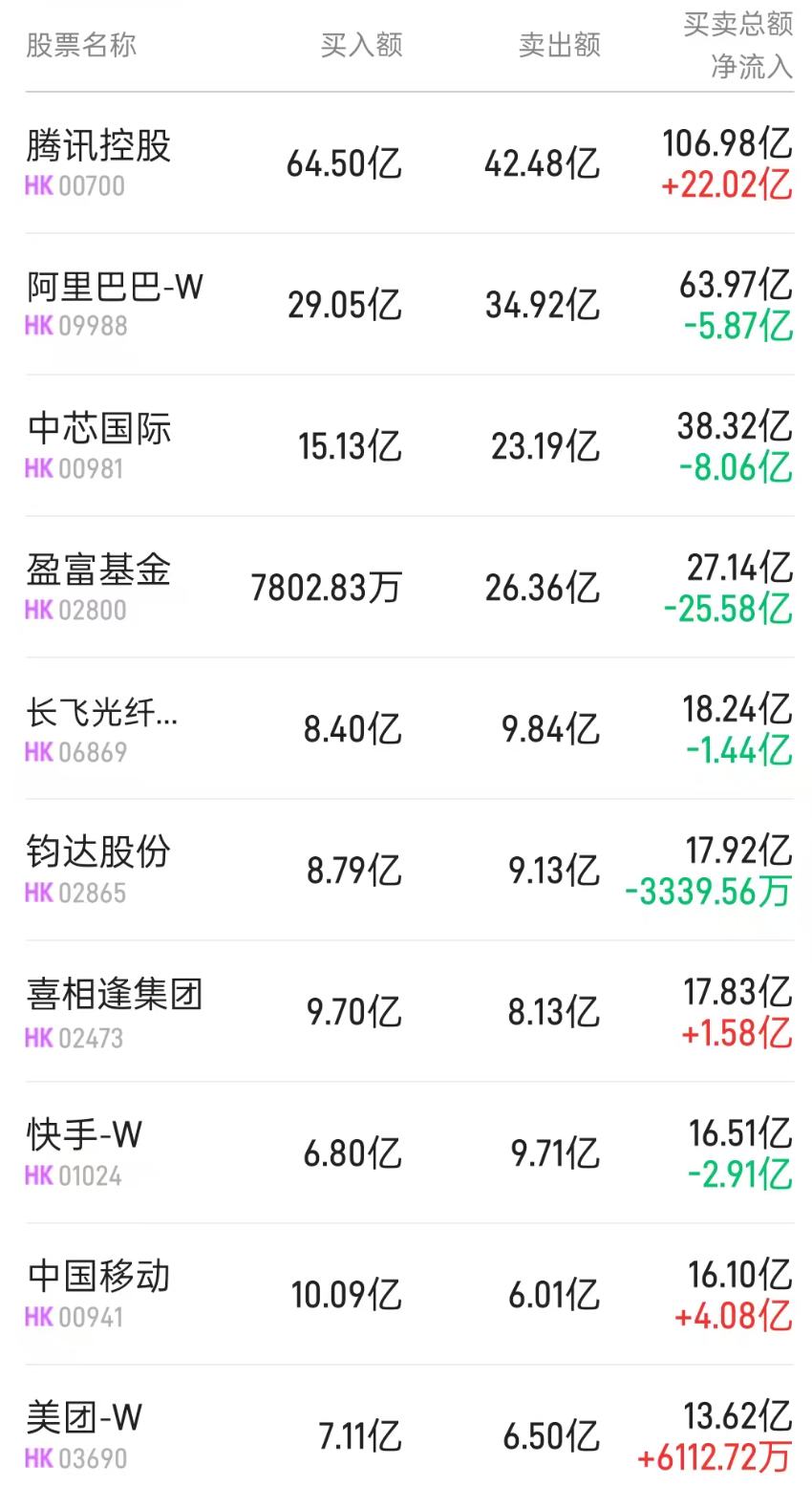
Summary of Key Points Core Viewpoint - The Hong Kong stock market experienced significant net buying and selling activity on February 3, with a total net buy of 9.52 billion HKD from Northbound trading, primarily driven by Tencent and Southern Hang Seng Technology stocks, while notable sell-offs occurred in the Yingfu Fund and Alibaba [1][4]. Group 1: Northbound Trading Activity - Northbound trading saw a net buy of 17.33 billion HKD through the Shanghai Stock Connect and a net sell of 7.81 billion HKD through the Shenzhen Stock Connect [1]. - The most bought stocks included Tencent (00700), Southern Hang Seng Technology (03033), and China Mobile (00941) [1]. - The most sold stocks were Yingfu Fund (02800), SMIC (00981), and Alibaba-W (09988) [1]. Group 2: Stock Performance Details - Tencent Holdings had a net inflow of 22.02 billion HKD, with total trading volume of 106.98 billion HKD [2]. - Alibaba-W experienced a net outflow of 5.87 billion HKD, with total trading volume of 63.97 billion HKD [2]. - SMIC saw a net outflow of 8.06 billion HKD, with total trading volume of 38.32 billion HKD [2]. - Yingfu Fund faced a significant net outflow of 25.58 billion HKD, with total trading volume of 27.14 billion HKD [2]. Group 3: Market Sentiment and Influences - Market rumors suggested potential tax rate adjustments for the financial and internet value-added services sectors, which negatively impacted stock prices, particularly for Tencent and other internet companies [4]. - However, tax experts clarified that the current VAT rate remains unchanged at 6%, dismissing the rumors as unfounded [4]. - China Mobile received a net buy of 4.07 billion HKD, with analysts noting its resilience against potential profit margin pressures due to its higher profitability [5]. - Xiaomi Group-W had a net buy of 3.29 billion HKD, attributed to strong electric vehicle deliveries and ongoing investments in AI and robotics [5]. Group 4: Chip Sector Dynamics - The semiconductor sector showed mixed results, with Hua Hong Semiconductor receiving a net buy of 2.56 billion HKD, while SMIC faced a net sell of 15.77 billion HKD [5]. - The chip industry is experiencing a price increase trend, with some domestic chip manufacturers announcing price hikes of up to 80% [6]. - Yingfu Fund's significant net sell was influenced by global risk-off sentiment and liquidity pressures, although a mid-term positive outlook for Chinese assets remains [6].
智通港股52周新高、新低统计|2月3日





智通财经网· 2026-02-03 08:44
Group 1 - A total of 78 stocks reached a 52-week high as of February 3, with notable performers including Asia Pacific Financial Investments (08193) at 57.14%, Chao Wei Holdings (08059) at 36.00%, and Asia Backup (08290) at 33.33% [1] - The closing prices for the top three stocks that reached new highs were 0.550, 0.052, and 0.024 respectively, with their highest prices being 0.550, 0.068, and 0.036 [1] - Other significant stocks that reached new highs include Huameilele (08429) with a high rate of 20.37% and Haode Holdings (08149) at 17.65% [1] Group 2 - The report also lists stocks that reached 52-week lows, with the worst performer being Gaodi Holdings (01676) at -10.00%, followed by Huajian Medical (01931) at -9.29% and Electronic Trading Group (08036) at -9.09% [3] - The closing prices for the stocks that reached new lows include 0.340, 1.280, and 0.021 respectively, with their lowest prices being 0.315, 1.270, and 0.020 [3] - Other notable stocks that reached new lows include Controllon (01912) at -8.93% and Cool Link (08491) at -8.11% [3]
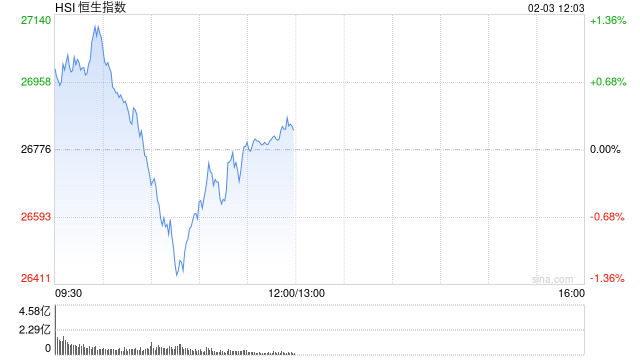
午评:港股恒指涨0.2% 科指跌1.32% 科网股普跌 商业航天概念回暖 百度跌超3%
Xin Lang Cai Jing· 2026-02-03 04:04
Market Overview - The Hong Kong stock market showed mixed performance with the Hang Seng Index rising by 0.2% to 26,830.23 points, while the Hang Seng Tech Index fell by 1.32% and the National Enterprises Index decreased by 0.22% [1][8] - Technology stocks experienced a broad decline, with Kuaishou and Bilibili dropping over 4%, and Baidu and Tencent falling more than 3% [1][8] - The commercial aerospace sector saw significant gains, particularly with Asia Pacific Satellite rising over 9% [1][8] Brokerage Sector - Chinese brokerage stocks weakened, with China International Capital Corporation (CICC) declining by over 2% [1][12] - GF Securities noted a continuous trend of incremental capital entering the market, suggesting that the brokerage sector may experience amplified elasticity due to seasonal market movements [5][12] IPO Performance - Dongpeng Beverage's Hong Kong stock debut saw it break below its issue price. The company issued 40.89 million H-shares at a price of HKD 248 each, raising approximately HKD 10.1 billion, marking it as the largest IPO in the Hong Kong consumer sector for 2026 [6][12] - The company attracted significant institutional investment, with notable backers including Qatar Investment Authority and Temasek, collectively subscribing for HKD 49.9 billion, accounting for about 49.2% of the offering [6][12]
港股互联网巨头集体下挫
Jin Rong Jie· 2026-02-03 02:59
Group 1 - The Hong Kong stock market saw a collective decline among major internet giants, with Kuaishou dropping over 6% [1] - Baidu Group, Bilibili, and Tencent each fell by more than 5% [1] - Alibaba experienced a decline of over 3%, while Meituan dropped more than 2% [1]
港股互联网巨头集体下挫,腾讯跌超5%





Xin Lang Cai Jing· 2026-02-03 02:53
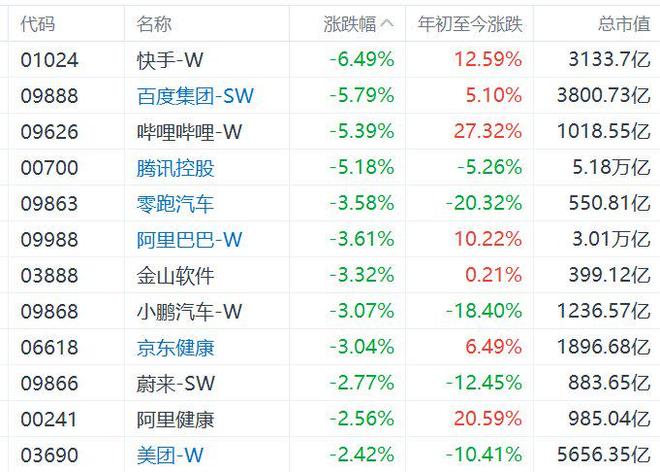
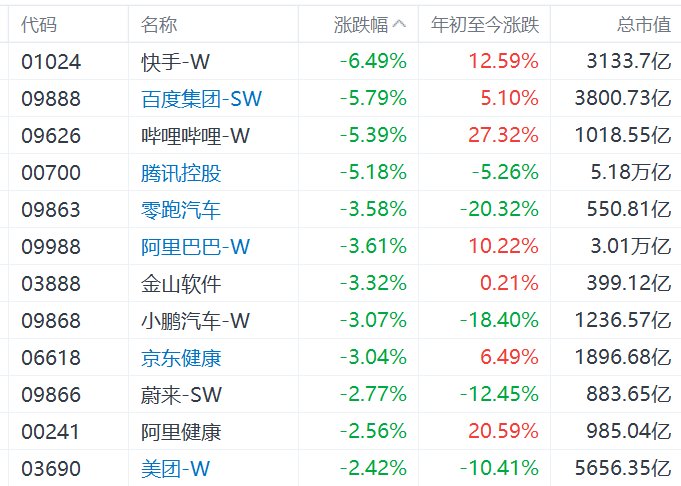
Group 1 - The Hong Kong stock market saw a collective decline among major internet giants, with Kuaishou dropping over 6%, Baidu, Bilibili, and Tencent falling over 5%, Alibaba down over 3%, and Meituan decreasing over 2% [1] Group 2 - Kuaishou's stock decreased by 6.49%, with a year-to-date increase of 12.59%, and a total market capitalization of 313.7 billion [2] - Baidu Group's stock fell by 5.79%, with a year-to-date increase of 5.10%, and a total market capitalization of 3800.73 billion [2] - Bilibili's stock declined by 5.39%, with a year-to-date increase of 27.32%, and a total market capitalization of 1018.55 billion [2] - Tencent Holdings experienced a drop of 5.18%, with a year-to-date decrease of 5.26%, and a total market capitalization of 5.18 trillion [2] - Alibaba's stock fell by 3.61%, with a year-to-date increase of 10.22%, and a total market capitalization of 3.01 trillion [2] - Meituan's stock decreased by 2.42%, with a year-to-date decrease of 10.41%, and a total market capitalization of 5656.35 billion [2]
互联网巨头集体下挫,腾讯跌超5%
Ge Long Hui· 2026-02-03 02:50
Core Viewpoint - The Hong Kong stock market experienced a significant decline among major internet companies, with notable drops in share prices for several key players on February 3rd [1] Group 1: Stock Performance - Kuaishou (快手) saw a decline of 6.49%, with a year-to-date increase of 12.59% and a total market capitalization of 313.7 billion [2] - Baidu Group (百度集团) dropped by 5.79%, with a year-to-date increase of 5.10% and a total market capitalization of 3800.73 billion [2] - Bilibili (哔哩哔哩) fell by 5.39%, with a year-to-date increase of 27.32% and a total market capitalization of 1018.55 billion [2] - Tencent Holdings (腾讯控股) decreased by 5.18%, with a year-to-date decline of 5.26% and a total market capitalization of 5.18 trillion [2] - Alibaba (阿里巴巴) experienced a drop of 3.61%, with a year-to-date increase of 10.22% and a total market capitalization of 3.01 trillion [2] - Meituan (美团) fell by 2.42%, with a year-to-date decline of 10.41% and a total market capitalization of 565.635 billion [2]
智通港股通持股解析|2月3日




智通财经网· 2026-02-03 00:32
Core Insights - The top three companies by Hong Kong Stock Connect holding ratios are China Telecom (00728) at 70.97%, Green Power Environmental (01330) at 68.68%, and Haotian International Construction Investment (01341) at 66.96% [1] - Tencent Holdings (00700), Pop Mart (09992), and Yangtze Optical Fibre and Cable (06869) saw the largest increases in holding amounts over the last five trading days, with increases of +2.954 billion, +1.333 billion, and +1.183 billion respectively [1] - Conversely, China Mobile (00941), Zijin Mining (02899), and Alibaba-W (09988) experienced the largest decreases in holding amounts, with reductions of -2.026 billion, -1.856 billion, and -1.609 billion respectively [2] Group 1: Top Holding Ratios - China Telecom (00728) has a holding of 9.851 billion shares, representing 70.97% [1] - Green Power Environmental (01330) has a holding of 0.278 billion shares, representing 68.68% [1] - Haotian International Construction Investment (01341) has a holding of 7.430 billion shares, representing 66.96% [1] Group 2: Recent Increases in Holdings - Tencent Holdings (00700) increased by +2.954 billion, with a change of +4.9354 million shares [1] - Pop Mart (09992) increased by +1.333 billion, with a change of +5.8896 million shares [1] - Yangtze Optical Fibre and Cable (06869) increased by +1.183 billion, with a change of +13.9887 million shares [1] Group 3: Recent Decreases in Holdings - China Mobile (00941) decreased by -2.026 billion, with a change of -2.5982 million shares [2] - Zijin Mining (02899) decreased by -1.856 billion, with a change of -4.69103 million shares [2] - Alibaba-W (09988) decreased by -1.609 billion, with a change of -0.98507 million shares [2]