
BOSIDENG(03998)

Search documents
范波在常熟调研促进民营经济高质量发展工作
Xin Lang Cai Jing· 2025-12-04 11:25
Core Points - The article emphasizes the importance of promoting high-quality development of the private economy in Suzhou, aligning with the spirit of the 20th Central Committee's Fourth Plenary Session and Xi Jinping's important discussions on private economic development [1][6] - The focus is on creating a first-class business environment to stimulate the vitality of business entities and continuously develop and strengthen the private economy [1][6] Company Insights - Bosideng Group, a globally recognized brand in the down jacket sector, is encouraged to deepen its market expansion, green development, and non-public enterprise party building, while leveraging local industrial resources and innovation elements [2][8] - Jiangsu Henrui Fraunhofer New Materials R&D Co., Ltd. is highlighted for its focus on automotive lightweight materials, with encouragement to strengthen collaborative innovation and accelerate the application of research results [2][8] - Zhengli New Energy Company, which specializes in lithium-ion power, energy storage, and aviation batteries, is urged to optimize its industrial layout and actively participate in the development of Suzhou's new energy industry [2][10] Policy and Development Initiatives - The article discusses the need for local governments to prioritize the healthy development of private enterprises and implement policies to promote the private economy [5][10] - It mentions the "Three Services" special action aimed at addressing practical issues such as financing, land use, and talent acquisition for enterprises [5][10] - The overall goal is to assist companies in overcoming challenges, achieving breakthroughs in new technologies, creating new products, and expanding into new markets for high-quality development [5][10]


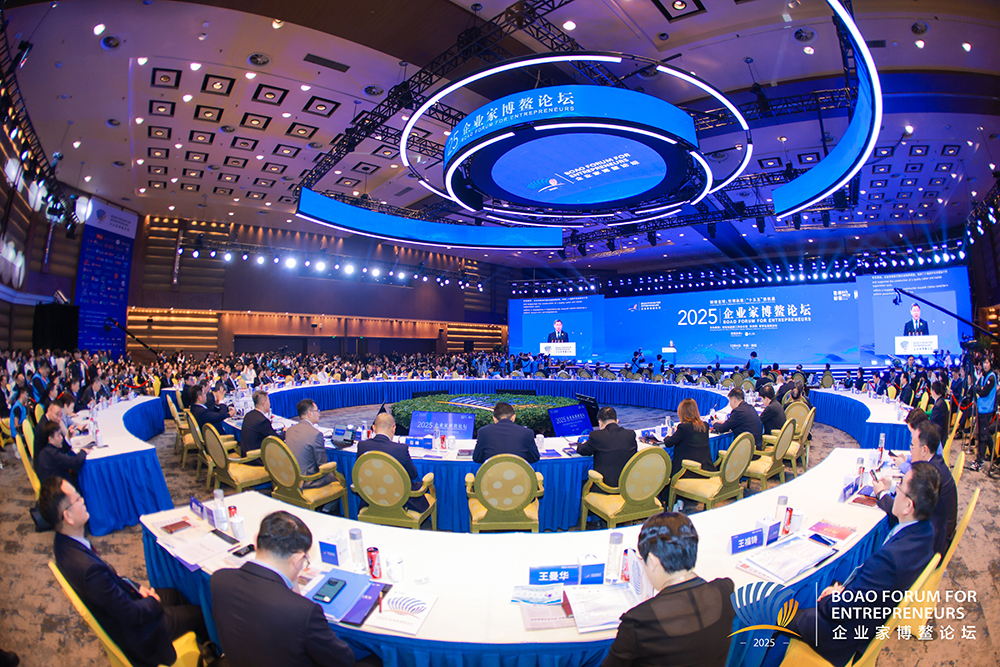
波司登亮相企业家博鳌论坛 以新质生产力领航高质量发展
Xin Hua Wang· 2025-12-04 09:07
Core Viewpoint - The 2025 Boao Forum for Entrepreneurs focuses on high-quality development paths in the new era, gathering leaders from global and Chinese top 500 companies to discuss new opportunities during the transition from the 14th to the 15th Five-Year Plan [1] Group 1: Company Overview - Bosideng Group, a leader in the Chinese down jacket industry, participated in the forum, sharing its strategic insights and achievements in global brand development [3] - Founded 49 years ago, Bosideng has maintained its commitment to the core business of down jackets, becoming a globally recognized brand with a market value of 118.058 billion yuan and leading sales in the Chinese market for 30 consecutive years [3] Group 2: Global Expansion and Brand Strategy - Bosideng has positioned itself as a pioneer in international markets, entering Europe in the 1990s and showcasing its brand at major fashion weeks in New York, Milan, London, and Paris [3] - The company has transitioned from "product export" to "brand export," enhancing its global reputation and trust in "Chinese warmth" [3] Group 3: Innovation and Production - Bosideng is accelerating the formation of new productive forces through innovation, utilizing high-end platforms like national industrial design centers and certified laboratories [4] - The company has integrated digital intelligence with its manufacturing system, reducing product delivery cycles to 7-10 days and achieving a digital closed loop from design to virtual garments [4] Group 4: Sustainability and Social Responsibility - Bosideng has embedded sustainable development into its corporate strategy, establishing a clear ESG framework and carbon goals, becoming the first Asian textile and apparel company to receive MSCI ESG AAA rating [4] - The company has contributed 1.55 billion yuan to social causes, promoting rural revitalization and common prosperity through long-term community partnerships [4] Group 5: Future Direction - As it enters a new decade, Bosideng aims to align with national development strategies and accelerate its journey from being the top in China to becoming globally leading, contributing to brand strength and modernization in China [5]
波司登(03998):羽绒服业务持续引领增长,期待旺季表现
Guotou Securities· 2025-12-04 08:07
Investment Rating - The report maintains a "Buy" rating for Bosideng with a target price of HKD 6.0 [1][4]. Core Insights - Bosideng's revenue for the first half of FY26 increased by 1.4% year-on-year to RMB 89.28 billion, while net profit rose by 5.3% to RMB 11.89 billion, indicating healthy growth [2][4]. - The brand's down jacket business saw an 8.3% increase in revenue to RMB 65.68 billion, although the gross margin declined by 2.0 percentage points to 59.1% [2][4]. - The OEM business faced challenges, with revenue decreasing by 11.7% to RMB 20.44 billion, but gross margin improved by 0.4 percentage points to 20.5% due to better supply chain management [3][4]. - The women's clothing segment experienced an 18.6% decline in revenue to RMB 2.51 billion, reflecting a tough market environment [3][4]. - The company is focusing on optimizing channel quality and enhancing store operations, with a net increase of 88 down jacket stores to 3,558 [3][4]. Financial Summary - For FY26, the projected earnings per share (EPS) are expected to be RMB 0.35, with a growth forecast of 10.1% for revenue and 11.3% for net profit [4][5]. - The gross margin is expected to stabilize around 57.3% for FY26, with a net profit margin of 13.7% [5][14]. - The company anticipates a steady increase in revenue from RMB 28.51 billion in FY26 to RMB 34.70 billion by FY28, with corresponding net profits rising from RMB 3.91 billion to RMB 4.86 billion [5][14].
主品牌增速放缓,雪中飞负增长,波司登如何守住羽绒服基本盘?
2 1 Shi Ji Jing Ji Bao Dao· 2025-12-03 12:44
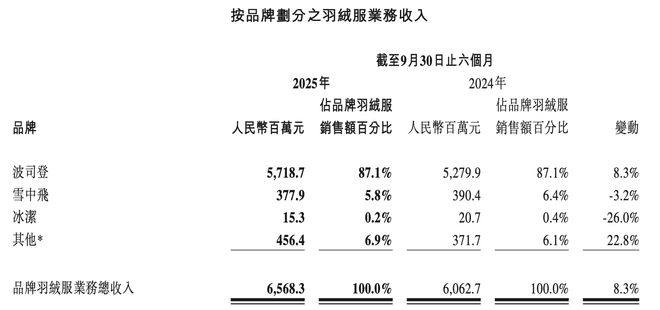
Core Viewpoint - Bosideng, a leading down jacket brand in China, reported a modest mid-term performance for the first half of the 2025/26 fiscal year, with revenue of approximately 8.93 billion yuan, a slight increase of 1.4% year-on-year, and a net profit of about 1.20 billion yuan, up 5.2% year-on-year [1] Revenue Performance - The brand down jacket business generated approximately 6.57 billion yuan, accounting for 73.6% of total revenue, with a year-on-year growth of 8.3%. However, this growth rate has slowed compared to the previous two fiscal years, which saw growth rates of 28.1% and 22.7% respectively [2][4] - The main brand, Bosideng, contributed 5.72 billion yuan with an 8.3% growth rate, significantly lower than the previous year's growth rates of 25.5% and 19.4% [4] Market Competition - The slowdown in growth is attributed to intensified competition in the high-end down jacket market, with brands like Arc'teryx, KAILAS, Descente, The North Face, and others targeting high-net-worth consumers [4] Cost Pressures - Rising raw material prices have added cost pressures, with the price of duck down (95% down content) increasing from 304 yuan/kg in 2020 to 669 yuan/kg in 2025 [5] Strategic Initiatives - Despite market challenges, Bosideng is maintaining its high-end positioning, launching new product lines such as the "Master Puff" series and collaborating with luxury brand creative director Kim Jones for the AREAL line [6][7] - The management indicated that the AREAL series has performed better than expected, with about 60% of sales coming from new customers, primarily young consumers [7] Snow Flying Brand Performance - The Snow Flying brand, positioned in the mid-range market, experienced a revenue decline of 3.2% to 378 million yuan, despite increasing retail outlets [10][11] - The management emphasized that Snow Flying will continue to be a focus for the company, with increased investment in brand marketing and product development [11] Diversification Efforts - The diversified clothing business segment generated approximately 6.4 million yuan, accounting for 0.7% of total revenue, down 45.3% year-on-year. The company is exploring functional apparel categories while maintaining a focus on down jackets as the core product [12]
主品牌增速放缓,雪中飞负增长 波司登如何守住羽绒服基本盘?
2 1 Shi Ji Jing Ji Bao Dao· 2025-12-03 12:39
Core Viewpoint - Bosideng (03998.HK), a leading down jacket brand in China, reported a modest mid-term performance for the first half of the 2025/26 fiscal year, with revenue of approximately 8.93 billion yuan, a year-on-year increase of 1.4%, and a net profit of about 1.20 billion yuan, up 5.2% [2]. Revenue Performance - The brand's down jacket business generated approximately 6.57 billion yuan, accounting for 73.6% of total revenue, with a year-on-year growth of 8.3%. However, this growth rate has slowed compared to the previous two fiscal years, which saw growth rates of 28.1% and 22.7% respectively [3][5]. - The main brand, Bosideng, contributed 5.72 billion yuan in revenue, also achieving an 8.3% growth rate, significantly lower than the previous years' growth rates of 25.5% and 19.4% [5]. Market Challenges - The slowdown in growth is attributed to intensified competition in the high-end down jacket market, with brands like Arc'teryx, KAILAS, Descente, The North Face, and others attracting high-net-worth consumers [5]. - Rising raw material costs have also pressured Bosideng's cost structure, with the price of duck down increasing from 304 yuan/kg in 2020 to 669 yuan/kg in 2025 [5]. Strategic Initiatives - Despite market challenges, Bosideng is committed to maintaining its high-end positioning, launching the "Master Puff" series during Paris Fashion Week and collaborating with renowned designers to introduce premium product lines [6][8]. - The company has strategically invested in the Canadian luxury down jacket brand Moose Knuckles, acquiring approximately 31.6% of its shares to strengthen its high-end market presence [7]. Brand Development - The management indicated that the AREAL series has performed better than expected, with around 60% of sales revenue coming from new customers, primarily younger consumers [8]. - Bosideng aims to deepen its focus on down jackets while exploring new categories, ensuring that all new product developments align with its core business strategy [9][14]. Snow Flying Brand Performance - The Snow Flying brand, positioned in the mid-range market, experienced a revenue decline of 3.2% to 378 million yuan, despite increasing its retail outlets [10][13]. - The management expressed optimism about Snow Flying's recovery, noting a shift from negative to positive growth in sales during October and November [13].
里昂:升波司登目标价至5.8港元 下半财年起销售强劲
Zhi Tong Cai Jing· 2025-12-03 06:06
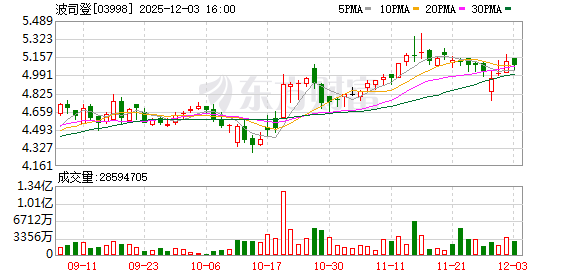
Core Viewpoint - The report from Credit Lyonnais indicates an upward adjustment of the target price for Bosideng (03998) from HKD 5.2 to HKD 5.8, driven by an increase in the forecasted price-to-earnings ratio to 13 times from the previous 12 times, highlighting an attractive risk-return profile with a projected dividend yield of 6.5% over the next 12 months [1] Group 1 - Bosideng's sales and net profit for the first half of the fiscal year increased by 1.4% and 5.3% year-on-year, respectively, aligning with expectations [1] - The management reiterated its guidance for fiscal year 2026, anticipating a 10% year-on-year sales growth, with net profit growth expected to exceed sales growth [1] - Since October, Bosideng's offline sales have recorded double-digit year-on-year growth, with a reduction in discount rates, while online sales maintained strong momentum during the Double Eleven shopping festival [1] Group 2 - The firm has revised its net profit forecasts for fiscal years 2026 to 2028 upwards by 1% to 2%, reflecting a more favorable business mix and stringent cost control, while sales forecasts remain largely unchanged [1]
里昂:升波司登(03998)目标价至5.8港元 下半财年起销售强劲
智通财经网· 2025-12-03 06:01
Core Viewpoint - Citi has raised the target price for Bosideng (03998) from HKD 5.2 to HKD 5.8, citing an increase in the forecasted price-to-earnings ratio to 13 times from 12 times, and a projected dividend yield of 6.5% over the next 12 months, making the risk-return profile attractive [1] Financial Performance - Bosideng's sales and net profit for the first half of the fiscal year increased by 1.4% and 5.3% year-on-year, respectively, aligning with expectations [1] - The management has reiterated its guidance for fiscal year 2026, anticipating a 10% year-on-year sales growth, with net profit growth expected to exceed sales growth [1] Sales Trends - Since October, Bosideng's offline sales have recorded double-digit year-on-year growth, with a reduction in discount rates [1] - The online business has also maintained strong momentum during the Double Eleven shopping festival [1] Profit Forecast Adjustments - The forecast for net profit for fiscal years 2026 to 2028 has been increased by 1% to 2% to reflect a more favorable business mix and strict cost control, while sales forecasts remain largely unchanged [1]
波司登(3998.HK):FY26H1淡季业绩稳健 冬季有望迎来更佳表现
Ge Long Hui· 2025-12-03 05:49
Core Viewpoint - In FY26H1, the company's revenue and net profit attributable to shareholders increased by 1.4% and 5.3% year-on-year, respectively, with the down jacket business growing by 8.3% [1][2] Financial Performance - FY26H1 revenue reached 8.93 billion, with an operating profit of 1.52 billion and a net profit of 1.19 billion, alongside a proposed interim dividend of 0.063 HKD per share, representing a cash dividend payout ratio of 60.9% [1][2] - The gross profit margin was 50.0%, up by 0.1 percentage points, mainly due to the increased proportion of high-margin down jacket business [3] - The operating profit margin was 17.0%, an increase of 0.3 percentage points, while the net profit margin was 13.3%, up by 0.5 percentage points [3] Business Segments - The brand down jacket business accounted for 73.6% of FY26H1 revenue, with the main brand Bosideng generating 5.72 billion, an increase of 8.3% [2] - The OEM and women's wear segments faced short-term pressure, with revenues of 2.04 billion and 0.251 billion, down by 11.7% and 18.6%, respectively [3] Store and Channel Performance - As of the end of September, the number of Bosideng and Snow Flying brand stores was 3,140 and 389, respectively, with changes of -67 and +126 stores since the beginning of the fiscal year [2] - Online revenue was 1.43 billion, up by 2.2%, while offline revenue was 4.73 billion, up by 9% [2] Future Outlook - In FY26H2, the company expects accelerated growth due to the sales peak season, with increased investment in the Bosideng main brand and the introduction of new product lines [4] - Revenue forecasts for FY26 to FY28 are 28.5 billion, 31.22 billion, and 34.09 billion, with corresponding net profits of 3.92 billion, 4.34 billion, and 4.8 billion, reflecting growth rates of 10.0%, 9.6%, and 9.2% [4]
波司登(03998.HK)26财年中期业绩点评:品牌羽绒服板块引领营收稳健增长 库存周转速度显著提升
Ge Long Hui· 2025-12-03 05:49
Core Viewpoint - Bosideng reported a stable revenue growth driven by its brand down jacket business, while the OEM processing business faced pressure due to tariffs [1][2] Group 1: Financial Performance - For the first half of FY2025/26, the company achieved revenue of 8.928 billion yuan, a year-on-year increase of 1.4%, and a net profit attributable to shareholders of 1.189 billion yuan, up 5.3% [1] - The brand down jacket business generated revenue of 6.568 billion yuan, growing by 8.3%, with the main Bosideng brand contributing 5.719 billion yuan, also up 8.3% [1] - The OEM processing business revenue declined by 11.7% to 2.044 billion yuan, while women's clothing revenue fell by 18.6% to 0.251 billion yuan [1] - The overall gross margin slightly increased by 0.1 percentage points to 50.0%, with the brand down jacket business gross margin decreasing by 2.0 percentage points to 59.1% [2] Group 2: Channel and Inventory Management - The company optimized its channel structure, resulting in a net increase of 88 retail stores to 3,558, with self-operated stores increasing by 3 to 1,239 [1] - The average inventory turnover days decreased by 11 days to 178 days, attributed to a slowdown in raw material procurement and inventory reduction efforts [3] - The online channel for the brand down jacket business saw a revenue increase of 2.4% to 1.383 billion yuan, accounting for 21.1% of the business [1] Group 3: Future Outlook - The company expects the OEM business to stabilize and return to growth in the second half of the fiscal year, while maintaining a focus on product innovation and channel quality improvement [3] - The net profit forecasts for FY2026-2028 are 3.931 billion yuan, 4.382 billion yuan, and 4.786 billion yuan, with corresponding PE ratios of 13.5, 12.1, and 11.1 times [3]
波司登(03998.HK):收入及利润正增长 全新设计师系列推动品牌价值提升
Ge Long Hui· 2025-12-03 05:49
Core Viewpoint - The company reported a revenue of 8.93 billion yuan for the first half of FY2025/26, reflecting a year-on-year growth of 1.4%, and a net profit attributable to shareholders of 1.19 billion yuan, up 5.3% year-on-year, indicating a dual growth in revenue and profit despite a high base [1] Business Segmentation - The core brand down jacket business achieved a revenue of 6.57 billion yuan, with a year-on-year increase of 8.3%, driven primarily by the Bosideng main brand [2] - The OEM processing segment saw a revenue decline of 11.7% to 2.04 billion yuan, attributed to external factors such as tariffs, with potential for recovery as these factors diminish [2] - The women's wear and diversified apparel segments are undergoing adjustments, with the company focusing on improving overall operational and management efficiency [2] Multi-Channel Collaboration - The company has been enhancing its Top store reform, implementing tailored strategies to improve store operational efficiency [3] - The self-operated and wholesale channels for the brand down jacket business reported year-on-year revenue growth of 6.6% and 7.9% respectively, contributing to overall revenue growth [3] - Online revenue increased by 2.4% in the first half of FY2025/26, supported by a focus on core categories, brand building, content innovation, and refined operations [3] Profit Forecast and Rating - The company is expected to maintain strong growth in the down jacket sector, with projected net profits for FY2026 to FY2028 at 3.914 billion yuan, 4.403 billion yuan, and 4.897 billion yuan, representing year-on-year growth rates of 11.38%, 12.50%, and 11.22% respectively [4] - The company’s strong brand power, product development capabilities, and efficient supply chain management create competitive barriers, supporting a "buy" rating [4]