XPENG-W(09868)

Search documents
港股异动 | 小鹏汽车-W(09868)涨近5% 10月交付量创单月新高 小鹏X9超级增程将于本周发布
智通财经网· 2025-11-03 02:40
Core Viewpoint - XPeng Motors (09868) shares rose nearly 5%, with a current price of HKD 91.35 and a trading volume of HKD 652 million, following the announcement of its latest delivery results [1] Delivery Performance - In October 2025, XPeng Motors delivered a total of 42,013 vehicles, representing a year-on-year increase of 76% and a month-on-month increase of 1%, marking a historical monthly delivery high with two consecutive months exceeding 40,000 units [1] - From January to October 2025, XPeng Motors achieved cumulative deliveries of 355,209 vehicles, reflecting a year-on-year growth of 190% [1] Upcoming Product Launch - XPeng Motors announced the launch event for the XPeng X9 Kunpeng Super Extended Range Technology, scheduled for November 6 at 19:00 [1] - The XPeng X9 will feature the "Kunpeng" Super Extended Range Technology, combining a 63.3 kWh ultra-fast charging lithium iron phosphate battery with a 60L fuel tank, achieving a total range of 1,602 kilometers, making it the longest-range seven-seater vehicle globally [1]
恒生指数开盘涨0.36% 恒生科技指数涨0.48%
Zheng Quan Shi Bao· 2025-11-03 02:11
Core Viewpoint - The Hang Seng Index opened with a gain of 0.36%, while the Hang Seng Tech Index increased by 0.48%, indicating a positive market sentiment towards technology stocks and overall market performance [1] Group 1: Market Performance - The Hang Seng Index opened at a 0.36% increase [1] - The Hang Seng Tech Index saw a rise of 0.48% [1] Group 2: Company Performance - NIO and Xpeng Motors both experienced gains of over 3% [1]


港股异动丨小鹏汽车盘初涨超4%,10月交付创单月历史新高
Ge Long Hui· 2025-11-03 02:04
小鹏汽车-W(9868.HK)盘初涨4.36%报91港元。消息面上,小鹏汽车宣布,2025年10月交付新车42,013 台,单月交付量创下历史新高,并连续2个月超过4万台。2025年1-10月,小鹏汽车累计交付355,209 台,同比增长190%。 ...
10月新能源车企销量普增,比亚迪、零跑等创新高
Cai Jing Wang· 2025-11-03 01:51
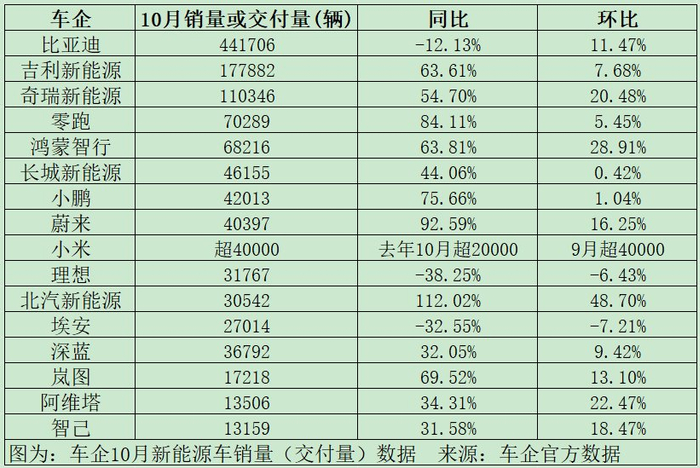
Core Insights - The overall delivery volume of new energy vehicle companies in October showed a month-on-month increase compared to September, with significant contributions from both traditional and new energy vehicle manufacturers [1] Group 1: Company Performance - BYD achieved a total sales volume of 441,706 units in October, marking an 11.47% increase month-on-month but a 12.13% decrease year-on-year [1] - Geely New Energy and Chery New Energy ranked second and third in sales, with year-on-year increases of 63.61% and 54.70%, respectively [1] - Leap Motor's monthly delivery volume reached a record high of 70,289 units, representing an 84.11% increase year-on-year [1] Group 2: State-Owned Enterprises - Among state-owned enterprises, Deep Blue, BAIC New Energy, and Lantu ranked highest in sales, with Lantu achieving nine consecutive months of growth since 2025 [1] - BAIC New Energy reported a remarkable year-on-year increase of 112.02% in sales, reaching 30,542 units in October [1] - Lantu's sales increased by 69.52% year-on-year, totaling 17,218 units [1] Group 3: Emerging Players - Companies like Xpeng and NIO also reported significant growth, with Xpeng achieving a year-on-year increase of 75.66% and NIO experiencing a decline of 38.25% [1] - The overall performance of new energy vehicle startups indicates a competitive landscape, with several companies breaking their previous monthly delivery records [1]




智通港股通资金流向统计(T+2)|11月3日
智通财经网· 2025-11-02 23:32
Core Insights - The article highlights the net inflow and outflow of funds for various companies in the Hong Kong stock market, indicating significant movements in investor sentiment and market dynamics [1][2][3] Net Inflow Summary - The top three companies with the highest net inflow of funds are Huahong Semiconductor (华虹半导体) with 388 million, Pop Mart (泡泡玛特) with 320 million, and Qingdao Beer (青岛啤酒股份) with 305 million [1][2] - The net inflow percentages for these companies are 8.15%, 7.92%, and 58.54% respectively, indicating strong investor interest, particularly in Qingdao Beer [2][3] Net Outflow Summary - The companies with the highest net outflow of funds include Alibaba-W (阿里巴巴-W) with -523 million, Southern Hang Seng Technology (南方恒生科技) with -429 million, and Tencent Holdings (腾讯控股) with -355 million [1][2] - The net outflow percentages for these companies are -3.89%, -4.86%, and -3.36% respectively, reflecting a negative sentiment among investors towards these stocks [2][3] Net Inflow Ratio Summary - The companies with the highest net inflow ratios are Shenzhen Expressway (深圳高速公路股份) at 68.48%, Anhui Wanshan Expressway (安徽皖通高速公路) at 64.22%, and Legend Holdings (联想控股) at 59.98% [1][3] - These ratios suggest a strong demand for shares in these companies relative to their trading volume [3] Net Outflow Ratio Summary - The companies with the highest net outflow ratios are Huadian International Power (华电国际电力股份) at -62.31%, CIMC Enric (中集安瑞科) at -54.98%, and Connoisseur-B (康诺亚-B) at -52.78% [1][3] - These figures indicate significant selling pressure and a lack of confidence among investors in these stocks [3]

10月份汽车市场延续强劲增长态势
Zheng Quan Ri Bao· 2025-11-02 17:00
Core Insights - The Chinese automotive market continued its strong growth in October, with major automakers reporting impressive sales figures, led by SAIC Motor with 454,000 units sold, followed by BYD and Chery Group, both exceeding 280,000 units [1][2] - The market dynamics were influenced by local subsidy policies, the National Day auto show, and year-end promotions, alongside the implementation of the fourth batch of trade-in subsidies and the launch of multiple new models [1][5] - The overall performance indicates a shift towards high-quality development in the Chinese automotive industry, with significant advancements in new energy vehicle penetration, high-end market positioning, and global expansion [1][5] Group 1: Major Automakers Performance - SAIC Motor achieved a monthly sales record of 454,000 vehicles in October, marking a year-on-year increase of 12.96% [2] - BYD sold 441,700 vehicles in October, with cumulative sales for the first ten months reaching 3,701,900 units, nearing its annual target for 2024 [2] - Geely and Chery also reported significant growth, with Geely's passenger vehicle sales at 307,100 units (up 35% year-on-year) and Chery's sales at 281,200 units (up 3.3%), including a remarkable 54.7% increase in new energy vehicle sales [2] Group 2: New Energy and Emerging Brands - New energy vehicles are becoming a key growth driver, with companies like Leap Motor achieving record sales of 70,300 units in October [3][4] - Hongmeng Zhixing and XPeng Motors are making strides in the high-end market, with Hongmeng selling 68,200 vehicles and XPeng achieving 420,100 units sold, reflecting a 76% year-on-year increase [4] - NIO and Li Auto are also progressing in multi-brand operations, with NIO selling nearly 40,400 units (up 92.6% year-on-year) and Li Auto reaching 31,800 units, with cumulative sales surpassing 1.46 million [4] Group 3: Market Outlook - The automotive market is expected to maintain its momentum into November, driven by promotional events like "Double 11" and the Guangzhou Auto Show, alongside continued subsidies [5] - The demand is anticipated to remain strong, with potential increases in sales due to the impending expiration of the new energy vehicle purchase tax exemption [5]

腾势N8L、奇瑞风云T11、北京现代EO等新车上市!上汽、比亚迪、赛力斯公布三季度财报!多家车企公布10月销量!丨一周大事件
电动车公社· 2025-11-02 16:14
New Car Launches - The new Zeekr 7X has been launched with a price range of 229,800 to 269,800 CNY, featuring three models and significant upgrades in design and technology [2][3][11] - The new Avita 12 Four Laser Edition is priced between 269,900 and 429,900 CNY, offering both range-extended and pure electric versions with advanced driving assistance systems [14][20][22] - Smart's new model, the Smart 5 EHD, is priced from 189,900 to 239,900 CNY, featuring a hybrid system and a luxurious interior [23][30] - The new Denza N8L is launched at a price of 299,800 to 329,800 CNY, showcasing a modern design and advanced technology features [4][38] - Beijing Hyundai's EO model is available for pre-sale at 119,800 to 149,800 CNY, targeting the compact SUV market with competitive features [5][47] - Chery's new model, the Wind Cloud T11, is priced between 189,900 and 249,900 CNY, boasting high-end configurations and a spacious interior [6][54] - The Galaxy Star 6 has been launched with a price range of 74,800 to 105,800 CNY, featuring a new design and advanced technology [7][58] - The Deep Blue L06 has opened for pre-sale with a price range of 139,900 to 161,900 CNY, featuring a sporty design and advanced driving assistance [8][67] Company Dynamics - Horizon Robotics has partnered with ZF to develop a city navigation assistance system, set to be mass-produced by 2026 [70][75] - Xiaopeng Motors is establishing the first low-altitude flying car "6S" store in Guangzhou, aiming to integrate various flying services [76][79] - 4D Map has rebranded to SEEWAY.AI, focusing on AI strategies and expanding into autonomous driving technologies [81][84] - SAIC Group reported a growth in both sales and revenue in Q3, driven by strong performance in the electric vehicle segment [87][90] - BYD's Q3 revenue decreased by 3.05% to 194.99 billion CNY, with net profit down 32.6% due to competitive pressures [91][92] - Seres reported a 15.75% increase in revenue to 48.13 billion CNY, while net profit slightly declined [94][95] Sales Performance - BYD's October passenger car sales reached 436,856 units, maintaining a leading position in the electric vehicle market [100][104] - SAIC Group sold 207,000 new energy vehicles in October, leading the industry in total sales [106] - Geely's October new energy vehicle sales were 177,882 units, with significant contributions from its Galaxy brand [107][110] - Chery's new energy vehicle sales reached 110,346 units in October, marking a significant milestone [111][112] - Chang'an's new energy vehicle sales were 119,000 units, with strong performance from its Deep Blue brand [119] - Great Wall Motors sold 46,155 new energy vehicles in October, reflecting its ongoing transition to electric vehicles [120][121] - Leap Motor delivered 70,289 units in October, showcasing its strong market presence [122] - Hongmeng Zhixing delivered 68,216 units in October, benefiting from increased production capacity [125][127] - Xiaopeng Motors delivered 42,013 units in October, with new models contributing to sales growth [128][130] - NIO delivered 40,397 units in October, reflecting a successful year for the brand [131][133] - Xiaomi's vehicle deliveries exceeded 40,000 units in October, supported by favorable market conditions [134][136] - FAW delivered 38,900 new energy vehicles in October, marking a significant achievement [137][138] - Li Auto delivered 31,767 units in October, facing competitive pressures in the market [143][144] - Dongfeng Yipai Technology delivered 31,107 units in October, showing steady growth [146][148] - BAIC New Energy sold 30,542 units in October, driven by new model launches [149][152] - Lantu delivered 17,218 units in October, continuing its upward trajectory [153][155] - Jishi delivered 1,426 units in October, with plans for future expansion [156][159]



汽车和汽车零部件行业周报20251102:文远、小马即将港股挂牌,智能驾驶催化密集-20251102
Minsheng Securities· 2025-11-02 14:07
Investment Rating - The report maintains a positive investment rating for the automotive and automotive parts industry, highlighting strong performance in the sector [5]. Core Insights - The automotive sector has shown resilience, with the A-share automotive sector rising by 2.2% from October 27 to October 31, outperforming the Shanghai and Shenzhen 300 index, which increased by 0.8% [29]. - Key companies to focus on include Geely Automobile, Xiaopeng Motors, Li Auto, BYD, Xiaomi Group, Berteli, Top Group, New Spring Co., Hu Guang Co., and Chunjun Power [9][12]. Summary by Sections Weekly Market Performance - The automotive sector outperformed the market, with various segments such as commercial passenger vehicles and automotive parts seeing significant increases in stock prices [29]. Weekly Insights - The report emphasizes the upcoming IPOs of Wenyan and Xiaoma, indicating a rapid development in smart driving technology [3][11]. - The report suggests a focus on the T-chain core line, with optimism surrounding the release of the Optimus robot in Q1 2026 [10]. Passenger Vehicles - The report highlights the positive impact of the "old-for-new" policy, which is expected to stimulate demand for passenger vehicles, particularly for high-quality domestic brands [12]. Smart Electric Vehicles - The report notes the ongoing growth in the smart electric vehicle segment, with a focus on the increasing market share of domestic brands and the potential for significant growth in the automotive parts sector [13]. Robotics - The report discusses the entry of leading companies into the robotics sector, indicating a new era of embodied intelligence and the potential for significant advancements in this field [15][17]. Motorcycles - The report highlights the rapid expansion of the large-displacement motorcycle market, with significant year-on-year sales growth [21][22]. Heavy Trucks - The report indicates a recovery in the heavy truck market, driven by expanded subsidies for replacing old vehicles, which is expected to boost demand [23][24]. Tires - The report emphasizes the ongoing globalization of the tire industry, with a focus on leading companies that are well-positioned for growth [25][27].
小鹏汽车CEO何小鹏:当十五运会火炬手感到骄傲、自豪
2 1 Shi Ji Jing Ji Bao Dao· 2025-11-02 13:13
(原标题:小鹏汽车CEO何小鹏:当十五运会火炬手感到骄傲、自豪) 南方财经 21世纪经济报道记者 谭砚文 黄子豪 郑全怡 广州报道 11月2日上午,第十五届全国运动会火炬传递于广州、深圳、香港、澳门四地开跑。此次火炬传递的"收 官之笔"意蕴深长。KNJ(投资)有限公司董事长何敬麟,香港霍英东集团行政总裁霍震寰依次跑过海 心沙星光大道,广东小鹏汽车科技集团有限公司董事长、首席执行官何小鹏进入收火仪式现场,登上舞 台后展示火炬并点燃火种盆,定格了大湾区深度协同的美好画面。 海外运营监制: 黄燕淑 海外运营内容统筹: 黄子豪 海外运营编辑:庄欢 吴婉婕 龙李华 郑全怡 出品:南方财经全媒体集团 其中,第50棒火炬手小鹏汽车CEO何小鹏在接受南方财经记者采访时表示:"作为十五运会广州站最后 一棒火炬手感到骄傲、自豪。" 策划:赵海建 监制:黄燕淑 内容:谭砚文 黄子豪 郑全怡 设计:刘妍妍 ...
利好来了!刚刚,最高猛增84%!新能源车,大消息
券商中国· 2025-11-02 07:33
Core Viewpoint - The October performance of the new energy vehicle (NEV) market has shown significant growth, marking a strong sales season that contrasts with the overall automotive market's decline [2][7][8]. Group 1: Sales Performance - Multiple NEV brands reported record-high delivery numbers in October, with Leap Motor delivering 70,289 vehicles, a year-on-year increase of over 84% [2][5]. - BYD achieved sales of 441,706 vehicles in October, the highest for the year, with cumulative sales from January to October reaching 3,701,852 vehicles, and over 14.2 million NEVs sold cumulatively [3]. - Geely's passenger car sales reached 307,133 units in October, a year-on-year increase of 35%, maintaining an upward trend for eight consecutive months [3]. - Changan's Avita Technology reported sales of 13,500 units in October, a year-on-year increase of 34%, marking a historical high [6]. Group 2: Market Dynamics - The NEV market's robust performance is attributed to supportive policies and the launch of new models, positioning it as a key driver for growth in the automotive industry [2][9]. - Despite the NEV market's growth, the overall passenger car market saw a decline, with retail sales dropping by 7% year-on-year in October [7][8]. - The China Passenger Car Association anticipates that the NEV penetration rate will reach new heights, driven by ongoing policy support and new model launches [9]. Group 3: Future Outlook - The fourth quarter is expected to see continued support from vehicle scrappage and replacement, as well as demand driven by the upcoming reduction in NEV purchase tax subsidies [9]. - Analysts suggest focusing on leading companies in the NEV industry and those with international market presence, as well as component suppliers and infrastructure firms benefiting from the NEV growth [9].