
AKESO(09926)

Search documents
交银国际:医保商保目录落地 多元支付体系创新药增量空间
Zhi Tong Cai Jing· 2025-12-10 06:40
Core Insights - The report from CMB International indicates a leading rating for the mainland pharmaceutical industry, following the National Healthcare Security Administration's announcement of the results from the 2025 Innovative Drug High-Quality Development Conference [1] Group 1: Industry Developments - The recent negotiations for the medical insurance and commercial insurance innovative drug catalog have resulted in many innovative pharmaceutical companies covered by CMB International having products newly included or successfully renewed in the insurance coverage [1] - Companies such as Heng Rui Medicine (600276), Innovent Biologics (01801), CanSino Biologics (09926), and China National Pharmaceutical Group (01177) have more than five products that received new coverage or new indications [1] Group 2: Market Outlook - The inclusion of more new drugs in the catalog is expected to enhance clinical medication levels and improve the overall R&D return rates in the innovative drug industry [1] - The introduction of commercial insurance funds is anticipated to provide significant incremental funding for innovative drug payments, paving the way for a diversified payment system alongside basic medical insurance [1] Group 3: Future Growth Potential - CMB International is optimistic about the sales growth potential of newly included products/indications in 2026, particularly for potential blockbuster products from companies like CanSino Biologics [1] - The report emphasizes the importance of monitoring the actual execution and payment situations of the first batch of commercial insurance catalog, as well as the dynamic adjustments in the list and pricing, and the long-term development opportunities arising from real-world data accumulation [1]



2025年医保谈判结果点评:医保平稳商保可期,国产创新药龙头胜出
Orient Securities· 2025-12-10 00:45
Investment Rating - The report maintains a "Positive" investment rating for the pharmaceutical and biotechnology industry, indicating an expected return that is stronger than the market benchmark by over 5% [5]. Core Insights - The National Medical Insurance Administration is strongly encouraging the high-quality development of innovative drugs, with clear policies supporting the payment side for innovative drugs. Domestic leading innovative drug companies are entering a commercial realization phase [3][7]. - The 2025 National Medical Insurance Drug List includes 127 products, with 114 successfully added, of which 50 are innovative drugs, marking a historical high. The overall negotiation success rate reached 90%, the highest in nearly seven years [7]. - The report highlights that the domestic innovative drug market is becoming increasingly concentrated, with leading companies like Heng Rui and Xin Da Biotech significantly benefiting from the new insurance policies [7]. Summary by Sections Investment Recommendations and Targets - Recommended stocks include Heng Rui Pharmaceutical (600276, Buy), Ke Lun Pharmaceutical (002422, Buy), Xin Li Tai (002294, Hold), Ao Sai Kang (002755, Buy), Jing Xin Pharmaceutical (002020, Buy), and others [3]. Market Dynamics - The report notes that the introduction of the commercial insurance directory marks the beginning of a "new golden decade" for Chinese innovative drugs, with a focus on high clinical efficacy and value innovation [7]. - The report emphasizes that the competition in the GLP-1 market remains clear, with the entry of new drugs not significantly altering the competitive landscape for existing treatments [7].


智通港股通活跃成交|12月9日
智通财经网· 2025-12-09 11:03
Core Insights - On December 9, 2025, Alibaba-W (09988), Xiaomi Group-W (01810), and Tencent Holdings (00700) were the top three companies by trading volume in the southbound trading of the Stock Connect, with trading amounts of 4.115 billion, 3.321 billion, and 2.930 billion respectively [1] - In the Shenzhen-Hong Kong Stock Connect, Alibaba-W (09988), Tencent Holdings (00700), and SMIC (00981) led the trading volume, with amounts of 3.237 billion, 1.987 billion, and 1.503 billion respectively [1] Southbound Trading Highlights - **Top Active Companies in Southbound Trading (Shanghai-Hong Kong Stock Connect)** - Alibaba-W (09988): Trading amount of 4.115 billion, net inflow of 83.45 million [2] - Xiaomi Group-W (01810): Trading amount of 3.321 billion, net inflow of 156 million [2] - Tencent Holdings (00700): Trading amount of 2.930 billion, net inflow of 1.126 billion [2] - SMIC (00981): Trading amount of 2.806 billion, net outflow of 133 million [2] - Pop Mart (09992): Trading amount of 1.880 billion, net outflow of 438 million [2] - **Top Active Companies in Southbound Trading (Shenzhen-Hong Kong Stock Connect)** - Alibaba-W (09988): Trading amount of 3.237 billion, net inflow of 342 million [2] - Tencent Holdings (00700): Trading amount of 1.987 billion, net outflow of 248 million [2] - SMIC (00981): Trading amount of 1.503 billion, net inflow of 14.69 million [2] - Xiaomi Group-W (01810): Trading amount of 1.203 billion, net inflow of 384 million [2] - Pop Mart (09992): Trading amount of 1.016 billion, net outflow of 136 million [2]



ETF盘中资讯 港股通创新药午后加速走低,康方生物挫逾5%!100%创新药研发标的“520880”跌超2%溢价飙升
Jin Rong Jie· 2025-12-09 07:05
Core Viewpoint - The Hong Kong innovation drug sector is experiencing a downturn, with the Hong Kong Stock Connect Innovation Drug ETF (520880) declining over 2% and major stocks like Kangfang Biotech and 3SBio dropping more than 5% [1][3] Group 1: Market Performance - The Hong Kong innovation drug sector has entered a phase of adjustment since early September, with the Hong Kong Stock Connect Innovation Drug ETF (520880) index retreating over 19%, indicating that previous high risks have been sufficiently released [3] - There is a surge in "bottom-fishing" capital, with over 56 million yuan entering the market recently, leading to a spike in the premium of the Hong Kong Stock Connect Innovation Drug ETF [1][3] Group 2: Policy and Market Opportunities - A favorable policy announcement was made with the release of the 2025 National Medical Insurance Drug List, which added 114 new drugs, including 50 innovative drugs, achieving an overall success rate of 88%, significantly higher than the 76% in 2024 [5][6] - The introduction of the first version of the "Medical Insurance + Commercial Insurance Dual Directory" by the National Medical Insurance Bureau is expected to boost investment enthusiasm in innovative drugs [6] Group 3: Investment Insights - Analysts suggest that the current market conditions may present a good opportunity for medium to long-term investment in core innovative drug assets [3][6] - The Hong Kong Stock Connect Innovation Drug ETF (520880) is highlighted for its unique advantages, including a pure focus on innovative drug companies, a high concentration of leading firms (over 72% in the top ten), and better risk control through the management of less liquid stocks [6][7]

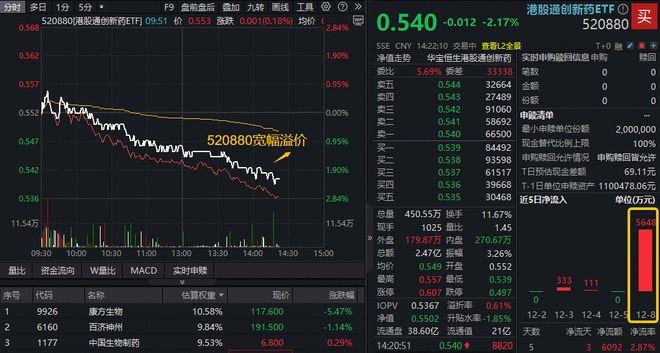
港股通创新药午后加速走低,康方生物挫逾5%!100%创新药研发标的“520880”跌超2%溢价飙升
Xin Lang Cai Jing· 2025-12-09 06:40
Core Viewpoint - The Hong Kong innovation drug sector is experiencing a downturn, with the Hong Kong Stock Connect Innovation Drug ETF (520880) declining over 2% and major stocks like Kangfang Biotech and 3SBio dropping more than 5% [1][9]. Group 1: Market Performance - The Hong Kong innovation drug sector has entered a phase of adjustment since early September, with the ETF index retreating over 19%, indicating that previous high risks have been sufficiently released [3][12]. - There is a surge in "bottom-fishing" capital, with over 56 million yuan entering the Hong Kong Stock Connect Innovation Drug ETF recently [1][9]. Group 2: Investment Opportunities - The National Healthcare Security Administration released the first version of the "Medical Insurance + Commercial Insurance Dual Directory," which may boost investment enthusiasm for innovative drugs in the short term [2][11]. - The 2025 National Medical Insurance Drug List successfully added 114 new drugs, including 50 innovative drugs, with an overall success rate of 88%, significantly higher than the 76% in 2024 [4][11]. - Analysts suggest that the current market conditions may present a favorable opportunity for long-term investment in core innovative drug assets [3][12]. Group 3: ETF Characteristics - The Hong Kong Stock Connect Innovation Drug ETF (520880) is the largest in its category, with a scale of 2.142 billion yuan and an average daily trading volume of 458 million yuan since its inception [7][15]. - The ETF's index has three unique advantages: it is purely focused on innovative drug companies, has a high concentration of leading firms with over 72% weight in the top ten stocks, and employs measures to control risks associated with less liquid stocks [5][6][13].

港股公告掘金 协合新能源11月权益发电量为697.23GWh,同比增长7.77%
Jin Rong Jie· 2025-12-07 13:34
Major Events - Chuangsheng Group-B (06628) announced updated efficacy data for osemitamab triple therapy as a first-line treatment for gastric or gastroesophageal junction adenocarcinoma at ESMO Asia [1] - Strength Development (01277) plans to acquire 100% equity of Taiyuan Shidi for approximately 384 million yuan and acquire Dongzhimen property for a total of 86.33 million yuan [1] - Innovent Biologics (01801) completed a global strategic collaboration with Takeda Pharmaceutical and issued 6.9138 million shares under general authorization [1] - Ascentage Pharma-B (06855) received FDA and EMA approval for global registration of a Phase III clinical trial for Nilotinib as a first-line treatment for Ph+ ALL [1] - Baiao Saitou-B (02315) announced that its business partner IDEAYA received IND approval from the FDA for IDE034 [1] - Jinfang Pharmaceutical-B (02595) initiated a registration clinical trial for GFH375, the world's first oral KRAS G12D inhibitor in a controlled chemotherapy Phase III study [1] - Xixiangfeng Group (02473) signed a business cooperation agreement with Hello Car Rental to develop car rental services in designated cities under a "co-branded store" model [1] - International Commercial Settlement (00147) signed a computer chip sales agreement with Hong Kong Antarctic Light to seize growth opportunities in the IC chip market [1] - CSPC Pharmaceutical Group (01093) received clinical trial approval in the U.S. for a GLP-1/GIP receptor dual agonist injection [1] - MIRXES-B (02629) plans to collaborate with Crystal Technology to build an AI-enabled integrated "diagnosis and treatment" research and industrialization platform [1] - Zhengtong Automobile (01728) intends to invest approximately 816 million yuan to acquire Xiamen Xinda 4S dealership and automotive sales and export business [1] - Guorui Life (00108) plans to acquire 78.3% of Beijing Chunyu Tianxia Software for 269 million yuan [1] - Innovent Biologics (01801) successfully included seven innovative products (including new indications) in the 2025 National Medical Insurance Drug List [1] - Peijia Medical-B (09996) had its registration application for the TaurusNXT® "non-aldehyde cross-linked" transcatheter aortic valve replacement system accepted by the National Medical Products Administration [1] - Fosun Pharma (02196) had new drugs included in the National Medical Insurance Directory and commercial insurance innovative drug directory [1] - Junshi Biosciences (01877) had Tuoyi® new indications and Junshida® included in the National Medical Insurance Directory [1] - Valiant Biotech-B (09887) presented clinical data for LBL-034 at the 67th ASH Annual Meeting [1] - Canfite BioPharma (09926) had all approved indications for five marketed drugs successfully included in the latest National Medical Insurance Drug List [1] - Fuhong Hanlin (02696) had Fuzhuoning® (Citrus Acid Vovizili Capsules) included in the National Medical Insurance Drug List [1] - Green Leaf Pharmaceutical (02186) successfully included five new products in the 2025 National Medical Insurance Drug List or commercial insurance innovative drug directory [1] - Yinnuo Pharmaceutical-B (02591) had its core products included in the National Medical Insurance Drug List [1] Operating Performance - Poly Real Estate Group (00119) reported a contract sales amount of approximately 47.7 billion yuan for the first 11 months, a year-on-year decrease of 8.45% [2] - GAC Group (02238) reported November automobile sales of approximately 179,700 units, a year-on-year decline of 9.72% [2] - Xiehe New Energy (00182) reported an equity power generation of 697.23 GWh in November, a year-on-year increase of 7.77% [2]
2025国谈结果公布:“药王”进医保 5款百万抗癌药进商保
经济观察报· 2025-12-07 12:13
Core Viewpoint - The recent adjustments to the national basic medical insurance directory and the introduction of the commercial insurance innovative drug directory mark significant steps towards enhancing access to innovative treatments in China, particularly for high-cost therapies like CAR-T drugs [2][6]. Summary by Sections National Basic Medical Insurance Directory Adjustments - A total of 114 new drugs were added to the basic medical insurance directory, including 50 first-class innovative drugs [2]. - The total number of drugs in the basic medical insurance directory has increased to 3,253, comprising 1,857 Western medicines and 1,396 traditional Chinese medicines [3]. - New inclusions cover various fields such as oncology, chronic diseases, mental health, and pediatric medications, with several rare disease treatments also added [3]. Commercial Insurance Innovative Drug Directory - The commercial insurance innovative drug directory aims to include high-innovation drugs that exceed the basic insurance scope but offer significant clinical value and patient benefits [6]. - A total of 121 drugs underwent formal review for the commercial insurance directory, with 24 entering price negotiation, ultimately resulting in 19 drugs from 18 companies being included [6]. - Notable inclusions are five CAR-T therapies, which previously cost over one million yuan per injection, making them unaffordable for many patients [6]. Performance of Pharmaceutical Companies - Several leading pharmaceutical companies have reported their successes in the 2025 national medical insurance negotiations, with Heng Rui Pharmaceutical having 20 drugs included, contributing 7.554 billion yuan to their total revenue [5]. - Innovent Biologics announced that 7 of its new drugs were included in the updated national medical insurance directory, with 12 of its 17 innovative drugs now covered [5]. Specific Drug Inclusions - The directory includes drugs for Alzheimer's disease, such as the monoclonal antibodies from Eisai and Eli Lilly, and several rare disease treatments [7]. - Some high-profile drugs, like Novo Nordisk's semaglutide and Bristol-Myers Squibb's nivolumab, were not included despite passing the formal review [8]. Implementation Timeline - The new directory is set to be officially implemented nationwide on January 1, 2026 [9].


康方生物5款已上市药物所有获批适应症均被成功纳入最新版国家医保药品目录
Zhi Tong Cai Jing· 2025-12-07 10:54
Core Viewpoint - 康方生物's five approved drugs have been successfully included in the latest version of the National Medical Insurance Drug List (2025) in China, which will take effect on January 1, 2026 [1][2] Group 1: Drug Approvals and Indications - 开坦尼 (卡度尼利, PD-1/CTLA-4) has successfully renewed its existing indication for recurrent or metastatic cervical cancer and added new indications for first-line treatment of locally advanced unresectable or metastatic gastric or gastroesophageal junction cancer, as well as first-line treatment for persistent, recurrent, or metastatic cervical cancer [1] - 依达方 (依沃西, PD-1/VEGF) has renewed its existing indication for locally advanced or metastatic non-squamous non-small cell lung cancer (NSCLC) after progression on EGFRTKI treatment and added a new indication for first-line treatment of PD-L1 positive (TPS≥1%) locally advanced or metastatic NSCLC [1] - 安尼可 (派安普利, PD-1) is included for the treatment of second-line and above classical Hodgkin lymphoma, first-line locally advanced or metastatic squamous NSCLC, second-line or above nasopharyngeal carcinoma, and first-line nasopharyngeal carcinoma [2] - 伊喜宁 (伊努西, PCSK9) is included for the treatment of primary hypercholesterolemia and mixed hyperlipidemia, as well as heterozygous familial hypercholesterolemia [2] - 爱达罗 (依若奇, IL-12/IL-23) is included for the treatment of moderate to severe plaque psoriasis [2] Group 2: Company Commitment and Future Plans - The company is dedicated to providing more globally innovative and best-in-class treatment options, continuously improving patient accessibility and affordability [2] - The company aims to deepen its focus in various disease areas and promote the inclusion of more innovative drugs and new indications in the National Medical Insurance Drug List to benefit more patients [2]
康方生物(09926)5款已上市药物所有获批适应症均被成功纳入最新版国家医保药品目录
智通财经网· 2025-12-07 10:39
Core Viewpoint - 康方生物's five approved drugs have been successfully included in the latest version of the National Medical Insurance Drug List (2025) in China, which will be implemented from January 1, 2026 [1][2][3] Group 1: Drug Approvals and Indications - 开坦尼® (卡度尼利, PD-1/CTLA-4) has renewed its original indication for recurrent or metastatic cervical cancer and added new indications for first-line treatment of locally advanced unresectable or metastatic gastric or gastroesophageal junction cancer, as well as first-line treatment for persistent, recurrent, or metastatic cervical cancer [1] - 依达方® (依沃西, PD-1/VEGF) has renewed its original indication for locally advanced or metastatic non-squamous non-small cell lung cancer (NSCLC) after progression on EGFRTKI treatment and added a new indication for first-line treatment of PD-L1 positive (TPS≥1%) locally advanced or metastatic NSCLC [1] - 安尼可® (派安普利, PD-1) is included for the treatment of second-line and above classical Hodgkin lymphoma, first-line locally advanced or metastatic squamous NSCLC, second-line or above nasopharyngeal carcinoma, and first-line nasopharyngeal carcinoma [2] - 伊喜宁® (伊努西, PCSK9) is included for the treatment of primary hypercholesterolemia and mixed hyperlipidemia, as well as heterozygous familial hypercholesterolemia [2] - 爱达罗® (依若奇, IL-12/IL-23) is included for the treatment of moderate to severe plaque psoriasis [3] Group 2: Company Commitment and Future Plans - The company is dedicated to providing more innovative and best-in-class treatment options for patients and aims to continuously improve patient accessibility and affordability [3] - The company plans to deepen its focus in various disease areas and advance more innovative drugs and new indications into the National Medical Insurance Drug List to benefit more patients [3]
康方生物(09926.HK)5款已上市药物所有获批适应症均被成功纳入最新版国家医保药品目录
Ge Long Hui· 2025-12-07 10:36
Core Insights - 康方生物's five approved drugs have been successfully included in the latest National Medical Insurance Drug List (2025) by the National Healthcare Security Administration of China, effective from January 1, 2026 [1][2][3] Group 1: Drug Approvals and Indications - 开坦尼 (卡度尼利, PD-1/CTLA-4) has renewed its existing indication for recurrent or metastatic cervical cancer and added new indications for first-line treatment of locally advanced unresectable or metastatic gastric or gastroesophageal junction cancer, as well as first-line treatment for persistent, recurrent, or metastatic cervical cancer [1] - 依达方 (依沃西, PD-1/VEGF) has renewed its existing indication for locally advanced or metastatic non-squamous non-small cell lung cancer (NSCLC) after progression on EGFR TKI treatment and added a new indication for first-line treatment of PD-L1 positive (TPS≥1%) locally advanced or metastatic NSCLC [1] - 安尼可 (派安普利, PD-1) is included for the treatment of second-line and above classical Hodgkin lymphoma, first-line locally advanced or metastatic squamous NSCLC, second-line or above nasopharyngeal carcinoma, and first-line nasopharyngeal carcinoma [2] - 伊喜宁 (伊努西, PCSK9) is included for the treatment of primary hypercholesterolemia and mixed hyperlipidemia, as well as heterozygous familial hypercholesterolemia [2] - 爱达罗 (依若奇, IL-12/IL-23) is included for the treatment of moderate to severe plaque psoriasis [3] Group 2: Company Commitment and Future Plans - The company is dedicated to providing more globally innovative and best-in-class treatment options, continuously improving patient accessibility and affordability [3] - The company aims to deepen its focus in various disease areas and promote more innovative drugs and new indications to be included in the National Medical Insurance Drug List, benefiting more patients [3]