
AKESO(09926)

Search documents
港股康方生物涨超3%
Mei Ri Jing Ji Xin Wen· 2025-12-12 03:31
Core Viewpoint - Kangfang Biologics (09926.HK) has seen its stock price increase by over 3%, currently trading at 121.9 HKD with a transaction volume of 271 million HKD [1] Group 1 - The stock price of Kangfang Biologics rose by 3.83% [1] - The current trading price is 121.9 HKD [1] - The total transaction volume reached 2.71 billion HKD [1]



康方生物再涨超3% 卡度尼利一线治疗胃癌国际Ⅲ期临床获FDA批准开展
Zhi Tong Cai Jing· 2025-12-12 03:20
Core Viewpoint - 康方生物's stock has increased by over 3%, currently trading at 121.9 HKD with a transaction volume of 271 million HKD, following the announcement of FDA approval for its innovative PD-1/CTLA-4 bispecific antibody, 卡度尼利单抗, for a pivotal clinical trial [1] Group 1: Company Developments - 康方生物 announced the initiation of the COMPASSION-37/AK104-311 international multicenter phase III clinical study, which evaluates 卡度尼利单抗 in combination with chemotherapy for HER2-negative, untreated, unresectable or metastatic gastric or gastroesophageal junction adenocarcinoma [1] - This study represents the second international multicenter registration clinical trial for 卡度尼利, following a previous study focused on immune-resistant hepatocellular carcinoma that has already commenced in the United States [1] - The launch of the COMPASSION-37 study is a significant step forward in the global development of 卡度尼利 and is a key initiative in 康方生物's globalization strategy, reinforcing its leading position in the field of tumor immunotherapy 2.0 [1]
港股异动 | 康方生物(09926)再涨超3% 卡度尼利一线治疗胃癌国际Ⅲ期临床获FDA批准开展
智通财经网· 2025-12-12 03:16
Core Viewpoint - 康方生物's stock has increased by over 3%, currently trading at 121.9 HKD with a transaction volume of 271 million HKD, following the announcement of FDA approval for its innovative PD-1/CTLA-4 bispecific antibody,卡度尼利单抗, for a pivotal clinical trial [1] Group 1 - 康方生物 announced the FDA approval for the international multicenter phase III clinical study (COMPASSION-37/AK104-311) of 卡度尼利单抗 in combination with chemotherapy for HER2-negative, untreated, unresectable or metastatic gastric or gastroesophageal junction adenocarcinoma [1] - The COMPASSION-37 study is the second international multicenter registration clinical study for 卡度尼利单抗, following a previous study for immune-resistant hepatocellular carcinoma [1] - The initiation of the COMPASSION-37 study marks a significant step forward in the global development of 卡度尼利单抗 and is a key initiative in 康方生物's globalization strategy, reinforcing its leading position in the tumor immunotherapy 2.0 field [1]
智通港股通持股解析|12月12日


智通财经网· 2025-12-12 00:33
Core Insights - The top three companies by Hong Kong Stock Connect shareholding ratios are China Telecom (72.50%), Power Assets Holdings (69.68%), and GCL-Poly Energy Holdings (69.67%) [1][2] - Xiaomi Group-W, Tracker Fund of Hong Kong, and China Merchants Bank saw the largest increases in shareholding amounts over the last five trading days, with increases of +4.913 billion, +2.976 billion, and +1.548 billion respectively [1][2] - The companies with the largest decreases in shareholding amounts during the same period include WanGuo Gold Group (-3.816 billion), Tencent Holdings (-2.649 billion), and Alibaba Group-W (-1.421 billion) [1][2] Shareholding Ratios - The latest shareholding ratios for the top 20 companies in Hong Kong Stock Connect are led by: - China Telecom (100.63 billion shares, 72.50%) - Power Assets Holdings (3.72 billion shares, 69.68%) - GCL-Poly Energy Holdings (2.82 billion shares, 69.67%) [1] Recent Increases in Shareholding - The top 10 companies with the largest increases in shareholding amounts over the last five trading days are: - Xiaomi Group-W: +4.913 billion (11.647 million shares) - Tracker Fund of Hong Kong: +2.976 billion (11.551 million shares) - China Merchants Bank: +1.548 billion (3.028 million shares) [1][2] Recent Decreases in Shareholding - The top 10 companies with the largest decreases in shareholding amounts over the last five trading days are: - WanGuo Gold Group: -3.816 billion (-49.945 million shares) - Tencent Holdings: -2.649 billion (-4.403 million shares) - Alibaba Group-W: -1.421 billion (-9.435 million shares) [1][2]
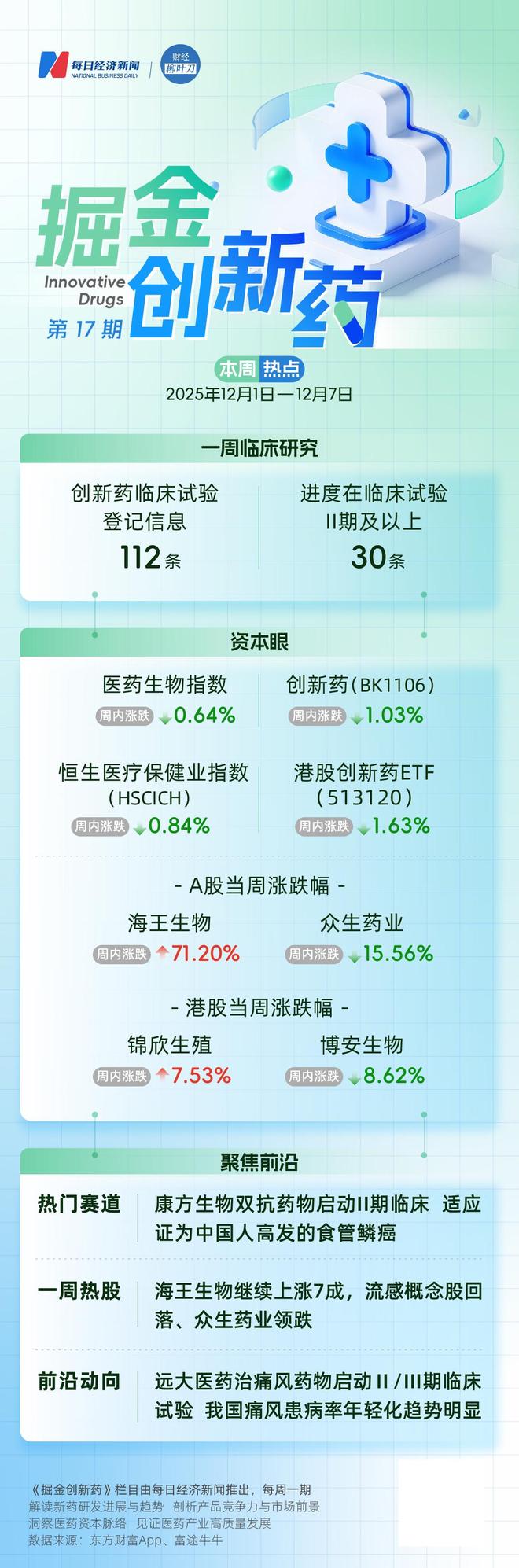
康方生物双抗药物启动II期临床,适应证为中国人高发的食管鳞癌;宝济药业登陆港交所,上半年净亏损扩大 | 掘金创新药
Mei Ri Jing Ji Xin Wen· 2025-12-11 07:59
Core Insights - The pharmaceutical and biotechnology index experienced a decline of 0.64% during the week, underperforming the Shanghai Composite Index by 1.34 percentage points, ending a two-week upward trend [4] - The National Healthcare Security Administration released the 2025 National Basic Medical Insurance Drug List, which included 114 products, achieving a success rate of 88% in negotiations, the highest in recent years [5] - The launch of the commercial health insurance innovative drug list included 19 drugs, complementing the basic medical insurance list and indicating a shift towards a multi-tiered healthcare system in China [5][19] Weekly Market Performance - The A-share market saw significant gains for Haiwang Bio, which rose by 71.20%, while Zhongsheng Pharmaceutical increased by 15.56% [2] - In the Hong Kong market, Jinxin Reproductive Medicine and Boan Biotechnology saw increases of 7.53% and 8.62%, respectively [2] Clinical Trials and Innovations - Kangfang Biopharma's dual-antibody drug, Kadunilumab, has initiated a Phase II clinical trial for esophageal squamous cell carcinoma, a prevalent cancer type in China [13][14] - A clinical trial for a gout treatment, polyethylene glycol-uricase injection (HZBio1), has also commenced, targeting patients with poorly controlled uric acid levels [17][18] New Drug Developments - Baoyi Pharmaceutical's stock surged nearly 140% on its first trading day, with a market capitalization of HKD 20.5 billion, despite a significant net loss of CNY 183 million in the first half of 2025 [6][7] - The company has 12 self-developed products, with SJ02 being the first long-acting FSH-CTP product approved in China [7] Industry Trends - The trend of "innovation + internationalization" remains a core direction for the pharmaceutical sector, supported by policies and increasing global competitiveness [5] - The demand for more effective and safer uric acid-lowering drugs is rising due to the increasing prevalence of gout, particularly among younger populations in China [18]


医药板块迈入“创新兑现期”,港股通创新药ETF嘉实(520970)布局港股创新药产业发展机会
Sou Hu Cai Jing· 2025-12-11 03:31
Core Viewpoint - The innovation drug sector in China is experiencing significant growth due to favorable policy developments, with the introduction of new drug listings in the national medical insurance catalog and commercial insurance, providing a stable policy outlook for innovative drug companies [1][2]. Group 1: Industry Trends - The China Hong Kong Stock Connect Innovation Drug Index increased by 0.30% as of December 11, 2025, with notable gains from companies such as Zhaoyan New Drug (+4.15%) and Rongchang Bio (+2.85%) [1]. - The national medical insurance catalog for 2025 successfully added 114 new drugs, including 50 innovative drugs, achieving a historical high success rate of 88% [1]. - The introduction of dual catalogs for medical insurance and commercial insurance is expected to directly benefit innovative drug companies, indicating a positive industry outlook [1]. Group 2: Market Opportunities - The top ten weighted stocks in the China Hong Kong Stock Connect Innovation Drug Index account for 72.68% of the index, highlighting the concentration of investment in leading innovative drug companies [2]. - The Harvest Innovation Drug ETF (520970) closely tracks the index, providing investors with access to leading companies involved in drug research, development, and production [2]. - Investors without stock accounts can leverage the Hong Kong Stock Connect Innovation Drug ETF linked fund (024700) to capitalize on the growth opportunities in the innovative drug sector [2].



港股异动 康方生物(09926)早盘涨超3% 依沃西方案一线治疗TNBC更新数据于ESMO IO 2025发布
Jin Rong Jie· 2025-12-11 03:04
Group 1 - The core point of the news is that Kangfang Biopharma's stock rose over 3% following the announcement of promising clinical trial results for its PD-1/VEGF bispecific antibody, Ivosidenib, in treating locally advanced unresectable or metastatic triple-negative breast cancer (TNBC) [1] - Ivosidenib has shown significant clinical potential in first-line treatment for TNBC, as evidenced by updated efficacy data presented at the ESMO IO conference [1] - The drug has been included in the Breakthrough Therapy Designation (BTD) list by the National Medical Products Administration (NMPA) in China, indicating its promising efficacy and safety [1] Group 2 - Ivosidenib is the world's first PD-1/VEGF bispecific antibody developed by Kangfang Biopharma, with its first indication expected to receive approval from the NMPA in May 2024 for treating locally advanced or metastatic non-small cell lung cancer (nsq-NSCLC) [2] - The drug represents a novel combination of tumor immunotherapy and anti-angiogenesis mechanisms, marking a significant advancement in cancer treatment [2] - In November 2024, Ivosidenib was included in the national medical insurance catalog, enhancing its accessibility for patients [2]
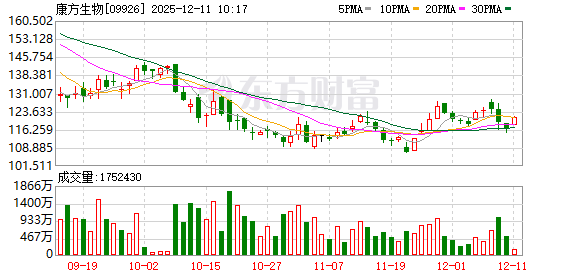
港股康方生物早盘一度涨超3%
Mei Ri Jing Ji Xin Wen· 2025-12-11 02:16
Core Viewpoint - 康方生物's stock price experienced a rise of over 3% in early trading, indicating positive market sentiment towards the company [2] Company Summary - 康方生物's stock is currently trading at 120.2 HKD, reflecting a gain of 2.83% [2] - The trading volume reached 100 million HKD, suggesting active investor interest [2]
康方生物早盘涨超3% 依沃西方案一线治疗TNBC更新数据于ESMO IO 2025发布
Zhi Tong Cai Jing· 2025-12-11 02:03
Core Viewpoint - Kangfang Biotech's PD-1/VEGF bispecific antibody, Ivosidenib, shows promising efficacy in treating locally advanced unresectable or metastatic triple-negative breast cancer (TNBC) in a phase II clinical study, highlighting its potential in first-line therapy [1] Group 1: Clinical Development - Ivosidenib has been included in the Breakthrough Therapy Designation (BTD) list by the National Medical Products Administration (NMPA) for its excellent efficacy and safety in treating TNBC [1] - A multicenter, randomized, double-blind phase III clinical study (HARMONi-BC1/AK112-308) for Ivosidenib in this indication is currently progressing efficiently [1] Group 2: Product Approval and Market Position - Ivosidenib is the world's first PD-1/VEGF bispecific antibody for tumor immunotherapy, with its first indication expected to receive approval from the NMPA in May 2024 for locally advanced or metastatic non-small cell lung cancer (nsq-NSCLC) after progression on EGFR-TKI treatment [2] - In November 2024, Ivosidenib was included in the national medical insurance catalog, enhancing its market accessibility [2]
港股异动 | 康方生物(09926)早盘涨超3% 依沃西方案一线治疗TNBC更新数据于ESMO IO 2025发布
智通财经网· 2025-12-11 02:01
Core Viewpoint - Kangfang Biopharma's innovative PD-1/VEGF bispecific antibody, Ivosidenib, shows promising efficacy in treating locally advanced unresectable or metastatic triple-negative breast cancer (TNBC) in a phase II clinical study, highlighting its potential in first-line therapy [1][2] Group 1: Clinical Development - Ivosidenib has demonstrated superior efficacy data in a phase II clinical study presented at the ESMO IO conference, indicating significant clinical potential for TNBC treatment [1] - The drug has been included in the Breakthrough Therapy Designation (BTD) list by the National Medical Products Administration (NMPA) in China, based on its excellent efficacy and safety profile [1] - A multicenter, randomized, double-blind phase III clinical study (HARMONi-BC1/AK112-308) for Ivosidenib in TNBC is currently progressing efficiently [1] Group 2: Regulatory Approvals - Ivosidenib is the first PD-1/VEGF bispecific antibody globally, with its first indication expected to receive approval from the NMPA in May 2024 for locally advanced or metastatic non-small cell lung cancer (nsq-NSCLC) after progression on EGFR-TKI treatment [2] - The drug was included in the national medical insurance catalog in November 2024, enhancing its accessibility [2]