
AKESO(09926)

Search documents
北水动向|北水成交净买入234.26亿 内资再度抢筹港股ETF 科网股亦获加仓
智通财经网· 2025-08-05 10:07
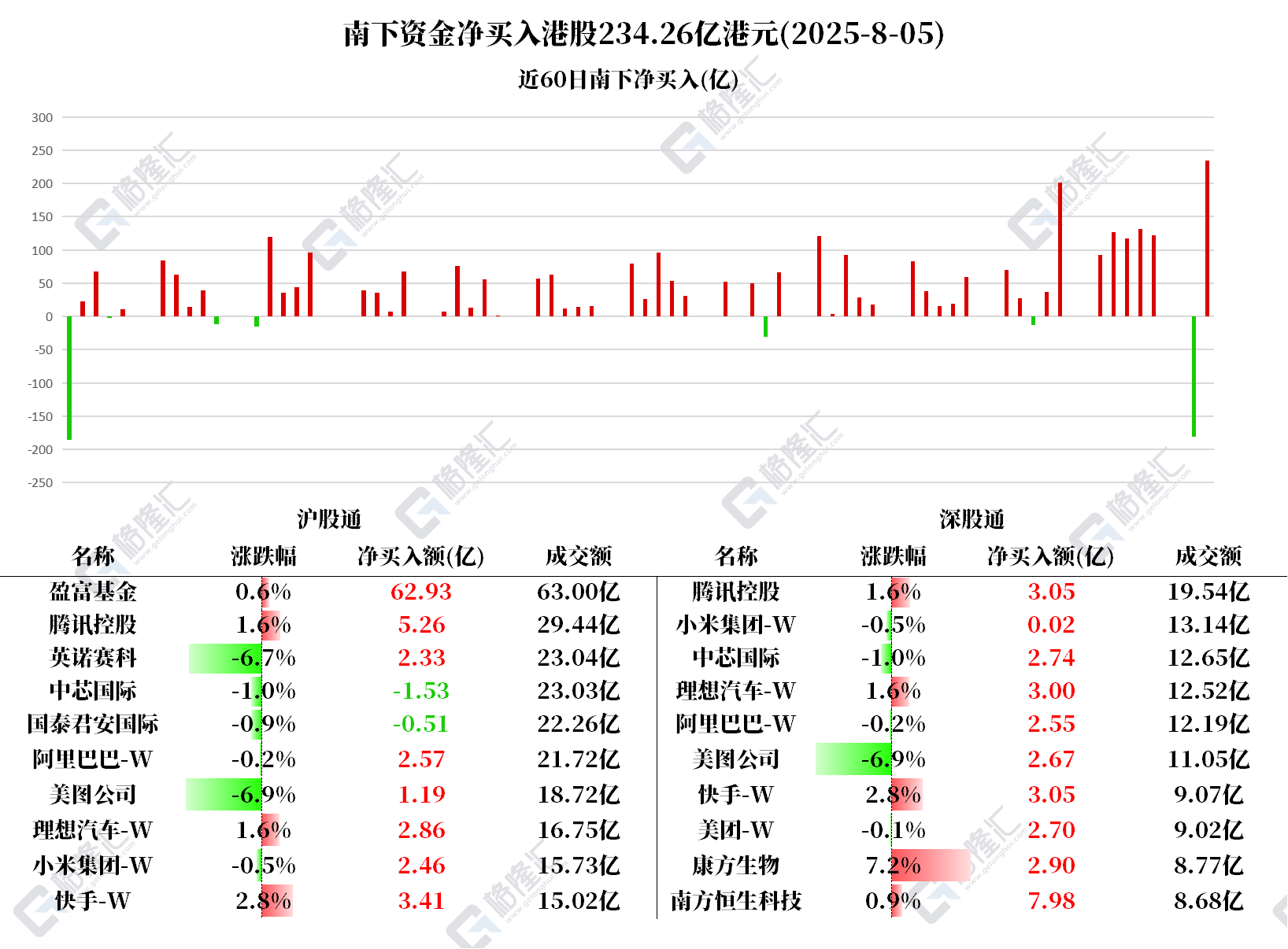
Summary of Key Points Core Viewpoint - The Hong Kong stock market experienced significant net inflows from northbound trading, indicating a positive sentiment among investors towards certain stocks and sectors, particularly technology and ETFs [1][6]. Group 1: Northbound Trading Activity - Northbound trading recorded a net buy of HKD 234.26 billion, with HKD 139.36 billion from the Shanghai Stock Connect and HKD 94.89 billion from the Shenzhen Stock Connect [1]. - The most purchased stocks included the Tracker Fund of Hong Kong (盈富基金, 02800), Tencent (00700), and the Southern Hang Seng Technology ETF (南方恒生科技, 03033) [1][6]. - The stock with the highest net sell was Guotai Junan International (国泰君安国际, 01788), with a net outflow of HKD 50.72 million [1][9]. Group 2: Individual Stock Performance - The Tracker Fund of Hong Kong (02800) saw a net inflow of HKD 62.93 billion, while Tencent (00700) had a net inflow of HKD 5.26 billion [2]. - Other notable net inflows included InnoCare Pharma (英诺赛科, 02577) with HKD 2.33 billion, and Alibaba (阿里巴巴-W, 09988) with HKD 2.57 billion [2][8]. - Li Auto (理想汽车-W, 02015) received a net inflow of HKD 5.86 billion following an announcement of configuration adjustments for its i8 model [7]. Group 3: Sector Insights - The technology sector, which constitutes nearly one-third of the Hong Kong market, is expected to undergo a revaluation driven by improving fundamentals and policy expectations [6]. - Companies like Meitu (美图公司, 01357) reported a projected net profit increase of 65% to 72% year-on-year, indicating strong operational performance [7]. - UBS highlighted the potential of Akeso's core product AK112 in various cancer treatments, projecting significant revenue contributions from upcoming clinical trials [8].



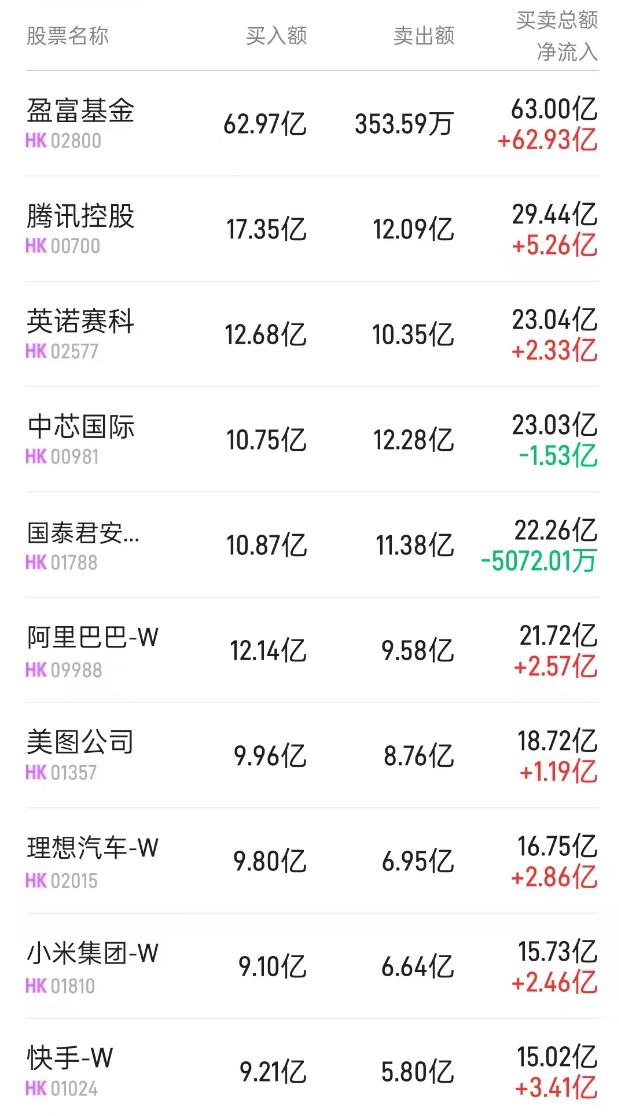
图解丨南下资金净买入港股234亿创3月12日以来新高,加仓腾讯、快手和理想汽车
Ge Long Hui A P P· 2025-08-05 10:05
Group 1 - Southbound funds recorded a net purchase of HKD 23.426 billion in Hong Kong stocks, marking the highest single-day net purchase since March 12 of this year [1] - The top net purchases included: - HKD 6.293 billion in the Tracker Fund of Hong Kong - HKD 0.831 billion in Tencent Holdings - HKD 0.798 billion in Southern Hang Seng Technology - HKD 0.646 billion in Kuaishou-W - HKD 0.586 billion in Li Auto-W - HKD 0.511 billion in Alibaba-W - HKD 0.386 billion in Meitu - HKD 0.290 billion in CanSino Biologics - HKD 0.270 billion in Meituan-W - HKD 0.248 billion in Xiaomi Group-W - HKD 0.232 billion in Innovent Biologics - HKD 0.121 billion in SMIC [1] Group 2 - Southbound funds have net purchased Tencent for 9 consecutive days, totaling HKD 4.426 billion - Southbound funds have net purchased Xiaomi for 8 consecutive days, totaling HKD 4.410 billion - Southbound funds have net purchased Kuaishou for 4 consecutive days, totaling HKD 2.452 billion [1]

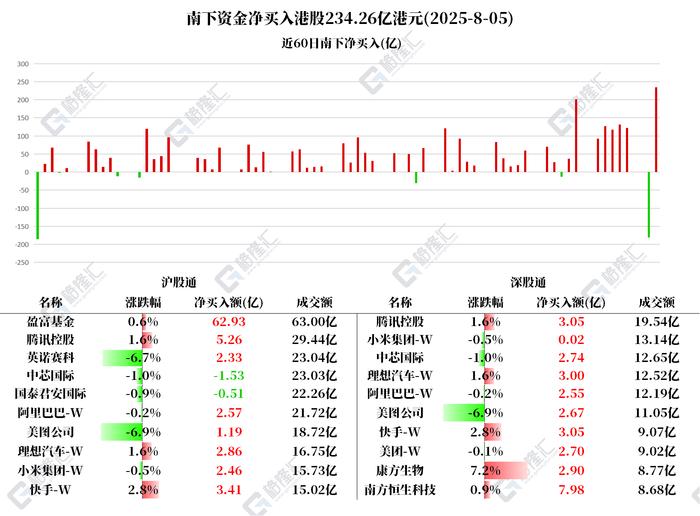
南下资金净买入港股234亿创3月12日以来新高!加仓腾讯控股8.31亿,快手6.46亿,理想汽车5.86亿,阿里巴巴5.11亿,小米集团2.48亿
Sou Hu Cai Jing· 2025-08-05 10:05
【免责声明】本文仅代表作者本人观点,与和讯网无关。和讯网站对文中陈述、观点判断保持中立,不对所包含内容的准确性、可靠性或完整性提供任何明 示或暗示的保证。请读者仅作参考,并请自行承担全部责任。邮箱:news_center@staff.hexun.com | | 了成道 | | | | | --- | --- | --- | --- | --- | | 名称 | 涨跌幅 | 浄买入额(亿) | 成交额 | 名称 | | 盈富長金 | 0.6% | 62.93 | 63.00亿 | 腾讯控股 | | 腾讯控股 | 1.6% | 5.26 | 29.44亿 | 小米集团-W | | 英诺赛科 | -6.7% | 2.33 | 23.04亿 | 中芯国际 | | 中心国际 | -1.0% | -1.53 | 23.03亿 | 理想汽车-W | | 国泰君安国际 | -0.9% | -0.51 | 22.26亿 | 阿里巴巴-W | | 阿里巴巴-W | -0.2% | 2.57 | 21.72亿 | 美图公司 | | 美图公司 | -6.9% | 1.19 | 18.72亿 | 快手-W | | 理想汽车-W | 1 ...
里昂:料中国医疗健康行业流动性及基本面持续改善 推荐石药集团等
Zhi Tong Cai Jing· 2025-08-05 06:20
Group 1 - The core viewpoint is that the liquidity and fundamentals of the Chinese healthcare industry continue to improve, maintaining a positive outlook for the healthcare sector [1] - The report indicates that the weak U.S. employment data may lead to heightened expectations for monetary easing in the second half of the year, suggesting an improved outlook for the industry [1] - The report highlights that the industry fundamentals are recovering, with a month-on-month increase in hospital prescription volumes in July, and significant profit growth expected in the third quarter due to the release of more innovative drugs [1] Group 2 - The company prefers leading large pharmaceutical firms and suggests avoiding companies overly reliant on biosimilars in the short term [2] - Selected stocks include: CSPC Pharmaceutical Group (01093), Sinopharm Group (01099), Hansoh Pharmaceutical (03692), and others [2] - The report emphasizes that the uncertainty in U.S. Treasury yields may prompt a reallocation of funds, further improving the liquidity of innovative drug assets [1]



里昂:料中国医疗健康行业流动性及基本面持续改善 推荐石药集团(01093)等
智通财经网· 2025-08-05 06:18
里昂指出,行业基本面持续复苏,7月院内处方量环比提升,随着更多创新药放量,第三季行业盈利有 望实现显著增长,加上美债不确定性可能促使资金重新配置,进一步改善创新药资产流动性,相信行业 拐点已过,未来将迎来盈喜等正面催化剂。 该行偏好领先大型药厂,短期而言避开过度依赖生物仿制药的公司。该行选股包括石药集团(01093)、 新诺威(300765.SZ)、翰森制药(03692)、爱尔眼科(300015.SZ)、恒瑞医药(01276,600276.SH)、康方生物 (09926)、中生制药(01177)、国药控股(01099)、康哲药业(00867)、大参林(603233.SH)、华东医药 (000963.SZ)、泰格医药(03347)及药明康德(02359)。 智通财经APP获悉,里昂发布研报称,中国医疗健康行业流动性及基本面持续改善,维持对医疗健康板 块正面看法,指出美国就业数据疲软或市场对下半年货币宽松预期急升温,预示着行业下半年改善前 景,相信特朗普再提最惠国药品定价政策及安徽启动生物类似药集中采购,对行业影响则相对有限。 ...
智通港股通资金流向统计(T+2)|8月5日
智通财经网· 2025-08-04 23:32
Group 1 - The top three stocks with net inflows of southbound funds are Yingfu Fund (02800) with 2.858 billion, Hang Seng China Enterprises (02828) with 2.255 billion, and Meituan-W (03690) with 1.397 billion [1][2] - The top three stocks with net outflows of southbound funds are Pop Mart (09992) with -0.382 billion, Ping An of China (02318) with -0.360 billion, and Laopu Gold (06181) with -0.345 billion [1][2] - In terms of net inflow ratio, the top three are Hopson Development Holdings (00754) at 70.43%, K Wah International Holdings (00173) at 64.10%, and Qingdao Port International (06198) at 61.26% [1][2] Group 2 - The top three stocks with the highest net outflow ratios are Gawei Electronics (01415) at -60.55%, Bank of China Aviation Leasing (02588) at -46.75%, and GX Hengsheng Technology (02837) at -43.69% [1][3] - The top ten stocks with the highest net inflows include Kuaishou-W (01024) with 1.391 billion and Alibaba-W (09988) with 1.040 billion [2] - The top ten stocks with the highest net outflows also include CICC (03908) with -0.333 billion and Kangfang Biologics (09926) with -0.263 billion [2]



智通港股通活跃成交|8月4日



智通财经网· 2025-08-04 11:02
Core Insights - On August 4, 2025, the top three companies by trading volume in the Southbound Stock Connect were Yingfu Fund (02800), Hang Seng China Enterprises (02828), and InnoCare Pharma (02577) with trading volumes of 94.85 billion, 46.53 billion, and 41.25 billion respectively [1] - In the Southbound Stock Connect for Shenzhen, the top three companies were Yingfu Fund (02800), Tencent Holdings (00700), and Hang Seng China Enterprises (02828) with trading volumes of 50.64 billion, 22.09 billion, and 17.90 billion respectively [1] Southbound Stock Connect (Shanghai) Active Companies - Yingfu Fund (02800) had a trading amount of 94.85 billion with a net buy of -94.77 billion [2] - Hang Seng China Enterprises (02828) recorded a trading amount of 46.53 billion with a net buy of -45.52 billion [2] - InnoCare Pharma (02577) achieved a trading amount of 41.25 billion with a net buy of +2.80 billion [2] - Tencent Holdings (00700) had a trading amount of 24.71 billion with a net buy of +6.17 billion [2] - Alibaba-W (09988) recorded a trading amount of 20.88 billion with a net buy of +7.26 billion [2] Southbound Stock Connect (Shenzhen) Active Companies - Yingfu Fund (02800) had a trading amount of 50.64 billion with a net buy of -50.58 billion [2] - Tencent Holdings (00700) recorded a trading amount of 22.09 billion with a net buy of -5.65 billion [2] - Hang Seng China Enterprises (02828) achieved a trading amount of 17.90 billion with a net buy of -17.74 billion [2] - Alibaba-W (09988) had a trading amount of 12.93 billion with a net buy of +228.97 million [2] - InnoCare Pharma (02577) recorded a trading amount of 12.76 billion with a net buy of +823.66 million [2]
港股通(深)净卖出69.68亿港元
Zheng Quan Shi Bao· 2025-08-04 10:37
Market Overview - On August 4, the Hang Seng Index rose by 0.92%, closing at 24,733.45 points, while southbound funds through the Stock Connect recorded a net sell of 18.092 billion HKD [1] - The total trading volume for the Stock Connect on August 4 was 130.07 billion HKD, with a net sell of 18.092 billion HKD [1] Trading Activity - In the Shanghai Stock Connect, the trading volume was 83.126 billion HKD with a net sell of 11.124 billion HKD, while in the Shenzhen Stock Connect, the trading volume was 46.944 billion HKD with a net sell of 6.968 billion HKD [1] - The most actively traded stock in the Shanghai Stock Connect was the Tracker Fund of Hong Kong (盈富基金), with a trading volume of 9.485 billion HKD, followed by Hang Seng China Enterprises and InnoCare Pharma, with trading volumes of 4.653 billion HKD and 4.125 billion HKD respectively [1] Net Buy/Sell Analysis - Alibaba-W recorded the highest net buy amount of 726 million HKD, despite a closing price drop of 0.60% [1] - The Tracker Fund of Hong Kong had the highest net sell amount of 9.477 billion HKD, while its closing price increased by 0.88% [1] - In the Shenzhen Stock Connect, the Tracker Fund of Hong Kong also led in trading volume with 5.064 billion HKD, and had a net sell of 5.058 billion HKD, closing up by 0.88% [2] Key Stocks Performance - Kuaishou-W had the highest net buy amount in the Shenzhen Stock Connect, with a net buy of 220 million HKD and a closing price increase of 3.22% [2] - Tencent Holdings and Hang Seng China Enterprises followed in trading volume with 2.709 billion HKD and 1.790 billion HKD respectively [2]
南向资金今日成交活跃股名单(8月4日)
Zheng Quan Shi Bao Wang· 2025-08-04 10:37
Core Insights - The Hang Seng Index rose by 0.92% on August 4, with southbound trading totaling HKD 130.07 billion, resulting in a net sell of HKD 18.09 billion [1] - The most actively traded stock by southbound funds was the Tracker Fund of Hong Kong, with a total trading amount of HKD 14.55 billion, followed by Hang Seng China Enterprises and InnoCare Pharma [1][2] - Alibaba-W had the highest net buy amount of HKD 728 million, despite a closing price drop of 0.60% [1][3] Southbound Trading Summary - Total southbound trading amounted to HKD 130.07 billion, with buy transactions at HKD 55.99 billion and sell transactions at HKD 74.08 billion, leading to a net sell of HKD 18.09 billion [1] - The southbound trading for Stock Connect (Shenzhen) was HKD 46.94 billion, with net selling of HKD 6.97 billion, while Stock Connect (Shanghai) had a total of HKD 83.13 billion with net selling of HKD 11.12 billion [1] - The stocks with the highest net buy amounts included Alibaba-W (HKD 728 million), InnoCare Pharma (HKD 363 million), and Kuaishou-W (HKD 220 million) [1][2] Continuous Net Buying Stocks - Three stocks experienced continuous net buying for more than three days, with Tencent Holdings, Xiaomi Group-W, and Kuaishou-W leading in net buying days at 8, 7, and 3 days respectively [2] - The highest net buying amounts during this period were for Xiaomi Group-W (HKD 4.16 billion), Tencent Holdings (HKD 3.59 billion), and Kuaishou-W (HKD 1.80 billion) [2]

南向资金8月4日净买出超-180亿港元:加仓阿里巴巴-W7.28亿港元
Jin Rong Jie· 2025-08-04 09:56
8月4日消息,南向资金今日成交1300.70亿港元,净流出约180.92亿港元。其中沪港股通净流出约111.24 亿港元,深港股通净流出约69.68亿港元 交易所数据显示,8月4日南向资金动向: 大幅净买入:阿里巴巴-W(09988.HK)7.28亿港元、英诺赛科(02577.HK)3.63亿港元、快手- W(01024.HK)2.20亿港元、中芯国际(00981.HK)2.18亿港元、腾讯控股(00700.HK)5260.40万港元、理想 汽车-W(02015.HK)4081.28万港元。 大幅净卖出:盈富基金(02800.HK)1453488.10万港元、恒生中国企业(02828.HK)632565.26万港元、南方 恒生科技(03033.HK)145309.15万港元、康方生物(09926.HK)32314.28万港元。 恒生中国企业今日涨1.00%,沪港股通净卖出455163.71万港元,深港股通净卖出177401.55万港元。 南方恒生科技今日涨1.32%,沪港股通净卖出145309.15万港元。 康方生物今日跌2.69%,深港股通净卖出32314.28万港元。 成交详情 阿里巴巴W今日跌0.60% ...