AKESO(09926)

Search documents
交银医疗健康混合发起A:2025年第二季度利润294.79万元 净值增长率17.76%
Sou Hu Cai Jing· 2025-07-18 11:11
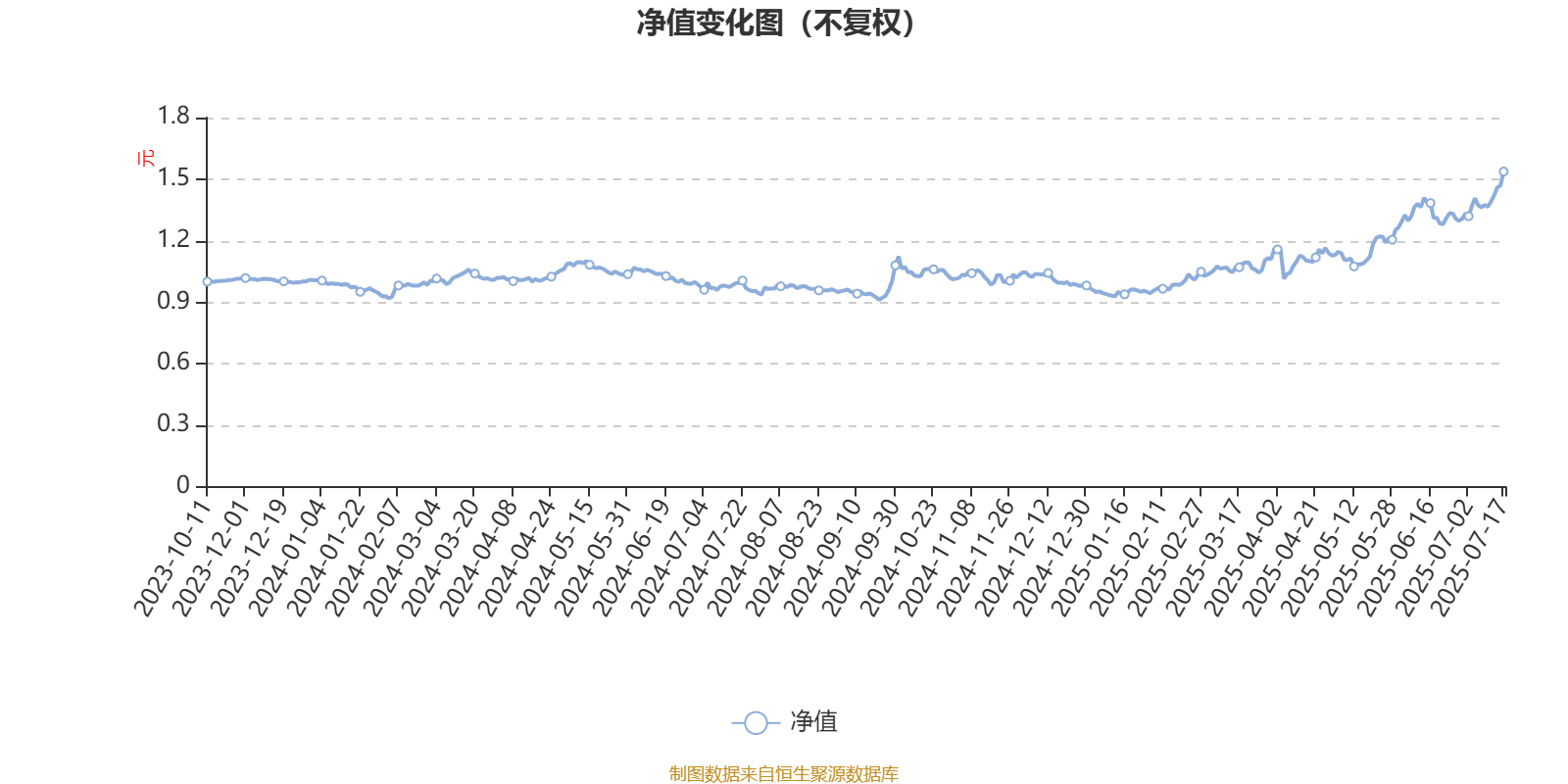
Core Viewpoint - The AI Fund, Jiaoyin Healthcare Mixed Fund A, reported a profit of 2.9479 million yuan for Q2 2025, with a weighted average profit per fund share of 0.1684 yuan, and a net value growth rate of 17.76% for the period [2] Fund Performance - As of July 17, 2025, the fund's unit net value was 1.537 yuan, with a fund size of 31.8706 million yuan [2][14] - The fund's net value growth rates over different periods are as follows: 39.70% over the last three months (ranked 19 out of 138), 61.76% over the last six months (ranked 27 out of 138), and 56.19% over the last year (ranked 33 out of 133) [2] Investment Strategy - The fund manager anticipates that the innovative drug market will continue to thrive, citing the absence of negative factors that could undermine industry trends and the lack of significant valuation bubbles among leading companies [2] - The strategy will focus on maintaining a core position in innovative drugs while also considering sectors and stocks expected to show performance inflection points in the second half of the year [2] Fund Metrics - The fund's Sharpe ratio since inception is 0.9484 [7] - The maximum drawdown since inception is 17.28%, with the largest quarterly drawdown occurring in Q4 2024 at 13.72% [9] - The average stock position since inception is 78.84%, with a peak of 90.79% at the end of H1 2025 and a low of 37.61% at the end of 2023 [12] Top Holdings - As of Q2 2025, the fund's top ten holdings include companies such as Innovent Biologics, Kelun-Biotech, Zai Lab, Hengrui Medicine, and others [17]



智通港股52周新高、新低统计|7月18日





智通财经网· 2025-07-18 08:43
Core Viewpoint - As of July 18, 160 stocks reached their 52-week highs, with notable performances from China New Economy Investment (00080), Aoyuan Group Equity (02905), and Zhong An Holdings Group (08462) showing high growth rates of 288.89%, 55.28%, and 50.00% respectively [1][2]. Summary by Category 52-Week High Performers - China New Economy Investment (00080) closed at 0.440, with a peak price of 0.700, achieving a growth rate of 288.89% [2]. - Aoyuan Group Equity (02905) closed at 0.218, with a peak price of 0.250, achieving a growth rate of 55.28% [2]. - Zhong An Holdings Group (08462) closed at 0.221, with a peak price of 0.228, achieving a growth rate of 50.00% [2]. - Other notable performers include Hualian International (00969) with a growth rate of 40.13% and Zhongke Bio (01237) with a growth rate of 37.25% [2]. Additional High Performers - Wanma Holdings (06928) closed at 0.550 with a growth rate of 30.43% [2]. - Lepu Biopharma-B (02157) closed at 7.940 with a growth rate of 24.54% [2]. - Other stocks with significant growth include ZhiJianYueDong (06860) at 17.14% and China Jindian Group (08281) at 17.12% [2]. 52-Week Low Performers - The document also lists stocks that reached their 52-week lows, with XI Ernan CO-U (09311) showing a decline of 16.10% [6]. - Other notable declines include XI Ernan CO (07311) at -12.62% and Haotian International Construction Investment (01341) at -5.70% [6].
港股创新药ETF(159567)涨0.56%,成交额22.50亿元
Xin Lang Cai Jing· 2025-07-18 07:14
Group 1 - The Hong Kong Innovative Drug ETF (159567) closed with a gain of 0.56% on July 18, with a trading volume of 2.25 billion yuan [1] - The fund was established on January 3, 2024, with a management fee of 0.50% and a custody fee of 0.10% [1] - As of July 17, 2024, the fund's latest share count was 2.025 billion, with a total size of 3.63 billion yuan, reflecting an increase of 412.28% in shares and 860.92% in size since December 31, 2023 [1] Group 2 - The current fund manager is Ma Jun, who has managed the fund since its inception, achieving a return of 79.25% during the management period [2] - The top holdings of the fund include Innovent Biologics, WuXi Biologics, BeiGene, and others, with significant weightings such as 9.52% for Innovent Biologics and 9.47% for WuXi Biologics [2] - The fund's trading liquidity is strong, with a cumulative trading amount of 40.368 billion yuan over the last 20 trading days, averaging 2.018 billion yuan per day [1][2]


野村预测康方生物下半年亏转盈 上调目标价至120.64港元
news flash· 2025-07-18 02:50
Group 1 - Nomura predicts that Kangfang Biotech (09926.HK) will turn from loss to profit in the second half of the year, raising the target price to HKD 120.64 [1] - The company’s mid-term revenue is expected to increase by 42% year-on-year to RMB 1.45 billion, which is 3% lower than market expectations [1] - Sales of the drugs Oritavancin and Ibrutinib are anticipated to accelerate, contributing RMB 800 million and RMB 600 million to mid-term revenue respectively [1] Group 2 - Mid-term operating expenses are projected to be RMB 1.3 billion, with an expected overall mid-term loss attributable to shareholders of RMB 8 million, nearing breakeven [1] - In comparison, the company recorded losses of RMB 239 million and RMB 276 million in the first and second halves of the previous year [1] - For the second half of the year, revenue is forecasted to reach RMB 1.9 billion, driven by sales of Oritavancin and Ibrutinib, with a projected net profit of RMB 271 million [1] Group 3 - The company has adjusted its revenue forecast for the year down by 9.6%, based on lowered expectations for sales and collaboration income from Anika [1] - However, the annual net profit forecast has been raised by 97.2%, based on higher gross margin assumptions [1] - The target price for Kangfang Biotech has been increased from HKD 99.66 to HKD 120.64, while maintaining a neutral rating [1]
康方生物(09926):结直肠癌3 期推进,依沃西肿瘤适应症全面展开
SINOLINK SECURITIES· 2025-07-17 15:25
Investment Rating - The report maintains a "Buy" rating for the company, indicating an expected price increase of over 15% within the next 6-12 months [4][12]. Core Insights - The company is advancing its global leadership with the innovative dual-target antibody Ivoris, which is undergoing pivotal Phase 3 clinical trials for first-line treatment of advanced pMMR/MSS mCRC [2][3]. - The company is entering an accelerated commercialization phase, with expected sales growth from the inclusion of Ivoris and Cardunili in national health insurance by 2024 [4]. - The company has a rich pipeline with over 50 projects in development, including differentiated ADCs and various therapeutic areas such as oncology, metabolism, and autoimmune diseases [4]. Financial Projections - Revenue forecasts for 2025 and 2026 have been adjusted downwards by 15% and 16% to 3.6 billion and 5.4 billion RMB, respectively. The net profit for the same years is projected to be -96 million and 426 million RMB [4][9]. - The company anticipates revenues of 7.5 billion RMB and a net profit of 1.3 billion RMB by 2027 [4][9]. - The projected revenue growth rates are 68.65% for 2025 and 49.36% for 2026, with a significant recovery expected in net profit growth by 2027 [9][11].
7月17日南向资金净买入18.55亿港元
Zheng Quan Shi Bao Wang· 2025-07-17 12:14
Market Overview - On July 17, the Hang Seng Index fell by 0.08%, closing at 24,498.95 points, with a total net inflow of HKD 1.855 billion through the southbound trading channel [1] - The total trading volume for the southbound trading was HKD 134.723 billion, with a net buy of HKD 1.855 billion [1] Southbound Trading Details - In the Shanghai Stock Exchange southbound trading, the total trading amount was HKD 85.121 billion, with a net buy of HKD 1.668 billion [1] - In the Shenzhen Stock Exchange southbound trading, the total trading amount was HKD 49.602 billion, with a net buy of HKD 0.187 billion [1] Active Stocks - The most actively traded stock in the Shanghai Stock Exchange southbound trading was Xiaomi Group-W, with a trading amount of HKD 38.09 billion, despite a closing price drop of 2.01% [1][2] - Other notable stocks included Guotai Junan International and Alibaba-W, with trading amounts of HKD 37.54 billion and HKD 34.26 billion, respectively [1] - In the Shenzhen Stock Exchange southbound trading, Xiaomi Group-W also led with a trading amount of HKD 26.80 billion [2] Net Buy/Sell Analysis - The highest net buy was for Xiaomi Group-W at HKD 6.06 billion, while the highest net sell was for Pop Mart at HKD 4.78 billion, which closed down by 0.87% [1][2] - In the Shenzhen Stock Exchange, Meituan-W had the highest net buy at HKD 3.30 billion, closing up by 1.13%, while Tencent Holdings had the highest net sell at HKD 3.79 billion, closing up by 0.10% [2]




南向资金今日成交活跃股名单(7月17日)
Zheng Quan Shi Bao Wang· 2025-07-17 12:09
Group 1 - The Hang Seng Index fell by 0.08% on July 17, with southbound trading totaling HKD 134.72 billion, including HKD 68.29 billion in buying and HKD 66.43 billion in selling, resulting in a net inflow of HKD 1.85 billion [1] - The southbound trading through Stock Connect (Shenzhen) had a total turnover of HKD 49.60 billion, with net buying of HKD 0.19 billion, while Stock Connect (Shanghai) had a turnover of HKD 85.12 billion, with net buying of HKD 1.67 billion [1] - The most actively traded stock by southbound funds was Xiaomi Group-W, with a total turnover of HKD 64.88 billion, followed by Alibaba-W and Guotai Junan International with turnovers of HKD 52.03 billion and HKD 50.25 billion respectively [1] Group 2 - Among the stocks with net buying, Meituan-W led with a net inflow of HKD 6.06 billion, while China Construction Bank and Xiaomi Group-W followed with net inflows of HKD 5.91 billion and HKD 3.15 billion respectively [1][2] - The stock with the highest net selling was Pop Mart, with a net outflow of HKD 8.44 billion, and Tencent Holdings and Kangfang Biotech also experienced significant net selling of HKD 3.79 billion and HKD 0.76 billion respectively [1][2] - Meituan-W has seen continuous net buying for 9 days, with a total net inflow of HKD 72.14 billion during this period [2]


南向资金7月17日净买入超18亿港元:加仓美团-W6.06亿港元
Jin Rong Jie· 2025-07-17 11:06
Group 1 - Southbound funds recorded a total transaction of 134.72 billion HKD with a net inflow of approximately 1.86 billion HKD on July 17 [1] - Major net purchases included Meituan-W (6.06 billion HKD), China Construction Bank (5.91 billion HKD), and Xiaomi Group-W (3.15 billion HKD) [1] - Significant net sales were observed in Pop Mart (844.33 million HKD), Tencent Holdings (379.45 million HKD), and Kangfang Biotech (76.18 million HKD) [1] Group 2 - Meituan-W saw a price increase of 1.13% with net purchases of 2.76 billion HKD from the Shanghai-Hong Kong Stock Connect [1] - China Construction Bank experienced a price drop of 0.95% with net purchases of 5.91 billion HKD [1] - Xiaomi Group-W declined by 2.01% with net purchases of 6.06 billion HKD from the Shanghai-Hong Kong Stock Connect and net sales of 290.13 million HKD from the Shenzhen-Hong Kong Stock Connect [1] Group 3 - Guotai Junan International fell by 0.16% with net purchases of 1.45 billion HKD from the Shanghai-Hong Kong Stock Connect [2] - Li Auto-W increased by 9.73% with net sales of 204.21 million HKD from the Shanghai-Hong Kong Stock Connect and net purchases of 2.91 billion HKD from the Shenzhen-Hong Kong Stock Connect [2] - Pop Mart decreased by 0.87% with net sales of 47.79 million HKD from the Shanghai-Hong Kong Stock Connect and 36.64 million HKD from the Shenzhen-Hong Kong Stock Connect [2]
智通港股通活跃成交|7月17日
智通财经网· 2025-07-17 11:01
Core Insights - On July 17, 2025, Xiaomi Group-W (01810), Guotai Junan International (01788), and Alibaba-W (09988) were the top three companies by trading volume in the Southbound Stock Connect, with trading amounts of 3.809 billion, 3.754 billion, and 3.426 billion respectively [1] - In the Shenzhen-Hong Kong Stock Connect, Xiaomi Group-W (01810), Alibaba-W (09988), and Li Auto-W (02015) led the trading volume, with amounts of 2.680 billion, 1.777 billion, and 1.720 billion respectively [1] Southbound Stock Connect - Top Active Companies - Xiaomi Group-W (01810) had a trading amount of 3.809 billion with a net buying amount of +606 million [2] - Guotai Junan International (01788) recorded a trading amount of 3.754 billion with a net buying amount of +145 million [2] - Alibaba-W (09988) had a trading amount of 3.426 billion with a net buying amount of +30.17 million [2] - Other notable companies included Pop Mart (09992) with a trading amount of 2.162 billion and a net selling amount of -478 million, and Li Auto-W (02015) with a trading amount of 1.997 billion and a net selling amount of -204 million [2] Shenzhen-Hong Kong Stock Connect - Top Active Companies - Xiaomi Group-W (01810) had a trading amount of 2.680 billion with a net selling amount of -290 million [2] - Alibaba-W (09988) recorded a trading amount of 1.777 billion with a net buying amount of +51.36 million [2] - Li Auto-W (02015) had a trading amount of 1.720 billion with a net buying amount of +29.1 million [2] - Other significant companies included Tencent Holdings (00700) with a trading amount of 1.627 billion and a net selling amount of -379 million, and Pop Mart (09992) with a trading amount of 1.316 billion and a net selling amount of -366 million [2]
港股创新药“杀疯了”,千亿市值股起舞!相关基金霸榜前十
2 1 Shi Ji Jing Ji Bao Dao· 2025-07-17 10:29
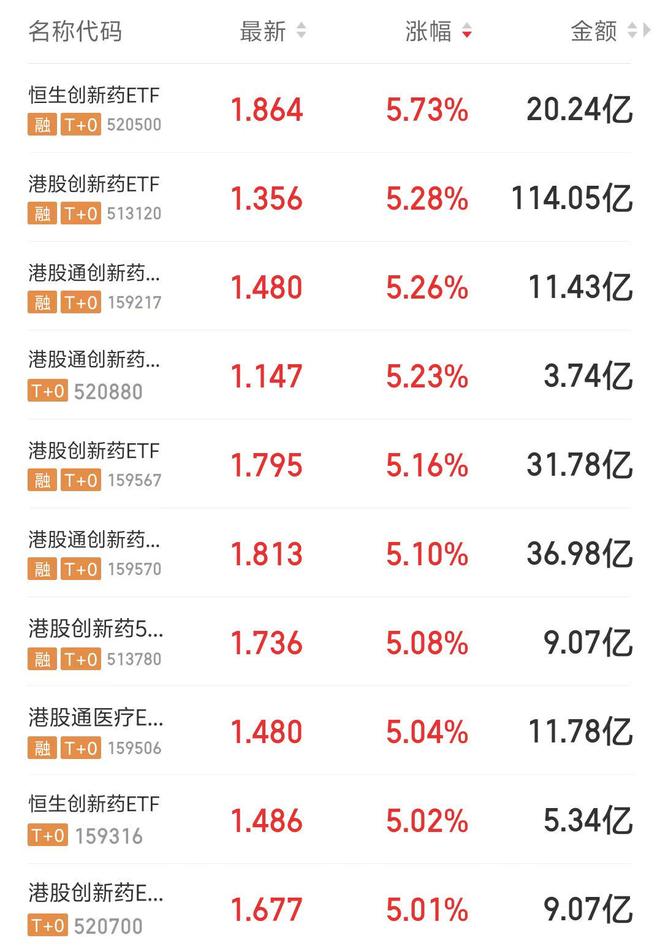
Core Viewpoint - The Hong Kong innovative drug-themed ETFs have shown significant performance, with the top 10 ETFs all increasing by over 5%, indicating strong market interest in the innovative drug sector [1][2]. Group 1: ETF Performance - The Hang Seng Innovative Drug ETF (520500) led the gains with a 5.73% increase, reaching a value of 1.864 [2]. - Other notable ETFs include the Hong Kong Innovative Drug ETF with a 5.28% increase and the Hong Kong Stock Connect Innovative Drug ETF with a 5.26% increase [2]. - Among the top-performing stocks, Kangfang Biotech (09926.HK) and BeiGene (06160.HK) both rose over 10%, while Innovent Biologics (01801.HK) and CSPC Pharmaceutical Group (01093.HK) increased by over 3% [2]. Group 2: Market Trends - A total of 25 ETFs have increased by over 40% this year, with 24 of them being related to the Hong Kong biopharmaceutical theme, highlighting the sector's strong performance [3]. - The Hong Kong Innovative Drug Index has risen over 70% since the beginning of the year, significantly outperforming the Hang Seng Index, reflecting high market recognition of the innovative drug industry [4]. Group 3: Policy and Market Drivers - The continuous optimization of the policy environment has positively impacted market sentiment, with the National Healthcare Security Administration initiating adjustments to the 2025 National Medical Insurance Directory, which includes innovative drugs with high clinical value [5]. - The trend of Chinese innovative drugs going global has reached historic breakthroughs, indicating an increase in global competitiveness [5]. - Fund managers express optimism about the innovative drug sector, citing strong clinical data and ongoing product commercialization as key factors for future performance [6].