
AKESO(09926)

Search documents
港股收评:三大指数涨跌不一,恒生科技指数涨0.56%,医药、军工、汽车大涨
Ge Long Hui· 2025-07-17 08:30
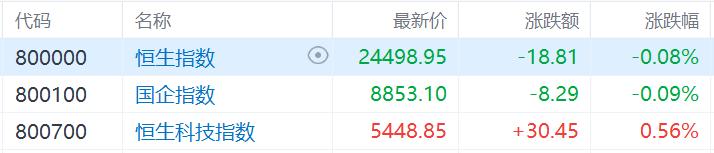
Market Overview - The Hong Kong stock market indices showed a narrow range of fluctuations, with a sharp drop in the last trading session [1] - The Hang Seng Index and the Hang Seng China Enterprises Index fell slightly by 0.08% and 0.09% respectively, while the Hang Seng Tech Index rose by 0.56% [2][3] Sector Performance - Large tech stocks had mixed performances, with Meituan rising over 1%, while Baidu and Xiaomi fell by over 3% and 2% respectively [2] - The biopharmaceutical sector surged, with notable gains from companies like CanSino Biologics, which rose by 14.5%, and others like Innovent Biologics and BeiGene, which increased by over 10% [5][6] - Semiconductor, military, automotive, and Apple concept stocks were active, with CITIC Securities and China International Capital Corporation showing significant gains in the afternoon session [4] Biopharmaceutical Sector Insights - The biopharmaceutical sector led the market, with CanSino Biologics up 14.5%, Innovent Biologics and BeiGene up over 10%, and several others showing strong performance [5][6] - Goldman Sachs noted that the Chinese biotech industry is undergoing a structural revaluation, indicating that the current surge is not just a short-term rebound [6] Entertainment and Media Stocks - The entertainment sector was active, with companies like Bigo Group and Damai Entertainment rising over 10% and 8% respectively [7][8] Military and Automotive Stocks - Military stocks saw significant increases, with companies like Xian Aircraft and AVIC rising over 4% and 3% respectively [9] - Automotive stocks also performed well, with Li Auto rising over 9% and several other manufacturers showing gains [10] Renewable Energy Sector - The solar energy sector saw gains, with Fuyao Glass rising over 4% and several other companies also showing positive movement [11] Education Sector - The education sector faced declines, with companies like Think Tank Education dropping nearly 5% [12] Metals and Mining Sector - The copper and gold sectors experienced declines, with companies like Jihai Resources falling over 7% and several others dropping significantly [13] Future Outlook - Analysts suggest caution regarding potential tactical adjustments in the Hong Kong market in early Q3, but see opportunities for buying during fluctuations as the market may improve with progress in US-China trade talks and potential interest rate cuts [13]


利好突袭!刚刚,集体异动!
券商中国· 2025-07-17 08:17
Core Viewpoint - The innovative drug sector is experiencing a significant surge in stock prices, driven by positive news and market momentum, with both A-shares and Hong Kong stocks showing substantial gains in related companies [1][2][3]. Group 1: Market Performance - On July 17, A-shares saw a collective rise, with the Shanghai Composite Index up by 0.37%, the Shenzhen Component up by 1.43%, and the ChiNext Index up by 1.76% [1]. - The innovative drug sector led the market, with nearly 20 related stocks hitting the daily limit or rising over 10%, including Chengdu XianDai, Saily Medical, and Lisheng Pharmaceutical [1][3]. Group 2: Positive News and Developments - A recent report indicated that the innovative drug "Qiruisuo Wei," developed in China for treating respiratory syncytial virus, has been included in the World Health Organization's priority list for children's medications, potentially providing accessible and affordable treatment for children globally [4][5][6]. - The WHO's initiative aims to accelerate the development of urgently needed children's medications, highlighting the critical need for effective treatments for respiratory syncytial virus, which causes millions of infections and significant mortality among young children each year [5]. Group 3: Policy Support - The National Healthcare Security Administration and the National Health Commission have issued measures to support the high-quality development of innovative drugs, including increasing support for R&D, facilitating access to insurance coverage, and enhancing clinical application [8]. - The introduction of a commercial health insurance directory for innovative drugs marks a significant step in expanding the role of commercial insurance in the multi-tiered healthcare system, providing more opportunities for high-priced innovative drugs [9][10]. Group 4: Industry Outlook - Analysts predict that the domestic innovative drug industry may reach a turning point in 2025, shifting from capital-driven growth to profit-driven growth, presenting opportunities for both performance and valuation recovery [11]. - China's share in global innovative drug business development transactions is expected to increase significantly, with a notable rise in the number and value of projects, particularly in areas like ADC and bispecific antibodies [12].




创新药板块爆发,港股创新药ETF(513120)强势上涨4.97%,成交额居权益类ETF首位!
Sou Hu Cai Jing· 2025-07-17 06:55
Core Insights - The Hong Kong Innovation Drug Index (931787) has shown a strong increase of 5.50% as of July 17, 2025, with significant gains in constituent stocks such as Lepu Biopharma-B (up 20.94%) and CanSino Biologics-B (up 14.50%) [1] - The Hong Kong Innovation Drug ETF (513120) has risen by 4.97%, marking a seven-day consecutive increase, with a trading volume of 9.798 billion HKD and a turnover rate of 67.06% [1] - Over the past year, the Hong Kong Innovation Drug ETF has achieved a net value increase of 109.64%, ranking 1st out of 122 QDII equity funds [2] Market Performance - The Hong Kong Innovation Drug ETF has a current scale of 14.035 billion HKD, making it the largest in the Hong Kong pharmaceutical ETF sector [1] - In the last 22 trading days, there have been net inflows on 12 days, totaling 838 million HKD [1] - The ETF has recorded a maximum monthly return of 23.82% since its inception, with an average monthly return of 7.75% during rising months [2] Index Composition - The index comprises a maximum of 50 listed companies primarily engaged in innovative drug research and development, reflecting the overall performance of the innovative drug sector in the Hong Kong market [2] - The top ten weighted stocks in the index account for 67.94%, with notable companies including Innovent Biologics (01801) and WuXi Biologics (02269) [3] Policy Environment - Recent adjustments to the national medical insurance drug list and commercial health insurance for innovative drugs have established a dual-track payment system, ensuring that innovative drugs are not included in centralized procurement [3] - The regulatory environment is supportive, with the resumption of the fifth set of listing standards for the Sci-Tech Innovation Board and a reduction in clinical trial review periods to 30 days [3] - The combination of favorable policies and significant overseas business development expectations is expected to drive the performance of the innovative drug sector in the coming years [3]

创新药产业链持续火热,港股医疗ETF(159366)场内价格创新高,60日涨超30%!
Sou Hu Cai Jing· 2025-07-17 05:40
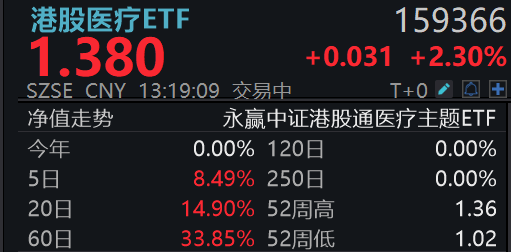
Group 1 - The China Securities Hong Kong Stock Connect Medical Theme Index (932069) has seen a strong increase of 2.89%, with notable gains in constituent stocks such as Kangfang Biotech (09926) up 10.16%, BeiGene (06160) up 9.17%, and Kelun-Biotech (06990) up 8.05% [1][2] - The Hong Kong Medical ETF (159366) has risen by 2.00%, marking its third consecutive increase, with the latest price reaching 1.38 HKD, a new high [1][2] - The index reflects the performance of 50 listed companies involved in medical devices, medical services, pharmaceuticals, and biotechnology within the Hong Kong Stock Connect framework [6] Group 2 - The 2025 National Basic Medical Insurance and other insurance drug directories have officially started adjustments, with the first addition of innovative drugs to the commercial health insurance directory this year [3] - WuXi AppTec has disclosed a positive half-year performance forecast for 2025, exceeding market expectations, leading to a collective rise in the CXO sector [4] - The AI medical technology sector is transitioning towards multi-modal integration, significantly enhancing the intelligence level in medical scenarios, with AI-assisted diagnosis systems penetrating 89% of top-tier hospitals [4] Group 3 - The medical device and traditional Chinese medicine sectors are expected to see a performance turning point in the second half of 2025, with a focus on new technology directions such as medical devices, AI healthcare, and brain-computer interfaces [5] - The Hong Kong Medical ETF aggregates rare and specialized medical segment leaders from the mainland, focusing on internet healthcare, CXO, and medical devices [5] - As of June 30, 2025, the top ten weighted stocks in the index accounted for 57.7% of the total, including companies like WuXi Biologics (02269) and JD Health (06618) [6]

异动盘点0717|创新药继续受资金追捧,政策、BD双轮驱动,三生涨超8%;Unity涨超14%;Circle涨19%
贝塔投资智库· 2025-07-17 03:40
Group 1: Market Performance - Bilibili-W (09626) rose over 4% due to growth in gaming and advertising, with Bank of America raising the target price to HKD 211 [1] - Innovation drugs continue to attract funding, with companies like 3SBio (01530) up over 8%, CanSino Biologics (09926) up over 12%, and others reaching historical highs [1] - DaMai Entertainment (01060) increased over 5% as it became the official channel for Scottish Super League matches, indicating growth in sports ticketing [1] Group 2: Industry Developments - The National Healthcare Security Administration of China initiated the 11th batch of centralized drug procurement, focusing on mature "old drugs" and excluding innovative drugs from the procurement [1] - In the first half of this year, the total amount of License out for Chinese innovative drugs approached USD 66 billion, surpassing the total BD transaction amount for 2024, indicating sustained interest from multinational corporations [1] Group 3: Company-Specific News - Meitu (01357) rose over 5% due to significant progress in overseas lifestyle and productivity scene expansion, including a strategic partnership with Alibaba [2] - Tengsheng Bo Pharmaceutical-B (02137) increased over 7% after granting exclusive rights for a new drug in Greater China to Health元 Group [2] - Smoore International (06969) fell over 2% as it expects a profit decline of up to 35% in the first half of the year due to increased expenses [2] Group 4: Notable Stock Movements - Blueport Interactive (08267) surged over 40% after establishing the LK Crypto division to accelerate Web3 and RWA layout [2] - Gilead Sciences-B (01672) saw an early morning increase of over 11% as clinical research for ASC47 in treating obesity was completed [2] - MicroPort Medical (0853.HK) rose over 6% as it considers a non-binding proposal to restructure its CRM business [3]



港股医药股延续涨势 三叶草生物涨超28%
news flash· 2025-07-17 02:39
Group 1 - The core viewpoint of the article highlights the significant rise in the stock prices of several pharmaceutical companies listed on the Hong Kong Stock Exchange, indicating a positive trend in the sector [1] Group 2 - Company "三叶草生物" (Clover Biopharmaceuticals) experienced a stock price increase of 28.17% [1] - Company "复旦张江" (Fudan Zhangjiang) saw a rise of 22.86% in its stock price [1] - Company "康诺亚-B" (CanSino Biologics) reported an increase of 11.10% in its stock price [1] - Company "康方生物" (Kangfang Biologics) had a stock price increase of 11.03% [1]
港股异动 | 创新药概念再度走强 政策利好及BD预期双轮驱动 机构称板块当前估值仍具吸引力
智通财经网· 2025-07-17 02:28
Group 1 - The innovative drug sector is experiencing a strong rally, with significant stock price increases for companies such as Lepu Biopharma-B (up 11.15%), CanSino Biologics (up 9.92%), and others [1] - Recent favorable news for the innovative drug industry includes the initiation of the 11th batch of national drug centralized procurement, which will not include innovative drugs, focusing instead on mature "old drugs" [1] - The National Healthcare Security Administration and the National Health Commission have issued measures to support the high-quality development of innovative drugs, including 16 specific initiatives across R&D support, medical insurance access, and clinical application [1] Group 2 - According to Zhongyou Securities, the innovative drug sector is expected to continue its positive trend due to overseas large-scale business development (BD) expectations and supportive policy documents [2] - The core driving force behind the current Hong Kong stock market's innovative drug rally is value reassessment, with current valuations still considered attractive [2] - Domestic capital has been increasing its positions through the Hong Kong Stock Connect, while foreign capital remains at a low position in innovative drugs, indicating a preference for fundamentally solid and cost-effective stocks [2]
港股生物医药股盘初拉升,康方生物(09926.HK)涨超8%,泰格医药(03347.HK)涨超4%,百济神州(06160.HK)、复宏汉霖(02696.HK)均涨近4%,金斯瑞生物科技(01548.HK)涨超3%。
news flash· 2025-07-17 01:39
Group 1 - Hong Kong biopharmaceutical stocks experienced an initial surge, with 康方生物 (09926.HK) rising over 8% [1] - 泰格医药 (03347.HK) increased by more than 4% [1] - 百济神州 (06160.HK) and 复宏汉霖 (02696.HK) both saw nearly 4% gains [1] - 金斯瑞生物科技 (01548.HK) rose by over 3% [1]
7月16日港股通净买入16.03亿港元
Zheng Quan Shi Bao Wang· 2025-07-16 12:18
7月16日恒生指数下跌0.29%,报收24517.76点,全天南向资金通过港股通渠道合计净买入16.03亿港 元。 证券时报·数据宝统计,7月16日港股通全天合计成交金额为1288.02亿港元,成交净买入16.03亿港元。 具体来看,沪市港股通成交金额819.58亿港元,成交净买入20.09亿港元;深市港股通成交金额468.44亿 港元,成交净卖出4.06亿港元。 | 代码 | 简称 | 类型 | 成交金额(万港元) | 成交净买入(万港元) | 日涨跌幅(%) | | --- | --- | --- | --- | --- | --- | | 09988 | 阿里巴巴-W | 港股通(沪) | 572834.28 | -34338.01 | 0.26 | | 01788 | 国泰君安国际 | 港股通(沪) | 567262.75 | 10080.56 | 4.93 | | 09992 | 泡泡玛特 | 港股通(沪) | 362346.76 | 31572.40 | -4.03 | | 09988 | 阿里巴巴-W | 港股通(深) | 307619.00 | 31374.96 | 0.26 | | 0070 ...




港股通7月16日成交活跃股名单
Zheng Quan Shi Bao Wang· 2025-07-16 12:15
Summary of Key Points Core Viewpoint - On July 16, the Hang Seng Index fell by 0.29%, with southbound funds recording a total transaction amount of HKD 128.80 billion, resulting in a net inflow of HKD 16.03 billion [1]. Southbound Fund Transactions - The total transaction amount for southbound funds was HKD 128.80 billion, with buy transactions amounting to HKD 65.20 billion and sell transactions at HKD 63.60 billion, leading to a net buy of HKD 16.03 billion [1]. - The southbound trading through Stock Connect (Shenzhen) had a total transaction amount of HKD 46.84 billion, with net selling of HKD 4.06 billion, while the trading through Stock Connect (Shanghai) had a total transaction amount of HKD 81.96 billion, resulting in a net buy of HKD 20.09 billion [1]. Active Stocks - The most actively traded stock by southbound funds was Alibaba-W, with a total transaction amount of HKD 88.05 billion, followed by Guotai Junan International and Pop Mart, with transaction amounts of HKD 76.18 billion and HKD 58.30 billion, respectively [1]. - The stocks with the highest net buying included Meituan-W with a net buy of HKD 8.57 billion, followed by China Construction Bank with HKD 7.59 billion and CanSino Biologics with HKD 1.30 billion [1]. - Tencent Holdings had the highest net selling amount of HKD 17.57 billion, with other notable net sells from Xiaomi Group-W and Kingsoft Cloud at HKD 2.67 billion and HKD 1.69 billion, respectively [1]. Continuous Net Buying and Selling - Meituan-W was the only stock to receive continuous net buying for more than three days, with a total net buy of HKD 66.08 billion over eight days [2]. - The stocks with the highest continuous net selling included Tencent Holdings and Xiaomi Group-W, with total net sells of HKD 35.78 billion and HKD 19.75 billion, respectively [2].
