BABA(09988)

Search documents
阿里巴巴“淘宝闪购”力争第一,香港科技股行业格局生变
Di Yi Cai Jing Zi Xun· 2026-01-09 09:57
港股100研究中心顾问余丰慧向第一财经记者表示,阿里巴巴在即时零售与人工智能领域的推进,对其 他互联网企业产生显著外溢效应。即时零售方面,阿里加大闪购等资源投入,行业竞争强度随之提升, 美团、京东需同步加快布局,通过优化服务及运营效率维持份额。人工智能方面,阿里持续迭代大模型 及应用,促使腾讯、百度等公司加速技术落地,行业整体研发节奏加快,具备技术储备、增长路径清晰 的企业获得更多关注。 1月8日下午,阿里巴巴(09988.HK)面向投资者的交流信息显示,淘宝闪购在最新季度取得关键进 展。阿里集团对于淘宝闪购2026年的投入战略明朗化:闪购首要目标是份额增长,会坚定加大投入以达 到市场绝对第一。 1月8日下午阿里巴巴一度加速下跌,全天跌2.26%,盘中一度创出141港元阶段新低,相比10月高点累 计下跌约25%;隔夜美股大幅反弹超过5%,引发投资者憧憬;1月9日香港交易时段,阿里巴巴高开后 回落,半天上涨2.81%,中午报收146.6港元,成交近115亿港元,京东集团(09618.HK)上涨近3%,美 团(03690.HK)下跌2.38%。 业内人士认为,阿里巴巴这一举动加剧了竞争,而本身有更多人工智能方面的 ...



2025年中国人形机器人320起融资!
机器人圈· 2026-01-09 09:56
| 自变量机器人 | 具身大模型 | 2025年2月18日 | Pre-A++4 | 数亿元 | 光速光合、君联资本、北京机器人产业基金、 田原谷本 | | --- | --- | --- | --- | --- | --- | | 中科第五纪 | 具身大模型 | 2025年2月19日 | 种子轮 | 未披露 | 草源亚洲 | | 重要图 | 人形机器人 | 2025年2月20日 | A48 | 3亿人民币 | 百度风投、高瓴资本、同歌创投、IDG资本、 | | | | | | | 蚂蚁集团 | | 玄鸟科智 | RV减速机 | 2025年2月20日 | 股权投资 | 未披露 | 成都高投 | | 干诀科技 | 具身大模型 | 2025年2月21日 | 股权投资 | 未披露 | 华业天成 | | 正德智控 | 电机 | 2025年2月25日 | 股权投资 | 1亿人民币 | 安徽省铁路发展基金 | | 松延动力 | SOLIns 人形机器人 | Int Research 2025年2月25日 | A+轮 | 1亿人民币 | 华强资本、彬复资本 | | 源升智能 | 灵巧手 | 2025年2月26日 | 天使轮 ...



南向资金今日净买入超68亿港元 腾讯控股获净买入居前
Xin Lang Cai Jing· 2026-01-09 09:55
Group 1 - The core point of the article highlights that southbound funds recorded a net purchase of approximately 68.15 billion HKD on January 9 [1] - Tencent Holdings received the highest net purchase among companies, amounting to about 14.12 billion HKD [1] - Xiaomi Group-W also saw significant net buying, with approximately 8.70 billion HKD [1] Group 2 - Alibaba-W experienced a notable net sell-off, with a total of 26.22 billion HKD [1]

南向资金今日净买入腾讯控股14.12亿港元
Zheng Quan Shi Bao Wang· 2026-01-09 09:48
Group 1 - The core point of the article is that southbound funds recorded a net purchase of 68.15 billion HKD today [1] - Tencent Holdings and Xiaomi Group-W received net purchases of 14.12 billion HKD and 8.70 billion HKD respectively [1] - Alibaba-W experienced a net sell-off of 26.22 billion HKD [1]
别低估了,淘宝闪购这一战的决心
Feng Huang Wang· 2026-01-09 08:35
Core Viewpoint - Alibaba is determined to lead the next retail revolution by significantly increasing its investment in instant retail, with a goal of market share growth by 2026 [2][4][18] Group 1: Strategic Importance of Instant Retail - The battle for instant retail is not just a business competition but a critical fight for Alibaba's future business model [5][9] - Instant retail is seen as a necessary response to the saturation of traditional e-commerce growth, with consumer demand for immediacy rapidly increasing [6] - Failure in this sector could result in Alibaba losing not just a business segment but also its influence in the evolving consumer landscape [9] Group 2: Investment Strategy - Alibaba plans to invest in three key dimensions to enhance its competitive edge: improving user and order value, expanding product categories, and optimizing fulfillment experiences [10][11] - The focus is on elevating the perception of instant retail from low-value delivery services to high-quality consumer experiences [11] - By integrating its extensive supply chain from Tmall and Hema, Alibaba aims to create a differentiated advantage in instant retail [15][17] Group 3: Efficiency and Long-term Vision - Despite a reported loss of approximately 20 billion yuan in the fourth quarter, Alibaba's loss reduction is outpacing competitors, indicating a strategic approach to spending [8][14] - The company is leveraging data and technology to ensure that every subsidy is effectively directed towards improving business fundamentals [8][14] - Alibaba's long-term strategy involves transforming instant retail into a service-oriented model, which is seen as a calculated investment for future growth [8][14][18] Group 4: Competitive Advantages - Alibaba's unique supply chain integration provides a significant barrier to entry for competitors, making it difficult for them to replicate its model [15][17] - The synergy between its physical retail networks and instant delivery capabilities enhances operational efficiency and product variety [17] - The shared consumer data across platforms allows for precise inventory management and targeted marketing, creating a more responsive retail environment [17]

CES变成中国科技秀:机器人跳舞、熊猫获奖
3 6 Ke· 2026-01-09 08:24
Group 1: Core Themes of CES 2026 - The main theme of CES 2026 is "human-centered" AI applications, marking a shift from traditional consumer electronics to AI-centric technological transformations [1] - Chinese companies are increasingly taking center stage at CES, with 942 exhibitors, accounting for approximately 22% of the total, maintaining their position as the second-largest exhibiting nation [1] - In specific sectors, Chinese firms dominate, with 55% of humanoid robot exhibitors and nearly 70% of AI glasses brands coming from China [1] Group 2: Robotics and AI Innovations - Chinese manufacturers are expected to continue leading in cost reduction and efficiency improvements in humanoid robots, showcasing their capabilities in unstructured environments [2] - Notable products include the Unitree H1 humanoid robot with advanced sensing capabilities and the latest generation of the "绝影" series robotic dogs, which excel in indoor navigation [4][11] - The "Care-bot" humanoid robot by Fourier demonstrates embodied intelligence in real-life interaction scenarios [7] Group 3: Consumer Electronics and Smart Devices - Over 80% of global smart glasses supply chain manufacturers are from China, with 16 Chinese companies showcasing their products at CES [15] - Innovations in smart home devices include the AI-driven "安安" companion robot designed for elderly and cognitively impaired individuals [16] - Companies like Alibaba and XREAL are launching advanced AI glasses, with features such as ultra-lightweight designs and integration with various AI services [19][20] Group 4: Automotive and AI Integration - The automotive industry is transitioning from "software-defined" to "AI-defined" vehicles, with companies like Geely and Great Wall showcasing new technologies [28] - Geely's G-ASD smart driving solution and Great Wall's focus on new energy technologies highlight the industry's shift towards AI integration [30][32] - New products like the AI-driven logistics solutions from New Stone and advanced lidar technology from Hesai demonstrate the growing importance of AI in transportation [34][35] Group 5: Home Appliances and AI - Hisense introduced new RGB-Mini LED display technology and AI-controlled smart refrigerators, showcasing the integration of AI in home appliances [41] - TCL's innovations in display technology, including the world's first printed OLED car screen, reflect advancements in consumer electronics [43][44] - Companies are increasingly focusing on AI capabilities in home security and smart home management systems [51][49] Group 6: Overall Impact of AI - CES 2026 emphasizes the profound impact of AI on the consumer electronics industry, with expectations for AI user numbers to grow significantly [59] - The event serves as a platform for global tech companies to set the foundation for future technological development and transformation [59] - The integration of AI into various sectors, including robotics, automotive, and consumer electronics, indicates a trend towards deeper AI adoption in everyday life [59]





小摩:对阿里巴巴-W未来6至12个月交易前景持建设性看法 建议增持股票
Zhi Tong Cai Jing· 2026-01-09 07:12
Core Viewpoint - Morgan Stanley maintains an optimistic outlook on Alibaba's (09988) trading prospects over the next 6 to 12 months, recommending an "overweight" rating on the stock, anticipating that the share price will overcome short-term profit pressures and be re-rated once the monetization point of "cloud business + generative AI" becomes clearer [1] Group 1 - Morgan Stanley believes that the risk and reward profile for Alibaba leans towards the upside, as the potential of AI-driven cloud business and the value of platform optionality outweigh short-term investment hurdles [1] - The firm has lowered its target price for Alibaba's U.S. stock from $230 to $215, based on a 16x price-to-earnings ratio for the fiscal year 2028, and reduced the target price for its Hong Kong stock from HKD 225 to HKD 210 [1] - Despite increased investments in food delivery, instant retail, and user acquisition for generative AI native applications potentially weakening profit margins in the short term, these adverse factors are gradually being understood by the market, with investment pace largely dependent on management's self-regulation [1] Group 2 - Morgan Stanley has revised its earnings per share forecasts for Alibaba for 2027 to 2028 down by 15% and 7% respectively, reflecting increased investment in food delivery, instant retail, and generative AI user acquisition, as well as weakened monetization capabilities in the domestic e-commerce sector amid soft consumer demand [2] - The firm anticipates that as these adverse factors continue to unfold over the coming quarters, profitability may have further downside potential, leading to a more differentiated and potentially volatile trading style [2]
小摩:对阿里巴巴-W(09988)未来6至12个月交易前景持建设性看法 建议增持股票
智通财经网· 2026-01-09 07:05
Group 1 - Morgan Stanley maintains an optimistic outlook on Alibaba's (09988) trading prospects for the next 6 to 12 months, recommending to overweight the stock as it is expected to overcome short-term profit pressures [1] - The target price for Alibaba's US stock is lowered from $230 to $215, based on a 16x price-to-earnings ratio for the fiscal year 2028, while the Hong Kong target price is adjusted from HKD 225 to HKD 210 [1] - Despite short-term profit margin pressures due to increased investments in food delivery, instant retail, and generative AI applications, these negative factors are gradually being understood by the market, with investment pace largely dependent on management's self-regulation [1] Group 2 - Earnings per share forecasts for Alibaba for 2027 and 2028 are reduced by 15% and 7% respectively, reflecting increased investment in user acquisition for food delivery, instant retail, and generative AI applications, alongside weakened monetization capabilities in the domestic e-commerce sector due to soft consumer demand [2] - It is anticipated that profit margins may have further downside potential in the coming quarters as these adverse factors continue to unfold, leading to a more differentiated and potentially volatile trading style [2]
CES 2026观察:AI眼镜并没有迎来iPhone时刻
Tai Mei Ti A P P· 2026-01-09 06:23
Core Insights - The CES 2026 highlighted AI glasses as a core topic, but failed to deliver groundbreaking innovations, indicating that the industry is still struggling to transition from niche products to mainstream necessities [1] - Despite promising growth projections, the AI glasses market has not yet crossed the gap from "geek toys" to "essential consumer products," suggesting that the anticipated explosion in demand may be more of an industry fantasy [1] Group 1: Exhibition Highlights - Several manufacturers showcased their innovations at CES, revealing both strengths and limitations in the current AI glasses market [2] Group 2: Company Innovations - Meta introduced the Ray-Ban Display series, featuring a micro-display and improved voice interaction, but faced limitations in field of view and battery life, indicating a focus on incremental innovation rather than breakthrough technology [3] - Thunder Innovation launched the X3 Pro Project eSIM, enabling independent communication and AI interaction, but its weight and eSIM subscription challenges may hinder widespread adoption [4] - XREAL presented the 1S model with advanced spatial computing capabilities, but its high price point and lack of quality AR content limit its market reach [5] - Quark's AI glasses S1 integrated various Alibaba services but struggled with competitive pricing and compatibility issues, reflecting a tension between high specs and market viability [7] - Rokid's lightweight glasses achieved a record low weight of 49 grams and strong sales, but compromised on camera quality and field of view, positioning it as a smart assistant tool rather than a full-fledged device [8] Group 3: Industry Challenges - The AI glasses industry faces three main barriers: technological limitations, unclear use cases, and fragmented ecosystems, which hinder the potential for explosive growth [9][10] - The "impossible triangle" of lightweight design, long battery life, and high performance remains unsolved, with current products often falling short of user expectations [9] - The lack of a unified operating system and collaboration with traditional optical retailers further complicates market development, leading to inconsistent product quality and consumer confusion [10] Group 4: Future Outlook - The AI glasses market is expected to remain in a phase of technological iteration and market education, with significant breakthroughs potentially taking 3-5 years [11] - The development of specialized low-power chips and advancements in optical technology are seen as critical for overcoming current limitations [11] - Price reductions and increased competition from companies like Xiaomi and Quark may drive market growth and improve product affordability [11] - The industry awaits a "killer app" or a revolutionary product that combines technological innovation, practical use cases, and ecosystem compatibility to trigger widespread adoption [12]

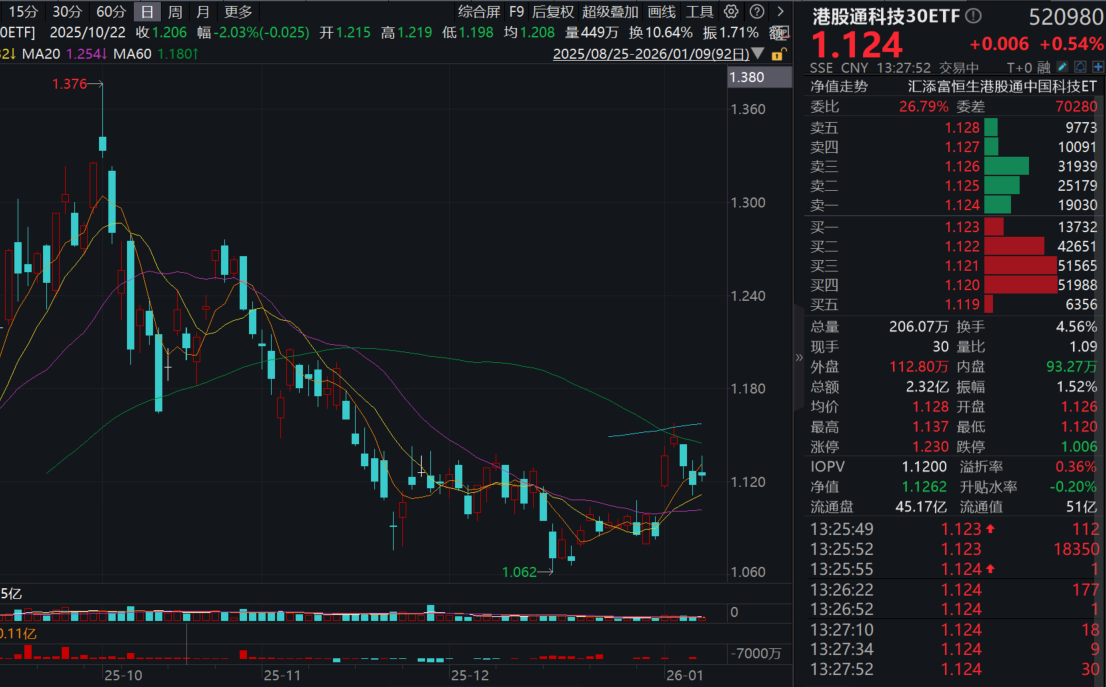
MiniMax港股上市暴涨,阿里巴巴大涨近3%!港股通科技30ETF(520980)、恒生科技ETF基金(513260)双双飘红!
Xin Lang Cai Jing· 2026-01-09 05:56
Group 1: Market Performance - The Hong Kong stock market's technology sector showed positive performance, with the Hong Kong Stock Connect Technology 30 ETF (520980) rising nearly 1% and achieving a trading volume exceeding 240 million yuan [1] - The Hang Seng Technology ETF (513260), which has the lowest management fee of 15 basis points, also increased by 0.35%, with a trading volume surpassing 300 million yuan [3] - Notable stocks in the technology sector included Alibaba-W and Kuaishou-W, both rising over 2%, while Meituan-W fell over 2% [7] Group 2: New Listings and Innovations - MINIMAX-WP, a leading global general artificial intelligence company, listed on the Hong Kong stock market on January 9, with its stock price surging over 80% shortly after opening [5] - Alibaba reported significant progress in its Taobao Flash Sale service, aiming for market share growth by 2026 [6] - JD.com established a "Chameleon Business Department" to focus on the commercialization of core AI products, with new self-developed AI toys set to launch in mid-January [6] Group 3: Fund Flows and Investor Sentiment - Southbound capital continued to flow into Hong Kong stocks, with Xiaomi Group-W leading net purchases at 4.401 billion HKD over the past week [9] - Institutional insights suggest that the Hong Kong market is attractive for long-term investment, driven by new year positioning and short covering [11] - The market is expected to enter a period of upward volatility, with potential for increased allocation of southbound funds into Hong Kong technology stocks [11]