SMIC(688981)

Search documents
芯片50ETF(516920)开盘涨0.10%,重仓股中芯国际涨0.19%,寒武纪跌0.77%
Xin Lang Cai Jing· 2025-12-11 01:41
Core Viewpoint - The Chip 50 ETF (516920) opened with a slight increase of 0.10%, indicating a stable market performance for the semiconductor sector [1] Group 1: ETF Performance - The Chip 50 ETF (516920) opened at 1.021 yuan, reflecting a modest gain [1] - Since its establishment on July 27, 2021, the fund has achieved a return of 2.15% [1] - The fund's performance over the past month has seen a decline of 1.83% [1] Group 2: Major Holdings Performance - Among the major holdings, SMIC opened with a gain of 0.19% [1] - Cambrian fell by 0.77%, while Haiguang Information saw a slight increase of 0.01% [1] - Northern Huachuang rose by 0.22%, and Lanke Technology increased by 2.75% [1] - Zhaoyi Innovation gained 1.46%, while Zhongwei Company decreased by 0.08% [1] - OmniVision Technologies rose by 0.23%, and Chipone Technology increased by 0.18% [1] - Changdian Technology experienced a decline of 0.08% [1]




268只科创板股融资余额环比增加
Zheng Quan Shi Bao Wang· 2025-12-11 01:27
Core Insights - The total margin financing balance on the STAR Market decreased by 8.63 billion yuan, with a notable reduction in both financing and securities lending balances [1][2] Financing Balance Summary - As of December 10, the total financing balance on the STAR Market was 2598.90 billion yuan, down by 8.42 billion yuan from the previous trading day [1] - The highest financing balance was recorded for Cambrian (寒武纪) at 14.78 billion yuan, followed by SMIC (中芯国际) at 13.02 billion yuan and Haiguang Information (海光信息) at 7.95 billion yuan [1] - A total of 268 stocks saw an increase in financing balance, while 320 stocks experienced a decrease [1] - The stocks with the largest increases in financing balance were Changguang Huaxin (长光华芯) at 17.32%, Holley (霍莱沃) at 13.47%, and Shijia Photon (仕佳光子) at 12.87% [1][2] Securities Lending Balance Summary - The total securities lending balance was 8.88 billion yuan, a decrease of 21.61 million yuan from the previous trading day [1] - Cambrian also led in securities lending balance at 4.2 million yuan, followed by Haiguang Information and SMIC at 2.6 million yuan and 2.6 million yuan respectively [2] - 112 stocks saw an increase in securities lending balance, while 164 stocks experienced a decrease [2] - The stocks with the largest increases in securities lending balance were Medisi (美迪西) at 248.28%, Tiancheng Technology (天承科技) at 68.29%, and Jucheng Co. (聚辰股份) at 59.42% [2]


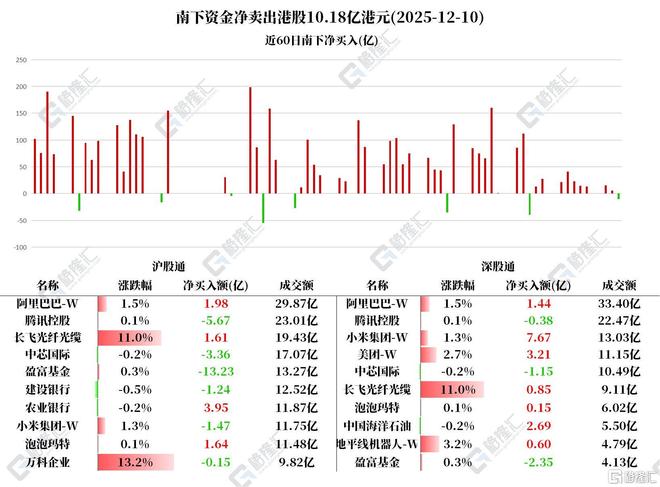
资金动向 | 北水卖出腾讯逾6亿港元,连续9日加仓小米!
Ge Long Hui· 2025-12-10 13:21
Group 1 - Southbound funds recorded a net sell of HKD 1.018 billion on December 10, with notable net buys in Xiaomi Group (HKD 619 million), Agricultural Bank (HKD 394 million), Alibaba (HKD 342 million), Meituan (HKD 320 million), China National Offshore Oil Corporation (HKD 269 million), and Pop Mart (HKD 179 million) [1] - The net sell included significant amounts in the Tracker Fund (HKD 1.559 billion), Tencent Holdings (HKD 605 million), China Construction Bank (HKD 123 million), and SMIC (HKD 118 million) [1] Group 2 - Southbound funds have continuously net bought Xiaomi for 9 days, totaling HKD 7.39843 billion, and Agricultural Bank for 3 days, totaling HKD 993.02 million [3] - In November, the sales volume of new energy passenger vehicles reached 1.321 million units, a year-on-year increase of 4.2% and a month-on-month increase of 3.0%; Xiaomi's automotive sales reached 46,249 units, with a year-on-year increase of 99.7% [4] - Morgan Stanley highlighted concerns regarding the asset quality risk related to Vanke's bond extension, noting that Vanke's bank loans account for only 0.10% of total loans in China's banking sector [4] Group 3 - Alibaba has established a new C-end business group, aiming to develop a super app as the primary entry point for users in the AI era [4] - Tencent repurchased approximately 1.06 million shares for about HKD 636 million, with repurchase prices ranging from HKD 595.5 to HKD 603 [4] - China Construction Bank announced a capital increase from RMB 250.011 billion to RMB 261.6 billion through a specific issuance of approximately 11.589 billion A-shares [5] - SMIC's monthly wafer production capacity is expected to exceed 1 million pieces by Q3 2025, with a utilization rate increase of 3.3 percentage points to 95.8%, indicating strong industry demand [5]




电子行业2026年投资策略:从云端算力国产化到端侧AI爆发,电子行业的戴维斯双击时刻
Soochow Securities· 2025-12-10 12:11
Investment Strategy Overview - The report highlights a significant investment opportunity in the electronic industry, driven by the dual forces of domestic cloud computing capabilities and the explosive growth of AI at the edge, marking a pivotal moment for the sector leading up to 2026 [1] Semiconductor Manufacturing - Capital expenditure in semiconductor manufacturing is set to reach new heights, with domestic fabs expected to experience a dual expansion in memory and advanced logic production in 2026, supporting a sustained high level of demand in the wafer foundry sector [2] - The semiconductor equipment sector is anticipated to witness a "β+α" resonance market, with a focus on industry leaders benefiting from expansion dividends and companies like Jingzhida and others that have a clear technology realization logic [2] Cloud Computing Chips - Global cloud service providers (CSPs) are increasing capital expenditures, with the combined capital expenditure of the four major overseas CSPs (Google, Amazon, Microsoft, Meta) reaching $97.9 billion in Q3 2025, a 10% quarter-on-quarter increase [5] - Domestic cloud computing is catching up, with significant growth potential as demand for computing power rises, particularly from leading firms like ByteDance [5][17] - Companies such as Cambricon and Haiguang Information are recommended for investment due to their expected performance release in the domestic computing power sector [5][17] Edge Computing Chips - The strategic importance of edge AI is rapidly increasing, with major tech companies integrating AI models into core products, enhancing the demand for System on Chip (SoC) manufacturers [7][36] - Companies like Amlogic and RichChip are positioned to benefit from the growing demand for edge AI applications, particularly in smart home devices [7][39] Storage Sector - The storage sector is experiencing a strong cyclical upturn, with DRAM and NAND indices showing significant increases of 101% and 79% respectively from September to November 2025 [5] - Major CSPs are increasing their procurement of storage products, leading to a sustained rise in storage prices and creating a "super cycle" in the industry [5] Analog Sector - The analog sector is seeing growth driven by increasing automotive demand, although price pressures are expected to persist [5] - The sector is poised for opportunities related to new AI applications as the industry evolves [5] Consumer Electronics - AI is driving a transformation in terminal interactions, with a notable shift in smartphone upgrades and the emergence of AR products [7] - The AR glasses market is expected to see significant growth in 2026, with major companies like Meta and Apple launching new products [7] PCB/CCL Market - The PCB/CCL market is set to benefit from increased capital expenditures by global cloud providers, with the AI PCB market projected to reach 60 billion yuan in 2026, a 229.8% year-on-year increase [7] - The introduction of low-loss materials and advanced architectures is expected to significantly enhance the value of PCB products [7]
科创板平均股价41.30元 8股股价超300元
Zheng Quan Shi Bao Wang· 2025-12-10 09:47
科创板百元股中,今日平均上涨0.59%,具体来看,今日上涨的有39只,涨幅居前的有C摩尔-U、长光 华芯、华盛锂电等。下跌的有32只,跌幅居前的有海博思创、聚辰股份、普冉股份等。 资金流向方面,科创板百元股今日主力资金合计净流出24.31亿元,净流入资金居前的有华盛锂电、长 光华芯、思瑞浦等,净流入资金分别为17170.58万元、14485.21万元、7247.72万元;净流出资金居前的 有寒武纪-U、中芯国际、德科立等,净流出资金分别为38522.97万元、26568.09万元、23367.00万元。 以最新收盘价计算,科创板平均股价为41.30元,其中股价超100元的有71只,股价最高的是寒武纪-U。 融资融券方面,百元股最新(12月9日)融资余额合计988.30亿元,融资余额居前的有寒武纪-U、中芯 国际、海光信息等,最新融资余额分别为149.60亿元、130.82亿元、80.90亿元。最新融券余额合计为 4.20亿元,融券余额居前的有海光信息、寒武纪-U、中芯国际等,最新融券余额分别为0.47亿元、0.44 亿元、0.25亿元。(数据宝) 证券时报·数据宝统计显示,科创板股今日上涨的有246只,下跌的 ...
三季度全球OLED面板出货量环比增长14%,消费电子ETF(561600)备受关注
Xin Lang Cai Jing· 2025-12-10 05:25
Group 1 - The core viewpoint of the news is that the global OLED panel shipment is expected to grow significantly due to strong seasonal demand for smartphones and a booming display market, with a projected quarter-on-quarter increase of 14% and a year-on-year increase of 5% by Q3 2025 [1] - The report from Western Securities highlights that new demographics, scenarios, and channels are becoming long-term structural drivers of domestic demand, particularly with the "Z generation" and "new middle class" showing strong engagement with high-repurchase products in smart technology consumption [1] - The trend of Chinese consumer brands expanding overseas is described as an irreversible supply replacement trend, which is expected to remain a theme of economic prosperity for the next 2-3 years, suggesting that these brands are worth investing in when valuations have a safety margin [1] Group 2 - As of December 10, 2025, the CSI Consumer Electronics Theme Index (931494) shows mixed performance among its constituent stocks, with Dongshan Precision (002384) leading with a 3.43% increase, followed by OmniVision Technologies (603501) at 2.35%, and Huagong Technology (000988) at 1.77%, while Industrial Fulian (601138) is the biggest loser [1] - The CSI Consumer Electronics ETF (561600) is closely tracking the CSI Consumer Electronics Theme Index, which includes 50 listed companies involved in component production and consumer electronics design and manufacturing, reflecting the overall performance of these securities [1] - The top ten weighted stocks in the CSI Consumer Electronics Theme Index (931494) as of November 28, 2025, include Luxshare Precision (002475), Cambricon Technologies (688256), Industrial Fulian (601138), and BOE Technology Group (000725), collectively accounting for 56.39% of the index [2]






中芯国际12月9日获融资买入4.84亿元,融资余额130.82亿元
Xin Lang Cai Jing· 2025-12-10 05:09
Core Insights - SMIC's stock price decreased by 0.75% on December 9, with a trading volume of 4.334 billion yuan, indicating a negative net financing buy of 204 million yuan for the day [1] - As of September 30, 2025, SMIC reported a revenue of 49.51 billion yuan, representing a year-on-year growth of 18.22%, and a net profit of 3.818 billion yuan, reflecting a 41.09% increase compared to the previous year [2] Financing Overview - On December 9, SMIC had a total financing balance of 13.107 billion yuan, with a financing buy of 484 million yuan and a repayment of 688 million yuan, resulting in a net financing buy of -204 million yuan [1] - The current financing balance of 13.082 billion yuan accounts for 5.62% of the circulating market value, which is above the 70th percentile of the past year [1] Short Selling Activity - On December 9, SMIC saw a short selling repayment of 9,483 shares and a short selling volume of 20,700 shares, amounting to a selling value of approximately 2.406 million yuan [1] - The short selling balance stood at 2.53275 million yuan, with a remaining short selling volume of 217,700 shares, which is above the 60th percentile of the past year [1] Shareholder Structure - As of September 30, 2025, SMIC had 336,200 shareholders, an increase of 33.27% from the previous period, with an average of 6,134 circulating shares per person, down by 25.41% [2] - The top ten circulating shareholders included several ETFs, with notable reductions in holdings from major funds like E Fund and Huaxia, while new entries included the 嘉实上证科创板芯片ETF and E Fund沪深300ETF [2]
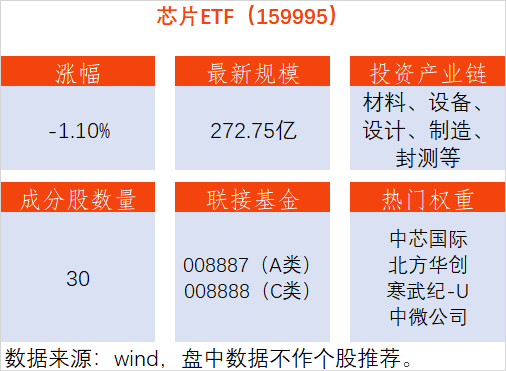
H200芯片或放开,芯片ETF(159995.SZ)下跌1.10%,华润微上涨10.06%
Mei Ri Jing Ji Xin Wen· 2025-12-10 02:55
Group 1 - A-shares experienced a collective decline on December 10, with the Shanghai Composite Index dropping by 0.60% during the session, while sectors such as forestry, retail, and engineering machinery showed positive performance [1] - The chip sector remained sluggish, with the chip ETF (159995) down by 1.10% as of 10:31 AM, and key component stocks like Lanke Technology, Haiguang Information, and Zhongwei Company falling by 3.27%, 2.69%, and 2.23% respectively [1] - Some individual stocks were active, with Huazhong Microelectronics rising by 10.61% and Haowei Group increasing by 2.97% [1] Group 2 - On December 9, U.S. President Trump announced that NVIDIA would be allowed to deliver its H200 chip products to qualified customers in China and other countries, under the condition of ensuring U.S. national security [3] - The sales revenue from these chip products will see 25% allocated to the U.S. government, and it was noted that China has been informed and responded positively [3] - Open Source Securities indicated that the restoration of supply for chips like the H200 could promote the comprehensive upgrade of domestic AI models, accelerating the development of the domestic AI ecosystem and potentially expanding demand for domestic computing power chips, which would be a long-term benefit for the domestic chip sector [3]


OpenAI等成立AI基金会,机构看好国产AI产业链前景,数字经济ETF(560800)盘中蓄势
Sou Hu Cai Jing· 2025-12-10 02:36
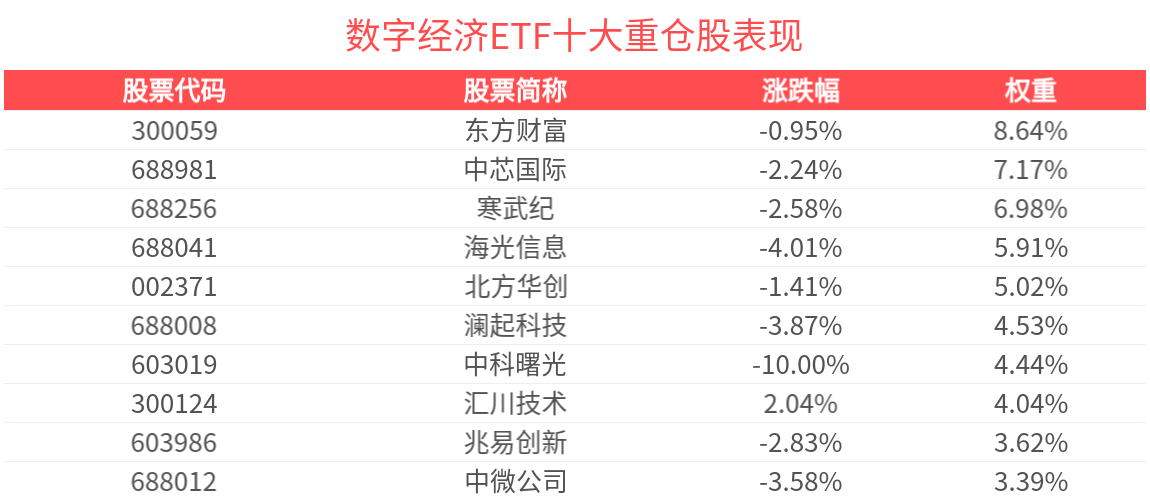
Core Insights - The digital economy theme index has seen a decline of 1.75% as of December 10, 2025, with notable movements among constituent stocks [1] - The digital economy ETF has experienced a significant scale increase of 15.91 million yuan over the past week, indicating strong investor interest [1] - A new AI foundation has been established by OpenAI, Anthropic, and Block, supported by major tech companies, aiming to transition AI systems from experimental to practical applications [1] Industry Analysis - The artificial intelligence industry is currently in a high prosperity cycle, presenting long-term growth potential as a core investment theme [2] - Key investment directions include computing infrastructure, which is essential for AI development, and the commercialization of AI applications, indicating a shift from technology exploration to value realization [2] - The digital economy ETF closely tracks the digital economy theme index, selecting companies involved in digital infrastructure and high digitalization applications to reflect overall performance [2] Stock Performance - The top ten weighted stocks in the digital economy theme index account for 54.6% of the index, with notable stocks including Dongfang Caifu, Cambricon, and SMIC [3] - Specific stock performances include Dongfang Caifu down by 0.95%, SMIC down by 2.24%, and Zhongke Shuguang down by 10.00%, indicating varied performance among leading companies [4]

“一天一个价” 存储器涨价影响几何?
Zheng Quan Ri Bao· 2025-12-10 00:18
Core Viewpoint - The global memory market has experienced an unprecedented price surge since September, with mainstream memory spot prices increasing by over 300% [1][2]. Group 1: Market Dynamics - The current price increase in memory products is characterized by rapid speed, significant magnitude, and a wide range of affected models [2]. - Demand from cloud service providers for ordinary and AI servers has driven strong demand for memory products, particularly HBM and various other models [2]. - The supply side faces challenges as new factory construction takes at least two years, making it difficult to significantly increase production capacity in the short term [2]. - The current cycle is driven by the exponential growth of data due to advancements in artificial intelligence, creating a substantial demand for memory [2][3]. Group 2: Industry Outlook - The memory industry is entering a "super cycle," with expectations of continued high demand and favorable conditions lasting until at least 2027 [3]. - Historical data indicates that the global memory market has undergone multiple cycles since 2000, each lasting approximately 3 to 5 years [3]. Group 3: Impact on Supply Chain - Upstream companies, such as semiconductor equipment manufacturers, are benefiting from the price increase, with strong order volumes reported [4]. - Midstream companies are experiencing revenue and profit growth due to rising product prices, with specific companies reporting significant year-on-year increases in revenue and net profit [5]. - Downstream consumer electronics manufacturers face challenges as memory price increases lead to higher overall production costs, potentially resulting in higher prices or reduced specifications for end products [5][6]. Group 4: Domestic Development - China's data storage capacity is projected to reach 1580 exabytes by the end of 2024, with advanced storage accounting for 28% [7]. - Domestic companies have made significant progress in key areas of the memory supply chain, enhancing the localization rate [8]. - Companies like Yangtze Memory Technologies and ChangXin Memory Technologies are rapidly increasing their market share in the memory wafer sector [8]. Group 5: Investment and Innovation - Companies are seizing the opportunity presented by the "super cycle" to invest in R&D and capacity expansion, with several firms announcing plans to raise funds for high-end memory development and production projects [9]. - The industry is expected to face both challenges and opportunities, with companies that master core high-end technologies likely to establish strong competitive barriers [9].