SPD BANK(600000)

Search documents
集体收跌
第一财经· 2025-05-22 08:09
Core Viewpoint - The A-share market experienced a decline, with major indices showing negative performance, while certain sectors like banking performed well amidst overall market weakness [3][4][6]. Market Performance - On May 22, the Shanghai Composite Index fell by 0.22% to 3380.19 points, the Shenzhen Component Index decreased by 0.72% to 10219.62 points, and the ChiNext Index dropped by 0.96% to 2045.57 points. The North Star 50 Index saw a significant decline of over 6% [3][4]. - Over 4400 stocks in the market experienced declines, with sectors such as beauty care, pet economy, chemical fiber, and aquaculture showing the largest drops [7]. Sector Analysis - Banking stocks, including Shanghai Pudong Development Bank, Jiangsu Bank, and Chengdu Bank, reached historical highs, indicating strength in this sector [6]. - Solid-state battery concept stocks faced significant declines, with companies like Ningxin New Materials, Lingge Technology, and Honggong Technology dropping over 10% [6]. Capital Flow - Main capital flows showed net inflows into aerospace, gaming, and insurance sectors, while there were net outflows from power, photovoltaic equipment, and food and beverage sectors. Notable net inflows included Kunlun Wanwei (1.274 billion), Qingdao Jinwang (455 million), and Hongbo Shares (393 million) [9]. - Conversely, Tianqimo, Hongbaoli, and Guoxuan High-Tech faced significant sell-offs, with outflows of 985 million, 616 million, and 599 million respectively [9]. Institutional Perspectives - Galaxy Securities noted that the fundamentals are being revised upwards for Q2, with global funds showing a preference for Hong Kong stocks over A-shares [11]. - CITIC Securities highlighted that the index has repeatedly tested the 3400-point mark without significant volume increase, suggesting potential for a breakthrough. They recommend investors focus on sector rotations and domestic technological innovations [11]. - Shanghai Securities emphasized that market liquidity remains ample, and even with adjustments, the downside is limited. They foresee continued foreign capital inflows and support for technology sectors as a long-term investment theme [11].





最新!又有多家银行宣布:下调!
天天基金网· 2025-05-22 05:26
Core Viewpoint - The recent reduction in deposit rates by multiple banks, including state-owned and joint-stock banks, aligns with market expectations and aims to stabilize net interest margins while supporting the real economy [1][5][6]. Group 1: Deposit Rate Adjustments - Nine out of twelve joint-stock banks have announced reductions in deposit rates, with significant cuts in medium to long-term deposit rates, particularly a 25 basis points (BP) decrease for 3-year and 5-year fixed deposits [1][2][3]. - Specific banks like Ping An Bank and Minsheng Bank have adjusted their deposit rates, with Ping An Bank's rates for various terms now at 0.70%, 0.95%, 1.15%, 1.20%, and 1.30%, reflecting reductions of 15 BP for most terms and 25 BP for longer terms [2][3]. - The speed of these adjustments is seen as necessary for banks to manage their liabilities effectively and maintain competitiveness in the current economic environment [5][6]. Group 2: Market Reactions and Expectations - Investors have anticipated the decline in deposit rates, with no significant rush to lock in rates observed at bank branches, indicating a broader acceptance of a long-term downward trend in deposit rates [3][5]. - Experts believe that the synchronized reduction in deposit rates by banks is crucial for reducing financing costs for the real economy and stabilizing net interest margins [5][6]. Group 3: Implications for Banking Sector - The current trend of deposit rate reductions is expected to create more room for lowering financing costs in the future, which is essential for improving banks' profitability and sustainability in serving the real economy [6][7]. - The recent adjustments have seen deposit rate cuts that exceed the reductions in the Loan Prime Rate (LPR), indicating a strategic move by banks to manage their interest expenses more effectively [6][7].





大面积涨停!这一概念爆发!
证券时报· 2025-05-22 04:11
Core Viewpoint - The article highlights the active performance of the defense and military industry, with significant stock price increases in related companies, driven by geopolitical tensions and government policies supporting military spending [20][21]. Defense and Military Industry - The defense and military sector showed strong performance, with stocks like Guoke Tiancai rising by 20%, and several others reaching their daily limit [4][7]. - The U.S. announcement of a $175 billion investment in missile defense systems has raised concerns about escalating military competition, which may benefit the defense sector in China [19]. - China's recent white paper on national security emphasizes the importance of maintaining territorial integrity and enhancing military capabilities, which supports the growth of the defense industry [20]. Banking Sector - The banking sector experienced a collective rise, with banks like Qingdao Bank and Shanghai Bank reaching new all-time highs [23][24]. - Recent adjustments in the Loan Prime Rate (LPR) and deposit rates are expected to impact the banking sector positively, with a focus on stabilizing growth and improving asset quality [26]. - Analysts predict that the banking sector will benefit from a series of financial policies aimed at supporting economic recovery, leading to a potential performance turnaround [26].



午评:北证50半日跌超4% 浦发银行等多只银行股再创历史新高
news flash· 2025-05-22 03:35
Core Viewpoint - The market experienced fluctuations with the North Stock Exchange 50 index dropping over 4%, while several bank stocks, including Pudong Development Bank, reached historical highs [1] Market Overview - The Shanghai and Shenzhen markets had a half-day trading volume of 719.4 billion, a decrease of 31.8 billion compared to the previous trading day [1] - Overall, the market saw more declines than gains, with 4,100 stocks falling [1] Sector Performance - Bank stocks showed resilience, with Pudong Development Bank and others hitting historical highs [1] - Military industry stocks experienced a surge, with Guorui Technology hitting the daily limit [1] - Data center power concept stocks also saw a rise, with Zhongheng Electric reaching the daily limit [1] - In contrast, new consumption concept stocks collectively fell, with Kexin Co. dropping over 10% [1] Index Performance - By the end of the trading session, the Shanghai Composite Index remained unchanged at 0.00%, while the Shenzhen Component Index fell by 0.28% and the ChiNext Index decreased by 0.44% [1]

又有多家银行宣布:下调!
新华网财经· 2025-05-22 02:41
Core Viewpoint - The recent reduction in deposit rates by nine joint-stock banks follows the lead of the six major state-owned banks, indicating a broader trend in the banking sector to lower interest rates in response to the central bank's monetary policy adjustments [1][4]. Group 1: Deposit Rate Adjustments - On May 21, seven joint-stock banks announced a reduction in their deposit rates, with a decrease of 15 basis points for 3-month, 6-month, 1-year, and 2-year fixed deposits, and a 25 basis points reduction for 3-year and 5-year fixed deposits [1][2]. - The new deposit rates for various terms at China Merchants Bank are set at 0.95% for 1-year, 1.05% for 2-year, 1.25% for 3-year, and 1.30% for 5-year deposits, while other banks have slightly different rates [1][2]. Group 2: LPR and Monetary Policy - The Loan Prime Rate (LPR) was also adjusted downwards, with the 5-year LPR at 3.5% and the 1-year LPR at 3%, both down by 10 basis points [4]. - Analysts suggest that the central bank is establishing a transmission mechanism from policy rates to LPR and deposit rates, indicating a coordinated approach to monetary policy [4][6]. Group 3: Implications for the Financial Market - The reduction in deposit rates is expected to lower the cost of liabilities for financial institutions and enhance the attractiveness of bond assets compared to loan assets, potentially leading to increased investment in the bond market [4][6]. - The average reduction in deposit rates is greater than that of the LPR, which reflects a strategy to protect bank interest margins while supporting the real economy [6].



活期存款利率已接近0 !7家银行同日发布公告下调存款利率
Guan Cha Zhe Wang· 2025-05-22 00:57
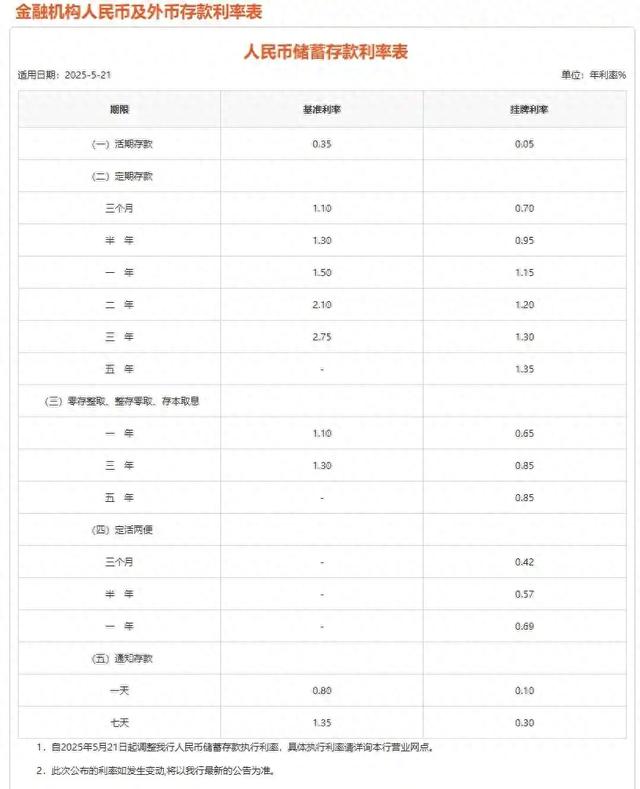
Group 1 - The core viewpoint of the article is that several banks in China have announced a reduction in RMB deposit rates, following a trend initiated by major state-owned banks, which is linked to the recent decrease in the Loan Prime Rate (LPR) [1][4][5] Group 2 - On May 20, six state-owned banks and several others, including China Merchants Bank and China Everbright Bank, announced a reduction in RMB deposit rates, with the adjustment range being 5 to 25 basis points [1] - Following this, on May 21, seven additional banks, including Ping An Bank and CITIC Bank, also announced similar reductions, with the new rates for demand deposits set at 0.05% and various fixed-term deposit rates adjusted accordingly [1][2] - The new fixed-term deposit rates for three months, six months, one year, two years, three years, and five years are 0.7%, 0.95%, 1.15%, 1.20%, 1.30%, and 1.35% respectively [1] - The recent LPR adjustments include a decrease in the 5-year LPR to 3.5% and the 1-year LPR to 3%, both down by 0.1% from the previous month [4] - The reduction in deposit rates is expected to lead to an overall decrease in deposit rates by approximately 0.11 to 0.13 percentage points, which may help stabilize banks' net interest margins [4][5] - As of the first quarter of 2025, the net interest margin for commercial banks was reported at 1.43%, a decrease of 0.09 percentage points, marking a historical low [5]


多家银行跟进,下调存款利率
新浪财经· 2025-05-22 00:43
Core Viewpoint - The recent reduction in deposit rates by nine joint-stock banks follows the earlier actions of the six major state-owned banks, indicating a broader trend in the banking sector to lower interest rates in response to the People's Bank of China's (PBOC) adjustments to the Loan Prime Rate (LPR) [1][3][6] Group 1: Deposit Rate Adjustments - On May 21, seven joint-stock banks announced a reduction in their deposit rates, with a decrease of 15 basis points for 3-month, 6-month, 1-year, and 2-year fixed deposits, and a reduction of 25 basis points for 3-year and 5-year fixed deposits [1][2] - Specific rates for China Merchants Bank were adjusted to 0.95% for 1-year, 1.05% for 2-year, 1.25% for 3-year, and 1.30% for 5-year deposits, while other banks set their rates at 1.15%, 1.20%, 1.30%, and 1.35% respectively for similar terms [1][2] Group 2: LPR and Monetary Policy - The PBOC announced a decrease in the LPR, with the 1-year LPR at 3% and the 5-year LPR at 3.5%, both down by 10 basis points [3] - Analysts suggest that the PBOC is establishing a transmission mechanism from policy rates to LPR and deposit rates, indicating a coordinated approach to monetary policy [3][4] Group 3: Market Implications - The reduction in deposit rates is expected to enhance the attractiveness of bond assets by lowering the yield advantage of loan assets, thereby improving the configuration value of bonds [3][4] - The larger reduction in deposit rates compared to LPR is seen as a measure to protect bank interest margins while encouraging credit growth [6]



跟进!多家股份行下调存款利率
Zhong Guo Jing Ying Bao· 2025-05-22 00:16
中经记者 慈玉鹏 北京报道 继5月20日国有六大行以及招商银行、光大银行宣布下调存款利率后,《中国经营报》记者统计发现,5 月21日又有七家股份行再次跟进下调存款利率,其中长期存款利率下调幅度大于短期。 记者注意到,截至目前,九家股份制银行普遍对六个月、一年期、二年期定存挂牌利率下调15个基点, 三年期、五年期定存挂牌利率普遍下调25个基点。其中长期存款利率下调幅度更大。 同时,除招商银行与五大行保持一致外,其余8家股份制银行整存整取一年期、三年期、五年期挂牌利 率分别降至1.15%、1.3%、1.35%。 或推动"存款搬家" 东方金诚首席宏观分析师王青表示:"截至2025年4月末,活期存款占比34.5%,此次六大行下调存款利 率并带动其他商业银行跟进调整后,或将带动整体存款利率下调0.11—0.13个百分点左右,基本能够覆 盖本次LPR报价下调带动各类贷款利率下行对银行资产端收益的影响,稳定银行净息差。" 从影响看,王青表示,最新数据显示,2025年一季度商业银行净息差为1.43%,较上季度下行0.09个百 分点,再创历史新低,且已明显低于1.8%的警戒水平。本次LPR报价下调带动银行存款利率同步下调, 在 ...


南财早新闻|第21届文博会今日开幕;八部门:支持小微企业融资
2 1 Shi Ji Jing Ji Bao Dao· 2025-05-21 23:40
Group 1 - The 21st China (Shenzhen) International Cultural Industries Fair will be held from May 22 to 26, with a significant "policy package" to support six key areas for high-quality cultural industry development [2] - The European Union plans to impose handling fees on small packages entering the EU, with China's Ministry of Foreign Affairs advocating for a fair and transparent business environment for Chinese enterprises [2] - China and the ten ASEAN countries have completed negotiations for the China-ASEAN Free Trade Area 3.0, adding nine new chapters including digital economy and green economy [2] Group 2 - International gold prices rebounded on May 21, with domestic gold jewelry prices surpassing 1,000 yuan per gram, with notable increases from major retailers [3] - Several banks, including Ping An Bank and CITIC Bank, have lowered deposit rates, particularly for medium- and long-term deposits, with some banks suspending five-year term deposits [3] - A surge in A-share buyback and increase plans has been observed, with 394 companies announcing such plans since the second quarter of 2025, a rise of over 60% compared to the first quarter [3] Group 3 - The Hong Kong Hang Seng Index closed up 0.62%, with BYD shares rising over 4% to a new historical high, and southbound funds net buying exceeding 1.4 billion HKD [4] - UBS noted a growing international interest in Chinese assets, highlighting the strategic importance of the Chinese stock market for global investors seeking excess returns [4] Group 4 - Baidu reported Q1 revenue of 32.452 billion yuan, a 3% year-on-year increase, with a notable 42% growth in Baidu Smart Cloud [5] - Xpeng Motors achieved Q1 revenue of 15.81 billion yuan, a 141.5% year-on-year increase, with a projected delivery volume of 102,000 to 108,000 units in Q2 [5] - Weibo's Q1 revenue remained stable at 396.9 million USD, with a 12% year-on-year increase in adjusted net profit [5] Group 5 - The stock price for Naxin Microelectronics was set at 163.15 yuan per share, with a subscription rate of 1.29 times from institutional investors [6] - The U.S. stock market saw declines across major indices, with significant drops in Chinese concept stocks such as iQIYI and Baidu [6]




银基“解绑”不是终点:银行瞄准定制化产品赛道
Zhong Guo Zheng Quan Bao· 2025-05-21 21:58
Core Viewpoint - The fund distribution market is undergoing a significant reshuffle, with fund companies increasingly terminating sales partnerships with banks due to competitive pressures and regulatory compliance requirements [1][2][3]. Group 1: Termination of Partnerships - Ping An Fund announced the termination of its sales cooperation with Xiamen Bank effective April 28, 2024, meaning investors can no longer conduct various fund transactions through the bank [1]. - Hua An Fund also announced it would end its sales cooperation with Bohai Bank by December 31, 2024, to protect investor rights [2]. Group 2: Market Dynamics - Despite banks holding nearly half of the market share in fund distribution, third-party sales institutions and brokerages are rapidly gaining market share, prompting banks to implement fee discounts to attract investors [1][3]. - As of the end of 2024, banks accounted for approximately 45% of the non-monetary fund holdings among the top 100 distribution institutions, but their dominance is being challenged by the rise of third-party sales platforms [3]. Group 3: Revenue Impact - The revenue from fund distribution for banks is under pressure, with significant declines reported. For instance, China Merchants Bank's fund distribution income fell by 19.58% year-on-year to 4.165 billion yuan in 2024 [4]. - The decline in income is attributed to reduced fund fees and a drop in the holdings of equity funds, leading to a decrease in commission income across various banks [4]. Group 4: Strategic Shifts - Banks are shifting from a "price war" strategy to a "value war," focusing on creating differentiated competitive advantages through customized products and services [5][6]. - Smaller banks are increasingly collaborating with various financial institutions to offer diversified distribution products, leveraging regional advantages to meet local customer needs [6]. Group 5: Regulatory Environment - Regulatory scrutiny on bank fund distribution is intensifying, with new guidelines requiring banks to enhance compliance management and risk assessment processes [7][8]. - Instances of regulatory penalties for banks due to violations in fund sales practices highlight the need for improved compliance and risk management frameworks [8].