BSU(600010)

Search documents
普钢板块10月22日跌0%,包钢股份领跌,主力资金净流出2.32亿元
Zheng Xing Xing Ye Ri Bao· 2025-10-22 08:19
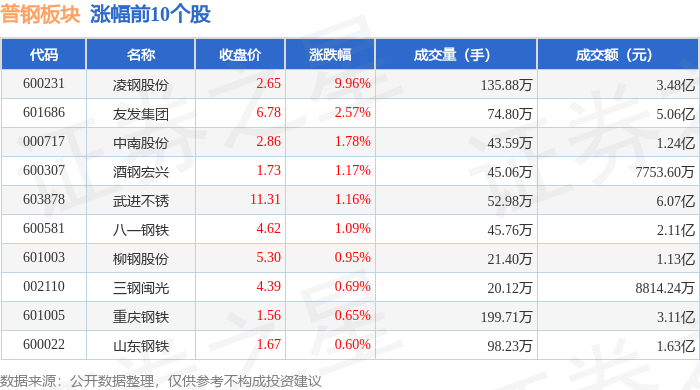
Market Overview - On October 22, the steel sector experienced a slight decline of 0.0%, with Baogang Co. leading the drop [1] - The Shanghai Composite Index closed at 3913.76, down 0.07%, while the Shenzhen Component Index closed at 12996.61, down 0.62% [1] Individual Stock Performance - Lingang Co. saw a significant increase of 9.96%, closing at 2.65, with a trading volume of 1.3588 million shares and a turnover of 348 million yuan [1] - Other notable performers included Youfa Group (+2.57%), Zhongnan Co. (+1.78%), and Jiugang Hongxing (+1.17%) [1] - Baogang Co. led the declines with a drop of 1.50%, closing at 2.63, with a trading volume of 9.0024 million shares and a turnover of 2.366 billion yuan [2] Capital Flow Analysis - The steel sector saw a net outflow of 232 million yuan from main funds, while retail investors contributed a net inflow of 333 million yuan [2] - The capital flow for individual stocks indicated that Lingang Co. had a net inflow of 84.85 million yuan from main funds, while Youfa Group experienced a net outflow of 31.99 million yuan [3] - The overall trend showed that retail investors were more active, with significant inflows into several stocks despite the outflows from institutional and speculative funds [3]


普钢板块10月21日涨0.78%,武进不锈领涨,主力资金净流入909.38万元
Zheng Xing Xing Ye Ri Bao· 2025-10-21 08:21
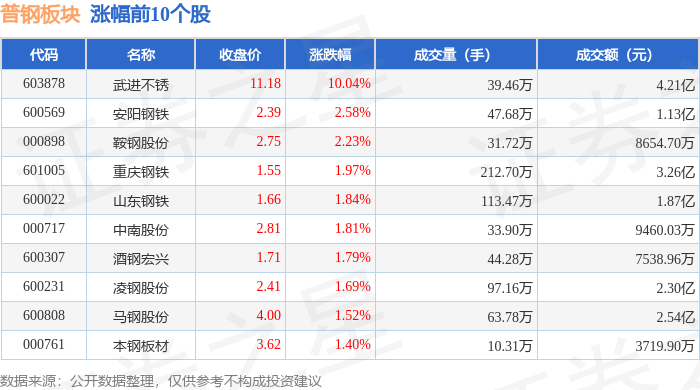
Market Performance - The steel sector saw an increase of 0.78% on October 21, with Wujin Stainless Steel leading the gains [1] - The Shanghai Composite Index closed at 3916.33, up 1.36%, while the Shenzhen Component Index closed at 13077.32, up 2.06% [1] Individual Stock Performance - Wujin Stainless Steel (603878) closed at 11.18, with a significant increase of 10.04% and a trading volume of 394,600 shares, amounting to a transaction value of 421 million yuan [1] - Anyang Iron & Steel (600569) rose by 2.58% to close at 2.39, with a trading volume of 476,800 shares and a transaction value of 113 million yuan [1] - Other notable performers include Ansteel (000898) with a 2.23% increase, Chongqing Steel (601005) up 1.97%, and Shandong Steel (600022) up 1.84% [1] Capital Flow Analysis - The steel sector experienced a net inflow of 9.09 million yuan from institutional investors, while retail investors contributed a net inflow of 19.3 million yuan [2] - However, there was a net outflow of 202 million yuan from speculative funds [2] Detailed Capital Flow for Selected Stocks - Wujin Stainless Steel had a net inflow of 66.62 million yuan from institutional investors, but a net outflow of 43.74 million yuan from speculative funds [3] - Nanjing Steel (600282) saw a net inflow of 23.69 million yuan from institutional investors, with a net outflow of 12.29 million yuan from speculative funds [3] - Baosteel (600019) had a net inflow of 12.40 million yuan from institutional investors, while retail investors showed a net outflow of 22.58 million yuan [3]


国泰海通:节后钢铁需求恢复增长 库存重回下降趋势
智通财经网· 2025-10-21 06:55
Core Insights - The steel industry is experiencing a gradual recovery in demand, with a notable increase in apparent consumption and a decrease in inventory levels, indicating a potential stabilization in the market [1][3] - Despite the positive demand trends, profitability in the steel sector has declined, with significant drops in gross margins for key products, suggesting ongoing cost pressures [2] - The supply side is expected to continue its contraction, supported by government policies aimed at reducing production and promoting a balance between supply and demand [3] Demand and Supply Analysis - Apparent consumption of the five major steel products reached 8.7541 million tons, up by 1.2398 million tons week-on-week, with construction materials and sheet products also showing increases [1] - Total steel production was 8.5695 million tons, down by 0.0636 million tons, while total inventory decreased to 15.8226 million tons, down by 0.1846 million tons, maintaining a low level [1] - The operating rate of blast furnaces remained stable at 84.27%, while electric furnace operating rates increased slightly, indicating a mixed response in production capabilities [1] Profitability Trends - The average gross profit for rebar fell to 111.6 CNY per ton, down by 34.3 CNY per ton, and for hot-rolled coils, it dropped to 21.6 CNY per ton, down by 67.6 CNY per ton [2] - The profitability rate for 247 steel companies decreased to 55.41%, down by 0.87% week-on-week, reflecting the challenges faced by the industry [2] Future Outlook - The demand from the real estate sector is expected to weaken, but stable growth is anticipated in infrastructure and manufacturing, which may support overall steel demand [3] - The government has introduced policies to control production, aiming to phase out inefficient capacities and support advanced enterprises, which may lead to a quicker recovery in the steel industry's fundamentals [3] Investment Recommendations - Companies with leading technology and product structures, such as Baosteel (600019.SH) and Hualing Steel (000932.SZ), are recommended for their competitive advantages [5] - Low-valuation, high-dividend steel companies like CITIC Special Steel (000708.SZ) and Yongjin Shares (603995.SH) are also highlighted as attractive investment opportunities [5] - The report suggests a positive outlook for upstream resource companies, recommending firms like Hebei Steel Resources (000923.SZ) and Erdos (600295.SH) due to their long-term advantages [5]



稀土狂飙,不只是因为“反制”
投中网· 2025-10-21 06:51
Core Viewpoint - The strategic value of rare earth elements is being highlighted due to China's export controls and policy upgrades, leading to a significant increase in stock prices and overall market performance in the rare earth sector [6][10][12]. Group 1: Market Performance - Shenghe Resources (600392.SH) saw its stock price rise by 5.04% to 26.26 yuan, with a year-to-date increase of 155.45% [6]. - The rare earth index (8841089.WI) has increased by 118.86% year-to-date, with five out of seven stocks in the sector doubling in value [6][10]. - On October 9, the rare earth sector surged by 7.97%, followed by a 9.49% increase on October 13, with several stocks recording over 110% gains [10][11]. Group 2: Supply and Demand Dynamics - China's rare earth reserves account for approximately 48% of the global total, with a production capacity of about 27,000 tons, representing nearly 70% of global output [8][9]. - The recent export controls by China, which include restrictions on key technologies and production lines, have tightened global supply and increased the strategic importance of rare earths [9][13]. - The demand for rare earths is expected to grow significantly, particularly in sectors like electric vehicles and renewable energy, with projections indicating a need for 3-5 kg of rare earth permanent magnets per electric vehicle [14][15]. Group 3: Price Trends - The price index for rare earths has been on an upward trend, with light rare earths like praseodymium and neodymium increasing from approximately 440,000 yuan/ton to 562,000 yuan/ton, a rise of about 27.7% [15]. - Heavy rare earths, such as dysprosium oxide, have seen even more dramatic increases, with prices soaring from around 830,000 yuan/ton to 2.6 million yuan/ton, marking a 212% increase [15]. - Recent announcements from companies like Northern Rare Earth and Baotou Steel have indicated continuous price increases for rare earth concentrates, reflecting ongoing supply constraints [17][19]. Group 4: Company Performance - In 2023, several rare earth companies are showing signs of recovery, with five out of seven companies reporting revenue growth in the first half of the year [21]. - Northern Rare Earth reported a revenue of 188.66 billion yuan in the first half of the year, with a net profit increase of 45.24% [22]. - Shenghe Resources anticipates a net profit of 740 million to 820 million yuan for the first nine months of the year, representing a growth of 696.82% to 782.96% [23]. Group 5: Future Outlook - Industry experts predict that while short-term fluctuations may occur, the mid-term price center for rare earths is likely to rise due to tightening supply and increasing strategic value [26]. - Analysts suggest that the recent export control measures will likely lead to price increases, particularly for light rare earth products, while cautioning about potential overvaluation of stocks in the sector [25][27].



稀土板块催化不断,稀土ETF嘉实(516150)近7天获得连续资金净流入,规模再创新高!
Sou Hu Cai Jing· 2025-10-21 02:38
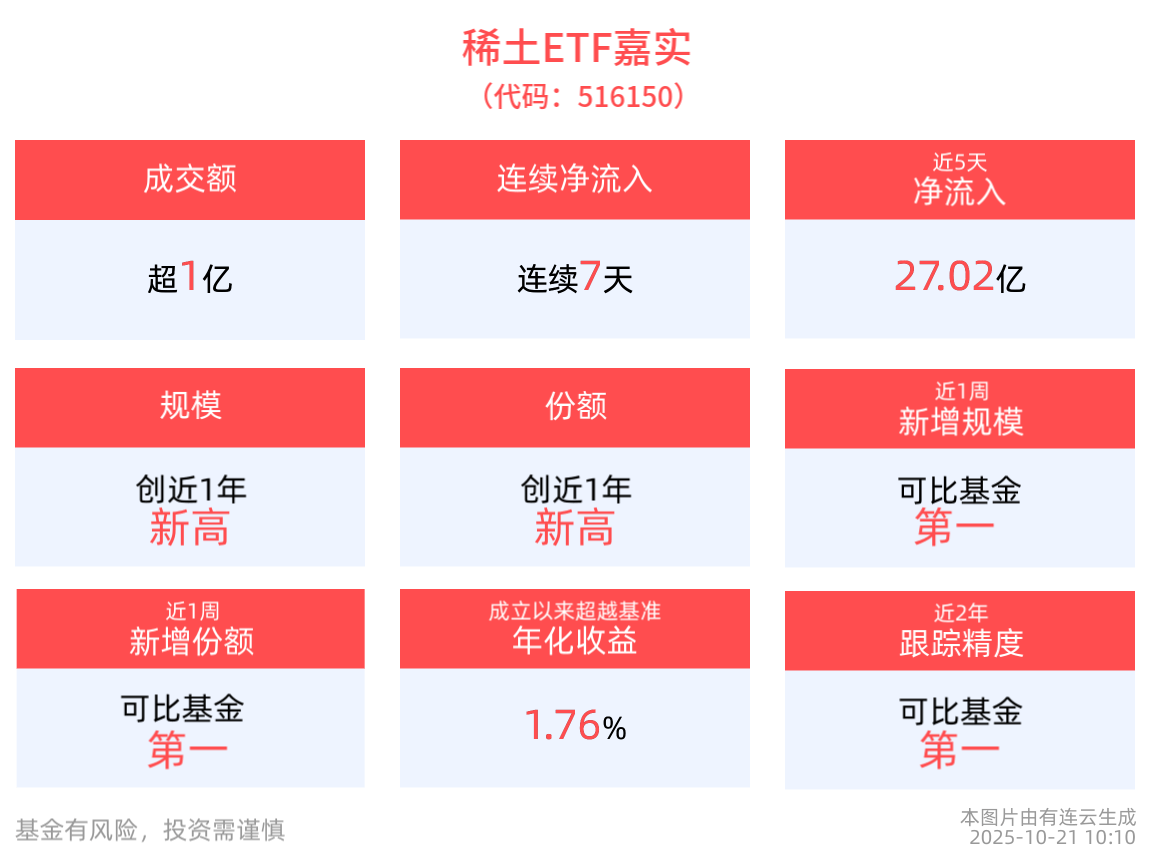
Group 1: Market Performance - The liquidity of the Rare Earth ETF managed by Jiashi has a turnover rate of 1.61%, with a transaction volume of 1.74 billion yuan [2] - The latest scale of the Rare Earth ETF reached 108.04 billion yuan, marking a new high since its establishment and ranking first among comparable funds [2] - The latest share count of the Rare Earth ETF is 6.034 billion shares, also a new high since its inception, and ranks first among comparable funds [2] - Over the past 7 days, the Rare Earth ETF has seen continuous net inflows, with a maximum single-day net inflow of 1.184 billion yuan, totaling 3.405 billion yuan [2] - As of October 20, the net value of the Rare Earth ETF has increased by 88.93% over the past two years, ranking 59th out of 2358 index equity funds, placing it in the top 2.50% [2] - The highest monthly return since the establishment of the Rare Earth ETF is 41.25%, with the longest consecutive monthly increase being 4 months and the longest increase percentage being 83.89% [2] Group 2: Industry Developments - On October 19, Tianhe Magnetic Materials announced plans to invest 850 million yuan in a project for high-performance rare earth permanent magnets and related equipment in Baotou City [3] - Northern Rare Earth and Baotou Steel announced an increase in rare earth prices for the fourth quarter of 2025 [3] - In September, the export of rare earths and related products reached 10,538 tons, a year-on-year increase of 7.6%, with a cumulative export of 95,875 tons from January to September, up 3.1% year-on-year [3] - The Ministry of Commerce of China issued two announcements on October 9 regarding rare earth export controls, indicating that products containing Chinese-origin rare earths valued at 0.1% or more may be subject to export restrictions [3] - The new regulations on rare earths are seen as a necessary response in the context of global supply chain competition, following similar measures for gallium and germanium [3] - It is recommended to focus on investment opportunities along the "resources + growth" dual lines, considering the potential impact of regional politics and export policies from major resource countries [3]



钢铁行业周度更新报告:节后需求恢复增长,库存重回下降趋势-20251020
GUOTAI HAITONG SECURITIES· 2025-10-20 12:32
Investment Rating - The report maintains an "Overweight" rating for the steel industry [5]. Core Viewpoints - Demand is expected to gradually bottom out, and supply-side market clearing has begun, indicating a potential recovery in the steel industry's fundamentals. If supply policies are implemented, the contraction of supply may accelerate, leading to quicker industry recovery [3][8]. - The report highlights a week-on-week increase in steel consumption and a decrease in inventory levels, suggesting a positive trend in demand recovery post-holiday [5][12]. - Profit margins for steel production have decreased, with average gross margins for rebar and hot-rolled coils declining significantly [5][42]. Summary by Sections Steel Prices and Inventory - Last week, the price of Shanghai rebar fell by 50 CNY/ton to 3210 CNY/ton, a decrease of 1.54%. Hot-rolled coil prices dropped by 120 CNY/ton to 3280 CNY/ton, a decline of 3.53% [8]. - Total inventory of major steel products decreased to 15.82 million tons, down 1.15% week-on-week [12]. Raw Materials - Iron ore spot prices decreased by 10 CNY/ton to 780 CNY/ton, while futures prices fell by 24.5 CNY/ton to 771 CNY/ton [51]. - Iron ore port inventory rose to 142.78 million tons, an increase of 1.81% [53]. Production and Profitability - The total steel production last week was 8.57 million tons, a decrease of 6.36 million tons week-on-week [36]. - The average gross margin for rebar was 111.6 CNY/ton, down 34.3 CNY/ton, while for hot-rolled coils, it was 21.6 CNY/ton, down 67.6 CNY/ton [42]. Market Outlook - The report anticipates that the demand for steel will stabilize, with a gradual recovery expected in the construction and manufacturing sectors, despite ongoing challenges in the real estate market [5][8]. - The steel industry is expected to benefit from policies aimed at reducing inefficient production capacity and promoting high-quality development [5].

包钢股份跌2.21%,成交额24.41亿元,主力资金净流出1.02亿元
Xin Lang Cai Jing· 2025-10-20 03:30
Core Viewpoint - Baosteel Co., Ltd. experienced a stock price decline of 2.21% on October 20, with a trading volume of 2.441 billion yuan and a total market capitalization of 120.015 billion yuan [1] Group 1: Stock Performance - The stock price of Baosteel Co., Ltd. has increased by 42.63% year-to-date, but has decreased by 5.02% over the last five trading days [1] - The stock has shown a 5.16% increase over the last 20 days and a 23.83% increase over the last 60 days [1] - The company has appeared on the "Dragon and Tiger List" twice this year, with the most recent appearance on July 30, where it recorded a net purchase of 374 million yuan [1] Group 2: Financial Performance - For the first half of 2025, Baosteel Co., Ltd. reported a revenue of 31.329 billion yuan, a year-on-year decrease of 11.02%, while the net profit attributable to shareholders increased by 39.99% to 151 million yuan [2] Group 3: Shareholder Information - As of June 30, 2025, the number of shareholders of Baosteel Co., Ltd. was 846,500, a decrease of 0.84% from the previous period [2] - The average circulating shares per person increased by 0.84% to 37,069 shares [2] - Major shareholders include Hong Kong Central Clearing Limited, which increased its holdings by 324 million shares, and several ETFs that also increased their holdings [3]
有色金属周报:铜铝价格上行,看好后续铝补涨行情-20251019
SINOLINK SECURITIES· 2025-10-19 08:33
Group 1: Copper - LME copper price increased by 2.41% to $10,624.00 per ton, while Shanghai copper decreased by 1.77% to 84,400 yuan per ton [1][12] - Domestic copper inventory increased by 0.55 thousand tons to 17.75 thousand tons due to weak downstream consumption and replenishment of imported sources [1][12] - The operating rate of domestic major refined copper rod enterprises rose to 62.5%, up 19.06% week-on-week, but down 16.39% year-on-year, indicating a recovery post-holiday but still below pre-holiday levels [1][12] Group 2: Aluminum - LME aluminum price rose by 1.82% to $2,796.00 per ton, while Shanghai aluminum decreased by 0.33% to 20,900 yuan per ton [2][13] - Domestic electrolytic aluminum ingot inventory decreased by 2.3 thousand tons, indicating a slight recovery in demand [2][13] - The operating rate of domestic aluminum processing enterprises remained stable at 62.5%, with a year-on-year decline of 1.4% [2][13] Group 3: Gold - COMEX gold price increased by 7.65% to $4,344.30 per ounce, influenced by U.S. government shutdown and geopolitical risks [3][14] - SPDR gold holdings increased by 17.46 tons to 1,034.62 tons, reflecting increased demand amid market uncertainties [3][14] - The U.S. government shutdown has led to delays in key economic data releases, impacting the economy and the dollar's position [3][14] Group 4: Rare Earths - The price of praseodymium and neodymium oxide decreased by 9.01% to 507,100 yuan per ton, with expectations of price recovery due to overseas replenishment [4][32] - The strategic importance of rare earths has increased due to regulatory changes, with a positive outlook for major companies in the sector [4][32] - The implementation of new regulations is expected to gradually show positive effects on supply and pricing [4][32] Group 5: Antimony - Antimony price decreased by 4.08%, but demand is expected to recover due to the stabilization of photovoltaic glass production [4][33] - The implementation of stricter standards for flame-retardant cables may provide a demand boost for antimony [4][33] - Global antimony prices are expected to trend upward due to resource scarcity and reduced supply from major mines [4][33] Group 6: Lithium - The average price of lithium carbonate decreased by 0.63% to 73,100 yuan per ton, while lithium hydroxide decreased by 0.43% to 78,200 yuan per ton [5][60] - Total lithium carbonate production increased to 21,100 tons, reflecting a slight recovery in supply [5][60] - Strong demand from the energy storage sector is expected to support lithium prices despite recent supply increases [5][60] Group 7: Cobalt - Cobalt price increased by 9% to 381,000 yuan per ton, driven by tight supply conditions [5][61] - The market is characterized by a "price without market" phenomenon, with strong upward pressure on prices due to raw material shortages [5][61] - Future price increases are anticipated as supply constraints from Congo continue to affect the market [5][61] Group 8: Nickel - LME nickel price increased by 0.1% to $15,200 per ton, while Shanghai nickel price decreased by 0.6% to 121,200 yuan per ton [5][62] - Concerns over the stability of nickel ore supply due to regulatory changes in Indonesia are providing short-term support for prices [5][62] - The market is expected to remain volatile due to the interplay between supply disruptions and weak fundamentals [5][62]

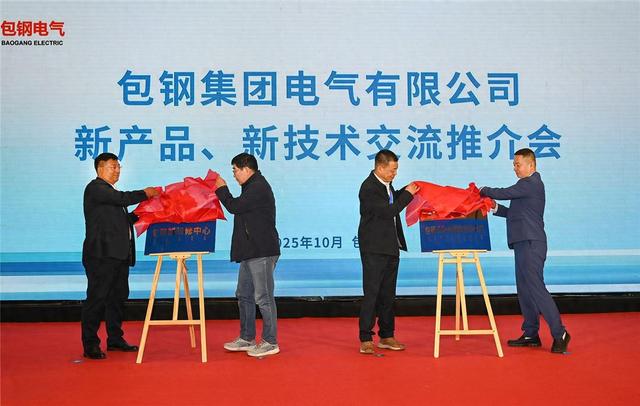
包钢电气发布四大核心成果 剑指工业绿色动力
Nei Meng Gu Ri Bao· 2025-10-19 08:08
Core Insights - Baogang Electric Company has made significant advancements in green manufacturing by launching four core technologies: permanent magnet motors, energy-saving transformers, steam turbine generator energy-saving technology, and smart diagnostic technology [1][3][5] - The establishment of the Baogang Chang'an Permanent Magnet Motor Research Institute and the inverter maintenance center marks a strategic move to enhance research capabilities and service offerings in the industrial sector [3][5] Group 1: Product and Technology Developments - The newly launched technologies specifically address high energy consumption issues in industrial sectors, with permanent magnet motors and energy-saving transformers forming an efficient hardware foundation [3][5] - The steam turbine generator energy-saving technology and smart diagnostic technology provide systematic energy efficiency optimization and lifecycle management solutions for equipment [3][5] Group 2: Market Strategy and Goals - Baogang Electric Company aims to achieve significant market share within an 800-kilometer radius over the next 2 to 3 years, focusing on a "manufacturing + service" ecosystem to support low-carbon industrial upgrades [5] - The company is transitioning from a core equipment manufacturer to a provider of green power solutions and full lifecycle services, actively promoting low-carbon green transformation in Northwest China's industry [5]

中国稀土出口管制政策对全球高端制造业的影响分析
Sou Hu Cai Jing· 2025-10-19 06:57
Core Insights - China's new rare earth export regulations, effective from October 9, 2025, significantly impact the global supply chain, reflecting a shift in strategic resource management and the competitive landscape in technology [1][11] - The regulations introduce a comprehensive control system that includes not only the export of raw materials but also extends to products containing Chinese rare earth elements, with a threshold of 0.1% for controlled substances [3][11] Regulatory Framework - The new regulations feature a "full-chain penetration control" approach, covering all aspects of the rare earth industry from mining to recycling [3] - Key elements include a 0.1% content threshold focusing on critical applications like high-performance magnets and semiconductor materials, and a 45-day approval cycle affecting global supply chain timelines [3][11] Global Manufacturing Impact - Rare earth elements are essential in high-end manufacturing, with significant applications in products like the F-35 fighter jet and Tesla Model 3 [4] - China dominates the rare earth market, controlling 70% of global mining, 90% of separation processing, and 93% of permanent magnet manufacturing [4] Case Studies - ASML, the sole producer of advanced EUV lithography machines, faces potential production disruptions due to the new regulations, as its products contain 0.3% dysprosium, exceeding the new threshold [5] - The U.S. military and semiconductor industries are also at risk, with rising costs and potential delays in production schedules due to increased rare earth prices [5][6] Market Reactions - The stock market has reacted variably, with Chinese rare earth companies seeing price increases while U.S. firms like Applied Materials experienced declines, indicating a reassessment of the strategic value of rare earths [6][11] Strategic Responses - Countries are diversifying their supply chains in response to the new regulations, with the U.S. supporting domestic rare earth industries and forming partnerships with countries like Australia and Canada [8] - Companies are adjusting inventory and procurement strategies, with some exploring alternative technologies to reduce reliance on rare earths [8] Industry Evolution - China's rare earth industry is focusing on upgrading and transitioning towards high-end, circular, and clustered development, enhancing its competitive edge in advanced processing technologies [9] - The new regulations signify a shift in China's role in global governance, moving from rule adaptation to active participation in rule-making [11][12]