
CMBC(600016)

Search documents
股市特别报道·财经聚焦|上市银行“大红包”相继“到账” ,累计分红总额超6000亿元
Shen Zhen Shang Bao· 2025-05-08 11:59
对此,苏商银行特约研究员武泽伟在接受记者采访时表示,六大国有行2024年分红总额大幅高于上一 年,这体现了银行业盈利能力的强劲及管理层对加大股东回报的重视。他进一步分析称,银行加大分红 主要有三大原因:第一,六大行净利润实现稳健增长,强劲的盈利能力成为六大行进行高分红的底气; 第二,过去监管层屡次强调上市公司要通过分红、回购等方式,增强投资者回报,银行通过大力分红响 应落实监管要求;第三,体现了银行管理层对市值管理的重视,通过高频分红、定期分红等,可以坚定 投资者长期持有公司股票的信心。 武泽伟指出,对于银行自身而言,加大分红力度,可以强化投资者对银行股"压舱石"属性的认可,吸引 社保、险资等中长期资金加大对银行板块的配置力度,从而促进银行股整体估值水平上升和股价水平上 涨。 随着近期财报的陆续披露完毕,各家上市银行去年分红情况也浮出水面。已公告的A股42家上市银行 2024年度累计分红总额为6315.42亿元,其中作为分红的"主力军",六大国有行2024年现金分红总额达 到约4206.36亿元,大幅高于上一年。另外,今年部分银行的分红落地时间也大幅提前。 4月29日晚间,西安银行(600928)、苏农银行( ...





季报透析|五家股份行一季度个贷增速均不及全行贷款,信用卡和消费贷是拖累项
券商中国· 2025-05-08 10:01
披露了个人贷款项目数据的上市股份行一季报里,个贷同比增速均低于各项贷款增速,成了一个很难忽略 的共性。 多家曾经高举零售大旗的股份行,一季度个贷余额不增反降。即便实现正增长,增幅也很有限。进一步拆解财 报,消费贷和信用卡等业务还未成规模回暖,成了个贷的主要拖累项。 个贷增长吃力,甚至下降 在一季报里详述个贷科目的上市股份行不多,比如浦发、华夏、光大、浙商等银行均未披露。在有据可查的招 行、中信、平安、兴业、民生等银行一季报里,一个集体特征浮出水面——个人贷款余额同比增速均低于同期 全行贷款增速。 各家银行在一季报里披露的数据不够详实。在有限的个贷结构数据维度里,我们可以合理推测,表现较为疲弱 的消费贷和信用卡是相关银行个贷不及全行贷款表现的拖累项。 什么意思?这些银行个贷"投不动了",贷款整体的增长主要是靠对公拉动的。 先来看招行。截至一季度末,招行零售贷款为36585.78亿元,较上年末增加139.53亿元,增幅仅为0.38%。而 同期,招行全行的贷款和垫款总额为71254.79亿元,较上年末增长3.44%。 招行的说法是,一季度居民消费仍在逐步复苏,所以该行持稳健"审慎"原则,推动零售贷款平稳运行。 再来 ...






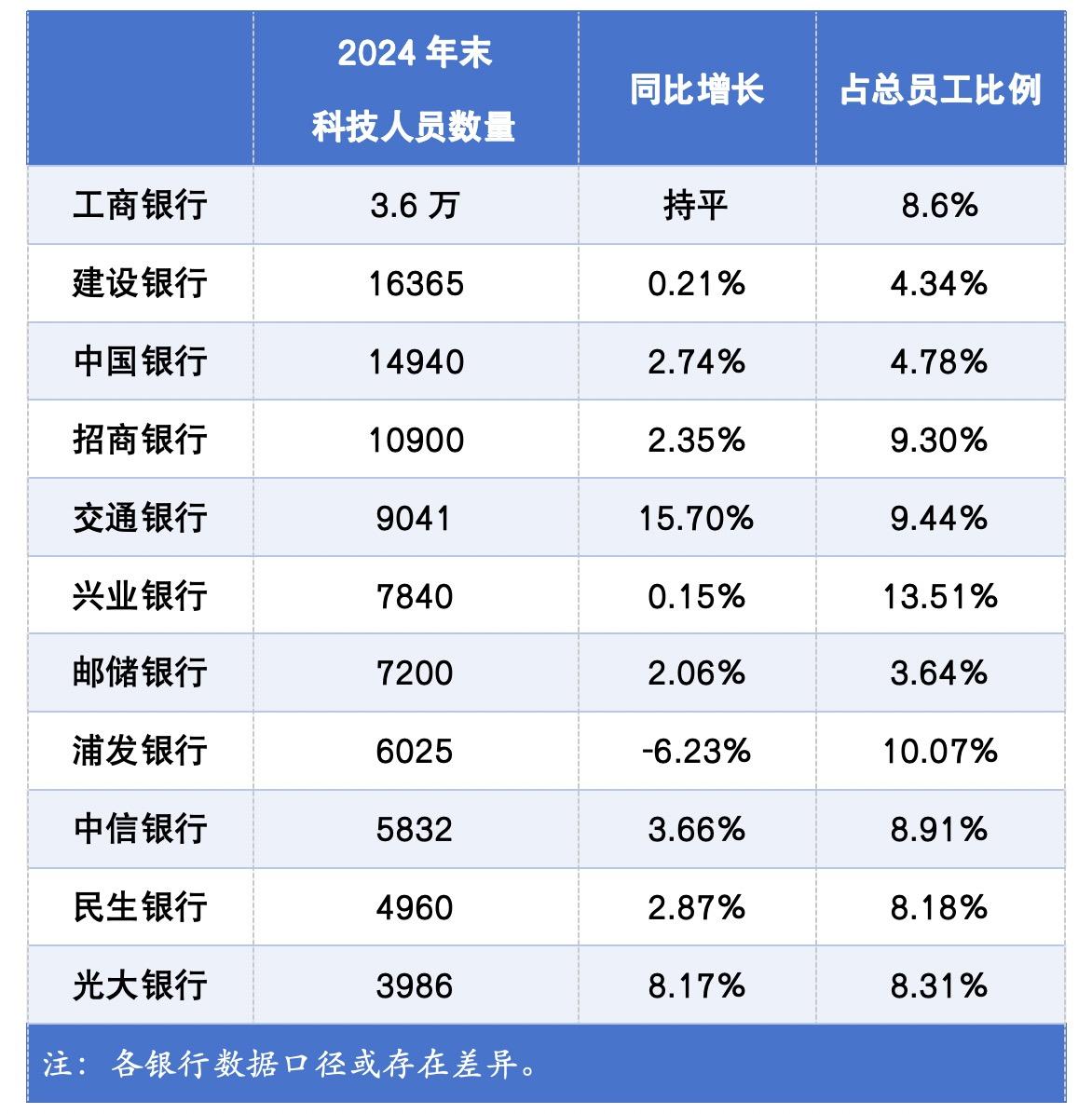
金融调研②“非硝烟”之争:谁是银行人才储备座上宾?
Nan Fang Du Shi Bao· 2025-05-08 02:36
Core Viewpoint - The Chinese banking industry is increasingly focusing on the recruitment and development of dual-skilled talent in finance and technology to support the growth of technology-driven financial services [1][10]. Talent Development - Banks are actively recruiting technology professionals, with some offering salaries as high as 800,000 yuan for AI talent [2][3]. - The demand for dual-skilled talent is evident, as banks emphasize the need for professionals who understand both finance and technology [2][3]. - Many banks are adjusting their recruitment strategies to prioritize candidates with engineering backgrounds over traditional finance degrees [6][7]. Performance Assessment - The implementation of a "duty exemption" system is being developed to encourage innovation while managing risks associated with technology finance [11][12]. - Banks are establishing internal guidelines for the duty exemption system, which aims to protect employees from penalties if they have acted diligently [11][13]. - The lack of standardized quantitative measures for assessing performance in technology finance remains a challenge, leading to subjective interpretations of responsibility [15][16]. Industry Trends - The number of technology personnel in major banks has generally increased, with notable growth in institutions like the Bank of Communications, which saw a 15.7% increase in technology staff [4][5]. - The proportion of technology personnel within banks is higher in joint-stock banks compared to state-owned banks, indicating a trend towards greater emphasis on technology expertise [4][5]. - Regulatory bodies are also setting standards for the number of technology specialists in banks, reflecting the importance of technology in financial services [9][10].



银行「消费贷」不良到底有多少亿?
3 6 Ke· 2025-05-08 02:01
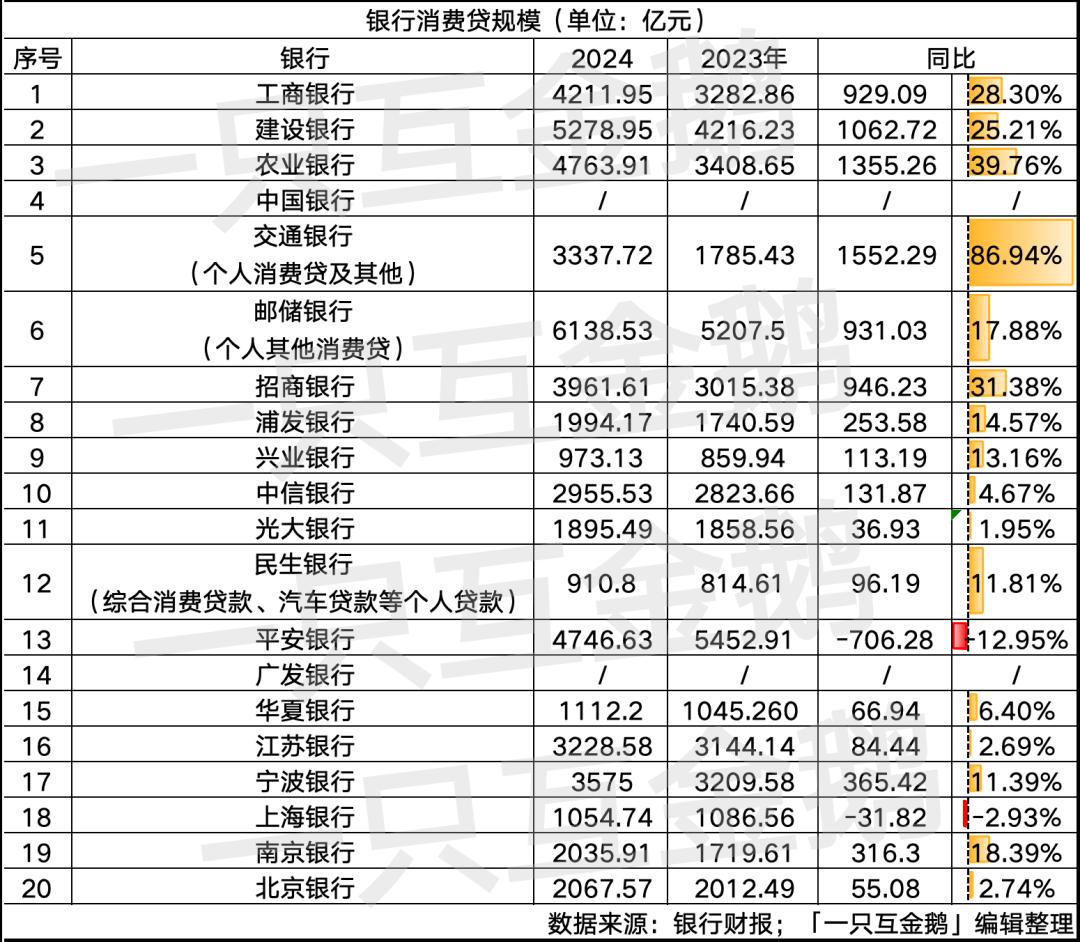
Core Viewpoint - The consumer finance market is primarily driven by licensed consumer finance companies and internet finance platforms, with banks being the largest players. Most banks reported significant growth in consumer loan balances for 2024, indicating a robust demand for consumer credit [1][4]. Summary by Sections Consumer Loan Growth - In 2024, major banks reported substantial increases in consumer loan balances, with notable growth from Agricultural Bank (39.76%), Industrial and Commercial Bank (28.30%), and Postal Savings Bank (17.88%). Overall, 16 banks collectively added over 750 billion yuan in consumer loans [2][4][5]. Non-Performing Loans (NPLs) - Among the 20 banks analyzed, 7 did not disclose specific NPL data for consumer loans. The remaining 13 banks reported a total of 662 million yuan in consumer loan NPLs, with Industrial and Commercial Bank having the highest NPL amount at 100.57 million yuan and a rate of 2.39% [7][8]. Consumer Loan Strategies - Major banks are focusing on high-quality customer segments for their consumer loan products. For instance, Industrial and Commercial Bank targets public sector employees and high-income individuals. Other banks are innovating their product offerings, such as integrating green finance initiatives and enhancing digital services [9][12][20]. Market Trends and Future Outlook - The regulatory environment is supportive of consumer finance growth, with the China Banking and Insurance Regulatory Commission encouraging banks to increase personal consumer loan issuance. This suggests that consumer loan growth is likely to continue in the near future [22][23].

引导金融活水精准发力 浙江再挺民营经济
Sou Hu Cai Jing· 2025-05-08 01:52
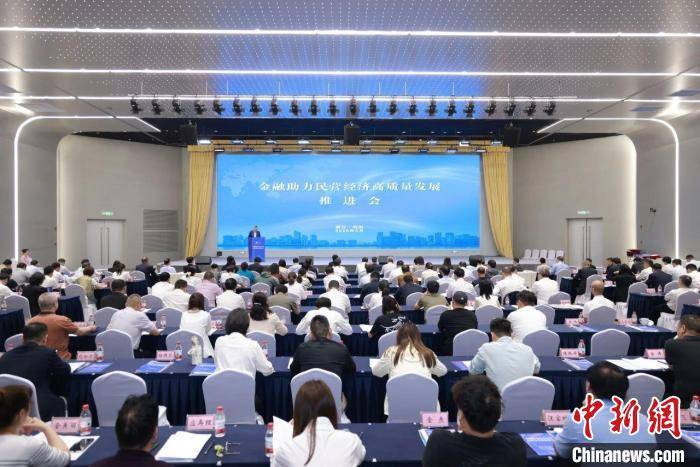
Core Insights - The event "Financial Support for High-Quality Development of Private Economy" was held in Hangzhou, focusing on enhancing financial services for private enterprises in Zhejiang province [3][4] - A comprehensive guide titled "Zhejiang Province Private Enterprise Financial Products and Services Handbook" was released, detailing 898 financial products and 490 value-added services from over 400 financial institutions across 11 cities in the province [3][4] - Strategic cooperation agreements were signed with seven major banks, committing to provide over 1.4 trillion yuan in credit support to private enterprises over the next three years [4][5] Financial Support Initiatives - The People's Bank of China, Zhejiang Branch, and the Zhejiang Federation of Industry and Commerce are collaborating to provide robust financial support for the development of the private economy [3] - A special action to enhance financial capabilities for technology enterprises has benefited over 32,000 tech firms, focusing on green development and low-carbon transformation [3][4] Strategic Partnerships - Seven banks, including Industrial and Commercial Bank of China and Agricultural Bank of China, have committed to support private enterprises through strategic partnerships [4] - The Zhejiang Federation of Industry and Commerce aims to strengthen connections between local financial institutions and private enterprises to create a supportive financial ecosystem [5]
12家全国性股份行2024年经营情况对比
数说者· 2025-05-07 12:43
Group 1: Total Assets and Structure - The total assets of the 12 national joint-stock banks exceed 15 trillion yuan, with two banks surpassing 10 trillion yuan and five banks between 5 trillion and 10 trillion yuan [2][3] - China Merchants Bank leads with total assets of 12.15 trillion yuan, followed by Industrial Bank at 10.51 trillion yuan [2][3] - All banks showed positive growth in total assets compared to the end of 2023, with China Merchants Bank having the highest growth rate of 10.19% [2][3] - Loans constitute the majority of total assets, with CITIC Bank having the highest loan-to-asset ratio at 60.01% [2][3] Group 2: Liabilities and Structure - The ranking of total liabilities mirrors that of total assets, with deposits being the primary source of liabilities for the banks [4][5] - China Merchants Bank has the highest deposit-to-liability ratio at 83.31%, indicating strong deposit-raising capability [4][5] - Four banks, including Industrial Bank and Minsheng Bank, have deposit ratios below 60%, with Huaxia Bank having the lowest at 53.64% [4][5] Group 3: Operating Income and Structure - China Merchants Bank reported operating income of 337.49 billion yuan, the highest among the banks, surpassing even the state-owned Bank of Communications [7][8] - Six banks experienced negative growth in operating income, with Ping An Bank showing the largest decline at 10.93% [8][10] - Net interest income remains the primary source of revenue, with Hengfeng Bank having the highest proportion of net interest income to operating income at 80.55% [8][10] Group 4: Net Profit Analysis - China Merchants Bank achieved a net profit of 149.56 billion yuan, the largest among the banks, nearly double that of the second-ranked Industrial Bank [14][15] - Four banks, including Minsheng and Guangfa, reported negative growth in net profit, with Minsheng Bank experiencing the largest decline at 9.07% [15][17] Group 5: Net Interest Margin and Quality - All banks reported a net interest margin below 2%, with China Merchants Bank having the highest at 1.98% [18][19] - The non-performing loan ratio for China Merchants Bank is the lowest at 0.95%, while Bohai Bank has the highest at 1.76% [19][20] - Provision coverage ratio for China Merchants Bank is significantly higher at 411.98%, compared to the second-highest, Ping An Bank, at 250.71% [19][20]

银行行业资金流入榜:民生银行、平安银行等净流入资金居前
Zheng Quan Shi Bao Wang· 2025-05-07 09:42
沪指5月7日上涨0.80%,申万所属行业中,今日上涨的有26个,涨幅居前的行业为国防军工、银行,涨 幅分别为3.70%、1.49%。银行行业位居今日涨幅榜第二。跌幅居前的行业为传媒、计算机,跌幅分别 为0.56%、0.42%。 银行行业资金流向排名 资金面上看,两市主力资金全天净流出254.59亿元,今日有6个行业主力资金净流入,国防军工行业主 力资金净流入规模居首,该行业今日上涨3.70%,全天净流入资金41.90亿元,其次是农林牧渔行业,日 涨幅为0.71%,净流入资金为6.66亿元。 主力资金净流出的行业有25个,计算机行业主力资金净流出规模居首,全天净流出资金79.55亿元,其 次是电子行业,净流出资金为67.25亿元,净流出资金较多的还有通信、非银金融、医药生物等行业。 银行行业今日上涨1.49%,全天主力资金净流入5.86亿元,该行业所属的个股共42只,今日上涨的有42 只;。以资金流向数据进行统计,该行业资金净流入的个股有28只,其中,净流入资金超5000万元的有 7只,净流入资金居首的是民生银行,今日净流入资金1.25亿元,紧随其后的是平安银行、建设银行, 净流入资金分别为1.24亿元、951 ...

63岁“薪酬之王”刚交最差成绩单 70岁副董在职超16年仍在任
Nan Fang Du Shi Bao· 2025-05-06 23:14
Group 1 - The resignation of Jin Yu as chairman of Shanghai Bank due to age marks a significant leadership change, with Gu Jianzhong appointed as the new party secretary [2] - The banking sector is witnessing a wave of retirements as many executives approach the legal retirement age, raising concerns about maintaining strategic continuity [2][14] - Wang Liang, the chairman of China Merchants Bank, reported a slight decline in revenue and a modest increase in net profit, reflecting the pressures faced by the banking industry [3] Group 2 - Gao Yingxin, chairman of Minsheng Bank, has become the highest-paid executive in the A-share listed banks, despite the bank reporting its worst performance in nearly a decade [4][5] - Lu Jianqiang, chairman of Zhejiang Commercial Bank, has recently been re-elected, emphasizing the "good financial" concept as part of the bank's strategy [6] - The upcoming retirement of several key executives, including those from major banks, poses challenges for strategic direction and organizational culture [14][15] Group 3 - The transition of leadership in banks like CITIC Bank and Beijing Bank is critical as they navigate retail transformation and digitalization strategies [9][10] - The performance of Jiangsu Bank under the leadership of Ge Renyu has shown growth in revenue and profit, highlighting the importance of digital transformation in the banking sector [11] - The retirement of senior executives may lead to instability in team dynamics and affect customer trust, necessitating effective management of the transition [17][19] Group 4 - The implementation of a flexible retirement policy starting in 2025 may allow banks to retain key executives beyond the legal retirement age, potentially stabilizing leadership during transitions [19][20] - A well-structured corporate governance mechanism is essential for maintaining strategic consistency and navigating economic cycles in the banking industry [20]



银行业2025年一季报综述:预期内盈利承压,拥抱稳定、可持续、可预期的回报确定性
Shenwan Hongyuan Securities· 2025-05-06 11:18
Investment Rating - The report maintains a positive outlook on the banking sector, highlighting it as a low-volatility dividend play in a counter-cyclical environment and a strong performer in absolute returns during a pro-cyclical phase [6]. Core Insights - The first quarter of 2025 saw a decline in both revenue and net profit for listed banks, with revenue and net profit down 1.7% and 1.2% year-on-year, respectively. The main reasons for this decline were the expected decrease in interest margins and pressure from non-interest income [3][12]. - Loan growth has remained stable, with a year-on-year increase of 7.9% in the first quarter. Notably, banks in Jiangsu and Zhejiang, as well as Chengdu, continue to show strong economic performance, while Chongqing has emerged as a new growth area with loan growth exceeding 16% [3][4]. - The average net interest margin for listed banks was 1.54% in the first quarter, reflecting a slight quarter-on-quarter increase of 2 basis points, supported by a decrease in the cost of interest-bearing liabilities [4][12]. - The non-performing loan (NPL) ratio for listed banks decreased to 1.23%, with an estimated annualized NPL generation rate of approximately 0.63% [5][19]. - The report emphasizes the importance of focusing on high-dividend yield banks, particularly those with solid provisions and growth opportunities in favorable policy environments [6][19]. Summary by Sections Performance Overview - The first quarter of 2025 saw a significant impact from the decline in interest margins and non-interest income, leading to a negative growth in both revenue and profit for listed banks [10][12]. - The report indicates that the performance of state-owned banks was below expectations, while city and rural commercial banks generally met expectations [3][19]. Loan and Credit Analysis - Loan growth has been stable, with a year-on-year increase of 7.9% in the first quarter. The report highlights that the demand for loans from small and medium-sized enterprises has weakened, affecting the growth rates of rural commercial banks [3][4]. Interest Margin and Cost Analysis - The report notes that the average net interest margin for listed banks improved slightly, with a quarter-on-quarter increase attributed to a reduction in the cost of interest-bearing liabilities [4][12]. Asset Quality and Risk Management - The NPL ratio for listed banks decreased to 1.23%, with proactive measures taken to manage and dispose of non-performing assets [5][19]. - The report indicates that the retail sector is experiencing some risk exposure, but overall asset quality remains stable [5][19]. Investment Recommendations - The report recommends focusing on banks with high dividend yields and solid fundamentals, particularly those that are well-positioned to benefit from favorable policy changes [6][19].

银行研究框架及24A、25Q1业绩综述:负债成本改善力度加大,息差降幅有望继续收窄
GOLDEN SUN SECURITIES· 2025-05-06 04:35
Investment Rating - The report indicates a cautious outlook for the banking sector, with expectations of continued narrowing of interest margin declines due to improved cost management on the liability side [5]. Core Insights - The overall revenue and profit growth rates for listed banks in Q1 2025 were -1.7% and -1.2%, respectively, showing a widening decline compared to 2024 [4]. - Net interest income decreased by 1.7% year-on-year, influenced by factors such as loan repricing and lower new loan rates, but the decline in interest margins is expected to continue to narrow [4][5]. - The overall asset quality remains stable, with a non-performing loan ratio of 1.23% and a provision coverage ratio of 238% [4]. Summary by Sections 1. Performance Overview - Listed banks' overall revenue and profit growth rates for Q1 2025 were -1.7% and -1.2%, respectively, with declines expanding by 1.8 percentage points and 3.5 percentage points compared to 2024 [4]. - The net interest income saw a year-on-year decline of 1.7%, attributed to factors like loan repricing and intensified competition [4]. 2. Revenue Breakdown - Fee and commission income for listed banks decreased by 0.7% year-on-year, with the decline rate narrowing by 8.7 percentage points compared to 2024 [4]. - Other non-interest income fell by 3.2% year-on-year, primarily due to significant fluctuations in the bond market affecting fair value changes [4]. 3. Asset Quality - The non-performing loan ratio stood at 1.23%, slightly down by 1 basis point from the end of Q4 2024, while the provision coverage ratio was 238%, showing a slight decrease of 2 percentage points from the previous year [4]. 4. Future Outlook - The narrowing trend in interest margin declines is expected to continue, supported by improved management of liability costs and stable asset quality [5]. - The report anticipates that the overall profit growth for the year will maintain a trend of quarterly improvement [5].