
CSN(600029)

Search documents
【浙商交运李丹丨南方航空】25三季报点评:Q3业绩超预期,看好盈利弹性兑现
Xin Lang Cai Jing· 2025-10-28 13:38
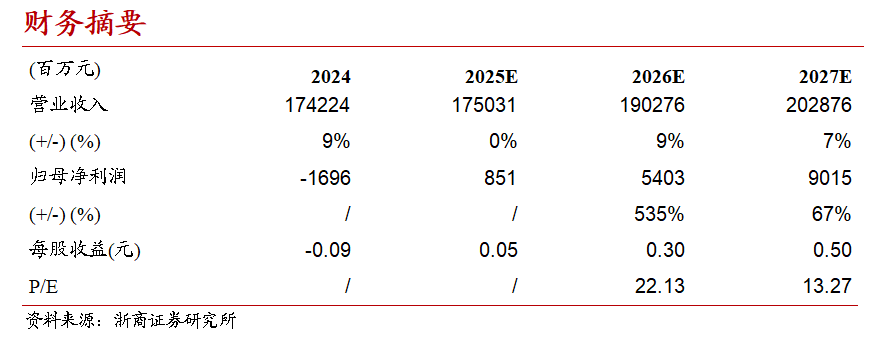
Core Viewpoint - The company reported a significant increase in net profit for Q3 2025, exceeding expectations, with a year-on-year growth of 20.3% [1][4]. Financial Performance - For the first three quarters of 2025, the company achieved operating revenue of 137.7 billion yuan, a year-on-year increase of 2.2%, and a net profit attributable to shareholders of 2.31 billion yuan, up 17.4% year-on-year [1]. - In Q3 2025, operating revenue reached 51.4 billion yuan, reflecting a 3.0% year-on-year increase, while net profit attributable to shareholders was 3.84 billion yuan, marking a 20.3% increase year-on-year [1][4]. Operational Data - As of the end of Q3 2025, the company operated 956 aircraft, a 4.3% increase from the end of 2024 [2]. - The Available Seat Kilometers (ASK) increased by 6% year-on-year, with a passenger load factor of 85.9%, up 0.4 percentage points year-on-year [2]. Revenue and Cost Analysis - The company estimated a 5% year-on-year decline in unit revenue per passenger for the first three quarters of 2025, with Q3 showing a 3% decline [3]. - Operating costs for the first three quarters of 2025 were 121.6 billion yuan, a 0.7% increase year-on-year, with unit ASK operating costs decreasing by 5% due to falling oil prices [3]. Profit Outlook - The company anticipates a sustained high profit elasticity due to limited industry supply and steady demand growth, projecting net profits of 0.851 billion yuan, 5.403 billion yuan, and 9.015 billion yuan for 2025, 2026, and 2027 respectively [4].


信达证券给予南方航空“增持”评级,2025年三季报点评:三季度业绩亮眼,看好全年利润转盈
Sou Hu Cai Jing· 2025-10-28 12:33
Core Viewpoint - The report from Xinda Securities on October 28 recommends a "Buy" rating for China Southern Airlines (600029.SH) based on several positive indicators for the company's performance and market conditions [1] Group 1: Financial Performance - Revenue showed a slight increase, with a significant year-on-year growth in net profit attributable to shareholders for Q3 2025 [1] - The company is expected to turn profitable for the full year, driven by a recovery in travel demand in the fourth quarter [1] Group 2: Market Conditions - High passenger load factors during the summer travel season indicate strong domestic and international travel demand [1] - There has been a slight decrease in ticket prices, while unit costs are benefiting from lower oil prices [1]
南方航空(600029):2025年三季报点评:三季度业绩亮眼,看好全年利润转盈
Xinda Securities· 2025-10-28 11:59
Investment Rating - The investment rating for the company is "Accumulate" [1] Core Views - The report highlights a significant increase in net profit for the third quarter of 2025, with a year-on-year growth of 17.4%, reaching 2.307 billion yuan, despite a slight increase in revenue of 2.2% to 137.7 billion yuan [2][3] - The report expresses optimism about the recovery of passenger traffic and revenue in the fourth quarter, driven by strong demand during the National Day holiday and improving ticket prices [5][7] Summary by Sections Financial Performance - For the first three quarters of 2025, the company achieved a revenue of 137.67 billion yuan, a year-on-year increase of 2.23%, and a net profit of 2.307 billion yuan, a year-on-year increase of 17.40% [2][3] - The quarterly net profit figures for Q1, Q2, and Q3 were -747 million, -786 million, and 3.84 billion yuan, respectively, indicating a substantial recovery in Q3 [2] Capacity and Traffic - The total Available Seat Kilometers (ASK) increased by 5.6% year-on-year for the first three quarters of 2025, with domestic, international, and regional ASK growing by 1.95%, 17.8%, and 1.5%, respectively [3] - The Revenue Passenger Kilometers (RPK) rose by 7.6% year-on-year, with international RPK recovering to 95.8% of the 2019 levels [3][4] Passenger Load Factor - The overall passenger load factor for the first three quarters was 85.6%, with domestic and international load factors at 86.2% and 84.2%, respectively, showing improvements compared to 2019 [4] - In Q3 alone, the load factor was 85.9%, reflecting a year-on-year increase of 0.4 percentage points [4] Pricing and Cost Management - The unit revenue per RPK decreased by 3.0% to 0.570 yuan, while the unit cost per ASK fell by 3.9% to 0.408 yuan, benefiting from lower oil prices and effective cost control [5] - The report notes that the decline in ticket prices is gradually stabilizing, which is expected to positively impact revenue [5] Future Outlook - The company is projected to achieve a net profit of 1.057 billion yuan in 2025, with significant growth rates of 162.3% and 486.0% expected in the following years [7] - The report maintains a positive outlook on the recovery of air travel and the company's profitability, reiterating the "Accumulate" rating [7]
锡林浩特—郑州—广州航线正式启航
Zhong Guo Min Hang Wang· 2025-10-28 10:33
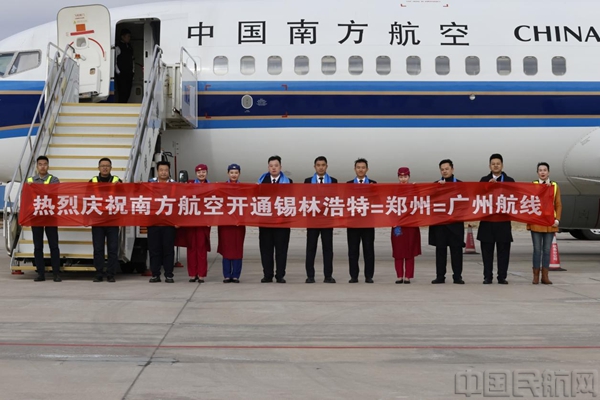
Group 1 - The successful inaugural flight of the Xilin Hot—Zhengzhou—Guangzhou route by China Southern Airlines (CZ8533) took place on October 28, 2025 [1] - The new route is operated by Boeing 737-800 aircraft with flights scheduled every Tuesday, Thursday, and Saturday, providing efficient travel options for passengers [3] - The flight schedule includes a total travel time of approximately 6 hours, facilitating quick transfers between northern and southern regions through the Zhengzhou hub [3] Group 2 - To celebrate the launch of the new route, Xilin Hot Airport and China Southern Airlines are offering promotional ticket prices starting from 780 yuan for one-way flights to Guangzhou and 430 yuan to Zhengzhou, excluding airport construction and fuel fees [4] - The opening of this route optimizes the network layout of Xilin Hot Airport, connecting three distinct tourist regions: the Xilin Gol Grassland, the Central Plains culture of Zhengzhou, and the Guangdong-Hong Kong-Macao Greater Bay Area [4] - This new connection is expected to enhance personnel exchanges, material circulation, and cultural interactions between northern and southern regions, thereby boosting regional cooperation and economic development [4]
10月28日晚间重要公告一览
Xi Niu Cai Jing· 2025-10-28 10:32
Group 1 - China Satellite reported a net profit of 14.81 million yuan for the first three quarters, marking a turnaround from losses, with a revenue of 3.102 billion yuan, up 85.28% year-on-year [1] - SAIYANG Technology signed a contract worth 533 million yuan for Airbus A320 series aircraft transport tooling, effective until 2038 [1] - Zhongwei Semiconductor achieved a net profit of 152 million yuan, a 36.78% increase year-on-year, with a revenue of 773 million yuan, up 19.03% [2] Group 2 - Jiao Cheng Ultrasonic reported a net profit of 94.03 million yuan, a significant increase of 359.81% year-on-year, with a revenue of 521 million yuan, up 27.53% [3] - Keda Li's net profit grew by 16.55% year-on-year to 1.185 billion yuan, with a revenue of 10.603 billion yuan, up 23.41% [3] - Ningbo Huaxiang's net profit fell by 87.68% to 88.73 million yuan, despite a revenue increase of 5.88% to 19.224 billion yuan [4] Group 3 - Mingzhi Electric reported a net profit of 49.84 million yuan, a 5.43% increase year-on-year, with a revenue of 2.043 billion yuan, up 11.66% [6] - Xianda Co. achieved a net profit of 196 million yuan, a staggering increase of 3064.56% year-on-year, with a revenue of 2.008 billion yuan, up 6.11% [7] - Longxin General's net profit rose by 75.45% to 1.577 billion yuan, with a revenue of 14.557 billion yuan, up 19.14% [8] Group 4 - Hainan Highway reported a net loss of 10.63 million yuan, despite a revenue increase of 133.41% to 314 million yuan [9] - Zhongci Electronics achieved a net profit of 443 million yuan, a 20.07% increase year-on-year, with a revenue of 2.143 billion yuan, up 13.62% [11] - Hangyang Co. reported a net profit of 757 million yuan, a 12.14% increase year-on-year, with a revenue of 11.428 billion yuan, up 10.39% [12] Group 5 - Yuanli Technology's net profit decreased by 2.89% to 152 million yuan, with a revenue of 1.654 billion yuan, down 3.69% [13] - Guihang Co. reported a net profit of 118 million yuan, a slight increase of 0.77%, with a revenue of 1.870 billion yuan, up 8.65% [14] - Haixing Co. achieved a net profit of 147 million yuan, a 41.41% increase year-on-year, with a revenue of 1.711 billion yuan, up 21.45% [16] Group 6 - Weiteng Electric reported a net profit decline of 87.47% to 13.66 million yuan, with a revenue of 2.597 billion yuan, down 5.40% [18] - Tiancai Control achieved a net profit of 50.33 million yuan, a 91.73% increase year-on-year, with a revenue of 1.855 billion yuan, up 27.3% [20] - Hangzhi Qianjin reported a net profit of 207 million yuan, a 9.59% increase year-on-year, with a revenue of 1.730 billion yuan, up 5.39% [21] Group 7 - Suli Co. reported a net profit of 139 million yuan, a remarkable increase of 1522.38%, with a revenue of 2.064 billion yuan, up 25.39% [23] - Sanqi Interactive achieved a net profit of 2.345 billion yuan, a 23.57% increase year-on-year, with a revenue of 12.461 billion yuan, down 6.59% [24] - Yongjie New Materials reported a net profit of 309 million yuan, a 30.99% increase year-on-year, with a revenue of 7.020 billion yuan, up 20.01% [26] Group 8 - Kang Enbei achieved a net profit of 584 million yuan, a 12.65% increase year-on-year, with a revenue of 4.976 billion yuan, up 1.27% [28] - Zhongyuan Highway reported a net profit of 961 million yuan, a 16.78% increase year-on-year, with a revenue of 4.888 billion yuan, up 3.89% [30] - Hunan Gold achieved a net profit of 1.029 billion yuan, a 54.28% increase year-on-year, with a revenue of 41.194 billion yuan, up 96.26% [32] Group 9 - Huadong Pharmaceutical reported a net profit of 2.748 billion yuan, a 7.24% increase year-on-year, with a revenue of 32.664 billion yuan, up 3.77% [33] - Dongyangguang achieved a net profit of 906 million yuan, a significant increase of 189.80%, with a revenue of 10.970 billion yuan, up 23.56% [35] - Xinrui Technology reported a net loss of 62.62 million yuan, despite a revenue increase of 28.02% to 1.672 billion yuan [37] Group 10 - Jiabiyou achieved a net profit of 129 million yuan, a 54.18% increase year-on-year, with a revenue of 428 million yuan, up 10.56% [38] - Ruifeng New Materials reported a net profit of 574 million yuan, a 14.85% increase year-on-year, with a revenue of 2.551 billion yuan, up 10.87% [39] - Zhongfu Industrial achieved a net profit of 1.187 billion yuan, a 63.25% increase year-on-year, with a revenue of 16.633 billion yuan, down 0.60% [40] Group 11 - Aohai Technology reported a net profit of 359 million yuan, a 19.32% increase year-on-year, with a revenue of 5.188 billion yuan, up 14.14% [41] - Kangzhong Medical announced a share transfer plan involving 5.33% of its shares due to shareholder funding needs [43] - Hualing Steel plans to invest 512 million yuan in a new continuous casting project [44]


航空机场板块10月28日涨0.61%,厦门空港领涨,主力资金净流入2209.64万元
Zheng Xing Xing Ye Ri Bao· 2025-10-28 08:34
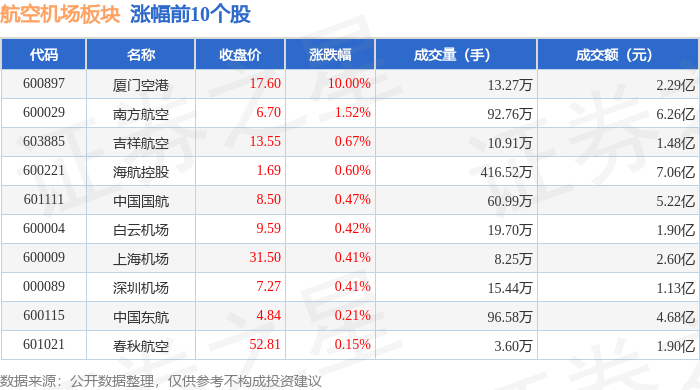
Core Insights - The aviation and airport sector saw a rise of 0.61% on October 28, with Xiamen Airport leading the gains [1] - The Shanghai Composite Index closed at 3988.22, down 0.22%, while the Shenzhen Component Index closed at 13430.1, down 0.44% [1] Stock Performance - Xiamen Airport (600897) closed at 17.60, up 10.00% with a trading volume of 132,700 shares and a transaction value of 229 million yuan [1] - Southern Airlines (600029) closed at 6.70, up 1.52% with a trading volume of 927,600 shares and a transaction value of 626 million yuan [1] - Other notable performances include: - Hainan Airlines (600221) up 0.60% to 1.69 [1] - China Eastern Airlines (600115) up 0.21% to 4.84 [1] Capital Flow - The aviation and airport sector experienced a net inflow of 22.1 million yuan from institutional investors, while retail investors saw a net inflow of 42.8 million yuan [2] - However, speculative funds recorded a net outflow of 64.9 million yuan [2] Individual Stock Capital Flow - Xiamen Airport had a net inflow of 45.72 million yuan from institutional investors, but a net outflow of 20.31 million yuan from speculative funds [3] - Shenzhen Airport saw a net inflow of 16.57 million yuan from institutional investors, with a net outflow of 5.96 million yuan from speculative funds [3] - China Eastern Airlines experienced a net outflow of 9.82 million yuan from institutional investors, while retail investors contributed a net inflow of 5.52 million yuan [3]




南方航空(600029):公司点评:成本优化明显 Q3净利大增
SINOLINK SECURITIES· 2025-10-28 07:09
Investment Rating - The report maintains a "Buy" rating for the company, indicating an expected price increase of over 15% in the next 6-12 months [4][12]. Core Insights - The company reported a revenue of 137.6 billion yuan for the first three quarters of 2025, a year-on-year increase of 2.2%, with a net profit of 2.3 billion yuan, up 17.4% [2]. - In Q3 2025, the company achieved a revenue of 51.4 billion yuan, reflecting a 3% increase year-on-year, and a net profit of 3.84 billion yuan, which is a 20% increase compared to the previous year [2]. - The growth in revenue was primarily driven by an increase in passenger traffic (RPK), which rose by 6% year-on-year, with domestic routes increasing by 5% and international routes by 9% [2]. - The company’s load factor reached a record high of 85.9% in Q3 2025, indicating strong demand and the potential for future price increases [3]. Summary by Sections Performance - For Q3 2025, the company’s revenue was 51.4 billion yuan, a 3% increase year-on-year, while the net profit was 3.84 billion yuan, up 20% [2]. - The overall revenue for the first three quarters of 2025 was 137.6 billion yuan, with a net profit of 2.3 billion yuan [2]. Cost Optimization - The gross margin for Q3 2025 was 16.5%, an increase of 1.1 percentage points year-on-year, attributed to cost improvements [3]. - The unit cost per seat kilometer decreased by 3.9% to 0.41 yuan due to lower oil prices [3]. Profit Forecast and Valuation - The net profit forecasts for 2025, 2026, and 2027 have been revised upwards to 1.3 billion yuan, 6.6 billion yuan, and 9.8 billion yuan, respectively [4]. - The report anticipates a sustainable improvement in supply-demand dynamics, leading to potential price increases and profit releases in the medium term [3].
交通运输行业周报:原油运价环比有所下跌,9月快递业务量同比增长12.7%-20251028
Bank of China Securities· 2025-10-28 06:55
Investment Rating - The report rates the transportation industry as "Outperform" [1] Core Views - Crude oil freight rates have decreased month-on-month, while container shipping rates on long-distance routes have increased. The China Import Crude Oil Comprehensive Index (CTFI) reported 1632.26 points on October 23, down 8.9% from October 16. The VLCC market remains cautious due to the implementation of special port fees between China and the US, leading to a weak sentiment among shipowners [2][13] - Guangdong Province has released a high-quality development plan for the low-altitude economy, aiming to establish itself as a national leader in this sector. The civil aviation industry has shown steady growth in the first three quarters of 2025, with a total transport turnover of 1220.3 billion ton-kilometers, a year-on-year increase of 10.3% [2][15][16] - In Shenzhen, the monthly delivery volume of autonomous vehicles has surpassed one million, with a year-on-year growth of 12.7% in express delivery volume in September. The postal industry reported a total business income of 152.57 billion yuan in September, up 6.8% year-on-year [2][22][24] Summary by Sections Industry Hot Events - Crude oil freight rates have decreased, while container shipping rates on long-distance routes have increased. The CTFI reported a decrease of 8.9% [2][13] - Guangdong's low-altitude economy development plan aims to optimize airspace management and promote low-altitude logistics [15][16] - Shenzhen's autonomous vehicle delivery volume has exceeded one million, with express delivery volume growing by 12.7% [22][24] High-Frequency Data Tracking - The Baltic Air Freight Price Index has increased month-on-month but decreased year-on-year. The Shanghai outbound air freight price index has shown a month-on-month increase of 6.9% [26] - Domestic cargo flights have increased by 3.05% year-on-year, while international flights have risen by 15.86% [32] - The express delivery business volume in September increased by 12.7% year-on-year, with total business income reaching 127.37 billion yuan [50][54] Investment Recommendations - Focus on the equipment and manufacturing export chain, recommending companies like COSCO Shipping Specialized Carriers, China Merchants Energy Shipping, and Huamao Logistics [4] - Pay attention to the low-altitude economy investment opportunities, recommending CITIC Offshore Helicopter [4] - Consider investment opportunities in the highway and railway sectors, recommending companies like Gansu Expressway and Beijing-Shanghai High-Speed Railway [4] - Explore investment opportunities in the express delivery sector, recommending SF Express, Jitu Express, and Yunda Express [4]





南方航空(600029):景气向上有望推动盈利弹性兑现
HTSC· 2025-10-28 03:40
Investment Rating - The report maintains a "Buy" rating for both A and H shares of the company, with target prices set at RMB 8.70 for A shares and HKD 6.30 for H shares [6]. Core Insights - The company reported a revenue of RMB 137.67 billion for the first nine months of 2025, reflecting a year-on-year increase of 2.2%, and a net profit attributable to shareholders of RMB 2.31 billion, up 17.4% [1]. - The third quarter of 2025 saw a revenue of RMB 51.37 billion, a 3.0% increase year-on-year, and a net profit of RMB 3.84 billion, marking a 20.3% increase [1][2]. - The report indicates that the airline industry is showing signs of recovery, with a tightening supply of flight schedules and a potential for ticket prices to turn positive in the fourth quarter of 2025 [1][4]. Financial Performance - The company's operating costs for the third quarter of 2025 were RMB 42.87 billion, a 1.6% increase year-on-year, while the average price of aviation fuel decreased by 11% [3]. - Gross profit for the third quarter increased by 10.6% to RMB 8.50 billion, resulting in a gross margin of 16.5%, up 1.1 percentage points year-on-year [3]. - The company’s fleet size reached 936 passenger aircraft and 20 cargo aircraft by September 2025, maintaining a leading position in the industry [4]. Profitability Forecast - The report projects significant growth in net profit for the years 2025 to 2027, with estimates of RMB 6.42 billion, RMB 6.05 billion, and RMB 8.56 billion respectively, corresponding to EPS of RMB 0.04, RMB 0.33, and RMB 0.47 [5][9]. - The report anticipates a continued improvement in unit revenue per passenger kilometer, with expectations for ticket prices to remain positive [5][25]. Market Dynamics - The supply growth in the airline industry is expected to remain low, which should support revenue improvement for the company [4]. - The report highlights that the cargo business is showing resilience, which may contribute to profit growth [4].
南方航空 - 2025 年三季度业绩超预期;上行周期逐步兑现
2025-10-28 03:06
Summary of China Southern Airlines 3Q25 Earnings Call Company Overview - **Company**: China Southern Airlines (CSA) - **Ticker**: 1055.HK - **Industry**: Transportation & Infrastructure - **Market Cap**: Rmb108,739.8 million - **Current Share Price**: HK$4.65 - **Price Target**: HK$5.33, indicating a 15% upside potential [5][7] Key Financial Highlights - **Net Profit**: Rmb3.8 billion in 3Q25, representing a 20% year-over-year increase [2][7] - **Profit Before Tax (PBT)**: Rmb5.8 billion, up 30% YoY, excluding Rmb0.3 billion of foreign exchange loss [2][7] - **Revenue**: Rmb51.4 billion in 3Q25, a 3% YoY increase [7] - **Operating Cash Flow**: Rmb18 billion in 3Q25, a 62% YoY increase, contributing to a total of Rmb32 billion for the first nine months of 2025 [7] - **Capital Expenditure (Capex)**: Rmb8 billion in 9M25, indicating positive free cash flow after lease payments [7] Operational Metrics - **Available Seat Kilometers (ASK)**: Increased by 5.7% YoY [7] - **Revenue Passenger Kilometers (RPK)**: Increased by 6.2% YoY, reaching 115% of 2019 levels [7] - **Unit Cost (including fuel)**: Decreased by 3% YoY, but increased by 3% compared to 3Q19 [7] Market Outlook - **Profitability**: High probability of continued YoY profitability improvement in 4Q25, with expectations of full-year profitability [7] - **Yield Trends**: Anticipated low-single-digit YoY drop in passenger yield in 3Q25, supported by strong long-haul international yields and improved domestic yields in September [7] Valuation and Risks - **Valuation Methodology**: Utilizes probability-weighted P/BV multiples with different scenarios (bull, base, bear) for 2026 estimates [13] - **Bull Case P/BV**: 3.2x; Base Case P/BV: 1.9x; Bear Case P/BV: 1.0x [13] - **Upside Risks**: Include yield improvements from higher ticket prices, faster-than-expected traffic recovery, and significant RMB appreciation [13] - **Downside Risks**: Include weak travel demand and RMB depreciation [13] Analyst Ratings - **Stock Rating**: Overweight [5] - **Industry View**: In-Line [5] Additional Insights - **Earnings Estimates**: Morgan Stanley's earnings estimates for CSA are above consensus for 2026-2027 [7] - **Market Sentiment**: The overall sentiment remains bullish on Chinese airlines, with CSA-H rated as Overweight and CSA-A rated as Equal-weight [7] This summary encapsulates the key points from the earnings call, highlighting the financial performance, operational metrics, market outlook, and valuation considerations for China Southern Airlines.