CITIC Securities Co., Ltd.(600030)

Search documents
中信证券:关注具备规模与技术实力的头部家电企业
Sou Hu Cai Jing· 2025-12-31 00:23
Core Viewpoint - The report from CITIC Securities indicates that the home appliance sector's stock performance will lag behind the market in 2025, with fund holdings dropping to historical lows, but recovery opportunities are emerging [1] Group 1: Domestic Demand - Domestic demand remains resilient supported by the "trade-in" policy, with expectations that the national subsidy policy will continue to underpin demand in 2026 [1] - The focus should be on the advancement of domestic demand policies [1] Group 2: External Demand - The impact of tariffs is gradually diminishing, allowing companies to accelerate local operations overseas [1] - There is significant growth potential in emerging markets [1] Group 3: Investment Recommendations - It is recommended to pay close attention to areas such as the promotion of domestic demand policies, expansion into emerging markets, and the structural upgrade of black appliances [1] - Preference should be given to leading home appliance companies with scale and technological strength [1]

中信证券:互联网板块AI叙事强化,垂类赛道呈现结构性机遇
Mei Ri Jing Ji Xin Wen· 2025-12-31 00:21
Core Viewpoint - The report from CITIC Securities indicates that the internet sector is expected to experience a fluctuating upward trend driven by AI-related value reassessment and improved liquidity by 2025 [1] Group 1: AI Impact on Valuation - AI will remain the core catalyst for valuation increases in the sector through 2026, with a focus on model iteration, application implementation, and performance realization strengthening narratives [1] - The listing of model companies is anticipated to provide valuation benchmarks, further driving the reassessment of internet companies' AI business value [1] Group 2: Short-term Stock Selection Criteria - For companies with lower short-term AI correlation, performance visibility and valuation cost-effectiveness will be key factors in stock selection [1] - Recommendations include focusing on relatively stable competitive landscapes, resilient performance leaders in niche markets, high-growth sectors driven by supply innovation, and absolute return targets at low valuations [1]
中信证券:银行需把握数字人民币渗透率提升机会
Di Yi Cai Jing· 2025-12-31 00:18
Core Viewpoint - The digital renminbi is transitioning from a "central bank liability" model (1.0) that replaces cash to a "deposit currency" model (2.0) integrated into the commercial banking liability system, allowing for interest-bearing accounts and reserve requirements [1] Industry Impact - This institutional adjustment is expected to enhance the stability of bank liabilities and improve the efficiency of monetary policy transmission under the reserve and interest rate framework [1] - The digital renminbi is anticipated to become a significant tool linking corporate and retail sectors, while also posing a competitive threat to third-party payment platforms [1] - Future development focus for banks regarding digital renminbi will shift from qualification to capability, necessitating a transition from account operations to specialized scenario-based services to capitalize on the increasing penetration of digital renminbi [1]

中信证券:互联网板块AI叙事强化 垂类赛道呈现结构性机遇
Di Yi Cai Jing· 2025-12-31 00:15
(文章来源:第一财经) 中信证券研报表示,2025年互联网板块在外部扰动反复的环境下走出震荡上行行情,上行动量主要为 AI驱动的价值重估及流动性改善。展望2026年,我们认为AI依然是板块估值上行的核心催化,核心关 注:1)模型迭代、应用落地以及业绩兑现带来的叙事强化;2)模型公司上市后带来的估值对标,有望 进一步驱动互联网公司AI业务价值重估。而对于短期AI相关性较低的公司,业绩能见度和估值性价比 将是选股核心要素,建议关注竞争格局相对稳定、业绩韧性较强的垂类龙头、以供给创新带动的高景气 赛道以及低估值下的绝对收益标的。 ...
50家券商主承销绿色债券1674亿 头部机构双核驱动领跑绿色金融
Chang Jiang Shang Bao· 2025-12-30 23:22
Core Viewpoint - Securities companies play a dual core role in the development of ESG, both as enterprises that need to practice ESG and as gatekeepers and guides in the capital market, significantly contributing to the ESG transformation of the entire economic system [1][3]. Group 1: ESG Role of Securities Companies - Leading securities firms such as CITIC Securities, CICC, Huatai Securities, Guotai Junan, and China Merchants Securities are at the forefront of ESG strategy, business integration, and report quality, having established dedicated ESG functional departments [1]. - In 2024, 50 securities companies acted as main underwriters for green bonds, managing a total of 148 bonds/products worth 167.405 billion yuan, with 69 asset securitization products amounting to 96.164 billion yuan [1]. Group 2: Performance of Leading Firms - In 2024, CITIC Securities, CITIC Jiantou, and CICC were particularly active in underwriting green bonds, with scales of 39.199 billion yuan, 26.372 billion yuan, and 8.956 billion yuan respectively [1]. - CITIC Securities underwrote green bonds (including carbon-neutral) totaling 51.7 billion yuan and 13.99 million USD in overseas ESG bonds, facilitating several pioneering projects in the green finance sector [2]. Group 3: Low-Carbon Transition Bonds - In 2024, 18 securities companies served as main underwriters for low-carbon transition bonds, underwriting 24 bonds with a total value of 26.79 billion yuan [2]. - CICC assisted in transactions exceeding 450 billion yuan in green-related fields and established funds covering green investment worth approximately 37 billion yuan [2]. Group 4: Future Outlook - The securities industry is expected to enhance its innovative leadership and resource allocation functions in the ESG field as the policy framework continues to improve and market demand deepens [3].

六大案例看2025券商并购大年: 强强合并重塑行业格局
Sou Hu Cai Jing· 2025-12-30 17:20
Core Viewpoint - The article discusses the ongoing trend of mergers and acquisitions in the Chinese securities industry, highlighting significant cases and the regulatory environment that encourages the formation of influential financial institutions by 2025 [1]. Group 1: Major Mergers and Acquisitions - Guolian Minsheng Securities officially rebranded after merging, reporting a revenue of 4.011 billion yuan and a net profit of 1.127 billion yuan for the first half of the year, marking a year-on-year growth of 269.4% and 1185.19% respectively [2]. - The merger of Guotai Junan and Haitong Securities, which became Guotai Haitong, is noted as the largest A+H market merger in Chinese capital market history, with Guotai Haitong achieving a net profit of 15.737 billion yuan in the first half of the year, surpassing CITIC Securities [4]. - The merger between Zhejiang Securities and Guodu Securities is progressing, with Zhejiang Securities establishing control over Guodu Securities through a series of share acquisitions [5][6]. Group 2: Regulatory Approvals and Market Impact - The merger of Xibu Securities and Guorong Securities received regulatory approval, with Xibu Securities planning to acquire a 64.5961% stake for 3.3217 yuan per share, totaling 3.825 billion yuan [8]. - The acquisition of Wanhe Securities by Guosen Securities was approved, with Guosen Securities aiming to gain control over Wanhe Securities, which has significantly smaller assets and profits compared to Guosen [9][10]. - Central Huijin's stake in CICC will increase to 1.936 billion shares post-merger with Dongxing Securities and Xinda Securities, maintaining its status as the controlling shareholder [13].



中信证券:孙毅获聘任为经营管理委员会执行委员
Zhi Tong Cai Jing· 2025-12-30 14:36
中信证券(600030)(06030)发布公告,于2025年12月30日召开的第八届董事会第四十二次会议上决议 聘任孙毅先生为本公司经营管理委员会执行委员,聘任自本次董事会决议之日起生效,任期至第八届董 事会届满之日;授权本公司经营管理层办理前述聘任涉及的备案等相关手续。 ...
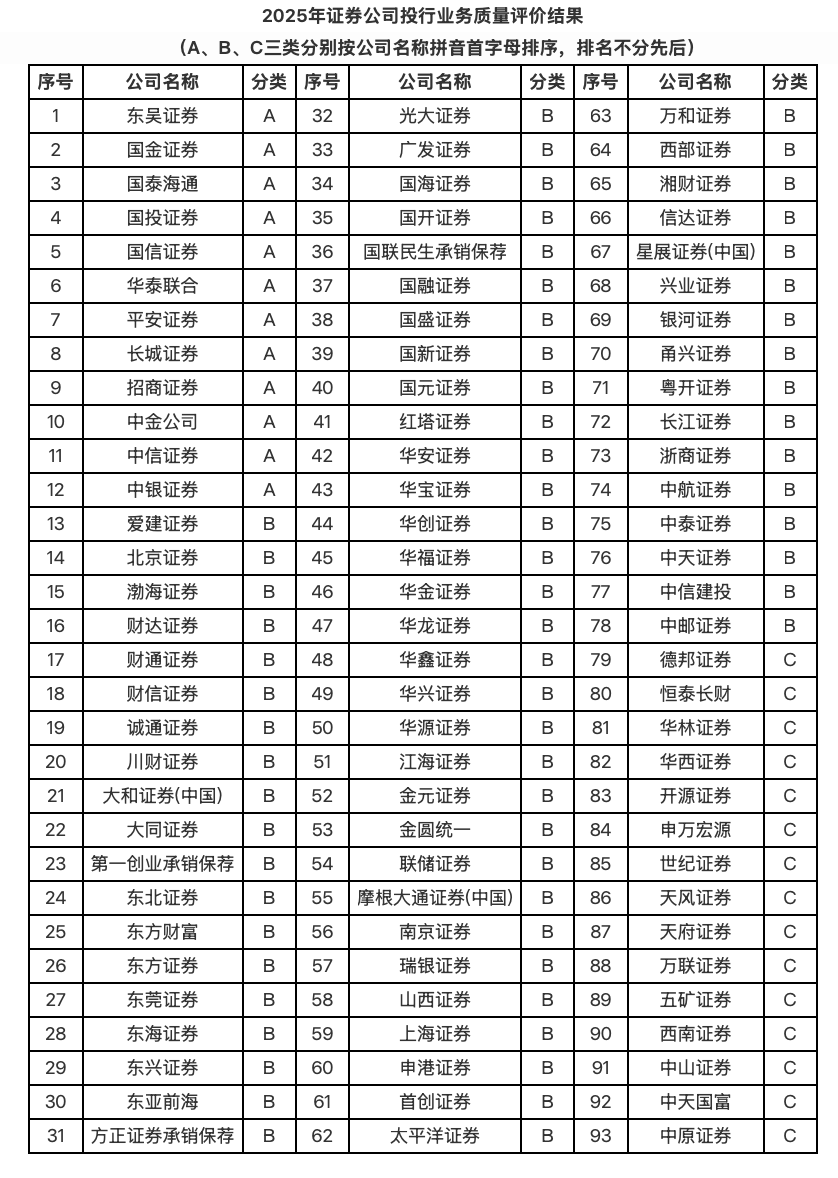
券业重磅!2025年三项业务成绩单出炉,12家券商获投行业务评价A类
券商中国· 2025-12-30 14:10
Core Viewpoint - The 2025 evaluation results of the investment banking business of securities companies in China show a significant distribution of ratings, with 12 firms rated as A-class, 66 as B-class, and 15 as C-class, reflecting the quality of their investment banking practices and internal controls [2][3][4]. Group 1: A-Class Firms - A total of 12 securities firms received an A-class rating, including Huatai United, CITIC Securities, and others, with Huatai United and CITIC Securities maintaining their A-class status for four consecutive years [2][3]. - The A-class firms are recognized for their high-quality practices in stock sponsorship, bond underwriting, and financial advisory services [10]. Group 2: B-Class and C-Class Firms - 66 firms were rated B-class, accounting for approximately 70% of the evaluated companies, including Dongfang Fortune and GF Securities [4]. - 15 firms received a C-class rating, including Debon Securities and Hengtai Changcai, indicating a decline in their investment banking quality [4]. Group 3: Changes in Ratings - 23 firms improved their ratings compared to 2024, with seven firms moving from B-class to A-class, while others like Century Securities dropped from A-class to C-class [11]. - The evaluation reflects both advancements and setbacks in the firms' investment banking practices, with specific firms facing penalties or negative events impacting their ratings [11][12]. Group 4: Evaluation Methodology - The evaluation criteria focus on the quality of investment banking services, internal control systems, and support for high-level technology and mergers and acquisitions [10]. - Recent revisions to the evaluation methodology include clearer scoring standards for negative events and enhanced focus on internal control and conflict of interest management [13][14]. Group 5: Future Directions - The China Securities Association emphasizes the importance of these evaluations in guiding firms to enhance their service capabilities and align with national strategic goals [15]. - The association aims to shift the focus from price competition to value competition, encouraging firms to improve their professional capabilities in investment banking [15].






最新投行评价结果出炉,A类12家
第一财经· 2025-12-30 13:38
Core Viewpoint - The Securities Association of China released the performance evaluation results for investment banking, bond underwriting, and financial advisory services for the year 2024, indicating a total of 93 securities firms engaged in investment banking, with 12 classified as A-level, 66 as B-level, and 15 as C-level [1][10]. Investment Banking - Among the 93 securities firms involved in investment banking, 12 firms received an A classification, including Dongwu Securities, Guojin Securities, Guotai Junan, and CITIC Securities [1][3]. - The majority of firms, 66, were classified as B, while 15 firms were rated C [1][10]. Bond Underwriting - For the bond underwriting and entrusted management business, 95 securities firms were evaluated, with 14 classified as A, 62 as B, and 19 as C [5][7]. - A-level firms in this category include Caixin Securities, Dongwu Securities, and Guotai Junan [5][7]. Financial Advisory - In the financial advisory sector, 30 securities firms were evaluated, with 5 classified as A, 19 as B, and 6 as C [5][10]. - A-level firms in financial advisory include Huatai United and Galaxy Securities [8][9]. Overall Evaluation - The evaluation results reflect the overall quality of practice among the firms and align with market expectations, promoting improvements in operational quality, internal control, and service capabilities [10].


最新评价结果出炉!券商投行业务谁更胜一筹?
Zheng Quan Ri Bao Wang· 2025-12-30 12:55
Core Viewpoint - The China Securities Association (CSA) has released the results of the evaluation of the underwriting business, bond business, and financial advisory services of securities firms, aiming to enhance the quality of practice and better serve the real economy and new productive forces [1][8]. Group 1: Evaluation Results - The evaluation of underwriting business included 93 securities firms, with results categorized into A, B, and C grades: 12 firms received A, 66 received B, and 15 received C [1][4]. - The bond business evaluation covered 95 firms, resulting in 14 firms rated A, 62 rated B, and 19 rated C [4][6]. - For the financial advisory services related to major asset restructuring, 30 firms participated, with 5 rated A, 19 rated B, and 6 rated C [6][8]. Group 2: Evaluation Criteria - The evaluation categories reflect the relative levels of practice quality, internal control systems, and service capabilities in underwriting, bond issuance, and financial advisory services, without assessing the creditworthiness or business qualifications of the firms [3][4]. - The CSA aims to guide firms to shift from price competition to value competition, enhancing the professionalism and influence of their underwriting services [8]. Group 3: Future Directions - The CSA plans to revise the evaluation indicators to further improve the quality of practice and guide firms towards function-oriented operations [8].