
CM BANK(600036)

Search documents
非银化增长,波动率加大
KAIYUAN SECURITIES· 2025-11-19 06:38
Investment Rating - Investment rating: Positive (maintained) [1] Core Views - The current credit growth continues to slow down, and social financing growth is also declining from high levels. Although policies are in place to support the market, their impact on demand recovery has not yet been reflected due to time lags. The retail risk for listed banks has increased but remains manageable, supported by substantial provisioning and stable dividend policies, which together form a "stable anchor" for the "dividend revaluation" logic of banks. The banks' advantages in capital markets, wealth management, and investment banking create a "growth sail" for differentiated valuations. Bank valuations are still at historically low levels, and medium to long-term funds have the potential for allocation, making increased allocation to the banking sector a favorable choice under the "high cut low" and balanced allocation strategy. It is recommended to invest in state-owned banks as they still offer good value compared to risk-free interest rates. Specific recommendations include CITIC Bank, benefiting from China Construction Bank, Agricultural Bank of China, China Merchants Bank, Jiangsu Bank, Chongqing Bank, Hangzhou Bank, and Chongqing Rural Commercial Bank [7]. Summary by Sections Deposit and Loan Growth - The deposit and loan growth rates for small and medium-sized banks continued to recover, with the national large banks' deposit-loan growth rate difference at -1.31% at the end of October, a decrease of 0.33 percentage points from the end of September. The four major banks' deposit-loan growth rate difference narrowed by 0.02 percentage points to -2.10%. Small and medium-sized banks recorded a deposit-loan growth rate difference of 3.74%, an increase of 0.08 percentage points [3][4]. Deposit Structure - In October, both large and small banks saw an acceleration in deposit growth, with large banks and small banks' deposit growth rates at 7.40% and 9.33%, respectively, increasing by 0.16 and 0.22 percentage points month-on-month. However, corporate deposits faced pressure, with both large and small banks experiencing negative growth in corporate deposits for the month. The increase in deposits was primarily driven by non-bank contributions, indicating a trend of "deposit migration" [4][5]. Credit Demand and Supply - The overall credit volume and structure remain poor, with small and medium-sized banks increasing lending. The total loans from deposit-taking financial institutions to residents and enterprises saw a year-on-year decrease. The credit growth is under pressure due to unfulfilled demand and other factors, including banks completing most of their annual credit targets in the first three quarters and a lack of actual credit demand conversion from policy measures [6]. Investment Recommendations - Given the current environment, increasing allocation to the banking sector is recommended as it presents a favorable opportunity for investors. The report emphasizes the potential of state-owned banks and suggests specific banks for investment based on their performance and market conditions [7].



刚刚,A股突变!
天天基金网· 2025-11-19 05:20
Market Overview - On November 19, the A-share market exhibited a volatile "roller coaster" trend, with the Shanghai Composite Index down 0.04% and the Shenzhen Component Index down 0.32%, while the ChiNext Index rose by 0.12% [3][4] - The total market turnover was 1.12 trillion yuan, showing a slight decrease compared to the previous day, with nearly 4600 stocks declining [4] Sector Performance - The oil and petrochemical, banking, insurance, and defense sectors showed positive performance, while real estate, media, building materials, and retail sectors struggled [4][19] - The motorcycle sector led with a 5.38% increase, followed by oil and gas at 2.54% and consumer goods at 2.25% [5] Stock Movements - In the Hong Kong market, major indices turned negative, with the Hang Seng Index down 0.45% and the Hang Seng Tech Index down 0.98%. Xiaomi Group led the decline, falling over 4% [6][7] - The media sector in A-shares saw significant declines, particularly in AIGC concept stocks, with Tianxiaxiu hitting the daily limit down [9][10] High-Profile Stocks - Among the top 10 market capitalization stocks, only Kweichow Moutai experienced a slight decline, while others, including Agricultural Bank of China and Industrial and Commercial Bank of China, saw gains [20] - The "Big Three" oil companies collectively performed well, with China Petroleum rising over 4% and China National Offshore Oil Corporation up over 2% [24][25] Concept Stocks - The Hainan Free Trade Port concept stocks experienced a collective pullback, with Hainan Ruize down over 9% and Hainan Airport down over 6% [11][12] - Solar glass concept stocks also faced declines, with Hainan Development dropping nearly 9% [13] Conclusion - The market showed clear signs of divergence, with large-cap stocks outperforming small-cap stocks, indicating a potential shift in investor sentiment [19][20]








今日35只个股突破半年线
Zheng Quan Shi Bao Wang· 2025-11-19 04:25
Core Points - The Shanghai Composite Index closed at 3938.29 points, slightly above the six-month moving average, with a change of -0.04% [1] - A total trading volume of A-shares reached 1,115.728 billion yuan today [1] - 35 A-shares have surpassed the six-month moving average, with notable stocks showing significant deviation rates [1] Summary of Key Stocks - Yaguang Technology (300123) had a price increase of 19.93% and a deviation rate of 14.34% from the six-month moving average [1] - Dongfang Ocean (002086) rose by 9.96% with a deviation rate of 7.83% [1] - Yaxing Anchor Chain (601890) increased by 10.02%, showing a deviation rate of 7.10% [1] - Other notable stocks include Chunfeng Power (603129) with a 10.00% increase and a deviation rate of 5.01% [1] - The stocks with the smallest deviation rates include China Merchants Bank, Xinda Securities, and Yanjinpuzi, which just crossed the six-month line [1] Additional Stock Performance - The trading turnover rates for the top-performing stocks varied, with Yaguang Technology at 23.03% and Dongfang Ocean at 12.92% [1] - The latest prices for the highlighted stocks were above their respective six-month moving averages, indicating positive momentum [1]





超4500只个股下跌
第一财经· 2025-11-19 03:53
Core Viewpoint - The article provides an overview of the A-share market performance, highlighting the fluctuations in major indices and sector performances, with a focus on the banking sector and specific stocks that have shown significant movements [3][5][9]. Market Performance - As of midday, the Shanghai Composite Index decreased by 0.04%, the Shenzhen Component Index fell by 0.32%, while the ChiNext Index rose by 0.12% [3]. - The total trading volume in the Shanghai and Shenzhen markets reached 1.11 trillion yuan, a decrease of 176.7 billion yuan compared to the previous trading day, with over 4,500 stocks declining [4]. Sector Highlights - The top-performing sectors included the shipbuilding sector, lithium extraction from salt lakes, precious metals, beauty care, and oil and gas [3]. - The banking sector showed strength, with China Bank's stock price reaching a new high, increasing by over 2% [5][6]. Notable Stocks - China Bank's stock rose by 2.60% to 5.93 yuan, while other banks like Everbright Bank and Traffic Bank also saw gains of 1.98% and 1.75%, respectively [6]. - Several high-position stocks continued to decline, with some experiencing limit-down situations [6]. Additional Market Indicators - The shipping index for European routes dropped over 2%, currently at 1649 points [5]. - Lithium carbonate futures saw an increase of over 4% during the day [7]. International Market Context - The Hong Kong market opened with the Hang Seng Index up by 0.09%, and notable gains were seen in companies like Baidu and XPeng Motors [10]. Economic Indicators - The People's Bank of China conducted a 31.05 billion yuan reverse repurchase operation with a rate of 1.40%, while the previous day's reverse repos amounted to 19.55 billion yuan [11]. - The central parity rate of the RMB against the USD was reported at 7.0872, depreciating by 16 basis points from the previous day [12].






中国银行股价创新高
Di Yi Cai Jing Zi Xun· 2025-11-19 02:53
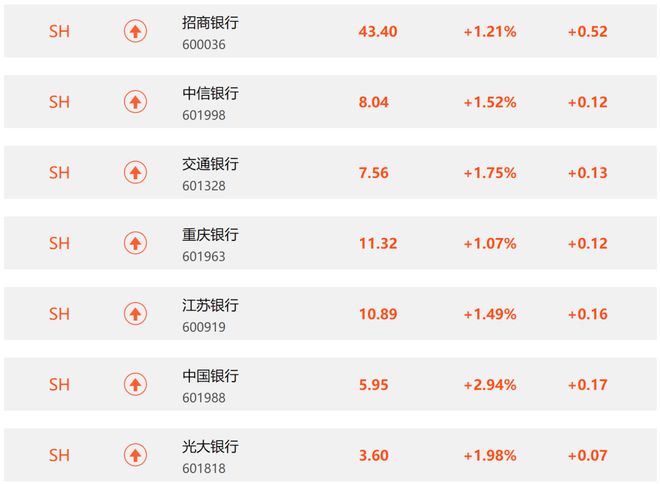
Core Points - Bank stocks experienced a volatile rise on November 19, with notable gains among several banks [1] - China Bank's stock price reached a new high, increasing by over 2% [1] Group 1: Stock Performance - China Bank's stock rose by 2.94%, reaching a price of 5.95 [2] - Everbright Bank's stock increased by 1.98%, with a price of 3.60 [2] - Jiangsu Bank's stock saw a rise of 1.49%, priced at 10.89 [2] - Traffic Bank's stock rose by 1.75%, reaching 7.56 [2] - Chongqing Bank's stock increased by 1.07%, priced at 11.32 [2] - CITIC Bank's stock rose by 1.52%, with a price of 8.04 [2] - China Merchants Bank's stock increased by 1.21%, priced at 43.40 [2]
A500ETF基金(512050)盘中飘红,成分股航天发展涨停,近5日吸金超2亿
Xin Lang Cai Jing· 2025-11-19 02:40
Group 1 - The A500 index (000510) has shown a slight increase of 0.26% as of November 19, 2025, with notable gainers including Aerospace Development (000547) up 10.01% and Spring Wind Power (603129) up 8.14% [1] - The A500 ETF fund (512050) has experienced a trading volume of 12.23 billion yuan with a turnover rate of 6.34%, and its average daily trading volume over the past month is 51.22 billion yuan [1] - The A500 ETF fund has seen a net inflow of 24.31 million yuan recently, with a total of 206 million yuan net inflow over the past five trading days, averaging 4.12 million yuan per day [1] Group 2 - Dongguan Securities suggests that profit-taking may lead to short-term volatility in the A-share market, but the long-term upward trend is expected to continue [2] - Debon Securities believes that despite short-term adjustments, the medium to long-term bull market pattern will persist, emphasizing the importance of policy support for economic data [2] - The A500 index includes 500 securities selected from various industries based on market capitalization and liquidity, reflecting the overall performance of representative listed companies [2] Group 3 - The A500 ETF fund (512050) has several related funds, including the 华夏中证A500ETF联接 A (022430), C (022431), Y (022979), and the 华夏中证A500指数增强 A (023619), C (023620) [3]





又有银行股创新高!中国银行涨近3%创历史新高
Ge Long Hui A P P· 2025-11-19 02:34
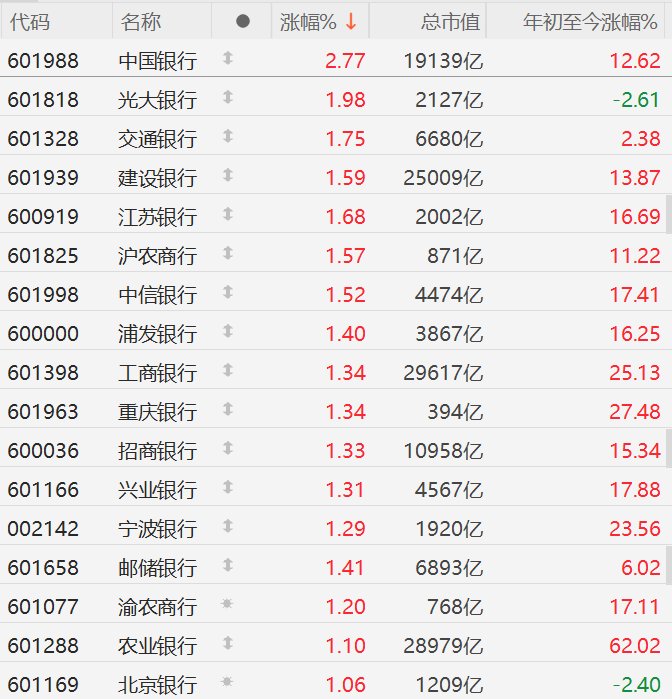
Core Insights - The A-share market saw a collective rise in bank stocks, with notable increases in China Bank, which rose nearly 3%, and other banks like Everbright Bank, Bank of Communications, and Agricultural Bank of China also showing gains of over 1% [1] Summary by Category Stock Performance - China Bank increased by 2.77%, reaching a total market capitalization of 191.39 billion, with a year-to-date increase of 12.62% [2] - Everbright Bank rose by 1.98%, with a market cap of 21.27 billion and a year-to-date decline of 2.61% [2] - Bank of Communications saw a 1.75% increase, with a market cap of 66.80 billion and a year-to-date increase of 2.38% [2] - Agricultural Bank of China increased by 1.10%, with a market cap of 289.79 billion and a year-to-date increase of 62.02% [2] - Other banks such as Construction Bank, Jiangsu Bank, and Industrial and Commercial Bank of China also reported gains, with year-to-date increases ranging from 15.34% to 25.13% [2] Historical Performance - China Bank reached a new historical high, following similar achievements by Agricultural Bank and Industrial and Commercial Bank [1]

银行股震荡走高,中国银行涨近2%
Mei Ri Jing Ji Xin Wen· 2025-11-19 02:34
Core Viewpoint - Bank stocks experienced fluctuations but ultimately rose, with notable gains in several major Chinese banks on November 19 [1]. Group 1: Stock Performance - China Bank saw an increase of nearly 2% [1]. - Other banks that performed well include Everbright Bank, Jiangsu Bank, Transportation Bank, Chongqing Bank, Citic Bank, and China Merchants Bank, which had significant gains [1].
小红日报 | 沪指三连阴,资金积极布局红利!标普红利ETF(562060)标的指数收跌1.17%
Xin Lang Ji Jin· 2025-11-19 01:09
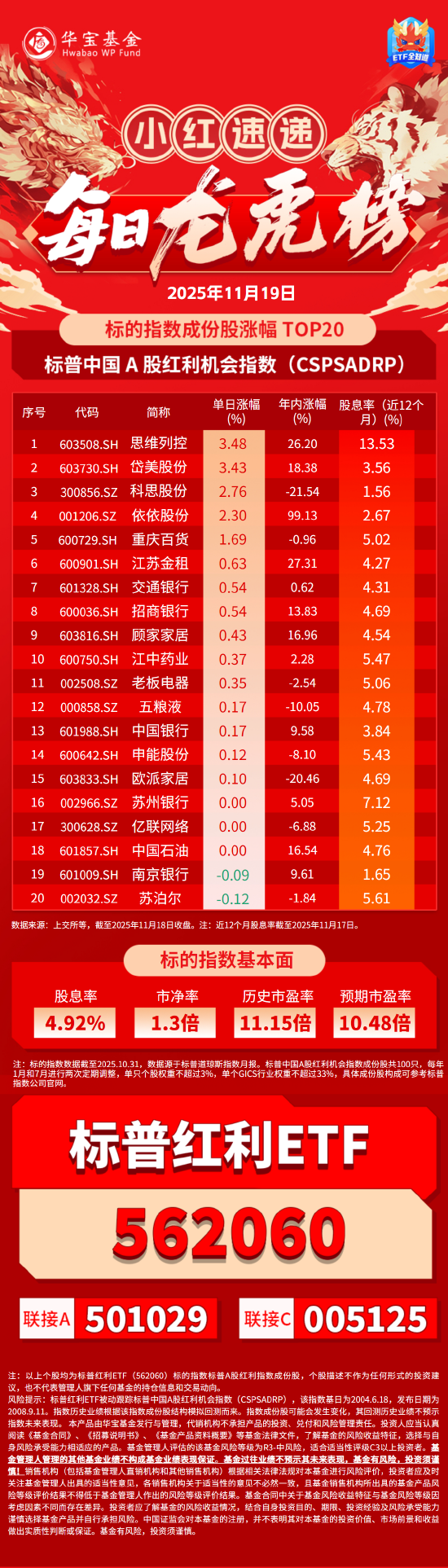
Core Insights - The article highlights the top-performing stocks in the S&P China A-Share Dividend Opportunity Index, showcasing significant daily and year-to-date gains along with dividend yields [1] Group 1: Stock Performance - The top stock, Siwei Liekong (603508.SH), experienced a daily increase of 3.48% and a year-to-date increase of 26.20%, with a dividend yield of 13.53% [1] - Dai Mei Co., Ltd. (603730.SH) saw a daily rise of 3.43% and an 18.38% increase year-to-date, with a dividend yield of 3.56% [1] - Yiyi Co., Ltd. (001206.SZ) had a remarkable year-to-date increase of 99.13%, despite a daily rise of only 2.30% and a dividend yield of 2.67% [1] Group 2: Dividend Yields - Jiangsu Jinxiang (600901.SH) reported a dividend yield of 4.27% with a year-to-date increase of 27.31% [1] - China Bank (601988.SH) has a dividend yield of 3.84% and a year-to-date increase of 9.58% [1] - China Petroleum (601857.SH) maintains a dividend yield of 4.76% with a year-to-date increase of 16.54% [1]



解码资本培育深圳实践:从“单点突破”迈向“集群共进”|决胜“十四五” 擘画“十五五”·地方资本市场高质量发展
Zheng Quan Shi Bao Wang· 2025-11-19 00:15
Core Insights - Shenzhen has emerged as a key engine city in the Guangdong-Hong Kong-Macao Greater Bay Area, showcasing significant achievements in capital market development during the 14th Five-Year Plan period, with over 400 billion yuan in equity financing and a leading proportion of technology companies listed [1][2] Group 1: Capital Market Development - During the 14th Five-Year Plan, Shenzhen's capital market facilitated over 400 billion yuan in equity financing, supporting advanced manufacturing projects [2] - The proportion of companies listed on the Growth Enterprise Market and the Sci-Tech Innovation Board reached 50.24%, the highest among major cities in China [2] - Shenzhen's overall R&D investment intensity reached a global leading level, with listed companies' R&D expenditure totaling 210.33 billion yuan in 2024, a 91.35% increase from 2020 [2] Group 2: Market Performance - In the first three quarters of 2025, Shenzhen's listed companies achieved a total revenue of 5.2 trillion yuan and a net profit of 457.797 billion yuan, reflecting year-on-year growth of 7.36% and 3.98%, respectively [3] - Shenzhen's securities firms ranked first nationally in performance, with public and private fund management scales among the top three [3] Group 3: Investor Engagement and Protection - During the 14th Five-Year Plan, 1,486 listed companies in Shenzhen implemented cash dividends totaling nearly 990 billion yuan, significantly exceeding the equity financing amount [4] - The regulatory authorities maintained a "zero tolerance" approach to violations, enhancing investor confidence and market integrity [4][6] Group 4: Future Directions - The Shenzhen government aims to establish a globally influential industrial financial center, focusing on high-quality development in banking, securities, insurance, venture capital, and mergers and acquisitions [7][8] - The capital market will emphasize the development of new productive forces, guiding funds towards high-tech and high-quality sectors to support industrial transformation and innovation [8]



