CM BANK(600036)

Search documents
数读A股|三季度外资调仓:科技制造吸金 摩根士丹利增持超三成
Xin Jing Bao· 2025-11-14 08:55
Group 1 - Foreign capital in A-shares decreased by 166 million shares in Q3, totaling 1.161 billion shares, but the total market value increased by 12.4% to 2.73 trillion yuan [4][5] - The electronic, chemical, and automotive sectors saw significant increases in foreign holdings, with increases of 19.6 million shares, 5.04 million shares, and 3.62 million shares respectively [8][10] - Major foreign institutions such as Morgan Stanley and Goldman Sachs increased their holdings by over 15%, with Morgan Stanley's holdings increasing by 33.1% [22][24] Group 2 - The electronic industry had the highest increase in foreign holdings, with a market value increase of 161.35 billion yuan, ranking first among all sectors [10][12] - Traditional sectors like banking, construction decoration, and non-bank financials faced significant reductions in foreign holdings, with declines of 67.68 million shares, 22.54 million shares, and 18.75 million shares respectively [12][21] - QFII/RQFII increased their holdings in the real estate sector by 361.1% compared to the previous quarter [15][18] Group 3 - The overall trend shows foreign capital is shifting from traditional consumer and financial sectors to technology and manufacturing sectors, reflecting confidence in China's economic transformation [25][32] - Foreign capital's interest in sectors like new energy and semiconductors continues to grow, while traditional blue-chip stocks are experiencing phase-out reductions [29][33] - The top foreign institutions are increasingly favoring high-end manufacturing and energy technology stocks, indicating a strategic shift in investment focus [22][25]








新华视点丨从“跑马圈地”到“精耕细作”:信用卡行业以创新发展破局
Xin Hua Wang· 2025-11-14 08:17
Core Insights - The credit card industry in China is undergoing a transformation from rapid expansion to a focus on refinement and optimization, with a significant reduction in the number of credit cards issued over the past three years [1][4][10] Market Trends - The total number of credit cards in China has decreased by over 90 million in recent years, with the current total at 715 million as of June 2023, marking a decline for 11 consecutive quarters [4][10] - Major banks have reported declines in credit card loan balances and transaction volumes, with specific examples including a reduction of approximately 20 billion yuan in credit card loan balances at China Merchants Bank and a 4.87% decrease at Citic Bank [4][10] Consumer Behavior - Consumers are increasingly selective about the credit cards they retain, with many choosing to cancel cards that are not frequently used or do not offer sufficient benefits [3][8] - The trend of consumers consolidating their credit cards reflects a demand for more tailored services, as many users now prefer to maintain only a few cards that meet their needs [8][9] Regulatory Environment - Regulatory policies have shifted to promote healthier credit card business practices, discouraging banks from focusing solely on the number of cards issued and requiring a reduction in dormant cards [7][10] - The introduction of regulations has led to a more cautious approach in card issuance, moving the industry from a phase of aggressive expansion to one of careful management and refinement [7][10] Competitive Landscape - The rise of alternative payment methods, such as "Huabei" and "Baitiao," has diverted users away from traditional credit cards, particularly among younger demographics [7][8] - Banks are adjusting their strategies to better align with consumer trends, focusing on product innovation and enhancing customer experiences to remain competitive in a shrinking market [10][12] Strategic Adjustments - Banks are exploring new consumer segments and adjusting their offerings, such as increasing installment credit for home renovations and targeting specific demographics like the elderly and young consumers [12][13] - Recent regulatory changes have allowed for more flexible credit card terms, including adjustments to overdraft interest rates, which may enhance the appeal of credit cards in a competitive market [13]






2025年10月金融数据点评:社融信贷均偏弱,存款搬家继续演绎
Yin He Zheng Quan· 2025-11-14 07:21
Investment Rating - The report maintains a "Recommended" rating for the banking industry [1]. Core Viewpoints - The growth of social financing (社融) has slowed down, with October's new social financing amounting to 814.9 billion yuan, a year-on-year decrease of 597.1 billion yuan. The total social financing stock increased by 8.49% year-on-year, with a slight month-on-month decline of 0.18 percentage points [3]. - Demand for loans remains weak, with a notable decrease in both household and corporate financing needs. In October, the balance of RMB loans grew by 6.5% year-on-year, a decrease of 0.1 percentage points from the previous month [3]. - The phenomenon of "deposit migration" continues, as M1 and M2 growth rates have declined. In October, M1 and M2 increased by 6.2% and 8.2% year-on-year, respectively, with month-on-month declines of 1 percentage point and 0.2 percentage points [3]. Summary by Sections Social Financing - In October, the new social financing was 814.9 billion yuan, down 597.1 billion yuan year-on-year. The government bond issuance has weakened its support for social financing [3]. - RMB loans decreased by 20.1 billion yuan in October, a year-on-year reduction of 316.6 billion yuan. The issuance of new government bonds was 489.3 billion yuan, down 560.2 billion yuan year-on-year [3]. Loan Demand - The demand for loans from the real economy remains weak, with household loans decreasing by 360.4 billion yuan in October, a year-on-year drop of 520.4 billion yuan. Corporate loans increased by 350 billion yuan, primarily driven by a significant rise in bill financing [3]. Deposit Trends - The total RMB deposits in financial institutions increased by 610 billion yuan in October, a year-on-year increase of 100 billion yuan. However, household deposits decreased by 1.34 trillion yuan, indicating ongoing deposit migration [3]. - Non-bank deposits increased by 1.85 trillion yuan year-on-year, reflecting a shift in capital towards more active markets [3]. Investment Recommendations - The report suggests that the weakening support from government bonds for social financing and the ongoing weak loan demand necessitate attention to the effectiveness of new policy financial tools. The banking sector's transformation driven by the 14th Five-Year Plan is expected to provide opportunities for fundamental recovery [3]. - Specific stock recommendations include Industrial and Commercial Bank of China (601398), Agricultural Bank of China (601288), Postal Savings Bank of China (601658), Jiangsu Bank (600919), Hangzhou Bank (600926), and China Merchants Bank (600036) [3].





2025年10月金融数据点评:信贷放缓、M1回落,量价均衡新周期愈发明朗
Shenwan Hongyuan Securities· 2025-11-14 06:30
Investment Rating - The industry investment rating is "Overweight," indicating that the industry is expected to outperform the overall market performance [24]. Core Insights - The report highlights a continued slowdown in credit growth, with October's new credit addition at 2.2 trillion yuan, a year-on-year decrease of 2.8 trillion yuan. The total new credit for the first ten months of the year is 14.97 trillion yuan, down 1.6 trillion yuan year-on-year [5][6]. - The report emphasizes the importance of monitoring forward-looking indicators such as PPI, which has shown signs of recovery, potentially improving the demand for real economy and reflecting positively on bank profits [5][6]. - The banking sector is expected to stabilize net interest margins, leading to improved net interest income growth. The focus will be on leading banks and quality regional banks for investment opportunities [5][6]. Summary by Sections Financial Data Overview - In October, new social financing was 815 billion yuan, a year-on-year decrease of 597 billion yuan, with a stock growth rate of 8.5%, down 0.2 percentage points month-on-month. M1 grew by 6.2%, while M2 grew by 8.2%, both showing a decline in growth rates compared to the previous month [3][6][9]. Credit Market Analysis - The report notes a significant decrease in corporate general loans, with a drop of 1.6 trillion yuan in October. The decline in corporate short-term loans was 1.9 trillion yuan, while bill discounting increased by over 500 billion yuan [5][6]. - Retail credit demand remains under pressure, with a net decrease of nearly 360 billion yuan in household credit in October, indicating a continued deleveraging phase for households [5][6]. Government Debt and Social Financing - The issuance of government bonds has slowed, contributing to the continued decline in social financing growth. In October, government bond issuance was 203.3 billion yuan, down over 560 billion yuan year-on-year [5][6]. - The report anticipates that the contribution from government bonds will weaken further, as the issuance for 2024 is expected to peak in the fourth quarter [5][6]. Investment Recommendations - The report suggests focusing on leading banks and undervalued regional banks as key investment themes. It highlights the potential for valuation recovery in leading banks and the opportunity for growth in quality regional banks under favorable policies [5][6].
2025年10月金融数据点评:信贷放缓、M1回落,“量价均衡”新周期愈发明朗
Shenwan Hongyuan Securities· 2025-11-14 05:11
Investment Rating - The industry investment rating is "Overweight" indicating a positive outlook for the sector compared to the overall market performance [3][5]. Core Insights - The report highlights a continued slowdown in credit growth, with new social financing in October at 815 billion, a year-on-year decrease of 597 billion, and new loans at 220 billion, down 280 billion year-on-year [3][5]. - The report emphasizes a shift towards "quantity-price balance" and "efficiency first" as the new normal in the banking sector, driven by the central bank's focus on stabilizing net interest margins [5]. - The report suggests that the banking sector's net interest income growth is expected to improve as interest margins stabilize and recover in the coming year [5]. Summary by Sections Credit Growth - In October, credit continued to slow down, with a year-on-year decrease of nearly 300 billion. The total new loans from January to October amounted to 14.97 trillion, a decrease of 1.6 trillion year-on-year [5]. - Corporate general loans decreased by 160 billion, while bill discounting increased by over 500 billion, indicating a shift in lending strategies [5]. Retail Lending - Retail short-term and medium-to-long-term loan demands remain under pressure, with a net decrease of nearly 360 billion in October, reflecting ongoing deleveraging in the household sector [5][19]. Social Financing - New social financing in October was 815 billion, with a year-on-year decrease of 597 billion, and the stock of social financing grew by 8.5% year-on-year, with a slight decline in growth rate [5][6]. Monetary Supply - M1 grew by 6.2% year-on-year, with a decrease in growth rate of 1.0 percentage points, while M2 grew by 8.2%, with a decline in growth rate of 0.2 percentage points [9][6]. Investment Analysis - The report suggests focusing on leading banks and undervalued regional banks as key investment opportunities, with a positive outlook for banks with strong fundamentals and dividend yields [5][21].
银行研思录25:银行股息率排名与中期分红进度梳理-20251114
CMS· 2025-11-14 03:02
Investment Rating - The report does not explicitly state an investment rating for the banking sector, but it provides detailed insights into dividend yields and distribution processes, which can inform investment decisions. Core Insights - The report outlines the latest dividend yields and mid-term dividend processes for A and H shares of listed banks, emphasizing the importance of accurately calculating dynamic dividend yields to avoid discrepancies across periods [1][2]. - It details the two processes for mid-term dividends following the 2023 revision of the regulatory guidelines, highlighting the conventional and simplified processes for implementing mid-term dividends [2]. - The report provides a comprehensive overview of key dates related to dividend distribution for both A and H shares, including the importance of purchasing shares before the ex-dividend date to qualify for dividends [3][4]. Summary by Sections Dynamic Dividend Yield Calculation - A simplified yet accurate method for calculating dynamic dividend yield is introduced, defined as "rolling 12-month EPS * cash dividend rate / share price," which helps avoid issues related to overlapping or missing annual and mid-term dividends [1]. - The report calculates the cash dividend rate using a standardized approach across different banks, resulting in a clear comparison of dividend yields as of November 13, 2025 [1]. Mid-Term Dividend Processes - The report explains the two processes for mid-term dividends: the conventional process requiring shareholder approval and a simplified process allowing for quicker implementation [2]. - The simplified process is designed to enhance flexibility for companies in distributing mid-term dividends, thereby improving shareholder returns [2]. Dividend Distribution Key Dates - For A shares, investors must purchase shares before the ex-dividend date to receive dividends on the same day, while H shares typically see a delay of about one month for dividend payments [3][4]. - The report outlines the differences in the dividend distribution timeline between A and H shares, emphasizing the need for investors to be aware of these timelines to maximize their returns [3][4]. Mid-Term Dividend Progress - As of November 13, 2025, 31 A-share banks have confirmed mid-term dividends, while 11 H-share banks have also confirmed their dividend distributions [9][11]. - The report categorizes banks based on their dividend status, detailing those that have implemented dividends, those that are pending, and those that have opted not to distribute dividends [9][10][11]. - It highlights that the end of 2025 and early 2026 is expected to be a peak period for mid-term dividend distributions, suggesting potential investment opportunities for dividend-seeking investors [11].






沪深300ESGETF南方(560180)开盘跌0.50%
Xin Lang Cai Jing· 2025-11-14 01:43
Core Viewpoint - The article discusses the performance of the Hu-Shen 300 ESG ETF managed by Southern Fund Management, highlighting its recent market movements and returns since inception [1]. Group 1: Fund Performance - The Hu-Shen 300 ESG ETF (560180) opened at 1.188 yuan, experiencing a decline of 0.50% [1]. - Since its inception on April 13, 2023, the fund has achieved a return of 19.48%, with a monthly return of 2.79% [1]. Group 2: Major Holdings Performance - Key stocks in the fund's portfolio include: - Ningde Times: down 2.07% - Kweichow Moutai: down 0.03% - China Merchants Bank: up 0.07% - Zhongji Xuchuang: down 3.29% - Yangtze Power: unchanged - Midea Group: down 0.13% - BYD: down 0.83% - Industrial Bank: up 0.05% - Industrial and Commercial Bank of China: up 0.24% - Heng Rui Pharmaceutical: down 0.17% [1].



这些银行,悄悄发力理财代销
3 6 Ke· 2025-11-14 01:09
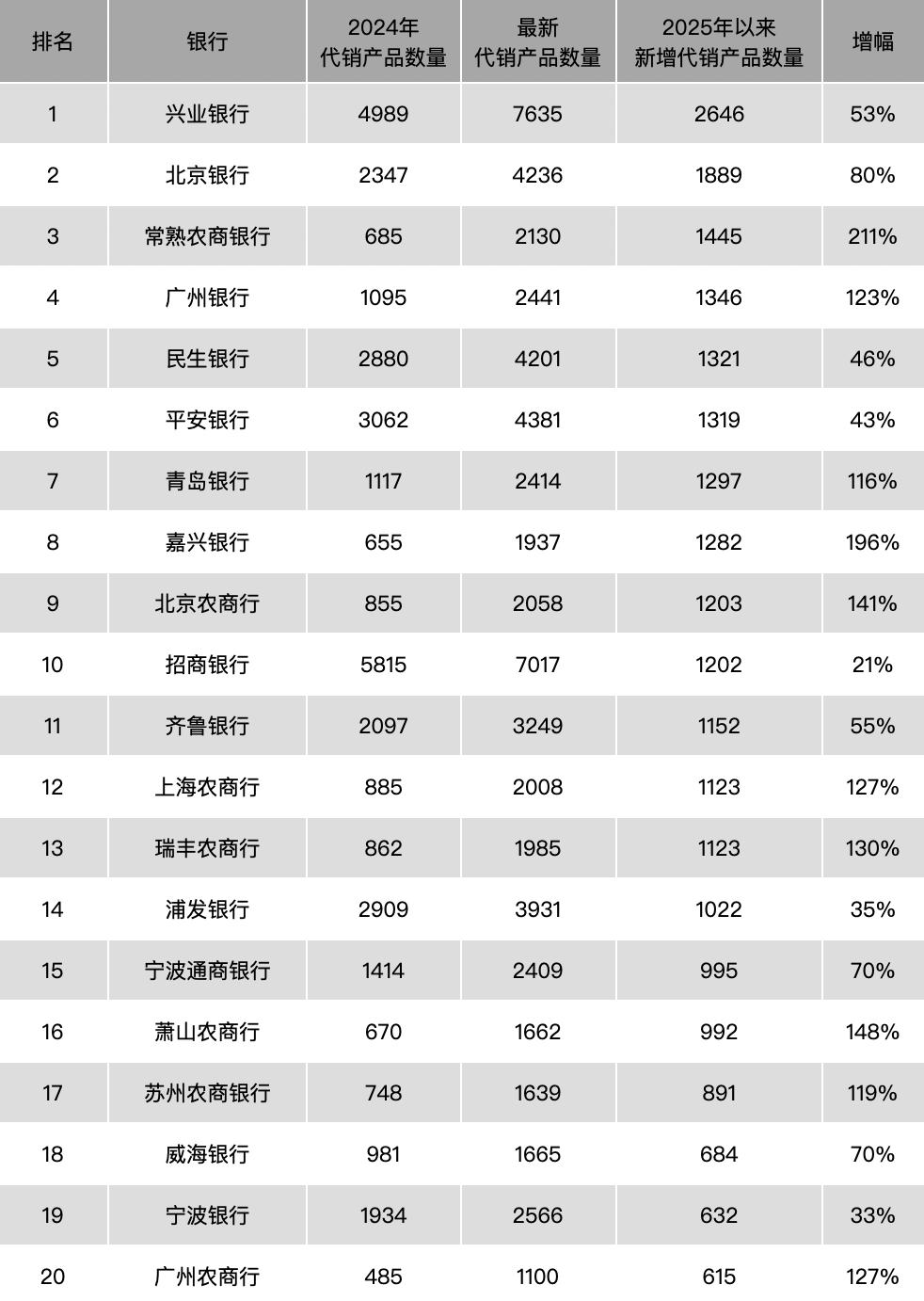
Core Insights - The banking wealth management distribution market has seen significant growth since 2025, with many banks rapidly increasing the number of wealth management products they distribute [2][3]. Distribution Growth - From the top 20 banks by incremental growth, at least 14 banks have added over 1,000 new wealth management products, with 10 banks doubling their product offerings compared to the end of last year, and some even exceeding a 200% increase [3][4]. - Notable banks include: - Industrial Bank: 7,635 products, a 53% increase [4] - Beijing Bank: 4,236 products, an 80% increase [4] - Changshu Rural Commercial Bank: 2,130 products, a 211% increase [4]. Performance Metrics - The wealth management distribution revenue for major banks has also increased significantly: - China Merchants Bank reported a wealth management distribution income of 7.014 billion yuan, an 18.14% year-on-year increase [8]. - Beijing Bank's distribution scale has exceeded last year's total, with a fee income growth of over 10% [8]. - Changshu Rural Commercial Bank's commission income grew over 57% in the third quarter, attributed to increased fees from agency wealth management services [8]. Market Dynamics - The wealth management distribution market has reached a new high, surpassing 32 trillion yuan, with 139 million investors holding wealth management products, a 12.7% year-on-year increase [10]. - The average annualized yield for cash management products is 1.33%, while fixed-income products yield 2.42%, indicating a competitive advantage over traditional savings [11]. Regulatory Changes - The implementation of the "Commercial Bank Agency Sales Business Management Measures" on October 1 has clarified standards and processes for distribution business [16]. - The market is witnessing a shift as many banks, especially smaller ones, are aggressively entering the wealth management distribution space to capture market opportunities amid narrowing interest margins [9][10]. Future Trends - The demand for retirement wealth management products is expected to grow, especially following the recent expansion of pilot programs for retirement financial products across the country [24][27]. - The market is preparing for increased competition as banks look to enhance their service capabilities and product offerings in response to evolving customer needs [23][24].


银行2025年三季报综述:息差筑底,手续费改善,国有行全部营利双增
China Post Securities· 2025-11-13 10:57
Industry Investment Rating - The industry investment rating is maintained at "Outperform" [2] Core Viewpoints - The overall operating income, pre-provision profit, and net profit growth rates for listed banks in the first three quarters of 2025 are 0.91%, 0.56%, and 1.48% respectively, indicating a recovery in performance driven by scale and an ongoing improvement in fee income [4][12] - The growth rate of interest-earning assets for listed banks is 9.40% year-on-year, with loans and debt investments increasing by 7.83% and 13.94% respectively [4][5] - The net interest margin for listed banks is stable at 1.35%, with a slight decline in state-owned banks, while other types of banks have stabilized [5] - Non-interest income has increased by 5.02% year-on-year, although it has seen a quarter-on-quarter decline due to adjustments in the bond market [5] - The asset quality is improving, with the non-performing loan ratio at 1.23%, showing a slight decrease from the previous half-year [5] Summary by Sections 1. Performance Recovery Driven by Scale and Fee Improvement - In the first three quarters of 2025, listed banks showed a growth in operating income, pre-provision profit, and net profit, with respective growth rates of 0.91%, 0.56%, and 1.48% [12] - City commercial banks outperformed other types of banks, while state-owned banks also showed positive growth [12] 2. Growth of Interest-Earning Assets and Slower Expansion of Liabilities - The year-on-year growth rate of interest-earning assets for listed banks is 9.40%, with loans and debt investments increasing by 7.83% and 13.94% respectively [4][5] 3. Stabilization of Net Interest Margin - The net interest margin for listed banks is stable at 1.35%, with a slight decline in state-owned banks [5] 4. Non-Interest Income Performance Affected by Bond Market Adjustments - Non-interest income increased by 5.02% year-on-year, but saw a quarter-on-quarter decline due to bond market adjustments [5] 5. Improvement in Asset Quality and Declining Credit Costs - The non-performing loan ratio for listed banks is 1.23%, showing a slight decrease from the previous half-year, with a significant decline in credit costs [5][12] 6. Investment Recommendations - Focus on banks with significant deposit maturities and potential for interest margin improvement, such as Chongqing Bank, China Merchants Bank, and Bank of Communications [6] - Attention to city commercial banks that will benefit from improvements in fixed asset investment, such as Jiangsu Bank, Qilu Bank, and Qingdao Bank [6]
【招银研究|宏观点评】淡化数量目标,强化利率比价——《2025年三季度货币政策执行报告》解读
招商银行研究· 2025-11-13 09:12
Core Viewpoint - The central theme of the report emphasizes the evolution of the central bank's monetary policy framework, highlighting the shift towards "diminishing quantity targets, strengthening interest rate comparisons, and optimizing structural tools" [1] Group 1: Economic Situation Assessment - The report indicates that the domestic economic recovery requires further consolidation, with a need to promote a smooth transition between old and new growth drivers and to transform the economic development model [2] - It acknowledges the complex international situation and the insufficient growth momentum in the global economy, while asserting that the long-term supportive conditions for China's economy remain unchanged [2] - The report shifts its focus on inflation from assessment to description, noting improvements in price movements and suggesting policies to positively influence reasonable price recovery [2] Group 2: Policy Stance - The monetary policy maintains a "moderately loose" tone, focusing on achieving a "fourfold balance" [3] - The report highlights the need for supportive monetary policy to stabilize growth and inflation, especially in light of the Federal Reserve's rate cuts and slowing domestic economic growth [3] - It notes that the non-performing loan ratio and net interest margin of commercial banks have not significantly improved, indicating that the loosening of monetary policy should remain moderate [3] Group 3: Policy Framework Evolution - The report details the evolution of the monetary policy framework, emphasizing the need for liquidity to remain ample and interest rates to be reasonably priced [4] - It states that the focus will shift from "financing and monetary aggregates" to "financial totals," indicating a reduced emphasis on quantity targets, particularly credit growth [5] - The report mentions that the growth rate of RMB loans has dropped to 6.6% in October, a decline of 4.1 percentage points compared to the average growth rate over the past five years [5] Group 4: Price Control Mechanisms - The report stresses the importance of price-based regulation in response to the anticipated decline in financial total growth and increased volatility [8] - It outlines five key interest rate relationships that need to be rationalized, including the relationship between central bank policy rates and market rates, and the relationship between different types of asset yields [8] - The report emphasizes the need for continuous evaluation of financial institutions' interest rate policies and self-regulatory agreements [8] Group 5: Structural Adjustments - The report calls for continued support for key financial initiatives and emphasizes the importance of enhancing data development and utilization in the fintech sector [9] - It reviews the achievements in financial support for the digital economy during the 14th Five-Year Plan period and outlines plans for the 15th Five-Year Plan, focusing on the integration of digital technology and data elements [9]