CM BANK(600036)

Search documents
已有7家银行私银客户超10万户
21世纪经济报道· 2025-11-12 05:38
Core Insights - The private banking business has seen significant growth in the first three quarters of this year, with seven listed banks surpassing 100,000 private banking clients as of September 30, 2023, driven by the increasing number of high-net-worth individuals and evolving wealth management needs [1][3][6] Growth of Private Banking Clients - Several banks reported a client growth rate exceeding 10%, with Minsheng Bank, Beijing Bank, and Nanjing Bank showing increases over 15%. Minsheng Bank led with an 18.21% growth, reaching 73,409 clients [3][6] - Beijing Bank's private banking clients grew by 17.9% to 20,586, with total assets under management (AUM) increasing by 14.39% to 224 billion yuan [3][6] - Nanjing Bank also reported a 15.43% increase in private banking clients [3] Dominance of State-Owned Banks - State-owned banks continue to lead in absolute numbers, with Agricultural Bank of China having 279,000 clients, followed by China Construction Bank with 265,500 clients [4] - China Merchants Bank and Ping An Bank have also joined the "100,000 club," with Ping An Bank reaching 103,300 clients, marking its first time surpassing this threshold [4][6] Market Dynamics and Competition - The private banking market is characterized by a competitive landscape where state-owned banks leverage their scale, while joint-stock banks focus on differentiated services and operational efficiency [7] - The growth of high-net-worth individuals is expected to drive competition towards service quality and asset allocation capabilities [7] Challenges in Wealth Management - The wealth management sector faces three main challenges: economic growth slowdown, declining risk-free returns, and reduced investor confidence [10][11] - Banks are urged to upgrade their wealth management services to meet clients' real needs and utilize various financial tools for comprehensive solutions [11] Changing Client Demographics - The core client base for private banking is shifting from traditional business owners to new economy groups, with a notable increase in demand for comprehensive wealth management services [9] - Banks are redefining their target clients based on their strengths, with some focusing on family wealth transfer and others on retirement financial management [9]








三季度公募含“银”量创五年新低,四季度银行股修复动能渐显
第一财经· 2025-11-11 14:59
Core Viewpoint - The article highlights the significant changes in the banking sector, particularly focusing on the increasing shareholding of local state-owned enterprises and insurance funds in various banks, while public funds and northbound capital are reducing their holdings. The overall market sentiment for bank stocks is showing signs of recovery in the fourth quarter after a challenging third quarter [3][10][12]. Group 1: Shareholding Changes - Action Person's total shareholding ratio has risen to 19.17%, making it the largest shareholder of Qingdao Bank [3]. - Many city commercial banks and national banks have disclosed shareholding increase plans or have already implemented them, including Chengdu Bank, Nanjing Bank, and Postal Savings Bank [3]. - The number of shareholders in banks like China Merchants Bank and Beijing Bank has increased significantly, indicating a rise in retail investor participation alongside a decline in institutional holdings [5][6]. Group 2: Fund Holdings and Market Performance - Public funds' exposure to bank stocks has dropped to a five-year low, with a decrease in their overall holdings [4][6]. - The banking sector saw a decline of 8.68% in the third quarter but rebounded with an increase of 8.23% in the fourth quarter as of November 11 [3]. - Northbound capital inflow into banks decreased by 31.66% in the third quarter, with only a few banks like Ningbo Bank and Chengdu Bank seeing net inflows [7]. Group 3: Institutional Investment Trends - Insurance funds and state-owned capital have maintained relatively stable holdings in bank stocks, with state-owned funds holding a total market value of 4.5 trillion yuan [8]. - The increase in local state-owned capital investments in city commercial banks reflects a strategy to strengthen regional financial resource control and capitalize on low valuations [9]. - The investment sentiment in the banking sector is expected to improve in the fourth quarter, with several banks announcing share buyback plans [10][11]. Group 4: Future Outlook - The article suggests that the banking sector may experience structural recovery opportunities in the fourth quarter, driven by high dividend yields and the resilience of regional banks [10][12]. - Analysts believe that the combination of increased institutional investment and favorable market conditions could lead to a stabilization phase for bank stocks [11][12].


监管研究系列三:存款非银化对流动性风险指标的影响与测算
KAIYUAN SECURITIES· 2025-11-11 14:12
Investment Rating - The investment rating for the banking industry is "Positive" (maintained) [1] Core Insights - The report highlights the ongoing trend of deposit non-bankization, which is leading to a marginal decline in liquidity indicators for banks. This trend is particularly pronounced among large banks, with a notable increase in the proportion of non-bank deposits [12][16] - The liquidity coverage ratio (LCR) and net stable funding ratio (NSFR) are critical indicators for banks, and the report provides quantitative assessments of how deposit non-bankization impacts these metrics. The effects are manageable for major banks, with LCR expected to remain above 120% even under significant conversion scenarios [4][34] Summary by Sections 1. Deposit Non-Bankization and Liquidity Management - The process of deposit non-bankization is intensifying the demand for banks to manage liquidity indicators more stringently. Since May 2025, the growth rate of personal fixed deposits has been declining, with large banks showing a decrease in monthly increments compared to the same period in 2024 [12][16] - The report quantifies the impact of deposit non-bankization on LCR and NSFR for major banks, indicating that even with a 70% conversion of personal fixed deposits to non-bank deposits, the LCR for most large banks is expected to remain above 120% [4][34] 2. Liquidity Indicator Management - The management of LCR focuses on maintaining liquidity asset reserves, while NSFR management emphasizes improving the liability structure. Issuing long-term interbank certificates of deposit is highlighted as an effective method to optimize these liquidity indicators [5][22] - The report details how the conversion of personal fixed deposits to non-bank deposits affects various liquidity risk indicators, with specific calculations provided for LCR and NSFR under different conversion scenarios [18][23] 3. Investment Recommendations - The report suggests a tiered investment strategy: - Core holdings should focus on large state-owned banks, benefiting from institutions like Agricultural Bank of China and Industrial and Commercial Bank of China - Core allocations should include leading comprehensive banks such as China Merchants Bank and CITIC Bank - Flexible allocations can target regional banks like Jiangsu Bank and Chongqing Bank [6][19]



三季度公募含“银”量创五年新低 四季度银行股修复动能渐显
Di Yi Cai Jing· 2025-11-11 13:51
Core Viewpoint - Qingdao Guoxin Financial Holdings has become the largest shareholder of Qingdao Bank with a total holding of 19.17% [1] - The banking sector is experiencing a mixed performance with increased shareholder activity, particularly from local state-owned and industrial capital, while facing pressure from public funds and northbound capital [1][2] Group 1: Shareholder Activity - Multiple city commercial banks and national banks have reported significant shareholder increases this year, including Chengdu Bank, Nanjing Bank, and Postal Savings Bank [1] - Public funds have reduced their holdings in bank stocks, with the proportion of public fund investment in bank stocks dropping to 1.78%, the lowest level in five years [2][3] - Northbound capital has also decreased its investment in banks, with a 31.66% decline in total market value held by northbound funds [3] Group 2: Market Performance - The banking sector saw an 8.68% decline in Q3 but rebounded with an 8.23% increase in Q4 as of November 11 [1] - The overall market style shift has led to a significant reallocation of funds from low-volatility bank stocks to high-growth sectors, with the Wind All A Index rising by 19.5% during the same period [4] Group 3: Institutional Investment Trends - Insurance and state-owned funds have maintained stable holdings in bank stocks, with state-owned funds holding a total market value of 4.5 trillion yuan [5][6] - Local state-owned and industrial capital are increasingly investing in city commercial banks, driven by regional financial resource integration needs and attractive valuations [6] Group 4: Future Outlook - There is a growing sentiment of recovery in the banking sector, with several banks announcing share buyback plans and improved core revenue capabilities [7] - Analysts suggest that Q4 presents structural recovery opportunities, particularly for quality regional banks and high-dividend state-owned banks [8]
三季度公募含“银”量创五年新低,四季度银行股修复动能渐显
Di Yi Cai Jing· 2025-11-11 13:40
Core Viewpoint - Qingdao Guoxin Chanin Holdings has become the largest shareholder of Qingdao Bank with a total holding of 19.17% [1] - The banking sector is experiencing a mixed performance with significant shareholder activity, particularly in the context of third-quarter financial reports [1][2] Shareholder Activity - Multiple city commercial banks and national banks have reported shareholding increases, including Chengdu Bank, Nanjing Bank, and Postal Savings Bank [1] - Public funds have reduced their holdings in bank stocks, with the proportion of public funds in bank stocks dropping to 1.78%, a decrease of 2.55 percentage points [2][3] Market Performance - The banking sector saw a decline of 8.68% in the third quarter but rebounded with an increase of 8.23% in the fourth quarter as of November 11 [1] - The overall market style shift has led to a significant reallocation of funds from low-volatility bank stocks to high-growth sectors [4] Fund Composition - Active funds have reduced their positions in major banks like China Merchants Bank and Jiangsu Bank, while some banks like Ningbo Bank and Chengdu Bank saw an increase in holdings [3] - Passive funds also exhibited a reduction in bank stock holdings, with a total market value of 841.12 billion yuan, down 5.67 percentage points [3] Institutional Investment Trends - Insurance and state-owned funds have maintained stable holdings in bank stocks, with state-owned funds holding a total market value of 4.5 trillion yuan [5][6] - Local state-owned capital is increasingly investing in city commercial banks, driven by regional financial resource integration needs and attractive valuations [6] Future Outlook - The fourth quarter has seen a wave of share buyback announcements from bank executives and major shareholders, signaling positive investment sentiment [7] - Analysts believe there are structural recovery opportunities in the banking sector, particularly for regional banks and high-dividend state-owned banks [7][8]
波段难做,多家银行相关投资收益下降,拖累前三季度非息收入
Zheng Quan Shi Bao· 2025-11-11 12:58
Core Viewpoint - The bond market faced significant pressure from strong commodity and equity market performances in Q3, leading to increased volatility and a notable rise in interest rates, which adversely affected banks' non-interest income due to unrealized losses on bond holdings [1] Group 1: Impact on Non-Interest Income - Many banks reported a decline in non-interest income due to reduced investment returns from the bond market, with at least ten banks showing a year-on-year decrease in non-interest income for the first three quarters [2][5] - China Merchants Bank's non-interest income fell by 11.42% year-on-year, primarily due to decreased bond and fund investment returns, with a cumulative loss of 8.827 billion yuan in fair value changes compared to a gain of 3.099 billion yuan in the same period last year [2] - Ping An Bank's investment income dropped nearly 50% year-on-year in Q3, with a total investment income of 16.275 billion yuan for the first three quarters, down approximately 11.41% from the previous year [2] Group 2: Market Conditions and Trends - The bond market experienced significant fluctuations, with yields on various bonds rising above 1.8% in September, marking a notable increase compared to the previous month [4] - The overall bond market has shown wide fluctuations this year, contrasting with last year's bullish trend, making it challenging for banks to execute effective trading strategies [4][5] - A report indicated that the other non-interest income of listed banks grew by only 5.4% year-on-year, with a significant decline in the growth rate attributed to bond market volatility [3] Group 3: Strategic Responses - Banks are advised to enhance their trading capabilities and consider increasing the use of derivative hedging and fixed-income assets to mitigate risks associated with bond market fluctuations [5][6] - China Merchants Bank plans to maintain a reasonable bond investment ratio of around 30%, optimize asset allocation, and improve trading operations to enhance income [5] - Recommendations include utilizing government bond futures and interest rate swaps to construct hedging portfolios and accurately identify market trends for better timing in trading [6]
波段难做,债市浮亏!多家银行相关投资收益下降,拖累前三季度非息收入
券商中国· 2025-11-11 12:24
Core Viewpoint - The article highlights the significant impact of bond market volatility on the non-interest income of several banks in the third quarter, leading to a decline in investment income and overall non-interest revenue due to losses from bond holdings [1][4]. Group 1: Impact on Non-Interest Income - Many banks reported a decrease in non-interest income due to reduced investment income from the bond market, with notable declines in the third quarter [2][4]. - For example, China Merchants Bank's non-interest income fell by 11.42% year-on-year, primarily due to decreased bond and fund investment returns, resulting in a cumulative fair value loss of 8.827 billion yuan compared to a gain of 3.099 billion yuan in the previous year [2]. - Ping An Bank's investment income dropped nearly 50% in the third quarter, with a year-to-date decrease of approximately 11.41% [2][3]. Group 2: Market Conditions and Bank Responses - The bond market experienced significant fluctuations, with yields rising above 1.8% for various bank categories, contrasting sharply with the previous year's bullish market [6]. - Banks are advised to enhance their trading capabilities and consider using derivatives for hedging to mitigate risks associated with market volatility [8]. - Strategies suggested include maintaining a reasonable proportion of bond investments, optimizing asset allocation, and utilizing derivative tools to manage risks effectively [8]. Group 3: Overall Trends in the Banking Sector - A total of 10 banks reported a year-on-year decline in non-interest net income, with decreases ranging from 4% to 23% [6][7]. - The research team from China International Capital Corporation noted that the growth rate of other non-interest income for listed banks slowed significantly, with only state-owned banks showing an increase in this metric [4][5].


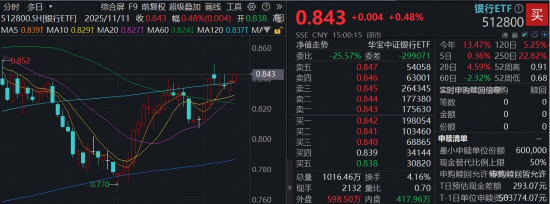
逆市上涨!农业银行涨超2%,逼近前高!双百亿银行ETF(512800)站稳所有均线,资金寻求“当下确定性”
Xin Lang Ji Jin· 2025-11-11 11:59
Core Viewpoint - The banking sector is experiencing a resurgence, with the bank ETF (512800) showing positive performance amidst market volatility, indicating strong buying interest and a favorable medium to long-term outlook [1][4]. Group 1: Market Performance - The bank ETF (512800) closed up 0.48% today, with intraday premium trading reflecting positive buying sentiment [1]. - The ETF has shown a two-day consecutive increase and is positioned above all moving averages, suggesting an optimistic medium to long-term trend [1]. - The ETF's latest scale exceeds 20.4 billion, with an average daily trading volume of over 800 million this year, making it the largest and most liquid bank ETF in A-shares [4]. Group 2: Stock Performance - Individual bank stocks are mostly performing well, with Xi'an Bank rising nearly 3%, Agricultural Bank up over 2%, and several others, including Qingdao Bank and China Merchants Bank, also showing gains [2][3]. - Over 10 listed banks have seen significant share purchases by shareholders or executives this year, indicating strong market confidence [3]. Group 3: Investment Sentiment - The current market environment has led to a shift towards stable cash flow and high-dividend sectors, with banks expected to attract more investment due to their stable and high dividend characteristics [3]. - The banking sector is perceived as being in a high cost-performance zone, with the bank ETF tracking a price-to-book ratio of only 0.72, indicating a mid-low range compared to the past decade [4]. - The dividend yield of the index tracked by the bank ETF is 4.02%, significantly exceeding the risk-free rate of 1.8%, highlighting its "quasi-fixed income" nature [4].
以创新为笔,招商银行青岛分行“背贴通”商票业务书写服务国家战略新篇章
Xin Lang Cai Jing· 2025-11-11 11:01
Core Viewpoint - The successful launch of the "Back贴通" commercial bill business by China Merchants Bank Qingdao Branch marks a significant advancement in the online transaction platform for bills, driven by process innovation and technology empowerment, aimed at transforming bill business online and serving the real economy [1] Group 1: Business Development - The collaboration with Shandong New Hope Liuhe Group, the largest private enterprise in Qingdao, highlights the bank's focus on meeting the needs of major local businesses [1] - The "Back贴通" business streamlines the bill process from "hour-level" to "minute-level" efficiency, addressing traditional bottlenecks in bill circulation [1] Group 2: Product Innovation - The new product is designed around customer needs, effectively integrating payment channels between parent and subsidiary companies and external suppliers [1] - The service model is tailored to the characteristics of the industry chain, enhancing the overall customer experience [1] Group 3: Strategic Empowerment - Innovation-driven development is emphasized as a core strategy for high-quality growth in the bank's bill business [1] - The product not only provides efficient services to meet corporate financing needs but also aligns with national strategic goals, showcasing the bank's financial responsibility [1]

11月11日投资时钟(399391)指数跌0.3%,成份股大连圣亚(600593)领跌
Sou Hu Cai Jing· 2025-11-11 09:59
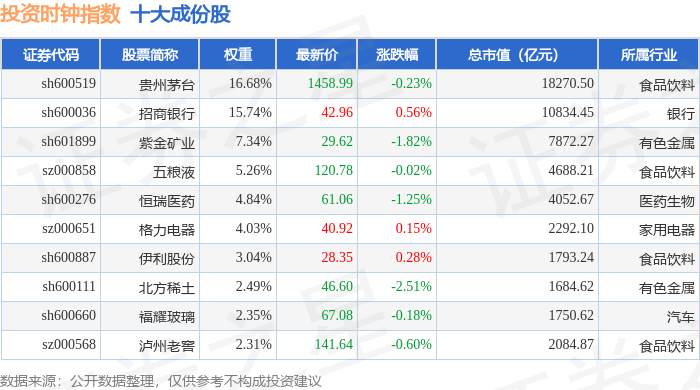
Core Points - The Investment Clock Index (399391) closed at 3417.83 points, down 0.3%, with a trading volume of 93.251 billion yuan and a turnover rate of 0.93% [1] - Among the index constituents, 35 stocks rose while 61 stocks fell, with China Overseas Land leading the gainers at 10.15% and Dalian Shengya leading the decliners at 6.62% [1] Index Constituents Summary - The top ten constituents of the Investment Clock Index include: - Kweichow Moutai (16.68% weight) at 1458.99 yuan, down 0.23%, with a market cap of 1827.05 billion yuan [1] - China Merchants Bank (15.74% weight) at 42.96 yuan, up 0.56%, with a market cap of 1083.445 billion yuan [1] - Yunnan Tin Company (7.34% weight) at 29.62 yuan, down 1.82%, with a market cap of 787.227 billion yuan [1] - Wuliangye Yibin (5.26% weight) at 120.78 yuan, down 0.02%, with a market cap of 468.821 billion yuan [1] - Hengrui Medicine (4.84% weight) at 61.06 yuan, down 1.25%, with a market cap of 405.267 billion yuan [1] - Gree Electric Appliances (4.03% weight) at 40.92 yuan, up 0.15%, with a market cap of 229.210 billion yuan [1] - Yili Industrial Group (3.04% weight) at 28.35 yuan, up 0.28%, with a market cap of 179.324 billion yuan [1] - Northern Rare Earth (2.49% weight) at 46.60 yuan, down 2.51%, with a market cap of 168.462 billion yuan [1] - Fuyao Glass (2.35% weight) at 67.08 yuan, down 0.18%, with a market cap of 175.062 billion yuan [1] - Luzhou Laojiao (2.31% weight) at 141.64 yuan, down 0.60%, with a market cap of 208.487 billion yuan [1] Capital Flow Analysis - The net outflow of main funds from the Investment Clock Index constituents totaled 3.8 billion yuan, while the net inflow from speculative funds was 919 million yuan, and the net inflow from retail investors was 2.881 billion yuan [1]