
CM BANK(600036)

Search documents
门槛有点高!有银行积存金起点“三连涨”,最高达到1500元
2 1 Shi Ji Jing Ji Bao Dao· 2025-11-12 11:37
Core Viewpoint - The international gold price has returned to $4,100 per ounce, prompting banks to raise the minimum investment threshold for gold accumulation, with some banks adjusting the starting point to a historical high of 1,500 yuan [1][3] Summary by Sections Investment Threshold Adjustments - On November 11, Citic Bank raised the minimum investment amount for its gold accumulation plan from 1,000 yuan to 1,500 yuan, effective from November 15 [3] - China Construction Bank revised its gold accumulation plan, increasing the minimum investment amount from 1,000 yuan to 1,200 yuan, marking the second increase this year [3] - Other banks, such as Agricultural Bank and Bank of Communications, have also implemented a "floating mechanism" for gold accumulation thresholds, allowing the starting point to adjust with market gold prices [4][5] Market Volatility and Risk Management - The gold price has experienced significant fluctuations, with a rise of over 60% this year, followed by a sharp decline [7] - Regulatory bodies and banks are enhancing risk warnings due to the volatile gold market, urging investors to be aware of potential risks [6] - Analysts suggest that the floating mechanism for investment thresholds allows for better alignment with market changes and provides investors with more flexibility [5] Future Price Predictions - Various institutions predict that gold prices could range from $4,200 to $4,600 per ounce by the end of 2025, with some forecasts suggesting prices could reach as high as $5,000 per ounce [8] - The outlook for gold remains optimistic due to factors such as a weakening dollar and inflation risks, although short-term volatility is expected [7][8]





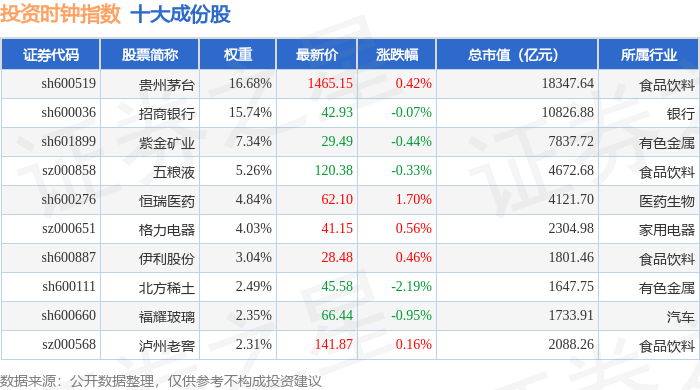
11月12日投资时钟(399391)指数跌0.01%,成份股华侨城A(000069)领跌
Sou Hu Cai Jing· 2025-11-12 10:04
Core Viewpoint - The Investment Clock Index (399391) closed at 3417.47 points, down 0.01%, with a trading volume of 89.182 billion yuan and a turnover rate of 0.94% on November 12 [1] Group 1: Index Performance - Among the constituent stocks of the Investment Clock Index, 28 stocks rose while 71 stocks fell, with China Aluminum leading the gainers at a 6.65% increase and Overseas Chinese Town A leading the decliners at a 4.1% decrease [1] - The top ten constituent stocks of the Investment Clock Index include Kweichow Moutai, China Merchants Bank, and others, with Kweichow Moutai holding the highest weight at 16.68% [1] Group 2: Stock Details - Kweichow Moutai's latest price is 1465.15 yuan, with a slight increase of 0.42% [1] - China Merchants Bank's latest price is 42.93 yuan, with a minor decrease of 0.07% [1] - The total market capitalization of Kweichow Moutai is approximately 183.48 billion yuan, while China Merchants Bank's market cap is around 108.27 billion yuan [1] Group 3: Capital Flow - The net outflow of main funds from the constituent stocks totaled 2.074 billion yuan, while retail investors saw a net inflow of 1.909 billion yuan [1] - The detailed capital flow indicates that China Aluminum had a net inflow of 390 million yuan from main funds, while it experienced a net outflow of 278.5 million yuan from speculative funds [2]






【诚邀您申请招商银行信用卡金卡】
招商银行App· 2025-11-12 09:29
Group 1 - The article discusses various credit card offerings and promotions from a specific bank, highlighting the benefits for new customers [8][10][11] - It emphasizes the attractive rewards for new cardholders, such as cash vouchers and branded gifts, which aim to incentivize sign-ups [8][10][13] - The article also mentions special privileges for existing cardholders who wish to apply for additional credit cards, indicating a strategy to retain and reward loyal customers [21][22] Group 2 - The promotions include specific rewards for referrals, encouraging current customers to recommend the bank's credit cards to friends and family [20] - The article outlines various themed credit cards, such as those linked to popular brands or characters, which appeal to niche markets and enhance customer engagement [11][13][16] - It highlights the convenience of managing multiple financial services through a single app, promoting a comprehensive banking experience [27]

18.10亿元资金今日流入银行股
Zheng Quan Shi Bao Wang· 2025-11-12 09:28
Market Overview - The Shanghai Composite Index fell by 0.07% on November 12, with 11 sectors rising, led by household appliances and comprehensive sectors, which increased by 1.22% and 1.05% respectively [1] - The banking sector rose by 0.50%, while the power equipment and machinery sectors experienced declines of 2.10% and 1.23% respectively [1] Fund Flow Analysis - The main funds in the two markets saw a net outflow of 58.897 billion yuan, with five sectors experiencing net inflows, led by the pharmaceutical and biological sector, which saw a net inflow of 2.402 billion yuan and a rise of 0.61% [1] - The banking sector had a net inflow of 1.810 billion yuan, with a daily increase of 0.50% [1] Banking Sector Performance - In the banking sector, 42 stocks were tracked, with 26 stocks rising and 12 stocks falling [2] - The top three stocks with the highest net inflow were Agricultural Bank of China (4.56 billion yuan), China Merchants Bank (2.49 billion yuan), and Bank of China (2.14 billion yuan) [2] - The stocks with the highest net outflow included Nanjing Bank (56.415 million yuan), China Construction Bank (38.058 million yuan), and Qingdao Bank (23.4865 million yuan) [2] Individual Stock Performance - Agricultural Bank of China had a daily increase of 3.49% with a turnover rate of 0.16% and a main fund flow of 456.41 million yuan [3] - China Merchants Bank saw a slight decrease of 0.07% with a main fund flow of 249.21 million yuan [3] - Bank of China increased by 1.41% with a main fund flow of 214.05 million yuan [3] Additional Stock Insights - Other notable performers included Industrial and Commercial Bank of China (0.37% increase, 201.69 million yuan flow) and Bank of Communications (0.81% increase, 161.39 million yuan flow) [3] - Several banks experienced negative fund flows, including Xiamen Bank (-73.02 thousand yuan) and Chongqing Bank (-938.65 thousand yuan) [4]



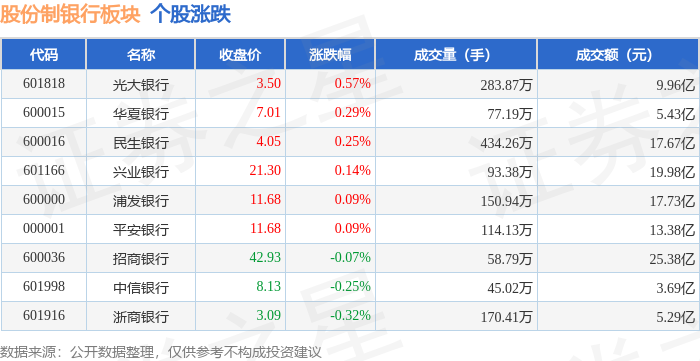
股份制银行板块11月12日涨0.04%,光大银行领涨,主力资金净流入6.81亿元
Zheng Xing Xing Ye Ri Bao· 2025-11-12 08:49
Market Overview - On November 12, the share price of the joint-stock bank sector increased by 0.04% compared to the previous trading day, with Everbright Bank leading the gains [1] - The Shanghai Composite Index closed at 4000.14, down 0.07%, while the Shenzhen Component Index closed at 13240.62, down 0.36% [1] Individual Bank Performance - Everbright Bank (601818) closed at 3.50, up 0.57% with a trading volume of 2.83 million shares and a transaction value of 996 million [1] - Huaxia Bank (600015) closed at 7.01, up 0.29% with a trading volume of 771,900 shares and a transaction value of 543 million [1] - Minsheng Bank (600016) closed at 4.05, up 0.25% with a trading volume of 4.34 million shares and a transaction value of 1.767 billion [1] - Industrial Bank (601166) closed at 21.30, up 0.14% with a trading volume of 933,800 shares and a transaction value of 1.998 billion [1] - Shanghai Pudong Development Bank (600000) and Ping An Bank (000001) both closed at 11.68, up 0.09% with transaction values of 1.773 billion and 1.338 billion respectively [1] - China Merchants Bank (600036) closed at 42.93, down 0.07% with a transaction value of 2.538 billion [1] - CITIC Bank (601998) closed at 8.13, down 0.25% with a transaction value of 369 million [1] - Zhejiang Commercial Bank (601916) closed at 3.09, down 0.32% with a transaction value of 529 million [1] Fund Flow Analysis - The joint-stock bank sector saw a net inflow of 681 million from main funds, while retail funds experienced a net outflow of 360 million [1] - The main fund inflow and outflow for individual banks showed varied results, with China Merchants Bank experiencing a main fund inflow of 2.86 billion, while retail funds saw a net outflow of 910 million [2] - Industrial Bank had a main fund inflow of 168 million and a retail fund outflow of 1.17 billion [2] - Everbright Bank had a main fund inflow of 65 million, with retail funds seeing a net outflow of 4.64 million [2]




AI走进指数投资,大模型青睐银行股、“易中天”
Di Yi Cai Jing Zi Xun· 2025-11-12 07:49
Core Insights - The integration of AI technology into the securities industry is accelerating, with a focus on utilizing large language models for investment decision-making and risk management [1][4] - The "Large Model Stable 50" index, launched by GaoHua Securities, has achieved a cumulative return of 23.2% since its inception, outperforming other indices [1][2] - The index primarily includes banking stocks, indicating a preference for stable, dividend-paying companies [2][6] Index Performance - The "Large Model Stable 50" index reached a point of 2007.24, with a monthly increase of 3.75% and a year-to-date increase of 16.8%, reflecting a historical annualized return of 20.5% [2] - The "Large Model New Quality Productivity" index, focusing on sectors like semiconductors and AI, has a year-to-date increase of 41.28% and a historical annualized return of 17.61% [2] - The top ten constituents of the "Large Model Stable 50" index are predominantly banks, with over 40% of the index's weight in the financial sector [2][3] Sector Focus - The "Large Model New Quality Productivity" index has a high concentration of technology stocks, with the top three constituents being New Yi Sheng, Hikvision, and Tianfu Communication [2][3] - The information technology sector comprises over half of the companies in the index, followed by communication services and industrial sectors [3] Investment Themes - The themes of dividends and growth are highlighted as significant for A-share investments, with a noted increase in the popularity of dividend-focused strategies over the past few years [6][7] - The integration of AI in investment strategies is expected to strengthen as the trend of index-based investing continues to grow [4][5] - The use of AI models for portfolio adjustments is based on comprehensive assessments of market data, fundamentals, and sentiment, ensuring a systematic approach to risk management [7]


已有7家银行私银客户超10万户
21世纪经济报道· 2025-11-12 05:38
Core Insights - The private banking business has seen significant growth in the first three quarters of this year, with seven listed banks surpassing 100,000 private banking clients as of September 30, 2023, driven by the increasing number of high-net-worth individuals and evolving wealth management needs [1][3][6] Growth of Private Banking Clients - Several banks reported a client growth rate exceeding 10%, with Minsheng Bank, Beijing Bank, and Nanjing Bank showing increases over 15%. Minsheng Bank led with an 18.21% growth, reaching 73,409 clients [3][6] - Beijing Bank's private banking clients grew by 17.9% to 20,586, with total assets under management (AUM) increasing by 14.39% to 224 billion yuan [3][6] - Nanjing Bank also reported a 15.43% increase in private banking clients [3] Dominance of State-Owned Banks - State-owned banks continue to lead in absolute numbers, with Agricultural Bank of China having 279,000 clients, followed by China Construction Bank with 265,500 clients [4] - China Merchants Bank and Ping An Bank have also joined the "100,000 club," with Ping An Bank reaching 103,300 clients, marking its first time surpassing this threshold [4][6] Market Dynamics and Competition - The private banking market is characterized by a competitive landscape where state-owned banks leverage their scale, while joint-stock banks focus on differentiated services and operational efficiency [7] - The growth of high-net-worth individuals is expected to drive competition towards service quality and asset allocation capabilities [7] Challenges in Wealth Management - The wealth management sector faces three main challenges: economic growth slowdown, declining risk-free returns, and reduced investor confidence [10][11] - Banks are urged to upgrade their wealth management services to meet clients' real needs and utilize various financial tools for comprehensive solutions [11] Changing Client Demographics - The core client base for private banking is shifting from traditional business owners to new economy groups, with a notable increase in demand for comprehensive wealth management services [9] - Banks are redefining their target clients based on their strengths, with some focusing on family wealth transfer and others on retirement financial management [9]




三季度公募含“银”量创五年新低,四季度银行股修复动能渐显
第一财经· 2025-11-11 14:59
Core Viewpoint - The article highlights the significant changes in the banking sector, particularly focusing on the increasing shareholding of local state-owned enterprises and insurance funds in various banks, while public funds and northbound capital are reducing their holdings. The overall market sentiment for bank stocks is showing signs of recovery in the fourth quarter after a challenging third quarter [3][10][12]. Group 1: Shareholding Changes - Action Person's total shareholding ratio has risen to 19.17%, making it the largest shareholder of Qingdao Bank [3]. - Many city commercial banks and national banks have disclosed shareholding increase plans or have already implemented them, including Chengdu Bank, Nanjing Bank, and Postal Savings Bank [3]. - The number of shareholders in banks like China Merchants Bank and Beijing Bank has increased significantly, indicating a rise in retail investor participation alongside a decline in institutional holdings [5][6]. Group 2: Fund Holdings and Market Performance - Public funds' exposure to bank stocks has dropped to a five-year low, with a decrease in their overall holdings [4][6]. - The banking sector saw a decline of 8.68% in the third quarter but rebounded with an increase of 8.23% in the fourth quarter as of November 11 [3]. - Northbound capital inflow into banks decreased by 31.66% in the third quarter, with only a few banks like Ningbo Bank and Chengdu Bank seeing net inflows [7]. Group 3: Institutional Investment Trends - Insurance funds and state-owned capital have maintained relatively stable holdings in bank stocks, with state-owned funds holding a total market value of 4.5 trillion yuan [8]. - The increase in local state-owned capital investments in city commercial banks reflects a strategy to strengthen regional financial resource control and capitalize on low valuations [9]. - The investment sentiment in the banking sector is expected to improve in the fourth quarter, with several banks announcing share buyback plans [10][11]. Group 4: Future Outlook - The article suggests that the banking sector may experience structural recovery opportunities in the fourth quarter, driven by high dividend yields and the resilience of regional banks [10][12]. - Analysts believe that the combination of increased institutional investment and favorable market conditions could lead to a stabilization phase for bank stocks [11][12].

监管研究系列三:存款非银化对流动性风险指标的影响与测算
KAIYUAN SECURITIES· 2025-11-11 14:12
Investment Rating - The investment rating for the banking industry is "Positive" (maintained) [1] Core Insights - The report highlights the ongoing trend of deposit non-bankization, which is leading to a marginal decline in liquidity indicators for banks. This trend is particularly pronounced among large banks, with a notable increase in the proportion of non-bank deposits [12][16] - The liquidity coverage ratio (LCR) and net stable funding ratio (NSFR) are critical indicators for banks, and the report provides quantitative assessments of how deposit non-bankization impacts these metrics. The effects are manageable for major banks, with LCR expected to remain above 120% even under significant conversion scenarios [4][34] Summary by Sections 1. Deposit Non-Bankization and Liquidity Management - The process of deposit non-bankization is intensifying the demand for banks to manage liquidity indicators more stringently. Since May 2025, the growth rate of personal fixed deposits has been declining, with large banks showing a decrease in monthly increments compared to the same period in 2024 [12][16] - The report quantifies the impact of deposit non-bankization on LCR and NSFR for major banks, indicating that even with a 70% conversion of personal fixed deposits to non-bank deposits, the LCR for most large banks is expected to remain above 120% [4][34] 2. Liquidity Indicator Management - The management of LCR focuses on maintaining liquidity asset reserves, while NSFR management emphasizes improving the liability structure. Issuing long-term interbank certificates of deposit is highlighted as an effective method to optimize these liquidity indicators [5][22] - The report details how the conversion of personal fixed deposits to non-bank deposits affects various liquidity risk indicators, with specific calculations provided for LCR and NSFR under different conversion scenarios [18][23] 3. Investment Recommendations - The report suggests a tiered investment strategy: - Core holdings should focus on large state-owned banks, benefiting from institutions like Agricultural Bank of China and Industrial and Commercial Bank of China - Core allocations should include leading comprehensive banks such as China Merchants Bank and CITIC Bank - Flexible allocations can target regional banks like Jiangsu Bank and Chongqing Bank [6][19]
三季度公募含“银”量创五年新低 四季度银行股修复动能渐显
Di Yi Cai Jing· 2025-11-11 13:51
Core Viewpoint - Qingdao Guoxin Financial Holdings has become the largest shareholder of Qingdao Bank with a total holding of 19.17% [1] - The banking sector is experiencing a mixed performance with increased shareholder activity, particularly from local state-owned and industrial capital, while facing pressure from public funds and northbound capital [1][2] Group 1: Shareholder Activity - Multiple city commercial banks and national banks have reported significant shareholder increases this year, including Chengdu Bank, Nanjing Bank, and Postal Savings Bank [1] - Public funds have reduced their holdings in bank stocks, with the proportion of public fund investment in bank stocks dropping to 1.78%, the lowest level in five years [2][3] - Northbound capital has also decreased its investment in banks, with a 31.66% decline in total market value held by northbound funds [3] Group 2: Market Performance - The banking sector saw an 8.68% decline in Q3 but rebounded with an 8.23% increase in Q4 as of November 11 [1] - The overall market style shift has led to a significant reallocation of funds from low-volatility bank stocks to high-growth sectors, with the Wind All A Index rising by 19.5% during the same period [4] Group 3: Institutional Investment Trends - Insurance and state-owned funds have maintained stable holdings in bank stocks, with state-owned funds holding a total market value of 4.5 trillion yuan [5][6] - Local state-owned and industrial capital are increasingly investing in city commercial banks, driven by regional financial resource integration needs and attractive valuations [6] Group 4: Future Outlook - There is a growing sentiment of recovery in the banking sector, with several banks announcing share buyback plans and improved core revenue capabilities [7] - Analysts suggest that Q4 presents structural recovery opportunities, particularly for quality regional banks and high-dividend state-owned banks [8]