
China Unicom(600050)

Search documents
三大运营商,拟中期分红逾740亿元
Zhong Guo Zheng Quan Bao· 2025-08-14 16:09
Core Insights - The three major telecom operators in China, China Mobile, China Telecom, and China Unicom, have released their interim reports for 2025, indicating a cautious approach to capital expenditure and a focus on AI and computing investments [1][2][3] Financial Performance - China Telecom reported a revenue of 2694.22 billion yuan for the first half of 2025, a year-on-year increase of 1.3%, with a net profit of 230.17 billion yuan, up 5.5% [3][4] - China Mobile's revenue for the same period was 5437.69 billion yuan, a decrease of 0.5%, marking the first decline in six years, while net profit rose by 5% to 842.35 billion yuan [7] - China Unicom achieved a revenue of 2002 billion yuan, a 1.5% increase, with a net profit of 63.49 billion yuan, up 5.1% [7] Dividend Distribution - The three operators plan a total interim dividend of approximately 742.56 billion yuan, with China Telecom distributing 165.8 billion yuan, China Mobile approximately 541.99 billion yuan, and China Unicom about 34.77 billion yuan [2][6][7] Business Transformation - The telecom operators are accelerating their business transformation, focusing on enterprise markets and new business areas due to saturation in the personal market [3][8] - China Telecom's mobile communication service revenue reached 1066 billion yuan, a 1.3% increase, while its digital industrial revenue grew to 749 billion yuan, with AI-related services showing significant growth [6][9] Capital Expenditure Plans - China Mobile's capital expenditure for the first half of 2025 was 584 billion yuan, down 8.75%, with a full-year plan of 1512 billion yuan, focusing on AI and computing [10][11] - China Telecom's capital expenditure was 342 billion yuan, a 27% decrease, with a full-year plan of 836 billion yuan, emphasizing AI infrastructure [12][13] - China Unicom's capital expenditure for the first half was 202 billion yuan, down 15%, with a full-year estimate of 550 billion yuan, shifting focus towards AI and cloud investments [14] AI and Computing Focus - All three operators highlighted the importance of AI in their business strategies, with China Mobile reporting that 75% of its incremental revenue from cloud services was driven by AI [8] - China Telecom is transitioning its strategy to fully embrace AI, enhancing its service offerings to meet diverse customer needs [9]




三大运营商 拟中期分红逾740亿元
Zhong Guo Zheng Quan Bao· 2025-08-14 15:38
Core Insights - The three major telecom operators in China, China Mobile, China Telecom, and China Unicom, have released their interim reports for 2025, indicating a cautious approach to capital expenditure and a focus on AI and computing investments [1][2][3] Financial Performance - China Telecom reported a revenue of 2694.22 billion yuan for the first half of 2025, a year-on-year increase of 1.3%, with a net profit of 230.17 billion yuan, up 5.5% [3][4] - China Mobile's revenue for the same period was 5437.69 billion yuan, a decline of 0.5%, marking the first revenue drop in six years, while net profit rose by 5% to 842.35 billion yuan [8] - China Unicom achieved a revenue of 2002 billion yuan, a 1.5% increase, with a net profit of 63.49 billion yuan, up 5.1% [8] Dividend Distribution - The three operators plan a total interim dividend of approximately 742.56 billion yuan, with China Telecom distributing 165.8 billion yuan, China Mobile approximately 541.99 billion yuan, and China Unicom about 34.77 billion yuan [2][7][8] Business Transformation - The telecom operators are accelerating their business transformation, focusing on enterprise markets and new business areas due to saturation in the personal market [3][9] - China Telecom's mobile communication service revenue reached 1066 billion yuan, a 1.3% increase, while its digitalization revenue grew to 749 billion yuan, with AI-related services showing significant growth [7][10] Capital Expenditure Plans - China Mobile's capital expenditure for the first half of 2025 was 584 billion yuan, down 8.75%, with a full-year plan of 1512 billion yuan, focusing on AI and computing [11][12] - China Telecom's capital expenditure was 342 billion yuan, a 27% decrease, with a full-year plan of 836 billion yuan, emphasizing AI infrastructure [13][14] - China Unicom's capital expenditure for the first half was 202 billion yuan, down 15%, with a full-year estimate of 550 billion yuan, shifting focus towards AI and cloud investments [15] AI and Computing Focus - All three operators highlighted the importance of AI in their business strategies, with China Mobile reporting that 75% of its cloud revenue growth was driven by AI [9][11] - China Unicom plans to enhance its AI infrastructure and services, while China Telecom is transitioning to a strategy that fully embraces AI [10][14]
全球算力前茅!中国凭啥坐稳世界第二把交椅?
Sou Hu Cai Jing· 2025-08-14 15:26
Core Insights - The article discusses the significance of computing power as a new form of productivity, likening it to "digital electricity" that integrates computing, networking, and storage [2][3] - The "Computing Power Interconnection Action Plan" aims to create a national computing network, enhancing resource integration and standardization, which is a competitive advantage for China compared to the U.S. [5][6] Group 1: Market Overview - The software revenue is projected to increase by 80% from 2020 to 2024, with over 10,000 smart factories covering 80% of major manufacturing categories, indicating that computing power is becoming a new engine for economic growth [5] - The Chinese computing power market is expected to reach 307.5 billion yuan by 2027, with every 1 yuan invested generating 3-4 yuan in economic growth [6] Group 2: Infrastructure Development - China Mobile is a key player with over 1 million computing servers and a computing scale exceeding 43 EFLOPS, accounting for one-sixth of the national resources [9] - The Sichuan computing center is a critical node in the "East Data West Computing" strategy, providing significant resources for large model training and intelligent services [11][12] Group 3: Competitive Landscape - China Unicom operates four smart computing centers with a total computing scale of 30 EFLOPS and has implemented a fully domestic platform supporting various local chips and models [14][15] - China Telecom has developed a cloud-intelligent layout with a computing scale of 21 EFLOPS and has integrated multiple partners into its platform [17][19] Group 4: Strategic Implications - The national computing network led by the three major telecom operators addresses the issue of resource dispersion and reduces computing costs for businesses, enhancing the overall efficiency of resource utilization [21] - The total computing power in China is currently at 280 EFLOPS, narrowing the gap with the U.S., and the competition in computing power is seen as a contest of ecosystems and layouts [21]
中国三大电信运营商公布中期业绩:前沿科技布局蹄疾步稳
Zhong Guo Xin Wen Wang· 2025-08-14 13:59
Group 1: Financial Performance - The three major telecom operators in China reported growth in net profits for the first half of 2025, with China Telecom's operating revenue at 271.5 billion RMB, a 1.3% increase year-on-year, and a net profit of 23 billion RMB, up 5.5% [1] - China Unicom's operating revenue exceeded 200 billion RMB, with a total profit of 17.7 billion RMB, reflecting a 5.2% year-on-year growth, and a net profit of 6.349 billion RMB, up 5.1% [1] - China Mobile achieved operating revenue of 543.8 billion RMB, with communication service revenue at 467 billion RMB, a 0.7% increase, and a net profit of 84.235 billion RMB, up 5.0% [1] Group 2: Technological Advancements - The three telecom operators are accelerating their layout in frontier technology fields, with China Telecom's strategic emerging business revenue growing rapidly, including Tianyi Cloud revenue of 57.3 billion RMB and intelligent revenue of 6.3 billion RMB, up 89.4% year-on-year [2] - China Mobile is enhancing AI innovation and application, with over 60 million monthly active users for its Lingxi intelligent agent and a new upgrade of its MoMA service engine [2] - China Unicom's cloud revenue reached 37.6 billion RMB, with data center revenue growing by 9.4% to 14.4 billion RMB, reflecting strong demand for intelligent services in various sectors [2] Group 3: Future Opportunities - The telecom operators emphasize the importance of seizing opportunities in the digital intelligence era, with China Telecom focusing on optimizing quantum products and promoting AI applications across various industries [3] - China Mobile plans to deepen reforms and enhance its capabilities in technology innovation and integration, aiming to release AI scale effects [3] - China Unicom aims to foster a new ecosystem of AI infrastructure and technology through collaboration with partners, with an expected fixed asset investment of around 55 billion RMB for the year [3]


230.2亿元,中国电信发布重要公告!中国联通、中国移动此前已公布
Mei Ri Jing Ji Xin Wen· 2025-08-14 09:51
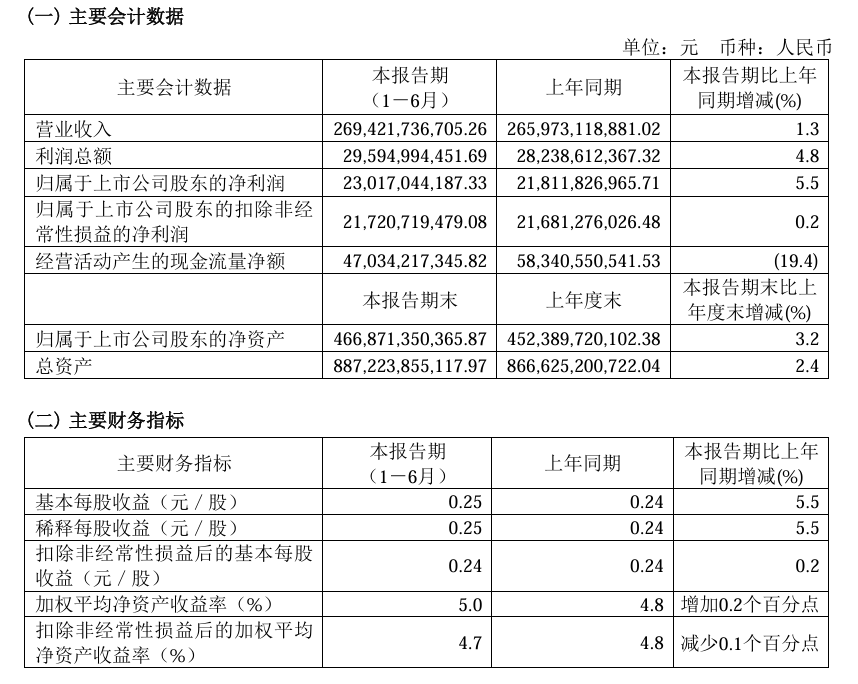
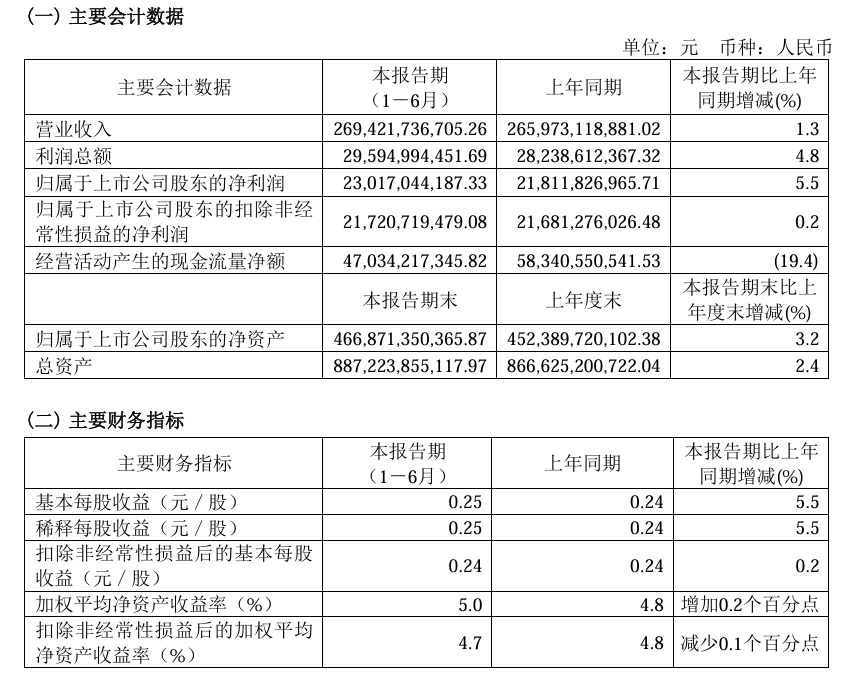
Core Viewpoint - China Telecom reported its financial results for the first half of 2025, showing modest growth in revenue and net profit, while emphasizing shareholder returns through increased dividends [3][5]. Financial Performance - The company achieved operating revenue of RMB 269.42 billion, a year-on-year increase of 1.3% [3][4]. - Net profit attributable to shareholders reached RMB 23.02 billion, reflecting a growth of 5.5% compared to the previous year [3][4]. - Total assets increased by 2.4% to RMB 887.22 billion, while net assets attributable to shareholders rose by 3.2% to RMB 466.87 billion [4]. Shareholder Returns - The board decided to distribute a mid-term dividend of RMB 0.1812 per share (including tax), which represents 72% of the profit attributable to shareholders for the first half of the year, marking an 8.4% increase from the previous year [5]. User Growth - As of Q2 2025, China Telecom had approximately 433 million mobile users, with 282 million being 5G users, reflecting a net increase of 15.81 million users in the quarter [6][7]. - The company also reported a total of 198.6 million broadband users, with a net increase of 490,000 users in the same period [7]. Industry Context - Competitors China Unicom and China Mobile also released their half-year results, with China Unicom reporting a revenue of RMB 200.20 billion and China Mobile reporting RMB 543.80 billion [8][9]. - China Unicom's net profit was RMB 63.49 billion, while China Mobile's net profit reached RMB 842 billion, both showing positive growth [8][9].
三大运营商2025上半年日赚6.27亿元
Xin Lang Ke Ji· 2025-08-14 09:28
【#三大运营商日赚6.27亿元#】#中国电信上半年日赚1.27亿元# 今日下午,#中国电信发布2025上半年 业绩#,截止目前,三大运营商均已发布上半年业绩报告。根据报告,中国移动上半年净利润842亿元, 中国联通上半年净利润63.49亿元,中国电信上半年净利润230.17亿元,以2025年上半年181天计算,三 大运营商上半年日赚6.2744亿元。 ...

TMT行业月报:三大运营商加强AI布局,算力需求驱动下国产服务器占比持续提高-20250814
HONGTA SECURITIES· 2025-08-14 08:37
Investment Rating - The industry investment rating is "Outperform the Market" [1][43] Core Insights - The report highlights a continuous growth trend in the market, with the Shanghai Composite Index rising by 3.54% in July 2025, while the communication sector increased by 10.7% and the computer sector by 3.86% [5][12] - The AI industry is experiencing significant growth, with the scale of China's AI industry expected to exceed 700 billion yuan in 2024, maintaining a growth rate of over 20% [23] - The demand for AI computing power is surging, driven by the widespread adoption of AI applications, which is expected to sustain high market activity in China's AI computing sector [5][12] Summary by Sections Market Review - From July 1 to July 31, 2025, the communication sector saw a notable increase, with Nvidia receiving U.S. government approval to resume sales of its "special version" H20 chips to China [5][12] - The report indicates that the top ten domestic telecom server manufacturers include ZTE, Inspur, and others, with ZTE holding a market share of 20.51% [37][40] Communication Industry - The domestic telecom business revenue reached 162.95 billion yuan in June 2025, reflecting a year-on-year growth of 4.86% [15][17] - The three major telecom operators are enhancing their AI capabilities, with significant investments in AI models and intelligent agents [6][23][29] Computer Industry - The domestic software industry reported revenues of 1,479.6 billion yuan in June 2025, marking a year-on-year increase of 13.53% [30] - The report notes that the domestic server market is expected to grow rapidly over the next three years, driven by increasing demand for domestic servers and technological innovation [7][40]
中国联通(600050):高科技成长,高股息回报
Yin He Zheng Quan· 2025-08-14 07:01
Investment Rating - The report maintains a "Recommended" rating for China Unicom [3] Core Viewpoints - The integration of AI+ is expected to bring new growth momentum, driving long-term high-quality development and providing high dividend returns to shareholders [2] Financial Performance Summary - For the first half of 2025, China Unicom achieved total revenue of 200.202 billion yuan, a year-on-year increase of 1.45%, and a net profit attributable to shareholders of 6.349 billion yuan, up 5.1%. The net profit after deducting non-recurring items reached 5.580 billion yuan, reflecting a growth of 10.3% [5] - In Q2 2025 alone, the company reported total revenue of 96.849 billion yuan, with a net profit of 3.743 billion yuan, representing a quarter-on-quarter increase of 43.63% [5] Business Segment Performance - The traditional connectivity business generated revenue of 131.9 billion yuan, accounting for 65.9% of total revenue, with over 11 million new mobile and broadband users and 330 cities utilizing 5G-A commercial services [5] - The smart network business segment reported revenue of 45.4 billion yuan, contributing 26% to total revenue, indicating a further increase compared to the previous year [5] Capital Expenditure and Future Outlook - The company plans to invest 55 billion yuan in capital expenditures for 2025, focusing on enhancing intelligent computing power and network capacity [5] - The projected net profit for 2025-2027 is estimated at 9.734 billion yuan, 10.599 billion yuan, and 11.551 billion yuan respectively, with corresponding EPS of 0.31 yuan, 0.34 yuan, and 0.37 yuan [6]
华泰证券今日早参-20250814
HTSC· 2025-08-14 03:10
Group 1: Macro and Financial Data Insights - In July, the growth of M1 and M2 exceeded market expectations, with M2 expanding by 8.8% year-on-year and M1 growing by 5.6%, up from 8.3% and 4.6% in June respectively [2][3] - New social financing in July was 1.16 trillion yuan, lower than the Bloomberg consensus of 1.63 trillion yuan, while new RMB loans decreased by 500 million yuan, indicating a shift in financing structure and seasonal factors [2][3] - The stock of social financing grew at a rate of 9.0% year-on-year, an increase from 8.9% in June, with seasonally adjusted month-on-month growth rising from 8.4% to 9.6% [2][3] Group 2: Banking Sector Analysis - The July social financing increment of 1.16 trillion yuan was below the expected 1.41 trillion yuan, with a year-on-year increase of 389.3 billion yuan [5] - The government bonds were the main support for social financing in July, while M1 growth showed a marginal recovery [5] - A new consumption loan subsidy policy is expected to stimulate the growth of consumer loans, indicating a positive outlook for the banking sector [5] Group 3: Company-Specific Insights - Tencent's Q2 revenue grew by 14.5% year-on-year, exceeding consensus expectations, with significant growth in value-added services, advertising, and fintech revenues [11] - The company is expected to benefit from the upcoming launch of several major shooting games, which could drive both player engagement and monetization [11] - Huatai Securities initiated coverage on Yuntianhua with a "buy" rating, citing its leading position in the phosphate industry and expected steady demand growth for fertilizers [15] Group 4: Technology and Robotics - The introduction of teaching-free robots is transforming the welding industry, addressing labor shortages and improving efficiency through advanced visual systems and welding software [7] - These robots are expected to penetrate more complex applications, such as shipbuilding, as technology continues to evolve [7] Group 5: Consumer and E-commerce Trends - SEA's Q2 revenue reached $5.26 billion, a 38.2% year-on-year increase, driven by strong performance in e-commerce and digital financial services [29] - The company anticipates continued growth in its e-commerce GMV, projecting a 25% year-on-year increase for Q3 [29] - Tencent Music's Q2 revenue was 8.44 billion yuan, up 17.9% year-on-year, benefiting from rapid growth in super memberships and strong performance in non-subscription services [27]



跟踪指数年内涨超20%,港股通央企红利ETF天弘(159281)即将结募,机构:港股红利资产股息溢价长期更高
2 1 Shi Ji Jing Ji Bao Dao· 2025-08-14 02:47
Core Viewpoint - The Hong Kong stock market is experiencing active performance in dividend-related concepts, with the Hong Kong Stock Connect Central Enterprise Dividend Index showing a year-to-date increase of 20.17% as of August 13 [1][2]. Group 1: Index and ETF Performance - The Hong Kong Stock Connect Central Enterprise Dividend Index (931233) has risen by 0.66% as of the latest report, with significant contributors including New China Life Insurance and China Overseas Grand Oceans Group [1]. - The Hong Kong Stock Connect Central Enterprise Dividend ETF Tianhong (159281) is currently being issued, with a management fee of 0.5% and a custody fee of 0.1% [1][2]. Group 2: Investment Value of the Index - The index reflects stable dividend levels and high dividend yields from centrally controlled enterprises, making it a favorable investment option within the Hong Kong Stock Connect framework [2]. - The investment value of the index is supported by four main factors: 1. High dividend assets are more attractive in a weak recovery market due to stable cash flows [2]. 2. Central enterprises are increasingly focusing on market performance and dividend expectations as part of their value management [2]. 3. The Hong Kong market has a higher emphasis on dividends compared to the A-share market, with significant differences in dividend ratios and yields [3]. 4. The long-term effectiveness of dividend investment strategies in the Chinese market is supported by historical data showing a 10% annualized return over the past decade [3]. Group 3: Market Comparisons - The Hang Seng Index's dividend yield is currently higher than that of the Shanghai Composite Index, with the Hang Seng High Dividend Yield Index at 6% compared to the 4.6% of the A-share market [3]. - The long-term dividend yield premium of Hong Kong dividend assets over long-term government bonds has remained positive since 2019, indicating a stronger performance compared to A-shares [3].