CNRE(600111)

Search documents
有色金属行业12月19日资金流向日报
Zheng Quan Shi Bao Wang· 2025-12-19 09:51
Market Overview - The Shanghai Composite Index rose by 0.36% on December 19, with 28 out of the 31 sectors experiencing gains, led by retail and comprehensive sectors, which increased by 3.66% and 2.22% respectively [1] - The non-ferrous metals sector saw an increase of 1.92% [1] - The banking, electronics, and coal sectors were the biggest losers, with declines of 0.44%, 0.29%, and 0.29% respectively [1] Capital Flow Analysis - The net inflow of capital in the two markets was 7.025 billion yuan, with 18 sectors experiencing net inflows [1] - The machinery equipment sector had the highest net inflow, totaling 3.884 billion yuan, with a daily increase of 1.18% [1] - The automotive sector also performed well, with a daily increase of 1.47% and a net inflow of 3.517 billion yuan [1] Non-Ferrous Metals Sector Performance - The non-ferrous metals sector had a net capital inflow of 3.102 billion yuan, with 116 out of 138 stocks in the sector rising [2] - Notable stocks with significant net inflows included Ganfeng Lithium, which saw an inflow of 637 million yuan, followed by Northern Rare Earth and Huayou Cobalt with inflows of 435 million yuan and 379 million yuan respectively [2] - The sector also had 20 stocks that declined, with five stocks experiencing outflows exceeding 50 million yuan, led by Sree New Materials, China Uranium, and Xingye Silver Tin [2][3] Non-Ferrous Metals Capital Inflow and Outflow Rankings - The top inflow stocks in the non-ferrous metals sector included: - Ganfeng Lithium: +2.70%, 6.18% turnover, 637.44 million yuan inflow - Northern Rare Earth: +3.15%, 2.25% turnover, 435.02 million yuan inflow - Huayou Cobalt: +3.22%, 4.22% turnover, 379.12 million yuan inflow [2] - The top outflow stocks included: - Sree New Materials: +1.34%, 7.28% turnover, -161.26 million yuan outflow - China Uranium: +0.22%, 16.92% turnover, -134.66 million yuan outflow - Xingye Silver Tin: +1.58%, 2.84% turnover, -108.09 million yuan outflow [3]



ETF盘中资讯|商务部表态!稀土出口破冰!北方稀土涨超1%,有色ETF华宝(159876)早盘拉升翻红!
Sou Hu Cai Jing· 2025-12-19 03:01
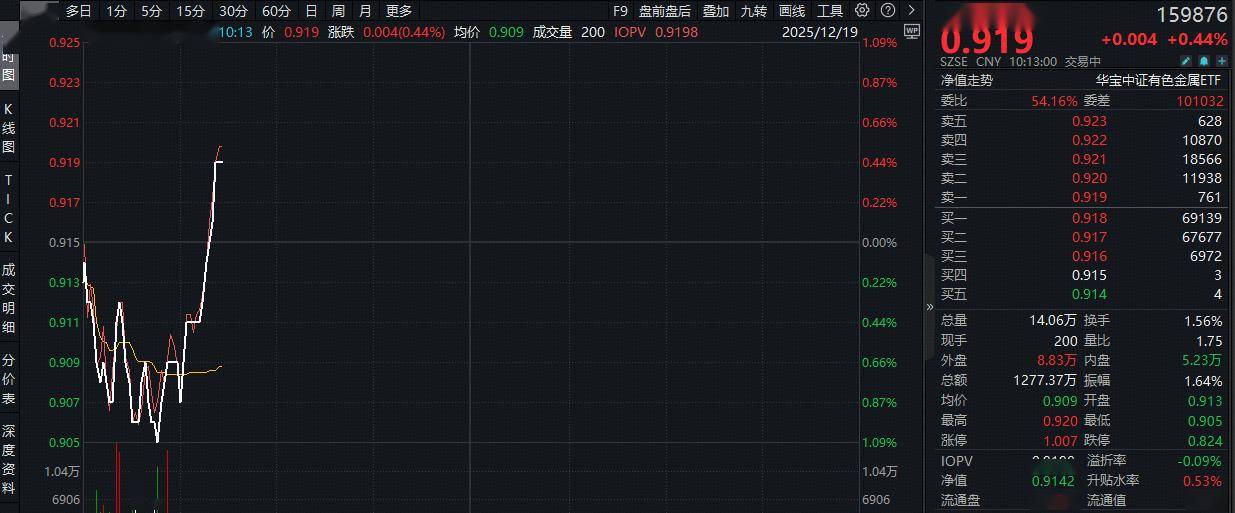
今日(12月19日)早盘,有色金属板块从水面下强势拉升翻红,同标的指数规模最大的有色ETF华宝(159876)场内价格现涨0.44%,当前站在所有均线上 方。 成份股方面,西部超导涨超3%,立中集团、楚江新材涨逾2%,天山铝业、盛和资源、中国稀土等个股跟涨。权重股方面,中国铝业、北方稀土涨超1%, 紫金矿业、洛阳钼业飘红。 | 15分 30分 60分 日 周 月 更多 | 多日 1分 5分 | F9 盘前盘后 叠加 九转 画线 工具 ♡ ② | 17 | 10:13 价 0.919 涨跌 0.004(0.44%) 均价 0.909 成交量 200 IOPV 0.9198 | 2025/12/19 | WE | | | --- | --- | --- | --- | --- | --- | --- | --- | | .09% | 0.925 | 四号 | 10:13:00 交易中 | SZSE CNY | | | | | 降值走势 | 0.923 | 0.87% | 54.16% 중 | 整次 | 又找图 | | | | 英 | 0.92 | 0.921 | 0.66% | 題 死 年 是 是 死 | 0.9 ...

商务部表态!稀土出口破冰!北方稀土涨超1%,有色ETF华宝(159876)早盘拉升翻红!
Xin Lang Cai Jing· 2025-12-19 02:28
今日(12月19日)早盘,有色金属板块从水面下强势拉升翻红,同标的指数规模最大的有色ETF华宝 (159876)场内价格现涨0.44%,当前站在所有均线上方。 成份股方面,西部超导涨超3%,立中集团、楚江新材涨逾2%,天山铝业、盛和资源、中国稀土等个股 跟涨。权重股方面,中国铝业、北方稀土涨超1%,紫金矿业、洛阳钼业飘红。 消息面上,商务部新闻发言人表态,目前已收到并批准了部分中国出口商提交的通用许可申请。对于民 用、合规的稀土出口申请,将得到中国政府的及时批准,全球供应链的紧张情绪有望得到缓解。 业内人士指出,商务部关于稀土出口管制的表态,对稀土板块形成四重核心利好: 1、审批效率提升:从"逐笔审批"到"通用许可",出口流程大幅简化,订单执行效率提升; 2、行业集中度提升:通用许可优先向合规龙头倾斜,头部效应强化,加速淘汰不合规中小企业; 3、价格中枢上移:管制政策强化供给刚性,同时通用许可保障合规需求释放,供需格局优化推动价格 稳步上涨; 4、战略价值重估:军民两用属性凸显,出口管制提升资源话语权,全球产业链地位巩固。 展望有色金属板块后市,中信建投证券认为,在四季度全球宏观经济波动加剧与地缘局势冲突升级 ...
小金属及新材料行业2026年度投资策略(有色板块成长篇):小金属供给收紧筑底,AI金属需求高增空间广
Western Securities· 2025-12-18 07:16
Core Conclusions - The small metal sector is expected to benefit from the rising demand in the AI industry, presenting new investment opportunities [6] - The report maintains an "overweight" rating for the small metal sector, indicating a positive outlook for the industry [7] Industry Overview - The small metal sector significantly outperformed the market in 2025, with an annual cumulative return of 83.54%, surpassing the cumulative return of the Shenwan Nonferrous Metals Index (82.05%) and the CSI 300 Index (20%) [10][13] - The rare earth sector is projected to maintain an upward trend in 2026 due to strong demand recovery and supply-side policy constraints, indicating that the industry cycle is not yet over [10] - The tungsten market is entering a new price cycle driven by supply constraints and emerging demand, suggesting a strategic value for investors [10] - The antimony market is experiencing a new phase characterized by supply rigidities and policy relaxations, with potential price increases anticipated in 2026 [10] - The tin market is also entering a new phase with supply constraints and demand upgrades, indicating a resilient supply-demand balance [10] - The demand for new metal materials is expected to grow alongside the rapid development of the AI industry, particularly for permanent magnetic materials and high-end copper alloys [10] Investment Recommendations - Recommended stocks in the rare earth sector include Northern Rare Earth, Zhenghai Magnetic Materials, and Jinli Permanent Magnet, with a focus on China Rare Earth and Shenghe Resources [6] - For tungsten, attention is drawn to Zhongtung High-tech and Xiamen Tungsten [6] - In the antimony sector, recommended stocks include Huayu Mining, Huaxi Nonferrous, and Hunan Gold [6] - For tin, focus on Tin Industry Co. and Huaxi Nonferrous [6] - In the new materials sector, recommended stocks include Bowei Alloy and Srey New Materials [6] Supply and Demand Dynamics - The rare earth industry is experiencing a strong price increase driven by supply-side constraints and a recovery in export demand, with the price of praseodymium-neodymium oxide increasing by 45.49% in 2025 [31] - The global rare earth production is expected to grow moderately, with China's production leading the market, indicating a dominant position in both production and reserves [41] - Domestic supply indicators for light rare earths are showing a significant slowdown in growth, with the supply structure increasingly dominated by major players [48]



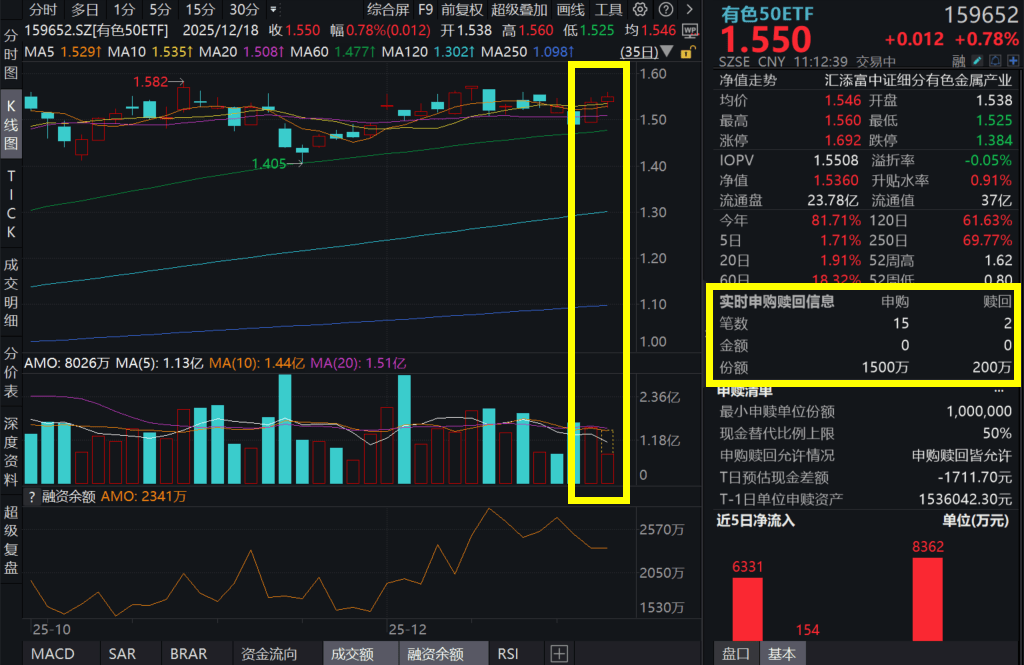
碳酸锂期货续涨超2%!华友钴业涨超4%,获8万吨“超级订单”!有色50ETF(159652)冲击两连阳,盘中强势吸金超2000万!金、铜后市怎么看?
Sou Hu Cai Jing· 2025-12-18 03:52
Core Viewpoint - The A-share market is experiencing an upward trend, particularly in the non-ferrous metals sector, driven by significant capital inflows and positive price dynamics in the sector [1][3]. Group 1: Market Performance - The non-ferrous 50 ETF (159652) saw a slight increase of 0.78%, aiming for a second consecutive day of gains, with over 20 million yuan in capital inflow during the trading session [1]. - Over the past five days, the non-ferrous 50 ETF attracted more than 120 million yuan in investments, indicating strong market interest [1]. Group 2: Key Stocks and Announcements - Major stocks within the non-ferrous 50 ETF index experienced gains, with Huayou Cobalt rising over 4% and Shandong Gold increasing by over 2%, influenced by an 80,000-ton "super order" [3][5]. - Huayou Cobalt announced a binding memorandum with a well-known international client to supply a total of 79,600 tons of ternary precursor products [5]. - Luoyang Molybdenum announced plans to acquire 100% equity in EQX's LatAm and Luna Gold Corp. for approximately 10.15 billion USD, equivalent to over 7.1 billion yuan [5]. Group 3: Industry Trends - Lithium carbonate futures surged again, following a previous increase of 7%, reflecting ongoing bullish sentiment in the market [6]. - The Jiangxi Yichun Natural Resources Bureau plans to revoke 27 mining rights, which could tighten lithium supply and support domestic lithium carbonate prices [8]. - The non-ferrous metals sector is seen as crucial for economic recovery and technological advancements, with copper being highlighted as a key indicator of economic health [9]. Group 4: Investment Opportunities - The non-ferrous 50 ETF (159652) is positioned to benefit from a super cycle in non-ferrous metals, covering a wide range of metals including gold, copper, aluminum, lithium, and rare earths [24][26]. - The ETF has a leading concentration of "gold and copper content," with copper accounting for 31% and gold for 14% of its index [26]. - The index has shown a cumulative return of 86.28% since 2022, driven by earnings rather than valuation expansion, indicating a favorable investment environment [28].



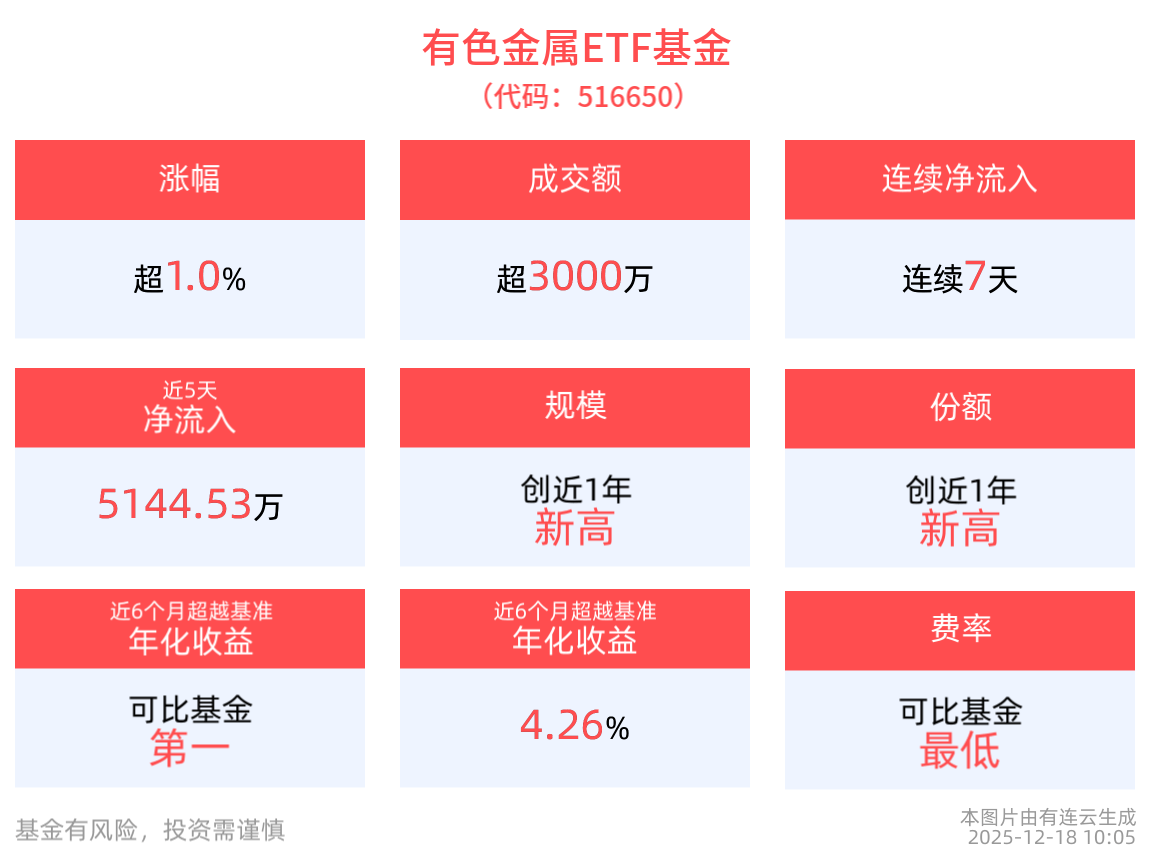
份额规模均创新高,有色金属ETF基金(516650)连续7天吸金1.44亿
Sou Hu Cai Jing· 2025-12-18 02:35
Core Insights - The recent rise in precious metals, including gold, silver, and copper, has positively impacted various ETFs, particularly the gold and non-ferrous metal ETFs [2] - The non-ferrous metal ETF (516650) has seen a continuous inflow of funds over the past week, totaling 144 million yuan, reaching a record high in both share count and total assets [2] - The ETF closely tracks the CSI sub-index for the non-ferrous metal industry, with the top ten weighted stocks accounting for 52.65% of the index [2] ETF Performance - The gold ETF (518850) increased by 0.13%, while the gold stock ETF (159562) rose by 0.46% [2] - The non-ferrous metal ETF (516650) experienced a 1.09% increase, with notable stock performances including Huaxi Nonferrous (7.01% increase) and Chihong Zinc & Germanium (5.04% increase) [2] - The latest share count for the non-ferrous metal ETF reached 1.391 billion, with a total asset size of 2.417 billion yuan [2] Top Holdings - The top ten weighted stocks in the non-ferrous metal ETF include Zijin Mining, Luoyang Molybdenum, Northern Rare Earth, Huayou Cobalt, and China Aluminum, among others [2] - These stocks are significant contributors to the ETF's performance, reflecting the overall strength of the non-ferrous metal sector [2]



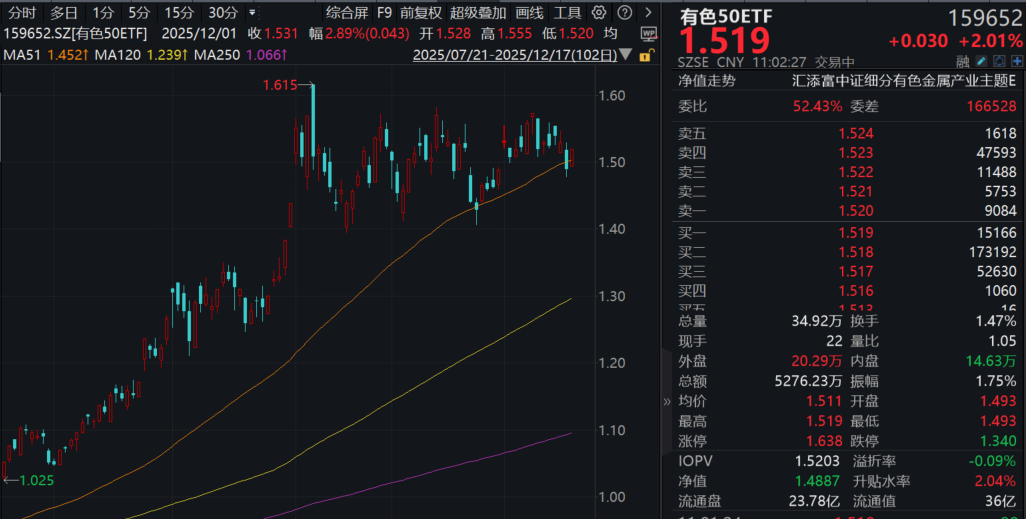
白银、碳酸锂暴涨!赣锋锂业涨超4%,有色50ETF(159652)涨超2%!“亚洲锂都”宜春或收紧采矿!金银铜锂为何齐涨,两大维度解读
Xin Lang Cai Jing· 2025-12-17 03:48
Group 1 - The A-share market experienced fluctuations on December 17, with the non-ferrous sector showing strong performance, particularly the Non-ferrous 50 ETF (159652), which rose over 2% in early trading and attracted over 830 million yuan in net subscriptions in the previous day [1] - The Non-ferrous 50 ETF has seen net subscriptions exceeding 650 million yuan over the past 20 trading days, with its latest scale surpassing 3.5 billion yuan, indicating a strong market interest [1] - Key stocks within the Non-ferrous 50 ETF, such as Tianqi Lithium and Ganfeng Lithium, saw significant gains, with Tianqi Lithium rising over 5% and Ganfeng Lithium over 4% [1] Group 2 - Lithium carbonate futures surged over 8% on December 17, reaching a new high since June 2024, with a cumulative increase of over 37% this year [3] - The Yichun city government plans to revoke mining licenses for 27 mining sites, including the Wuqiao ceramic stone mine, indicating regulatory actions impacting lithium supply [3] Group 3 - The current market dynamics for copper show a slight increase of 0.79% in LME copper prices, with expectations of a 10% reduction in copper smelting capacity to address negative processing fee trends [6] - The copper supply-demand gap is projected to widen, with increasing demand driven by traditional sectors and emerging technologies like AI, which is expected to significantly boost copper demand [16] Group 4 - The precious metals market is witnessing historical highs, with silver prices surpassing $65 per ounce and gold prices reaching over $4,320 per ounce, driven by strong investment demand and low inventory levels [5] - The financial attributes of gold, silver, and copper are expected to strengthen amid global inflation expectations and concerns over the US dollar's credit risk, making them attractive for investors seeking to hedge against uncertainty [12] Group 5 - The Non-ferrous 50 ETF (159652) is positioned to benefit from a super cycle in non-ferrous metals, covering a wide range of metals including gold, copper, aluminum, lithium, and rare earths, with a focus on strategic assets [26] - The ETF's composition shows a leading concentration in gold and copper, with copper accounting for 31% and gold for 14%, indicating a strong alignment with market trends [28]
供需结构支撑强劲,机构看好行业景气,有色ETF基金(159880)盘中净申购700万份
Sou Hu Cai Jing· 2025-12-16 07:04
Core Viewpoint - The non-ferrous metals industry is expected to enter a new upward cycle, driven by macroeconomic recovery, supply chain disruptions, and liquidity easing from the Federal Reserve's interest rate cuts, which will enhance metal prices and industry performance [1]. Group 1: Market Performance - As of December 16, 2025, the non-ferrous metals industry index (399395) showed mixed performance among its constituent stocks, with Zhongtung High-tech (000657) leading the gains at 3.05%, followed by Yahua Group (002497) at 2.25%, and Xiamen Tungsten (600549) at 0.59% [1]. - The overall market is experiencing a pullback, but funds are strategically positioning in the non-ferrous sector [1]. Group 2: Future Outlook - According to China Galaxy Securities, the industry is expected to stabilize in 2024, with macroeconomic expectations improving in 2025, alongside supply chain disruptions due to resource control policies in other countries [1]. - The anticipated liquidity easing from the Federal Reserve's rate cuts is expected to drive up non-ferrous metal prices and enhance the profitability of non-ferrous metal companies, continuing the upward trend in the industry [1]. - The narrative around copper supply remains positive, and cobalt prices are expected to rise under policy adjustments in the Democratic Republic of Congo [1]. - The strategic value of rare earths is increasing, with a favorable supply-demand balance [1]. Group 3: ETF and Index Information - The non-ferrous ETF (159880) closely tracks the non-ferrous metals industry index, which includes 50 prominent securities in the sector, reflecting the overall performance of listed companies in the non-ferrous metals industry [2]. - As of November 28, 2025, the top ten weighted stocks in the non-ferrous metals industry index accounted for 52.34% of the index, including companies like Zijin Mining (601899) and China Aluminum (601600) [2].


上海证券交易所:上汽集团、北方稀土、华电新能、中科曙光调入上证50指数样本
Ge Long Hui· 2025-12-16 04:02
格隆汇12月16日|根据上海证券交易所此前公告,上证50指数更换4只样本,其中,上汽集团、北方稀 土、华电新能、中科曙光调入上证50指数样本。上汽集团方面认为这一调整不仅印证了公司在市值规 模、市场流动性等核心指标上的实力,更标志着其全面深化改革与创新转型成效获得资本市场高度认 可。 ...



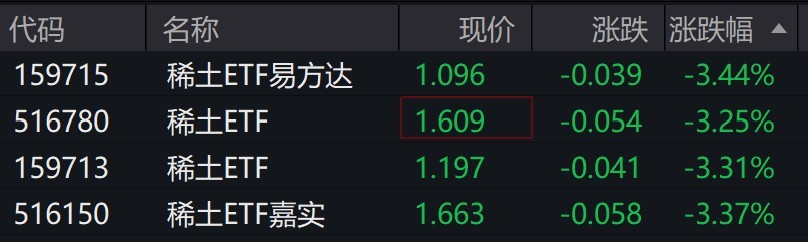
稀土概念股早盘走弱,稀土相关ETF跌超3%
Mei Ri Jing Ji Xin Wen· 2025-12-16 03:40
Core Viewpoint - Rare earth concept stocks weakened in early trading, with significant declines observed in companies such as Jin Feng Technology, China Rare Earth, and Northern Rare Earth, alongside a drop in related ETFs [1][2]. Group 1: Stock Performance - Jin Feng Technology fell over 6%, China Rare Earth dropped over 4%, and both Northern Rare Earth and Wolong Electric Drive decreased by more than 3% [1]. - Rare earth-related ETFs experienced a decline of over 3% [1]. Group 2: Market Analysis - Analysts indicate that rare earths, as core resources for high-end manufacturing and strategic emerging industries, are showing a resonant pattern on both supply and demand sides [2]. - The strategic position of the rare earth industry chain is expected to further solidify, providing long-term driving force for high-end manufacturing development due to increased supply concentration and upgraded demand structure [2].