FOTON(600166)

Search documents
商用车板块1月5日涨1.07%,宇通客车领涨,主力资金净流出2.25亿元
Zheng Xing Xing Ye Ri Bao· 2026-01-05 08:59
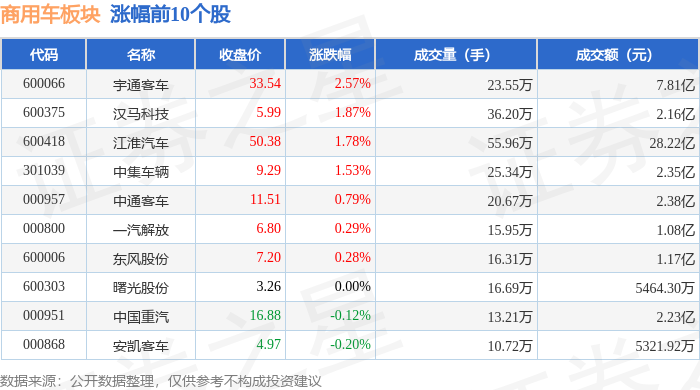
Group 1 - The commercial vehicle sector increased by 1.07% on January 5, with Yutong Bus leading the gains [1] - The Shanghai Composite Index closed at 4023.42, up 1.38%, while the Shenzhen Component Index closed at 13828.63, up 2.24% [1] - Key stocks in the commercial vehicle sector showed varied performance, with notable increases in stocks like Zhitong Bus (up 2.57%) and Hanma Technology (up 1.87%) [1] Group 2 - The commercial vehicle sector experienced a net outflow of 225 million yuan from institutional investors, while retail investors saw a net inflow of 158 million yuan [3][4] - Individual stock performances varied, with King Long Automobile seeing a significant net outflow from institutional investors of 38.81 million yuan [4] - The overall trading volume for the commercial vehicle sector was substantial, with Jianghuai Automobile recording a trading volume of 559,600 shares and a transaction value of 2.82 billion yuan [1]



12月新能源牵引车销近3万辆大涨195%!徐工第一,解放/三一/陕汽/重汽超3000辆 | 头条
第一商用车网· 2026-01-05 06:58
Core Viewpoint - In December 2025, the sales of new energy tractors in China reached a record high of 28,600 units, marking a year-on-year increase of 195% and a month-on-month increase of 45% [3][20]. Group 1: Market Performance - The total sales of new energy heavy trucks in December 2025 reached 34,500 units, representing a year-on-year increase of 191% [1]. - The new energy tractor market achieved a monthly sales record with a total of 28,600 units sold in December, which is approximately 2.95 times the sales of December 2024 [3][20]. - The year 2025 saw a cumulative sales figure of 158,300 units for new energy tractors, reflecting a year-on-year growth of 223% [12]. Group 2: Regional Insights - In December 2025, all 30 provincial-level administrative regions in China reported new sales of new energy tractors, with 26 regions adding over 100 units each [4]. - Shanghai led the sales with over 7,000 new energy tractors sold in December, followed by Shanxi with nearly 4,000 units [4][6]. Group 3: Company Performance - In December 2025, 12 companies sold over 100 new energy tractors, with 9 companies exceeding 1,000 units. XCMG topped the list with 4,222 units sold [8][9]. - The top three companies in cumulative sales for 2025 were Jiefang (25,400 units), XCMG (24,900 units), and SANY (22,200 units), all exceeding 20,000 units [12][14]. - The market share of the top five companies in 2025 was over 10%, with Jiefang at 16.0%, XCMG at 15.7%, and SANY at 14.1% [18].






北汽集团、地平线机器人成立智驭科技公司
Zheng Quan Shi Bao Wang· 2026-01-05 06:31
Core Viewpoint - Beijing Zhiyu Technology Co., Ltd. has been established, focusing on artificial intelligence applications and automotive components [1] Group 1: Company Overview - The legal representative of Beijing Zhiyu Technology Co., Ltd. is Wang Lei [1] - The company's business scope includes the development of artificial intelligence application software, basic software, smart vehicle equipment manufacturing, and wholesale and retail of automotive parts [1] Group 2: Ownership Structure - The company is jointly held by Beijing Automotive Group Co., Ltd.'s wholly-owned subsidiary, Beijing Automotive Research Institute Co., Ltd., and Beijing Horizon Robotics Technology Research and Development Co., Ltd. [1]

福田汽车跌2.05%,成交额1.49亿元,主力资金净流出1247.80万元
Xin Lang Cai Jing· 2026-01-05 02:35
Group 1 - The core viewpoint of the news is that Foton Motor's stock has experienced fluctuations, with a recent decline of 2.05% and a total market capitalization of 22.644 billion yuan [1] - As of November 20, Foton Motor had 120,100 shareholders, with an average of 65,908 circulating shares per person, indicating stable shareholder numbers [2] - For the period from January to September 2025, Foton Motor achieved operating revenue of 45.449 billion yuan, representing a year-on-year growth of 27.09%, and a net profit attributable to shareholders of 1.113 billion yuan, up 157.45% year-on-year [2] Group 2 - Foton Motor has cumulatively distributed 2.441 billion yuan in dividends since its A-share listing, with no dividends distributed in the past three years [3] - As of September 30, 2025, the top ten circulating shareholders included Hong Kong Central Clearing Limited, holding 160 million shares, a decrease of 41.5019 million shares from the previous period [3] - The company operates in the automotive industry, specifically in commercial vehicles, with its main business segments including light vehicles, overseas sales, management and R&D, engines, and buses [1]
芜湖:全国50强,中部非省会城市第1位!
Sou Hu Cai Jing· 2026-01-04 09:12
近日,大江资讯记者从芜湖商务经济发展情况新闻发布会上获悉,2025年1-11月,全市进出口额1712.6亿元、同比增长28.3%,总量、增速分别居全省第2 位、第1位;实际到位外资23.2亿元、同比增长15.8%;实际对外投资9.66亿美元,总量居全省第1位。 开放能级持续提升,以高水平开放促进高质量发展。我市坚持提升开放发展能级,持续扩大开放通道、建强开放平台、优化发展环境,以高水平开放促进 高质量发展。"十四五"期间,芜湖口岸开放不断扩大,芜宣机场获批临时开放货运功能,我市成为全省唯一兼具水运、航空开放功能的城市。芜湖港口岸 扩大开放三山港区通过国家验收,并实现国际船舶首航;朱家桥港区扩大开放获国务院批复并通过省级验收,争取2026年上半年通过国家验收。 不断优化开放平台,芜湖综合保税区成功落地全国首单汽车变速箱保税维修业务、全省首笔综保区货物质押融资业务。芜湖港朱家桥外贸综合物流园区一 期项目等一批重点项目相继完工。芜湖港获批国家智慧口岸建设试点,是全省唯一获批的水运口岸。 2025年,我市组织开展徽动消费·金秋购物季等640余场促消费活动,发放消费券3.4亿元,带动消费超60亿元。消费品以旧换新累计交 ...

主机厂品牌反超第三方!电机榜:汇川第一还能守多久?
Xin Lang Cai Jing· 2026-01-04 01:29
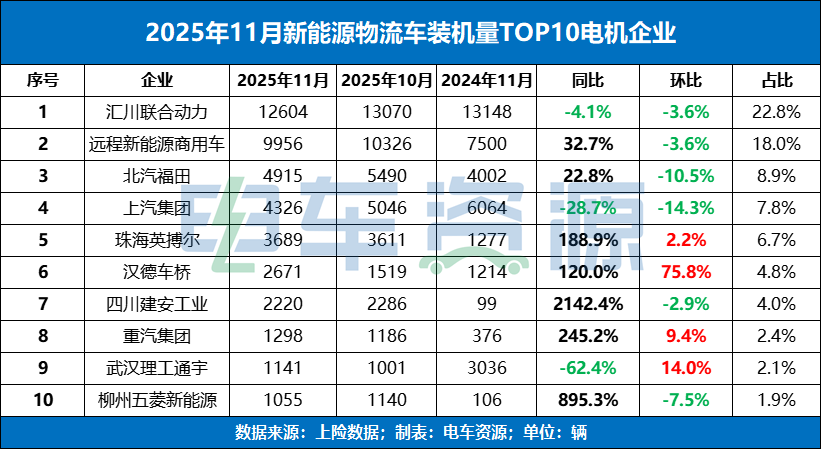
Core Insights - The electric motor market for new energy logistics vehicles is undergoing a significant transformation, with the market share of OEM (Original Equipment Manufacturer) brands surpassing that of third-party brands for the first time [1][10] Group 1: Market Dynamics - From January to November 2025, the market structure has shifted, with OEM brands capturing 40.2% of the market share, while third-party brands dropped to 39.5% [4][12] - The top three companies in terms of installed electric motors in November 2025 are Huichuan United Power, Remote New Energy Commercial Vehicles, and Beiqi Foton, with respective shares of 22.8%, 18.0%, and 8.9% [2][11] - The overall installed capacity in November 2025 saw a decline compared to previous months, indicating volatility influenced by vehicle sales [1][10] Group 2: Company Performance - Huichuan United Power remains the leader in installed capacity with 123,017 units, despite a year-on-year decline of 7.7% [3][13] - Remote New Energy Commercial Vehicles and Beiqi Foton have shown impressive growth rates of 66.3% and 125.8% respectively, highlighting the strong performance of OEM brands [3][12] - Third-party brands like Wuhan University of Technology have experienced a significant decline, with a year-on-year drop of 46.8% [3][12] Group 3: Competitive Advantages - The growth of OEM brands is attributed to their ability to adapt technology to meet the increasing demands for long-range and heavy-load capabilities in the logistics sector [8][17] - OEMs benefit from vertical integration of the supply chain, allowing for collaborative development of the electric motor, battery, and control systems, which enhances performance and reduces costs [9][18] - Policy support and market positioning have enabled OEMs to quickly launch models equipped with self-developed motors, giving them a competitive edge over third-party brands [9][18] Group 4: Future Outlook - The market concentration in the electric motor sector is expected to increase, with OEM brands likely to maintain and expand their lead [10][18] - Third-party brands need to focus on technological innovation and deepen collaboration with OEMs to carve out competitive advantages in niche areas [10][18]


瞄准5万亿美元市场:跨界布局机器人,时代的新共识
3 6 Ke· 2026-01-04 00:26
Core Insights - The Chinese robotics industry is poised for significant growth by the end of 2025, with humanoid robots transitioning from experimental concepts to practical applications, achieving over 50% growth and indicating a trillion-yuan industry on the horizon [1] - The entry of major players from various sectors such as automotive, electronics, and the internet into the robotics field marks a shift from niche exploration to widespread competition, creating a unique trend of "cross-industry integration" [1] Group 1: Market Dynamics - In the first eight months of 2025, the primary market financing in the robotics sector reached 38.624 billion yuan, 1.8 times the total for 2024, highlighting the blue ocean effect attracting significant investment [2] - The global industrial robot sales are projected to reach 542,000 units in 2024, with China accounting for 295,000 units, representing 54% of the global market [2] - By 2025, the Chinese robotics market is expected to exceed 150 billion yuan, capturing 35% of the global market share, with predictions suggesting the market for embodied intelligence could reach 400 billion yuan by 2030 and over a trillion yuan by 2035 [2] Group 2: Industry Trends - At least 20 automotive companies have entered the humanoid robot market by the end of 2025, with notable developments including Chery's humanoid robot Mocha and BYD's production line for core robot components [3] - The automotive industry's supply chain overlaps significantly with robotics, with a 60% compatibility rate, driving car manufacturers to invest in robotics as they view vehicles as "mobile intelligent robots" [3] - Home appliance manufacturers are transitioning from traditional manufacturing to smart ecosystems, with companies like Midea establishing dedicated innovation centers for humanoid robots and developing comprehensive R&D systems [7] Group 3: Strategic Shifts - The automotive sector is seen as a key player in the transition to robotics, with companies like Geely planning to invest 5 billion yuan over three years to develop critical components and establish an ecosystem covering all robotics applications [6] - Internet giants are leveraging their technological and capital advantages to enter the robotics space, with ByteDance and Huawei making significant investments in developing advanced robotic models and systems [8] - The competition in the robotics sector is viewed as a strategic restructuring driven by technological advancements, with companies aiming to activate existing technological capabilities and build new ecosystems [9] Group 4: Challenges Ahead - Despite the enthusiasm for entering the robotics market, cross-industry players face challenges such as adapting core competencies to the robotics field, where technology paths are still being defined [10] - The high precision and stability required for industrial applications pose significant challenges for companies transitioning from other sectors, as they may struggle to meet the diverse demands of various operational environments [11] - Cost remains a critical issue, with companies like BYD and GAC aiming to reduce the production cost of humanoid robots to below 200,000 yuan, which requires overcoming substantial supply chain and process optimization challenges [11]



从这里读懂中国车企老大们的心思
汽车商业评论· 2026-01-03 23:04
Core Viewpoint - The Chinese automotive industry in 2025 is characterized by a focus on "progress" rather than just sales figures, emphasizing product quality and brand value enhancement [5][10][13]. Group 1: Sales and Market Position - BAIC Group announced that its self-owned brand sales have returned to over one million units after six years, highlighting a significant increase in the proportion of new energy vehicles [5]. - Changan Automobile reported that its new energy vehicle sales have surpassed one million units for the first time, marking the establishment of its three-brand matrix: Avita, Deep Blue, and Qiyuan, which target different market segments [7]. - Dongfeng Motor also achieved over one million new energy vehicle sales, with its self-owned brand accounting for over 60% of total sales, driven by strategic adjustments [10]. Group 2: Technological Advancements - The industry is focusing on technological breakthroughs, with companies like GAC and Dongfeng establishing solid-state battery pilot lines and achieving significant advancements in key components such as high-efficiency engines and hybrid transmission systems [13][15]. - Companies are enhancing their AI technology capabilities, with Geely and GAC developing comprehensive AI systems to improve vehicle decision-making and environmental understanding [14]. - The progress in autonomous driving is notable, with BAIC and Changan receiving the first L3 autonomous driving licenses in China, indicating a new phase in regulatory acceptance [15]. Group 3: Global Expansion and Collaboration - Chinese automakers are shifting from merely selling cars abroad to establishing roots in foreign markets, exemplified by Geely's technical cooperation with Renault in Brazil [16]. - Companies like CATL are making strides in overseas manufacturing, while Chery is focusing on cultural integration in international markets [17]. - The industry is moving towards collaborative efforts, with BAIC easing financial pressures on suppliers and GAC partnering with major tech firms to build a smart electric vehicle ecosystem [17][18]. Group 4: Internal Reforms and Strategic Focus - Automakers are undergoing significant internal reforms, transitioning from broad growth strategies to lean operations and collaborative efforts [26][30]. - GAC has relocated its headquarters to its manufacturing base to enhance operational efficiency, while BAIC is implementing top-down management strategies to improve marketing and quality [29][30]. - The focus is on building resilient and efficient systems rather than just increasing sales, with companies emphasizing user-centric approaches in product development [30][35]. Group 5: Future Outlook - The competition in the automotive industry is evolving from individual companies to ecosystems, where collaboration and strategic partnerships will determine success [20][24]. - The industry is at a critical juncture, with companies emphasizing the importance of strategic determination amidst changing external environments and user expectations [22][23]. - The long-term winners will be those who focus on core values and sustainable growth rather than opportunistic trends [24][35].



中国车畅销以色列市场
中国能源报· 2026-01-03 14:13
Core Insights - The Chery-produced Jietu 7 has become the best-selling model in Israel for 2025, with approximately 13,000 units sold [1] - The second best-selling model is the Hyundai Kona, with around 12,000 units sold [1] - Chinese automotive brands sold a total of 101,000 units in Israel in 2025, leading the market, while Korean brands sold 52,000 units and Japanese brands sold 41,000 units [1] - In the electric vehicle segment, Chinese brands hold a dominant market share of 79.2%, with total sales of 46,000 units [1]

以色列销量最高车型,来自中国
中国基金报· 2026-01-03 07:31
Group 1 - The core viewpoint of the article highlights that the Chery-produced Jetour 7 is projected to be the best-selling car model in Israel for 2025, with an estimated sales volume of approximately 13,000 units [2] - In 2025, Chinese automotive brands are expected to achieve total sales of 101,000 units in Israel, leading the market, while Korean brands are forecasted to sell 52,000 units, and Japanese brands 41,000 units [2] - In the electric vehicle sector, Chinese brands dominate with a market share of 79.2%, selling a total of 46,000 units throughout the year [2]