YANKUANG ENERGY(600188)

Search documents
——煤炭行业2025年年报业绩前瞻:下半年煤价及行业利润边际改善,煤价筑底、盈利回升可期
Shenwan Hongyuan Securities· 2026-01-23 11:54
Investment Rating - The report maintains a positive outlook on the coal industry, suggesting an "Overweight" rating, indicating that the industry is expected to outperform the overall market [22]. Core Insights - The coal industry is anticipated to see a recovery in prices and profits in the second half of 2025, driven by seasonal demand and improved market conditions [1]. - Domestic raw coal production is projected to grow slightly by 1.2% year-on-year in 2025, while coal imports are expected to decline by 9.6% [2][11]. - The fourth quarter of 2025 is expected to witness a significant rebound in both thermal coal and coking coal prices, with thermal coal prices rising approximately 13.9% quarter-on-quarter [2][15]. Summary by Sections Supply and Demand Dynamics - Domestic raw coal production for 2025 is estimated at 4.832 billion tons, reflecting a year-on-year increase of 1.2%. Monthly production figures for October, November, and December are projected at 407 million, 427 million, and 437 million tons, respectively, with slight declines in growth rates [5]. - Coal imports for 2025 are expected to total 490 million tons, a decrease of 9.6% compared to the previous year, with notable monthly fluctuations in the last quarter [11]. Price Trends - In Q4 2025, the average spot price for thermal coal at Qinhuangdao port is projected to be around 767 RMB/ton, down 6.99% year-on-year but up 13.9% from Q3 2025 [14][15]. - Coking coal prices are also expected to rise, with the average price for Shanxi's main coking coal reaching 1,727 RMB/ton, marking a 0.8% increase year-on-year and a 10.44% increase from Q3 2025 [15]. Company Performance Forecasts - Key companies in the coal sector are expected to report varying performance in Q4 2025. China Shenhua is projected to achieve a net profit of 14.129 billion RMB, a year-on-year increase of 12.16% [16]. - Other companies such as TBEA and Erdos are also expected to show significant profit growth, while companies like Shaanxi Coal and Energy may see declines due to price pressures [16]. Valuation Metrics - The report includes a valuation table for key coal companies, indicating their expected earnings per share (EPS) and price-to-earnings (PE) ratios for 2025 and beyond, providing insights into their market positioning [17].



煤炭行业2025年年报业绩前瞻:下半年煤价及行业利润边际改善,煤价筑底、盈利回升可期
Shenwan Hongyuan Securities· 2026-01-23 10:41
Investment Rating - The report maintains a positive outlook on the coal industry, indicating a "Look Forward" investment rating for 2025 [2]. Core Insights - The report highlights a slight increase in domestic raw coal production in 2025, with a year-on-year growth of 1.2%, reaching 4.832 billion tons. However, coal imports are expected to decline by 9.6% to 490 million tons [3][8]. - In Q4 2025, both thermal coal and coking coal prices are projected to rebound significantly, with thermal coal prices increasing by approximately 13.9% from Q3 2025 [3][20]. - Key companies in the coal sector are expected to show varied performance in Q4 2025, with some exceeding expectations, while others may fall short [3][21]. Summary by Sections Supply and Demand Dynamics - Domestic raw coal production growth is slowing, with a total output of 4.832 billion tons in 2025, reflecting a 1.2% increase from 2024. Monthly production figures for October, November, and December show slight declines [3][8]. - Coal imports are projected to decrease to 490 million tons in 2025, a 9.6% drop compared to the previous year, with significant monthly fluctuations noted in Q4 [15][16]. Price Trends - Q4 2025 sees a notable increase in both thermal and coking coal prices, with the average price of Qinhuangdao port's 5500 kcal thermal coal at approximately 767 CNY/ton, a 13.9% increase from Q3 2025 [3][20]. - Coking coal prices are also on the rise, with the average price for Shanxi's main coking coal reaching 1727 CNY/ton, marking a 10.44% increase from Q3 2025 [20]. Company Performance Forecasts - Six companies are expected to exceed profit expectations in Q4 2025, including China Shenhua, TBEA, and others, with projected profits showing significant year-on-year growth [3][21]. - Ten companies are anticipated to meet expectations, while one company, Shaanxi Black Cat, is expected to underperform [3][21]. Investment Recommendations - The report suggests focusing on growth-oriented thermal coal companies such as TBEA and Jinkong Coal, as well as stable dividend-paying companies like China Shenhua and Shaanxi Coal [3][21].



小红日报 | 奥特维收涨14.41%,标普A股红利ETF华宝(562060)标的指数上涨0.83%创新高
Xin Lang Cai Jing· 2026-01-23 01:16
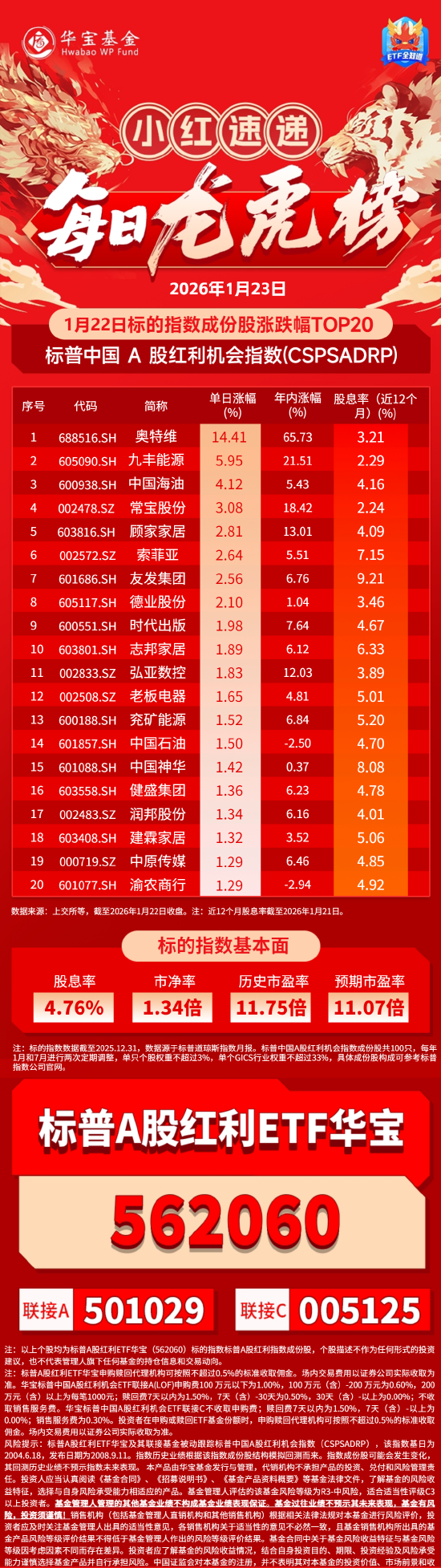
Group 1 - The article highlights the top 20 stocks in the S&P China A-Share Dividend Opportunity Index (CSPSADRP) based on their daily and year-to-date performance as of January 22, 2026 [1][5] - The stock "奥特维" (code: 688516.SH) leads with a daily increase of 14.41% and a year-to-date increase of 65.73%, with a dividend yield of 3.21% [1][5] - Other notable performers include "九丰能源" (code: 605090.SH) with a daily increase of 5.95% and a year-to-date increase of 21.51%, and "中国海滩" (code: 600938.SH) with a daily increase of 4.12% and a year-to-date increase of 5.43% [1][5] Group 2 - The overall dividend yield for the index is reported at 4.76%, with a historical price-to-earnings (P/E) ratio of 11.75 times and an expected P/E ratio of 11.07 times [2] - The data indicates a positive trend in stock performance, with several companies showing significant year-to-date gains, suggesting a favorable investment environment [4][8]




24股获推荐,紫金矿业目标价涨幅超60%丨券商评级观察
2 1 Shi Ji Jing Ji Bao Dao· 2026-01-23 01:09
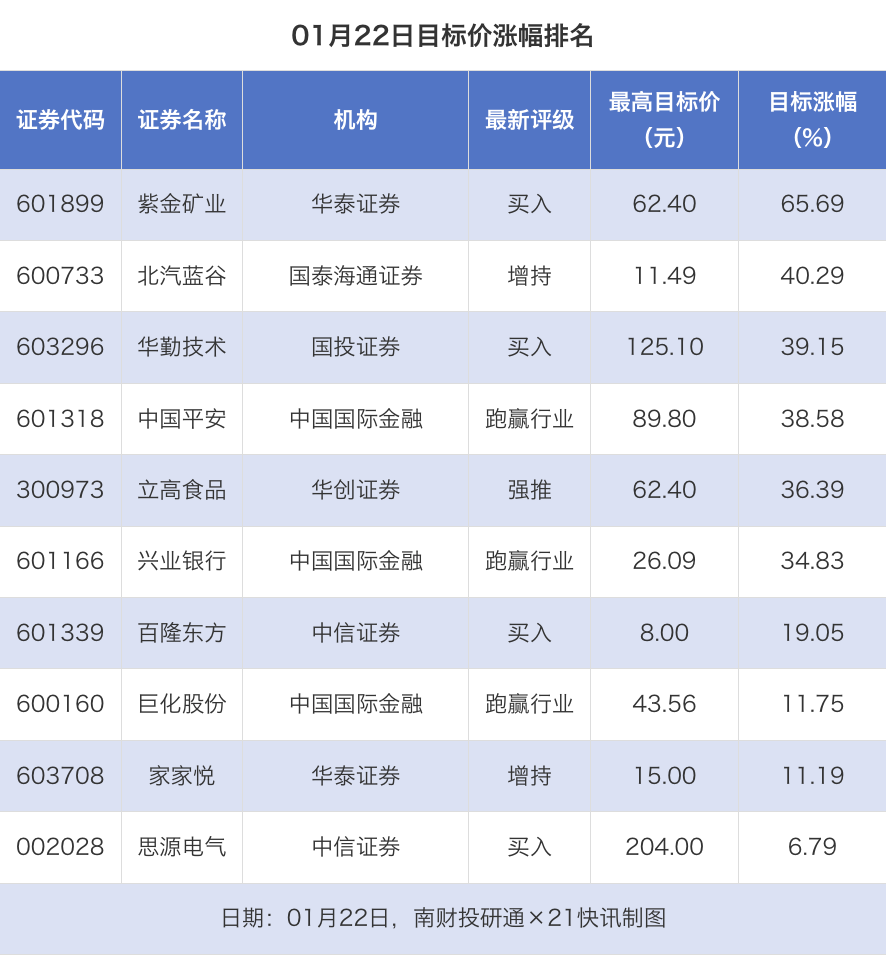
Group 1 - The core viewpoint of the article highlights the target price increases for several listed companies, with Zijin Mining, BAIC Blue Valley, and Huqin Technology leading the rankings with target price increases of 65.69%, 40.29%, and 39.15% respectively, across the industrial metals, passenger vehicles, and consumer electronics sectors [1][2]. Group 2 - On January 22, a total of 24 listed companies received recommendations from securities firms, with Lihigh Food receiving 2 recommendations, while companies like Baolong Oriental and BAIC Blue Valley received 1 recommendation each [4]. - The companies that received first-time coverage on January 22 include BAIC Blue Valley with a "Buy" rating from Guotai Junan Securities, Yanzhou Coal with an "Outperform" rating from Guosen Securities, Hezhu Intelligent with a "Buy" rating from Huayuan Securities, and Jiachih Technology with a "Buy" rating from Kaiyuan Securities [5][6].



兖矿能源:成长与高分红兼备的优质龙头煤企-20260123
Guoxin Securities· 2026-01-23 00:05
Investment Rating - The investment rating for Yanzhou Coal Mining Company (兖矿能源) is "Outperform" [1] Core Views - Yanzhou Coal Mining Company has established itself as a leading coal enterprise with a strong focus on growth and high dividends, supported by a diversified business model that includes mining, high-end chemical materials, high-end equipment manufacturing, smart logistics, and new energy [2][4] - The company has significant coal resources and production capacity, with a total coal resource of 889.74 billion tons and an exploitable reserve of 177.44 billion tons as of the end of 2024 [2][10] - The coal quality is excellent, characterized by low ash, low sulfur, and high calorific value, which enhances its market reputation [2][55] - The coal chemical business is technologically advanced and poised for growth, with plans to expand production capacity significantly in the coming years [2][4] - The company is actively pursuing acquisitions to enhance its resource base and operational capabilities, including recent acquisitions of mining assets [22][24] Summary by Sections 1. Company Overview - Yanzhou Coal Mining Company was founded in 1997 and has listings in multiple stock exchanges, becoming an international energy company with a diversified portfolio [2][10] - The company aims to create green energy and lead energy transformation, focusing on five main industries: mining, high-end chemical materials, new energy, high-end equipment manufacturing, and smart logistics [10][21] 2. Coal Resource and Production Capacity - The company has a rich distribution of coal resources across various regions, including Shandong, Shaanxi, Inner Mongolia, Xinjiang, and Australia, with a total coal resource of 464.3 billion tons and an exploitable reserve of 60.05 billion tons [2][55] - The company plans to achieve a coal production target of 300 million tons per year, with significant capacity expansions expected from new mines in the coming years [2][4] 3. Coal Chemical Business - The coal chemical segment is a key growth area, with advanced technologies and plans for new projects that will enhance production capacity and product diversity [2][4] - The company is set to launch several high-end coal chemical projects, including an 80,000-ton ethylene project and a 50,000-ton high-temperature Fischer-Tropsch project [2][4] 4. Other Business Segments - The company is diversifying into non-coal mining, logistics, and equipment manufacturing, with significant resources in molybdenum and potassium salts [2][4] - Recent acquisitions have strengthened the company's logistics capabilities, enhancing its integrated logistics system [22][24] 5. Financial Forecast and Valuation - Revenue projections for 2025-2027 are estimated at 135.8 billion, 145.7 billion, and 147.4 billion yuan, with net profits of 10.6 billion, 13.3 billion, and 13.4 billion yuan respectively [2][4] - The stock is expected to have a reasonable valuation range of 15.9 to 17.2 yuan by 2026, indicating a potential upside of 15% to 24% compared to the closing price on January 19, 2026 [2][4]
煤炭行业深度:弱化并非恶化,穆迪下调不改市场预期
Si Lu Hai Yang· 2026-01-22 09:28
Investment Rating - Moody's downgraded the family rating of Shandong Energy and its subsidiary Yanzhou Coal from Ba1 to Ba2, with a stable outlook [4][5]. Core Insights - The downgrade reflects the high leverage, rising debt, and weakening profitability of Shandong Energy, mirroring the structural challenges faced by the coal industry amid energy transition and cyclical downturns [1][4]. - Despite the downgrade, Shandong Energy maintains a strong resource endowment and financing capability, with overall debt risk being manageable [1][49]. Summary by Sections Rating Adjustment Event Review - On August 1, 2025, Moody's downgraded Shandong Energy's corporate family rating from Ba1 to Ba2, with a stable outlook, and also downgraded the baseline credit assessment (BCA) of Shandong Energy and Yanzhou Coal [4][5]. Shandong Energy Analysis - Shandong Energy is the largest coal enterprise in Shandong Province, with a significant portion of its revenue derived from coal trading and other businesses [7]. - The company has substantial coal reserves totaling 889.74 billion tons, with a recoverable reserve of 177.44 billion tons, ranking fifth among coal enterprises [7]. Profitability - Shandong Energy's net profit peaked at 24.041 billion yuan in 2022 but fell to 15.203 billion yuan in 2024 due to declining coal prices [8][11]. - The gross profit margin decreased from 16.41% in 2022 to 9.81% in 2024, significantly below the industry average of 24.17% [8]. Debt - The asset-liability ratio of Shandong Energy rose from 66.98% at the end of 2020 to 72.84% by the end of 2024, exceeding the industry average [15]. - As of June 2025, Shandong Energy's total interest-bearing debt was 447.58 billion yuan, with a short-term debt ratio of 39.22% [15]. Cash Flow - Operating cash flow showed significant volatility, with a net inflow in 2021-2022 due to rising coal prices, but a decline in 2023 as prices fell [24]. - The company plans to invest 84.80 billion yuan in 2025, indicating ongoing capital expenditure pressures [29]. Contingent Liabilities - As of June 2025, Shandong Energy had external guarantees totaling 44.268 billion yuan, with a significant portion related to its investment in Yulong Petrochemical [30]. External Support - Shandong Energy benefits from strong government support in various aspects, including resource acquisition and project approvals [31]. Coal Industry Trends and Influencing Factors Coal Prices - Coal prices have been on a downward trend in 2025, averaging around 80% of the 2024 levels, with some recovery observed in July due to production cuts and increased demand [33]. Demand Side - The rapid development of clean energy has significantly suppressed the demand for thermal coal, with clean energy capacity surpassing thermal power for the first time in August 2023 [35]. Supply Side - Coal production has been increasing, leading to high inventory levels and a decline in capacity utilization, which fell to 69.30% by June 2025 [39]. Conclusion - The downgrade of Shandong Energy's rating is a reflection of the cyclical downturn in the coal industry and individual operational challenges, yet the company retains strong resource advantages and financing capabilities [49]. - The coal industry faces a soft demand environment, but government policies may provide support for coal prices in the near term [49].
研报掘金丨国信证券:首予兖矿能源“优于大市”评级,看好2026年煤炭行业基本面改善
Ge Long Hui· 2026-01-22 08:01
Core Viewpoint - Yanzhou Coal Mining Company has evolved from a local coal enterprise to a large international energy group through continuous mergers and acquisitions, establishing a diversified industrial chain with five main sectors: mining, high-end chemical new materials, high-end equipment manufacturing, smart logistics, and new energy [1] Company Summary - The company has rich coal resources with a wide distribution and significant capacity growth potential [1] - The coal chemical business is technologically advanced and has promising growth prospects, while other business segments are also performing well [1] - The company is expected to benefit from an improving coal industry fundamentals and a moderate increase in coal prices by 2026, with a high market coal share that provides elasticity, growth potential, and high dividend attributes [1] - The estimated reasonable valuation range for the company's stock in 2026 is between 15.9 and 17.2 yuan, indicating a premium of 15% to 24% compared to the closing price on January 19, 2026 [1] - The initial coverage rating for the company is "outperform the market" [1]
国信证券:首予兖矿能源“优于大市”评级,看好2026年煤炭行业基本面改善
Jin Rong Jie· 2026-01-22 07:52
Core Viewpoint - Yanzhou Coal Mining Company has evolved from a local coal enterprise to a large international energy group through continuous mergers and acquisitions, establishing a diversified industrial chain with five main sectors: mining, advanced chemical new materials, high-end equipment manufacturing, smart logistics, and new energy [1] Company Overview - The company has rich coal resources with a wide distribution and significant capacity growth potential [1] - The coal chemical business is technologically advanced and has promising growth prospects, while other business segments are also performing well [1] Industry Outlook - The coal industry is expected to see a fundamental improvement by 2026, with a moderate increase in coal prices [1] - The company has a high market coal share, which provides it with elasticity, growth potential, and high dividend attributes [1] Valuation - The estimated reasonable valuation range for the company's stock in 2026 is between 15.9 and 17.2 yuan, indicating a premium of 15% to 24% compared to the closing price on January 19, 2026 [1] - The initial coverage rating is set at "outperform the market" [1]
3415.44万元主力资金今日抢筹煤炭板块
Zheng Quan Shi Bao Wang· 2026-01-21 09:23
Market Overview - The Shanghai Composite Index rose by 0.08% on January 21, with 18 out of the 28 sectors experiencing gains. The top-performing sectors were non-ferrous metals and electronics, with increases of 2.79% and 2.62% respectively [1] - The coal industry saw a decline of 1.57%, ranking second in terms of the largest drop [1] Capital Flow - The net inflow of capital in the two markets was 11.98 billion yuan, with 14 sectors experiencing net inflows. The electronics sector led with a net inflow of 16.37 billion yuan, followed by the non-ferrous metals sector with a net inflow of 7.29 billion yuan [1] - In contrast, 17 sectors experienced net outflows, with the power equipment sector leading at a net outflow of 6.69 billion yuan, followed by the defense and military industry with a net outflow of 2.91 billion yuan [1] Coal Industry Analysis - Within the coal industry, there were 37 stocks, of which 4 rose and 30 fell. The net inflow of capital for the coal sector was 34.15 million yuan [2] - The top three stocks with the highest net inflow were Shaanxi Coal and Chemical Industry with 102 million yuan, followed by China Shenhua and Yanzhou Coal with net inflows of 37.21 million yuan and 28.83 million yuan respectively [2] - The stocks with the largest net outflows included Yongtai Energy, Electric Power Investment Energy, and Dayou Energy, with net outflows of 67.19 million yuan, 39.60 million yuan, and 37.50 million yuan respectively [2] Individual Stock Performance - The performance of individual stocks in the coal sector showed significant declines, with Dayou Energy dropping by 8.31% and Yongtai Energy by 1.20% [3] - Other notable declines included Zhengzhou Coal Electricity at -4.05% and Shaanxi Black Cat at -3.54% [3]
煤炭开采板块1月20日涨1.28%,大有能源领涨,主力资金净流入3.71亿元
Zheng Xing Xing Ye Ri Bao· 2026-01-20 08:59
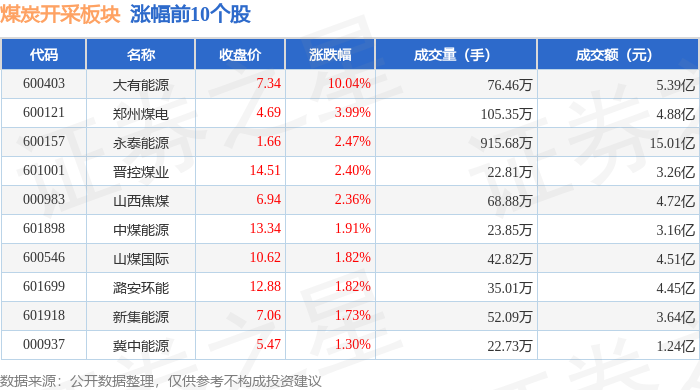
Group 1: Market Performance - The coal mining sector increased by 1.28% compared to the previous trading day, with Dayou Energy leading the gains [1] - The Shanghai Composite Index closed at 4113.65, down 0.01%, while the Shenzhen Component Index closed at 14155.63, down 0.97% [1] Group 2: Individual Stock Performance - Dayou Energy (600403) closed at 7.34, up 10.04% with a trading volume of 764,600 shares and a transaction value of 539 million [1] - Zhengzhou Coal Power (600121) closed at 4.69, up 3.99% with a trading volume of 1,053,500 shares [1] - Yongtai Energy (600157) closed at 1.66, up 2.47% with a trading volume of 9,156,800 shares [1] - Other notable stocks include Jinkong Coal Industry (601001) at 14.51, up 2.40%, and Shanxi Coking Coal (000983) at 6.94, up 2.36% [1] Group 3: Capital Flow Analysis - The coal mining sector saw a net inflow of 371 million from main funds, while retail funds experienced a net outflow of 143 million [2] - Dayou Energy had a main fund net inflow of 176 million, representing 32.63% of its trading volume, while retail funds saw a net outflow of 112 million [3] - Yongtai Energy recorded a main fund net inflow of 141 million, with a retail net outflow of 64.86 million [3]