
Hengrui Pharma(600276)

Search documents
恒瑞医药(01276)9月24日斥资972.52万元回购14万股A股
智通财经网· 2025-09-24 09:18
智通财经APP讯,恒瑞医药(01276)发布公告,该公司于2025年9月24日斥资972.52万元人民币回购14万 股A股,每股回购价格为69.3-69.6元人民币。 ...
恒瑞医药(01276.HK)9月24日耗资972.52万元回购14万股A股

Ge Long Hui· 2025-09-24 09:18
格隆汇9月24日丨恒瑞医药(01276.HK)公告,9月24日耗资972.52万元回购14万股A股。 相关事件 恒瑞医药(01276.HK)9月24日耗资972.52万元回购14万股A股 恒瑞医药(01276.HK)获The Capital Group增 持172.82万股 ...
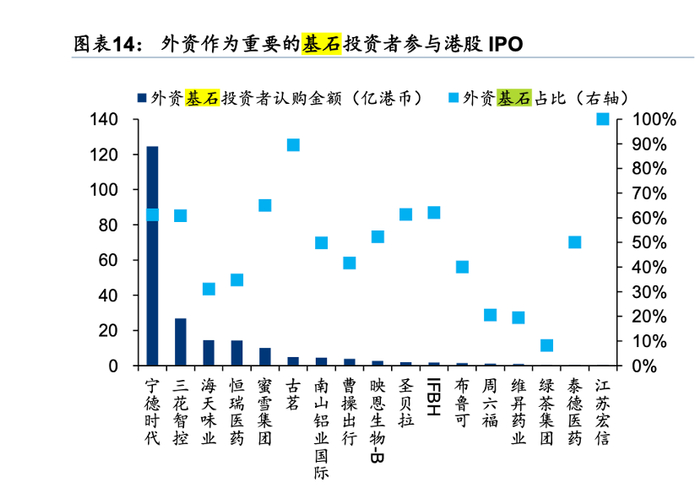
七成浮盈、最高回报超10倍,机构溢价争抢港股IPO基石份额
第一财经网· 2025-09-24 07:53
Core Insights - The core viewpoint of the articles is the significant shift in the Hong Kong IPO market, where cornerstone investments have surged from being overlooked to highly sought after, driven by substantial returns on investment [1][10]. Group 1: Market Dynamics - The planned subscription amount for cornerstone investors was initially set at 40% of the IPO issuance, but demand has exceeded this by over three times, indicating a strong interest in cornerstone investments [1][3]. - Since 2025, the participation of cornerstone investors in Hong Kong IPOs has increased dramatically, with an average of 5.35 cornerstone investors per company, up nearly 290% from 1.37 last year [1][2]. - Major IPOs, such as that of Ningde Times, attracted up to 23 cornerstone investors, highlighting the trend of large-scale capital inflow into significant projects [2]. Group 2: Investor Composition - The number of cornerstone investors has risen to 289 this year, with a notable increase from professional investment institutions and listed companies [4][8]. - In 2025, 93 investment institutions contributed a total of 302.06 million HKD, accounting for approximately 66.82% of the cornerstone investment total, marking them as the dominant force in the market [5][8]. - Foreign capital has played a crucial role, with foreign investors accounting for over 210 million HKD in cornerstone investments, representing half of the total [8]. Group 3: Investment Returns - Over 77% of cornerstone investors are currently in profit, with some projects yielding returns exceeding ten times the initial investment [1][10]. - Notable examples include the investment in Lao Pu Gold, which saw a price increase of 166% from the IPO price, resulting in a paper profit of over 4.5 billion HKD for Tencent [10]. - The highest returns have been observed in innovative pharmaceutical companies, with some stocks increasing over tenfold since their IPO [11][12]. Group 4: Sector Performance - The pharmaceutical sector has shown the highest returns, with companies like Yaojie Ankang-B seeing a price increase of over 1155.51% [11][12]. - Other sectors, including technology and consumer goods, have also performed well, with companies like Mixue Group and Gu Ming seeing stock prices rise over 100% [11][12].

七成浮盈、最高回报超10倍,机构溢价争抢港股IPO基石投资份额
Di Yi Cai Jing· 2025-09-24 07:48
Core Viewpoint - The cornerstone investment in Hong Kong IPOs has shifted from being overlooked to a competitive and premium-seeking environment, with demand significantly exceeding supply [1][4]. Group 1: Investment Trends - The cornerstone investment participation in Hong Kong IPOs has surged, with an average of 5.35 cornerstone investors per company in 2025, a nearly 290% increase from 1.37 last year [1][2]. - The recent IPO of Botai Vehicle Networking Technology Co., Ltd. attracted cornerstone investments totaling 4.66 billion HKD, representing over 40% of the total fundraising [2]. - Large IPO projects are particularly favored, with notable examples like CATL attracting 23 cornerstone investors with a total subscription amount of 203.71 billion HKD, accounting for 66% of the total fundraising [3]. Group 2: Investor Composition - The number of cornerstone investors has increased to 289 this year, with significant contributions from professional investment institutions and listed companies [5]. - Market-oriented funds and listed companies have become major players, with 93 investment institutions contributing 302.06 billion HKD, making up approximately 66.82% of the total cornerstone investment [5][9]. - Foreign investors have played a crucial role, accounting for over 210 billion HKD in subscriptions, which is about half of the total cornerstone investment amount [9]. Group 3: Investment Returns - Over 77% of cornerstone investors are currently in profit, with some projects yielding returns exceeding tenfold [1][10]. - Notable high-return sectors include innovative pharmaceuticals, with companies like Yaojie Ankang-B seeing a price increase of over 1155% from the subscription price [12][13]. - The overall trend indicates that the majority of cornerstone investors are experiencing gains, with 42 out of 54 companies having current market prices above the average subscription price [11].
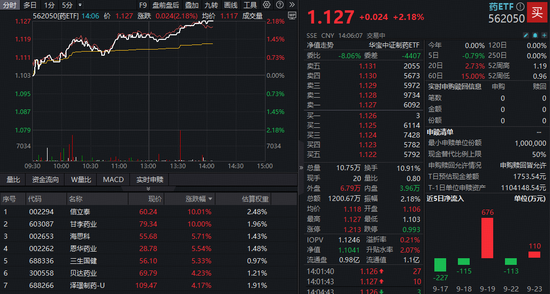
创新药冲锋,中药助攻,全市场唯一药ETF(562050)冲上2%!
Xin Lang Ji Jin· 2025-09-24 06:12
Group 1 - The pharmaceutical sector is experiencing a rally, with the only drug ETF (562050) rising over 2% [1] - Innovative drug concepts are leading the gains, with companies like Xinlitai and Ganli Pharmaceutical hitting the daily limit [1] - Traditional Chinese medicine stocks also performed well, with Taiji Group, Dong'e Ejiao, and Darentang all rising over 2% [1] Group 2 - Recent developments in Hengrui Medicine include its drug being included in a list of potential breakthrough therapies, and it has received priority review status for its drug application [1] - Changchun High-tech's subsidiary has partnered with Denmark's ALK-Abelló A/S for allergen-specific immunotherapy products, enhancing its innovative technology layout [1] - The innovative drug sector remains highly prosperous, with continuous recommendations for innovative drugs and medical devices [3] Group 3 - The drug ETF (562050) passively tracks the pharmaceutical index, with top ten weighted stocks including Hengrui Medicine, Pianzaihuang, and Yunnan Baiyao [3] - The market outlook for the domestic demand sector is expected to improve due to optimized collection rules and active promotion by the medical insurance bureau [3] - The recovery in the CXO and upstream pharmaceutical sectors is anticipated, with leading medical device companies likely to see a resurgence [3]

恒瑞医药获The Capital Group Companies, Inc.增持172.82万...
Xin Lang Cai Jing· 2025-09-24 00:09
香港联交所最新资料显示,9月19日,The Capital Group Companies, Inc.增持恒瑞医药(01276) 172.82万股,每股均价87.2873港元,总金额约为1.51亿港元。增持后最新持股数目为1974.58万股,最新 持股比例为7.65%。 来源:新浪港股 ...
恒瑞医药(01276.HK)获The Capital Group增持172.82万股
Ge Long Hui· 2025-09-23 23:04
Group 1 - The Capital Group Companies, Inc. increased its stake in 恒瑞医药 (Hengrui Medicine) by acquiring 1.7282 million shares at an average price of HKD 87.2873 per share, totaling approximately HKD 151 million [1] - Following the acquisition, The Capital Group's total shareholding in 恒瑞医药 rose to 19.7458 million shares, increasing its ownership percentage from 6.98% to 7.65% [1][2]

德勤中国预计港股前三季度新股融资额登顶全球
Zhong Guo Zheng Quan Bao· 2025-09-23 20:16
Group 1 - The Hong Kong IPO market has shown strong activity since the third quarter, with a significant increase in financing driven by a surge in companies filing for listings [1][2] - Deloitte's report predicts that the Hong Kong IPO market will maintain its position as the world's largest in terms of financing for the first three quarters of 2025, with total financing expected to reach between HKD 250 billion and HKD 280 billion [1][4] - The influx of overseas capital and regulatory encouragement for mainland companies to list in Hong Kong are key factors contributing to the growth of the IPO market [3][5] Group 2 - In the first three quarters of 2025, the Hong Kong IPO market is expected to see 66 new listings, raising HKD 182.3 billion, representing a 228% year-on-year increase in financing [2][4] - Notable companies such as CATL, Hengrui Medicine, and Sanhua Intelligent Control have raised over HKD 10 billion each through the "A+H" listing model, significantly boosting overall market financing [3] - The performance of these stocks in the secondary market has been strong, with cumulative price increases exceeding 70% since their listings [3] Group 3 - The fourth quarter of 2025 is anticipated to continue the strong momentum of the Hong Kong IPO market, supported by the Federal Reserve's potential interest rate cuts, which may lead to increased liquidity [4][5] - Deloitte estimates that there will be 80 new listings in the Hong Kong IPO market for the entire year of 2025, with total financing projected to be between HKD 250 billion and HKD 280 billion, a significant increase from previous forecasts [4] - The market is expected to see a diverse range of new listings, including those from pharmaceutical, specialized technology, and consumer sectors [4][5]


恒瑞医药:公司阿得贝利单抗注射液新适应症的药品上市许可申请获国家药监局受理
Zheng Quan Ri Bao Wang· 2025-09-23 13:41
证券日报网讯9月23日晚间,恒瑞医药(600276)发布公告称,近日,公司子公司上海盛迪医药有限公 司收到国家药品监督管理局下发的《受理通知书》,公司阿得贝利单抗注射液新适应症的药品上市许可 申请获国家药监局受理。 ...
恒瑞医药:公司SHR7280片的药品上市许可申请获国家药监局受理
Zheng Quan Ri Bao Wang· 2025-09-23 13:41
Core Viewpoint - Heng Rui Medicine (600276) has received acceptance for its drug listing application for SHR7280 tablets from the National Medical Products Administration [1] Group 1 - The company announced on the evening of September 23 that it has received the acceptance notice for its drug listing application [1]