HEILAN HOME(600398)

Search documents
新股消息 | 海澜之家递表港交所
智通财经网· 2025-11-21 12:33
Core Insights - HLA Group Co., Ltd. (海澜之家) has submitted an application to list on the Hong Kong Stock Exchange, with Huatai International as the sole sponsor [1] - The company is recognized as a leading brand apparel retail group in China, distinguished by its diversified brand portfolio, extensive supply chain network, and strong channel integration capabilities [1] - According to Frost & Sullivan, HLA ranked fourth in revenue among Chinese apparel groups in 2024 [1] - As of June 30, 2025, HLA's global store count exceeded 7,200 [1] Company Overview - HLA operates 5,631 stores across 31 provincial-level administrative regions in China, covering nearly all prefecture-level cities, establishing the most extensive offline network among men's apparel brands in China [4] - The company has developed a global sales network comprising 5,723 stores, including 92 overseas locations [4] - In addition to men's apparel, HLA's proprietary brands include the affordable luxury women's brand OVV and the high-end children's brand Ying's, catering to diverse customer preferences and personalized expressions [4]


海澜之家递表港交所
Zhi Tong Cai Jing· 2025-11-21 12:31
Core Viewpoint - Haier Home (600398) has submitted an application to list on the Hong Kong Stock Exchange, with Huatai International as its sole sponsor, highlighting its position as a leading brand apparel retail group in China [1]. Group 1: Company Overview - Haier Home is recognized as one of the top apparel retail groups in China, ranking fourth in revenue among Chinese apparel groups according to Frost & Sullivan [1]. - As of June 30, 2025, Haier Home operates over 7,200 stores globally, with 5,631 stores located across 31 provincial-level administrative regions in China [1][4]. - The company has established a comprehensive sales network that includes 5,723 stores worldwide, with 92 of these located overseas [4]. Group 2: Brand and Product Offering - In addition to its main men's apparel line, Haier Home also offers a light luxury women's brand, OVV, and a high-end children's brand, Ying's, catering to diverse customer preferences and personalized expressions [4].
新股消息 | 海澜之家(600398.SH)递表港交所
智通财经网· 2025-11-21 12:26
Core Insights - HLA Group Co., Ltd. (referred to as HLA) has submitted an application to list on the Hong Kong Stock Exchange, with Huatai International as the sole sponsor [1] - HLA is recognized as a leading brand apparel retail group in China, distinguished by its diversified brand portfolio, extensive supply chain network, and strong channel integration capabilities [1] - According to Frost & Sullivan, HLA ranked fourth in revenue among Chinese apparel groups in 2024, with a total of over 7,200 global stores as of June 30, 2025 [1] Company Overview - As of June 30, 2025, HLA operates 5,631 stores across 31 provincial-level administrative regions in China, covering nearly all prefecture-level cities, establishing the most extensive offline network among men's apparel brands in China [4] - The company has built a global sales network comprising 5,723 stores, including 92 overseas locations, in addition to its men's apparel offerings, it also features its own brands such as the premium women's brand OVV and the high-end children's brand Ying's, catering to diverse customer preferences and personalized expressions [4]
海澜之家向港交所提交上市申请书
Ge Long Hui· 2025-11-21 12:13
格隆汇11月21日|利弗莫尔证券显示,海澜之家集团股份有限公司向港交所提交上市申请书,独家保荐 人为华泰国际。 ...
海澜之家向港交所递交上市申请
Xin Lang Cai Jing· 2025-11-21 12:06
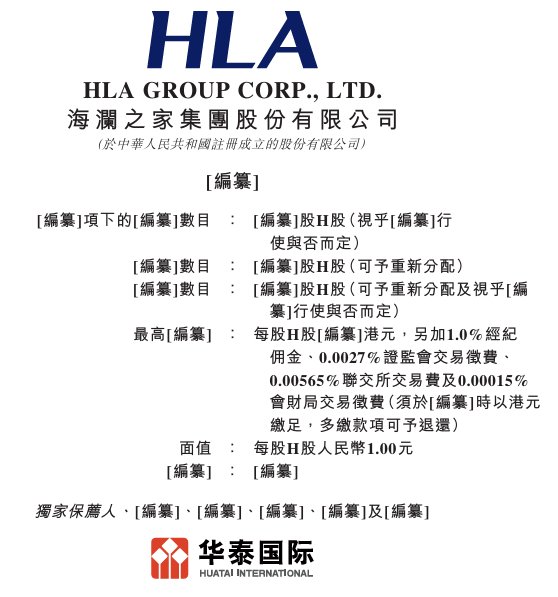
Group 1 - HLA Group Corp., Ltd. submitted a listing application to the Hong Kong Stock Exchange on November 21 [1] - The exclusive sponsor for the listing is Huatai International [1] - The application involves H shares, with the number of shares subject to reallocation depending on the exercise of options [3] Group 2 - The maximum offer price for each H share is set in Hong Kong dollars, with additional fees including a 1.0% brokerage commission and various transaction fees [3] - The par value of each H share is RMB 1.00 [3]
海澜之家:集团向港交所提交上市申请书
Mei Ri Jing Ji Xin Wen· 2025-11-21 12:01
每经AI快讯,11月21日,据港交所文件:海澜之家(600398)集团股份有限公司向港交所提交上市申 请书。 ...
据港交所文件:海澜之家集团股份有限公司向港交所提交上市申请书。
Xin Lang Cai Jing· 2025-11-21 11:56
Core Viewpoint - Haier Group Co., Ltd. has submitted a listing application to the Hong Kong Stock Exchange [1] Company Summary - Haier Group Co., Ltd. is seeking to go public by submitting a listing application to the Hong Kong Stock Exchange [1]
实测16款冲锋衣!防水、耐磨、透湿...谁的性能更能打?
Zhong Guo Zhi Liang Xin Wen Wang· 2025-11-21 06:43
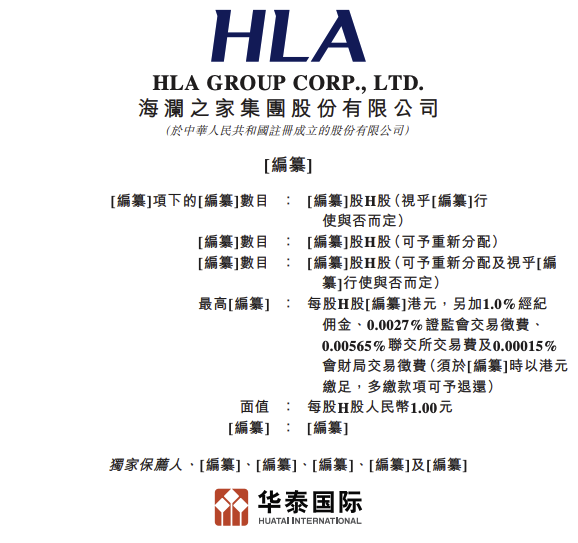
Core Viewpoint - The article discusses a comparative test conducted by the Shenzhen Consumer Council on 16 different brands of outdoor jackets, highlighting the importance of features such as waterproofing, durability, and comfort in outdoor apparel [1][3]. Group 1: Testing Brands and Prices - The tested brands include The North Face, Decathlon, Camel, Quechua, Jack Wolfskin, Xtep, JD.com, Li Ning, Toread, Semir, HLA, Kelty, Shixia, Taiping Bird, Columbia, and Anta [3]. - The sampling prices for the jackets range from 209.75 yuan to 1927 yuan [3]. Group 2: Testing Standards and Chemical Safety - The testing was based on the national standard GB/T 32614-2023, which includes chemical safety indicators such as PFOS and PFOA [4]. - Among the 16 jackets tested, only two brands, Decathlon and Quechua, were labeled as "fluorine-free" products [4]. - All tested samples showed no detectable levels of PFOS, and 8 samples had no detectable levels of PFOA, with 10 samples meeting the limit of <1.0μg/m² for both substances [4]. Group 3: Physical Performance and Durability - All 16 samples met the standard requirements for tear strength, with 7 samples exceeding 20N in both directions, indicating good durability [6]. - The abrasion resistance of all samples met the standard requirement of ≥10,000 cycles, and the appearance after washing and lightfastness also complied with the standards [6]. Group 4: Waterproof Performance - The waterproof performance was evaluated based on surface wetting resistance and hydrostatic pressure [7][9]. - After three washes, 7 samples achieved a surface wetting resistance of level 4 or higher, indicating good waterproofing [7]. - Five samples scored high in hydrostatic pressure tests, demonstrating strong waterproof capabilities [10]. Group 5: Breathability - The moisture permeability rate is crucial for comfort, with 6 samples exceeding 8000g/㎡•24h after three washes, indicating good breathability [11]. Group 6: Overall Evaluation - Among the 16 tested samples, 7 received a five-star rating based on laboratory testing results [12].




9个月烧光35亿!海澜之家被“除名”了
商业洞察· 2025-11-20 09:23
Core Viewpoint - Haier's brand, once a leader in men's fashion, is now facing significant challenges, including being removed from the MSCI index, indicating a failure to meet key market standards and a decline in growth potential [6][8][29]. Group 1: Financial Performance - In the first three quarters of 2025, Haier's revenue reached 15.599 billion yuan, showing a slight increase of 2.23%. However, the main brand's revenue, which accounts for over 70% of total revenue, declined by 3.99% to 10.849 billion yuan, indicating insufficient growth momentum [9]. - The sales expenses for the first three quarters of 2025 amounted to 3.524 billion yuan, representing 22% of total revenue, while R&D expenses were only 157 million yuan, a decrease of 4.69%, accounting for just 1% of revenue [9][10]. - Since 2019, Haier's revenue has fluctuated between 21.9 billion yuan and 20.9 billion yuan, failing to achieve significant growth, with net profit also showing wide fluctuations [11]. Group 2: Inventory and Operational Efficiency - Haier has been trapped in a high inventory cycle, with inventory turnover days increasing from 262 days in 2019 to 394 days in the first three quarters of 2025, while inventory levels rose from 9.044 billion yuan to 11.518 billion yuan [12][13]. - The company has struggled to establish a healthy inventory turnover mechanism, leading to a situation where inventory levels increased despite a slight decline in revenue [12][13]. Group 3: Strategic Misalignment - Haier's frequent strategic shifts and unclear market positioning have resulted in a loss of growth momentum, characterized by a focus on marketing over product development [13][24]. - The brand has attempted to appeal to various consumer segments without a clear target, leading to a mismatch in product offerings and consumer expectations [24][25]. - Recent marketing efforts, such as the introduction of the "Aurora 95 Down" concept, have raised questions about innovation versus mere rebranding, as the product lacks distinct competitive advantages compared to established brands [21][22]. Group 4: Market Position and Brand Identity - Haier's attempts to cater to both young consumers and business professionals have resulted in a diluted brand identity, with products failing to resonate with either group [24][25]. - The brand's reliance on celebrity endorsements has not translated into sustained revenue growth, as shifts in target demographics have not aligned with product design [19][20]. - The company faces criticism for its pricing strategy, which appears misaligned with its target audience, leading to a perception of being out of touch with market demands [25][26]. Group 5: Future Outlook - Following its removal from the MSCI index, Haier is expected to face increased pressure in the secondary market, necessitating a strategic refocus on core consumer segments and product offerings [29][31]. - The company must enhance its R&D investment to remain competitive, as reliance on design alone is insufficient in the current market landscape [29][31].

2026年纺织服装行业投资策略:整固蓄势,挖掘新消费,看好全球制造
Shenwan Hongyuan Securities· 2025-11-18 01:48
Investment Strategy Overview - The report emphasizes the stabilization of global tariff negotiations, which does not alter the core competitiveness of global manufacturing, and highlights optimism towards two major industrial chains and a price increase cycle [3][4]. Industry Performance Review - As of November 14, 2025, the SW textile and apparel index has increased by 16.9%, ranking 17th in relative performance across the market. The manufacturing sector shows higher certainty compared to brands still in recovery [4][8]. - Domestic demand is at a low point in 2025 but is expected to recover in 2026-2027, focusing on the characteristics of young consumer groups to explore high-growth areas in new consumption [4][21]. New Consumption Trends - High-performance outdoor apparel is identified as a growth area with low penetration and high potential, with the market size projected to reach 102.7 billion yuan in 2024, growing by 17% year-on-year [4][33]. - Discount retail is highlighted as a scarce high-growth area within the consumption sector, with rapid expansion in urban outlets and hard discount specialty stores [4][46]. - The personal care and cleaning market, particularly wet wipes, is noted for its rapid growth and increasing necessity among young consumers, with a market size in China expected to reach 100 billion yuan [4][62]. - The sleep economy is emerging as a significant market, with explosive growth in household textile products, driven by young consumers' acceptance [4][20]. - The report discusses Nike's innovation cycle, which is expected to benefit from inventory replenishment and product innovation, similar to Adidas's recovery cycle [4][20]. - The Australian wool price increase cycle is anticipated due to supply contraction and demand highlights, with potential market space comparable to previous high points in 2011 and 2018 [4][20]. - The healthcare material upgrade cycle presents broad replacement opportunities for overseas non-woven fabrics [4][20]. Global Manufacturing Insights - The report notes that the resolution of tariff variables is expected to lead to a new growth phase for leading companies [4][27]. - The textile industry has undergone a pressure test for external demand, with recent tariff negotiations expected to boost export chain expectations for 2026 [4][26]. Investment Recommendations - The report suggests focusing on high-growth new consumption areas and the competitive strength of global manufacturing as key investment strategies [4][27].