TONGWEI CO.,LTD(600438)

Search documents
通威股份(600438) - 通威股份有限公司2024年年度股东大会会议资料
2025-05-09 11:15
2024 年年度股东大会会议资料 通威股份有限公司 2024 年年度股东大会会议资料 资料汇编 二〇二五年五月 | 2024 年年度股东大会会议议程 | | 3 | | --- | --- | --- | | 2024 年度董事会工作报告 | | 5 | | 年度监事会工作报告 2024 | | 10 | | 2024 年年度报告及年度报告摘要 | | 13 | | 2024 年度财务决算报告 | | 14 | | 2024 年度利润分配预案 | | 17 | | 关于董事、监事 2024 | 年度薪酬与考核的议案 | 18 | | 关于续聘会计师事务所的议案 | | 20 | | 关于 2025 | 年度公司及下属子公司相互提供担保的议案 | 23 | | 关于 2025 | 年度为公司客户提供担保的议案 | 41 | | 关于 2025 | 年申请综合授信的议案 | 43 | | 关于 2025 | 年开展票据池业务的议案 | 44 | | 关于修订公司章程等一系列制度的议案 | | 47 | | 关于选举第九届董事会成员的议案 | | 63 | | 关于公司第九届董事会董事薪酬方案的议案 | | 67 ...

通威股份: 通威股份有限公司关于召开2024年度暨2025年第一季度业绩说明会的公告
Zheng Quan Zhi Xing· 2025-05-09 10:38
股票代码:600438 股票简称:通威股份 公告编号:2025-053 债券代码:110085 债券简称:通 22 转债 通威股份有限公司关于 召开 2024 年度暨 2025 年第一季度业绩说明会的公告 本公司董事会及全体董事保证本公告内容不存在任何虚假记载、误导性陈述 或者重大遗漏,并对其内容的真实性、准确性和完整性承担法律责任。 重要内容提示: ?会议召开时间:2025 年 5 月 16 日(星期五)下午 15:00-16:30 ?会 议 召 开 地 点 : 上 海 证 券 交 易 所 上 证 路 演 中 心 ( 网 址 : https://roadshow.sseinfo.com/) ?会议召开方式:上证路演中心视频直播和网络互动 ?投资者可于 2025 年 5 月 9 日(星期五)至 5 月 15 日(星期四)16:00 前登录 上证路演中心网站首页点击"提问预征集"栏目或通过公司邮箱 zqb@tongwei.com 进行提问。公司将在说明会上对投资者普遍关注的问题进行 回答。 通威股份有限公司(以下简称"公司")已于 2025 年 4 月 30 日发布公司 2024 年度报告及 2025 年第一季 ...
通威股份(600438) - 通威股份有限公司关于召开2024年度暨2025年第一季度业绩说明会的公告
2025-05-09 10:01
股票代码:600438 股票简称:通威股份 公告编号:2025-053 债券代码:110085 债券简称:通 22 转债 通威股份有限公司关于 投资者可于 2025 年 5 月 9 日(星期五)至 5 月 15 日(星期四)16:00 前登录 上 证 路 演 中 心 网 站 首 页 点 击 " 提 问 预 征 集 " 栏 目 或 通 过 公 司 邮 箱 zqb@tongwei.com 进行提问。公司将在说明会上对投资者普遍关注的问题进行 回答。 通威股份有限公司(以下简称"公司")已于 2025 年 4 月 30 日发布公司 2024 年度报告及 2025 年第一季度报告,为便于广大投资者更全面深入地了解公司 2024 年度及 2025 年第一季度经营成果、财务状况,公司计划于 2025 年 5 月 16 日(星期五)15:00-16:30 举行 2024 年度暨 2025 年第一季度业绩说明会, 就投资者关心的问题进行交流。 一、说明会类型 本次投资者说明会以视频直播和网络互动方式召开,公司将针对 2024 年度 及 2025 年第一季度的经营成果及财务指标的具体情况与投资者进行互动交流和 沟通,在信息披露 ...
新能源与有色金属专题:多晶硅交割概况分析及近期行情展望
Hua Tai Qi Huo· 2025-05-09 01:18
Report Investment Rating The report does not mention the investment rating for the polysilicon industry. Core Views - **Strategy**: For the 2506 contract, it is advisable to be cautiously bullish. When the market rebounds above 40,000 yuan/ton, producers can consider selling hedging at high prices. In the short term, conduct a positive spread arbitrage between the 06 and 07 contracts. If the warehouse receipt volume starts to increase rapidly, switch to a reverse spread arbitrage. There are no strategies for cross - variety and spot - futures operations. For options, sell near - month deep out - of - the - money put options and buy call options [6][7][69]. - **Industry Situation**: The polysilicon upstream and downstream industries have high concentration, with leading enterprises having a large share of production capacity. Most enterprises are currently in a state of losing cash costs, and several polysilicon listed companies reported losses in the first quarter. Some enterprises have shut down for a long time, and most have reduced production loads. The number of polysilicon types and grades is large, and it is subject to brand - based delivery. The standard delivery product on the market is n - type dense material, with relatively high delivery requirements and large discounts for alternative delivery products. The amount of warehouse receipts registered by manufacturers at the current market price is expected to be very small [9][70]. Summary by Directory 1. Polysilicon Production Overview - **Production Enterprises**: The polysilicon industry has high concentration, with the top four enterprises (Tongwei Co., Ltd., GCL Technology, Daqo New Energy, and Xinte Energy) having a combined market share of over 60%. Each of these enterprises has its own development strategy and production characteristics [14][15]. - **Capacity and Output**: By the end of 2024, the polysilicon production capacity reached about 2.86 million tons, a year - on - year increase of 42%, but the capacity utilization rate was only about 30%. Leading enterprises are still expanding production capacity. Due to industry self - restraint on production, the production enthusiasm of enterprises is limited, and the output is expected to decline slightly. The industry has been in a de - stocking pattern since 2025, but the high total inventory has a large inhibitory effect on the spot market [18]. - **Downstream Enterprises**: The downstream of polysilicon is also highly concentrated. According to the 2024 production capacity statistics, the top 5 enterprises account for nearly 53% of the production capacity, and the top 2 account for 33% [23]. - **Cost**: The production cost of polysilicon mainly consists of raw material cost, electricity cost, labor cost, depreciation cost, and technological differences. The raw material, electricity, and depreciation costs account for about 80% of the total cost. Leading enterprises have different production costs due to differences in electricity cost ratios and technological routes [26]. 2. Polysilicon Classification - **Physical Form**: Polysilicon can be classified into block silicon and granular silicon. Block silicon has a stable quality and can be stored for a long time, while granular silicon can avoid the crushing step but is easily contaminated [28]. - **Purity**: It can be divided into metallurgical - grade polysilicon (MG - Si), solar - grade polysilicon (SOG - Si), and electronic - grade polysilicon (SEG - Si) in descending order of purity [33]. - **Downstream Doping and Conductivity Type**: Solar - grade polysilicon is mainly divided into N - type and P - type, depending on the type of doping impurities [34]. - **Surface State**: Block silicon can be further divided into dense material, cauliflower - like material, and coral - like material. Dense material is mainly used for pulling single - crystal silicon, while cauliflower - like and coral - like materials are mainly used for making poly - silicon wafers [35]. 3. Polysilicon Delivery Rules Interpretation - **Brand Delivery System**: Polysilicon futures implement a brand - based delivery system. The delivery products must be from registered brands approved by the exchange. Registered brand products can be warehoused without inspection if the owner can provide relevant quality certificates. There are 7 enterprises with 12 production plants in the first batch of registered brands [41][42]. - **Delivery Details**: The delivery area covers 8 provinces (autonomous regions), and there is no premium or discount between regions. The delivery unit is 30 tons per lot. The warehouse receipt has a 6 - month validity period, and products with a production date over 90 days cannot be registered as warehouse receipts. The delivery methods include one - time delivery, rolling delivery, and futures - to - cash transactions [49][50][53]. - **Delivery Requirements**: The benchmark delivery product is N - type block silicon, and the alternative is P - type block silicon with a discount of 12,000 yuan/ton. Strict quality indicators are specified, and packaging and storage requirements are also defined. There are also position - limit and risk - control measures [58][63][64]. 4. Polysilicon Delivery and Recent Market Analysis and Outlook - **Delivery Situation**: The current market price is expected to result in a very small amount of warehouse receipts. The recent market has seen continuous increases in positions and price declines, with low trading volume. The 2506 contract is expected to rise in the short term, and it is estimated that the market price needs to be above 39,000 yuan/ton for warehouse receipt registration to be cost - effective, and above 40,000 yuan/ton for producers to have a strong willingness to register [66][67]. 5. Summary - **Industry Status**: The polysilicon upstream and downstream industries are highly concentrated, and most enterprises are in a state of loss. There are many types and grades of polysilicon, and the delivery requirements are high. The amount of warehouse receipts registered at the current market price is expected to be small [70]. - **Strategy**: The same as the core strategy, including unilateral, cross - period, cross - variety, spot - futures, and option strategies [69].


英美就关税贸易协议达成一致,通威暂无计划通过交割去库
Dong Zheng Qi Huo· 2025-05-09 00:42
Report Industry Investment Rating No relevant content provided. Core Viewpoints of the Report - The agreement between the US and the UK on tariff trade has led to a rise in market risk appetite, with the gold price falling by over 2%, the US dollar index strengthening, and the US stock index futures showing a short - term risk preference recovery. However, tariff negotiations remain complex, and the long - term impact is uncertain [2][3][14][17]. - In the commodity market, different sectors have different trends. For example, the steel price continues to decline, the inventory of some metals and energy products shows changes, and the prices of agricultural products are affected by factors such as supply and demand and policy [6][24][41]. Summary by Directory 1. Financial News and Comments 1.1 Macro Strategy (Gold) - The US and the UK reached a tariff trade agreement, reducing the US tariff on British - made cars to 10% and the beef tariff close to zero. The gold price fell by over 2%. In the short term, gold is under pressure, but the negotiation is complex, and there is still room for correction [14]. - Investment advice: Pay attention to the progress of US trade negotiations, and be aware of the short - term correction risk of gold [14]. 1.2 Macro Strategy (Foreign Exchange Futures (US Dollar Index)) - Trump criticized Powell for not cutting interest rates. The US and the UK reached the first trade agreement since the Trump tariff war, leading to a significant recovery in market risk appetite and a strengthening of the US dollar index. The US dollar index is expected to maintain a short - term rebound [15][17][18]. 1.3 Macro Strategy (US Stock Index Futures) - Trump announced a major agreement with the UK. The US House of Representatives Committee will start deliberating on Trump's tax - cut plan next week. The short - term market risk preference recovers, but tariff negotiations tend to be long - term, and it is not recommended to chase high [19][20]. 1.4 Macro Strategy (Treasury Bond Futures) - The central bank conducted 158.6 billion yuan of 7 - day reverse repurchase operations, resulting in a net investment of 158.6 billion yuan. The current one - sided market opportunities are limited, and attention can be paid to various arbitrage strategies, such as the curve - steepening strategy. The opportunity to steepen the curve has initially emerged, and subsequent changes in capital interest rates should be continuously monitored [21][22][23]. 2. Commodity News and Comments 2.1 Agricultural Products (Soybean Oil/Rapeseed Oil/Palm Oil) - As of March 31, Canada's rapeseed ending inventory was 5.8694 million tons, a significant year - on - year decrease. The oil market continued to fluctuate. The short - term palm oil price has reached the support level, and it is recommended to wait for the MPOB report data before operating [24]. 2.2 Agricultural Products (Soybean Meal) - Brazil announced the 25/26 sanitary interval schedule. The USDA weekly export sales report met expectations. The domestic soybean meal futures price is expected to fluctuate, and the spot will continue to be under pressure. Attention should be paid to the USDA monthly supply and demand report on May 12 [25][27][28]. 2.3 Agricultural Products (Sugar) - Brazil's sugar and molasses exports in April decreased by 17.65% year - on - year. In China, the sugar production in Guangxi increased, and the sales rate reached 63.96%, a 6 - percentage - point year - on - year increase. The domestic sugar price has strong resistance to decline in the short term, but the external market is under pressure, and the Zhengzhou sugar is expected to fluctuate weakly in the second quarter of 2025. Attention should be paid to the sugar factory's inventory reduction progress [30][33][34]. 2.4 Agricultural Products (Corn Starch) - Deep - processing enterprises continued to raise prices to promote purchases, but the effect was not good. The overseas cassava starch startup rate decreased seasonally. The CS - C futures spread is expected to have small fluctuations [35][36][37]. 2.5 Agricultural Products (Corn) - The inventory of deep - processing enterprises continued to decline. It is recommended to hold the 07 long positions and pay attention to the 7 - 9 and 7 - 11 positive spread opportunities. If the import auction starts, focus on the transaction rate and price [38]. 2.6 Black Metals (Rebar/Hot - Rolled Coil) - In April, China's heavy - truck market sales were about 90,000 vehicles, and the national passenger - car market retail sales were 1.791 million vehicles. The inventory of the five major steel products increased by 289,700 tons week - on - week. The steel price continued to decline, and the short - term downward space is difficult to open. It is recommended to hold a light position and wait and see in the short term, and use the rebound hedging strategy for the spot [39][40][41]. 2.7 Black Metals (Steam Coal) - After the holiday, the port coal inventory was full, and the coal price may decline rapidly again. It is recommended to pay attention to whether the price can hold at the 600 - yuan level [43]. 2.8 Black Metals (Iron Ore) - FMG's iron ore shipments in the first quarter of 2025 were 46.1 million tons. With the seasonal weakening of demand, the iron ore price is expected to fluctuate weakly [44][45][46]. 2.9 Black Metals (Coking Coal/Coke) - The port coke spot market was stable. During the May Day holiday, the supply of coking coal was sufficient, and the second round of coke price increase was postponed. In the short term, it will maintain a volatile trend, and in the long term, it will be weak [47][48]. 2.10 Non - ferrous Metals (Nickel) - In April, the total actual output of nickel pig iron in China and Indonesia was 181,500 tons of metal, with a month - on - month increase of 3.62% and a year - on - year increase of 24.34%. It is recommended to wait and see or conduct band operations in the short term [48][49][50]. 2.11 Non - ferrous Metals (Copper) - Several copper - related companies had acquisition and project progress. The UK - US trade agreement may increase market risk appetite and benefit the copper price. The domestic copper inventory continued to decline, supporting the price. It is recommended to conduct band operations in the short term and gradually stop profiting from the positive spread strategy [51][53][54]. 2.12 Non - ferrous Metals (Polysilicon) - Tongwei has no plan to destock through the polysilicon futures delivery. The 06 contract price rebounded after reaching a low point. It is expected that the polysilicon will continue to destock in May. Long positions and positive spreads can continue to be held [55][56][57]. 2.13 Non - ferrous Metals (Industrial Silicon) - The organic silicon DMC price is expected to fluctuate. The demand for industrial silicon is weak, and it is recommended to partially stop profiting from previous short positions and wait for clear signals before considering bottom - fishing [58]. 2.14 Non - ferrous Metals (Lithium Carbonate) - Liontown received 15 million Australian dollars in support from the Western Australian government, and BYD and Tsingshan Holdings withdrew from the Chilean lithium processing plant plan. In the long term, the lithium carbonate market is in surplus, and the cost support may move down. It is not recommended to chase short positions at the current point, and wait for rebound short - selling opportunities [59][60][62]. 2.15 Non - ferrous Metals (Lead) - The lead ingot social inventory continued to increase. The lead market is in a situation of weak supply and demand, and the short - term price is expected to fluctuate. It is recommended to wait and see in the short term and pay attention to high - level internal - external positive spread opportunities [63][64][65]. 2.16 Non - ferrous Metals (Zinc) - Pan American and Lundin Mining's zinc production increased in the first quarter of 2025. The zinc social inventory decreased slightly. The short - term zinc price is supported by low inventory and strong spot, but the medium - term demand is weak. It is recommended to pay attention to short - selling opportunities on rallies and internal - external positive spread opportunities [66][67][68]. 2.17 Energy Chemicals (Liquefied Petroleum Gas) - China's LPG weekly commodity volume decreased by 1.6% week - on - week, and the inventory increased. The short - term price is expected to maintain a volatile trend [70][71][72]. 2.18 Energy Chemicals (Carbon Emissions) - The CEA price is in an oscillating adjustment phase. In 2025, the overall supply - demand relationship of carbon emission allowances is relatively loose, and the price is expected to be weak in the short term [74][75]. 2.19 Energy Chemicals (PTA) - The terminal operating rate in Jiangsu and Zhejiang increased. The PTA price is expected to be oscillatingly strong or continue to rebound in the short term [76][77][78]. 2.20 Energy Chemicals (Styrene) - China's styrene production increased this week. The styrene price is expected to fluctuate weakly in the near future. The cost end drags down the price, and the downstream profit expansion space is limited [79][80][81]. 2.21 Energy Chemicals (Caustic Soda) - On May 8, the caustic soda market in Shandong had an upward transaction, and the enterprise inventory was at a low level. The caustic soda spot price rebounded, but the overall commodity market is weak, and the caustic soda market is difficult to rise significantly [82][83]. 2.22 Energy Chemicals (Pulp) - The price of imported wood pulp in the spot market was mainly stable. The short - term pulp market is expected to be oscillatingly weak [84]. 2.23 Energy Chemicals (PVC) - The spot price of PVC powder decreased. Although the inventory is decreasing and the basis is strengthening, the market expects negative impacts from tariffs, and the PVC performance may continue to be weak [85]. 2.24 Energy Chemicals (Bottle Chips) - The export quotation of bottle chips increased slightly in some areas. The supply pressure of bottle chips is increasing, and the processing fee is expected to be under pressure [86][87][88]. 2.25 Energy Chemicals (Soda Ash) - As of May 8, the total inventory of domestic soda ash manufacturers increased by 1.74%. The soda ash futures price continued to fall, and the market sentiment was weak. It is recommended to short on rallies in the medium term and pay attention to the impact of maintenance on the 09 contract [89]. 2.26 Energy Chemicals (Float Glass) - The inventory of float glass manufacturers increased significantly this week. The glass price continued to fall, and the demand is expected to decline seasonally. The glass price is expected to be under pressure, and attention should be paid to real - estate policy variables [90][91]. 2.27 Shipping Index (Container Freight Rate) - Maersk's EBIT in the first quarter of 2025 was 1.253 billion US dollars. Affected by the peace talks between the Houthi and the US, the European - line futures weakened. It is recommended to treat the market as a wide - range oscillation and wait and see in the short term [92].
光伏行业重写竞争规则,这家公司如何逆周期前行?
阿尔法工场研究院· 2025-05-08 14:46
Core Viewpoint - Tongwei Co., Ltd. is leveraging its technological moat, financial resilience, and globalization strategy to navigate the cyclical challenges in the photovoltaic industry, representing a microcosm of China's photovoltaic industry's transformation and providing a "Chinese solution" for global energy transition [1][28]. Group 1: Financial Performance - In the first quarter of 2025, Tongwei reported a revenue of 159.33 billion yuan, a year-on-year decline of 18.58%, while the full-year revenue for 2024 was 919.94 billion yuan, down 33.87% year-on-year [3][9]. - Despite the overall industry downturn, Tongwei's core product sales continued to grow, with high-purity crystalline silicon sales reaching 467,600 tons, a year-on-year increase of 20.76%, maintaining a 30% market share in China and ranking first globally [7]. - The company’s solar cell sales reached 87.68 GW in 2024, up 8.70% year-on-year, marking the eighth consecutive year of leading global cell shipments with a market share of approximately 14% [7]. Group 2: Technological Innovation - Tongwei is focusing on cost reduction and innovation as dual engines to counteract the industry's price war, optimizing processes and introducing key technologies to enhance market competitiveness [11][10]. - The company has made significant advancements in technology, with its TNC2.0 module achieving a front power of 682.8 watts and a conversion efficiency of 25.28%, setting new records in the industry [13][14]. - Tongwei's R&D investment exceeded 11 billion yuan over the past three years, with a total of 2,675 patents authorized, positioning the company favorably for upcoming technological iterations [17]. Group 3: Financial Resilience - Tongwei maintained a positive cash flow from operating activities in 2024, with total monetary funds and trading financial assets amounting to approximately 40 billion yuan by the end of the first quarter of 2025, a 77.20% increase from the beginning of the year [20][21]. - The company initiated a share repurchase plan in April 2024, repurchasing 102 million shares for 2.008 billion yuan, marking one of the largest repurchase cases in the photovoltaic industry that year [22]. Group 4: Globalization Strategy - In 2024, Tongwei expanded its overseas market presence, achieving a 98.76% year-on-year increase in overseas sales, with new product certifications in 16 regions and significant orders from countries like Saudi Arabia and Poland [25][26]. - The company has established partnerships with leading distributors in Europe and is actively pursuing opportunities in the Middle East and Africa, including a supply agreement for a 1.175 GW project in Saudi Arabia [26][27]. Group 5: Industry Context - The photovoltaic industry is undergoing a transition from chaotic growth to high-quality development, with leading companies like Tongwei restructuring their competitive advantages during this cyclical adjustment [27]. - The combination of increasing industry concentration and policy guidance is expected to amplify the advantages of leading enterprises in the future [29].

光伏企业一季度业绩“冷暖”交织:通威、隆基等巨头亏损,逆变器、设备厂商盈利
Cai Jing Wang· 2025-05-08 09:07
Core Viewpoint - The performance of photovoltaic companies has been significantly impacted by the decline in industry chain prices, leading to increased losses among major players while some equipment and storage companies have shown resilience and growth [1][2][5]. Group 1: Industry Performance - In Q1 2025, among 67 listed companies in the photovoltaic equipment sector, 30 companies reported revenue growth year-on-year, accounting for approximately 44.77% [1]. - 34 companies experienced losses, representing about 50% of the total, with major integrated companies like Tongwei Co., TCL Zhonghuan, and Longi Green Energy reporting significant losses [2]. - Tongwei Co. reported a revenue of 15.933 billion yuan, down 18.58% year-on-year, with a net loss of 2.593 billion yuan, a decline of 229.56% [2]. - TCL Zhonghuan's revenue fell to 6.101 billion yuan, down 38.58%, with a net loss of 1.906 billion yuan, worsening by 116.67% compared to the previous year [3]. Group 2: Segment Analysis - The battery segment is facing intense price competition, with JunDa Co. reporting a revenue decline of 49.52% and a net loss of 106 million yuan, a drop of 636.04% year-on-year [3]. - Major component manufacturers like JA Solar and Trina Solar have also shifted from profit to loss, with JA Solar reporting a revenue of 13.843 billion yuan, down 40.03%, and a net loss of 1.39 billion yuan [3][4]. - Trina Solar's revenue decreased by 21.48% to 14.335 billion yuan, with a net loss of 1.32 billion yuan compared to a profit of 516 million yuan in the previous year [4]. Group 3: Resilient Companies - In contrast, companies in the energy storage and equipment sectors have shown strong performance, with Sungrow Power achieving a revenue of 19.036 billion yuan, up 50.92%, and a net profit of 3.826 billion yuan, up 82.52% [5]. - DeYe Co. also reported a revenue increase of 36.24% to 2.566 billion yuan, with a net profit of 706 million yuan, up 62.98% [6]. - JinkoSolar and other equipment manufacturers have also reported significant revenue growth, with Jiejia Weichuang achieving a revenue of 4.099 billion yuan, up 58.95% [6]. Group 4: Global Expansion - Companies are increasingly focusing on international markets, with Hengdian East Magnetic reporting a revenue of 5.222 billion yuan, up 23.25%, and a net profit of 458 million yuan, up 29.65% [8]. - DeYe Co. has expanded its overseas sales significantly, with foreign sales revenue increasing by 83.2% [9]. - The global clean energy transition is expected to drive long-term growth in the photovoltaic industry, with a reported 59.71 GW of new photovoltaic installations in Q1 2025, a year-on-year increase of 30.5% [10].





一季度国内光伏新增装机同比增超30%,新能源ETF(159875)上涨1.42%,冲击4连涨
Sou Hu Cai Jing· 2025-05-08 05:49
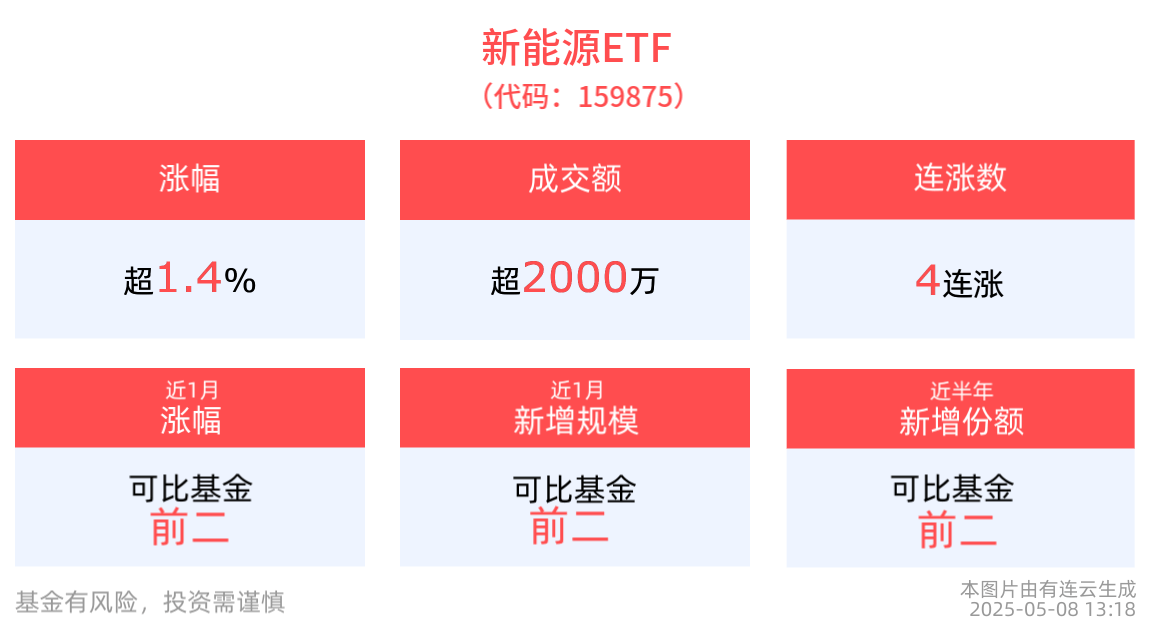
Group 1 - The core viewpoint of the article highlights the significant growth and favorable valuation of the New Energy ETF, which has seen a notable increase in trading volume and fund size, indicating strong investor interest [3] - The New Energy ETF has a turnover rate of 2.42% during trading, with a transaction volume of 22.09 million yuan, and an average daily transaction volume of 36.57 million yuan over the past year, ranking it among the top two comparable funds [3] - The fund's size has increased by 42.11 million yuan in the past month, and its shares have grown by 51 million in the last six months, demonstrating substantial growth [3] Group 2 - The underlying index tracked by the New Energy ETF, the CSI New Energy Index, is currently valued at a historical low with a price-to-book ratio (PB) of 1.99, which is below 87.04% of the time over the past three years, indicating attractive valuation [3] - In the first quarter, China's newly installed photovoltaic capacity reached 59.71 GW, representing a year-on-year growth of 30.5%, with March alone seeing an installation of 20.24 GW, a remarkable increase of 124.39% year-on-year [3] - Analysts suggest that the photovoltaic sector is poised for a recovery in fundamentals, driven by a gradual rebound in demand and supply-side constraints, alongside potential benefits from upcoming reform policies [3] Group 3 - As of April 30, 2025, the top ten weighted stocks in the CSI New Energy Index include CATL, LONGi Green Energy, Sungrow Power Supply, China National Nuclear Power, Three Gorges Energy, TBEA, Eve Energy, Huayou Cobalt, Tongwei Co., and Ganfeng Lithium, collectively accounting for 44.26% of the index [3]




储能大厂工资哪家高?宁德时代人均报酬23.6万、亿纬锂能16万,阳光电源年薪超35万
Sou Hu Cai Jing· 2025-05-08 03:10
出品 | 搜狐财经 作者 | 王泽红 年报季结尾,新能源企业又进入业绩盘点时刻。 回顾2024年,光伏行业洗牌加剧,组件价格大幅下降,造成主产业链企业普遍亏损,但储能业务成为新增长点,整体呈喜忧参半局面。 光伏业务占比较大的企业,即便储能成新增长曲线,但也未能扭转业绩下滑局面,如隆基绿能、通威股份、TCL中环等,去年均亏损。 业务布局以动力电池系统、储能电池系统为主的企业,去年利润则呈增长态势,典型如宁德时代、国轩高科、亿纬锂能等。 在此背景下,新能源企业的人均薪酬和高管薪酬,也随企业业绩上涨或下跌,上下起伏,尤其是高管薪酬的变化,亏损或业绩下滑严重的企业,高管报酬集 体削减呈普遍现象。 搜狐财经以储能为主线,选取了A股40家上市企业,从数据层面管窥新能源行业2024年的风云变化,瑞浦兰钧、中创新航和海辰储能等港股上市企业,并未 列入对比。 此外,比亚迪7771亿元的营收构成中,汽车、汽车相关产品及其他产品营收占比为79.45%,光伏、储能业务均被包含在内,在年报中并未进一步细分。但 从储能电芯销量看,比亚迪处在行业前三之列,所以也被纳入统计。 27家年薪上涨:天齐锂业人均报酬46.87万 40家企业中,有2 ...


【投资视角】启示2025:中国饲料行业投融资及兼并重组分析(附投融资汇总、产业园区和兼并重组等)
Qian Zhan Wang· 2025-05-08 03:09
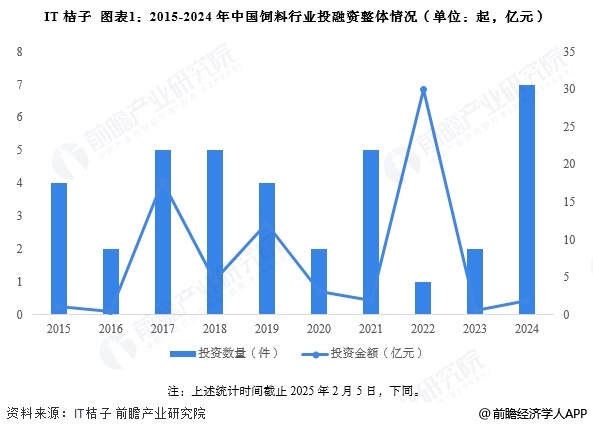
Core Insights - The Chinese feed industry has experienced significant fluctuations in investment and financing activities since 2015, with the highest financing amount reaching 3 billion yuan in 2022 and the most financing events occurring in 2024 with 7 instances [1][2]. Investment Scale - The investment scale in the feed industry is substantial, with the highest single financing amount recorded at 3 billion yuan in 2023, while the second-highest was 1.62 billion yuan in 2017 [2]. Development Stage - The feed industry is currently in a developmental phase, with financing amounts showing volatility. The largest single financing event in 2023 reached 3 billion yuan [2]. Financing Rounds - Financing rounds in the feed industry are primarily concentrated in angel rounds, A rounds, and strategic investments, with 14 angel rounds, 14 A rounds, and 10 strategic investment events recorded [5]. Regional Concentration - Investment activities in the feed industry are concentrated in Beijing, Guangdong, and Jiangsu, with Guangdong leading with 11 financing events, followed by Beijing and Jiangsu with 7 events each [6]. Investment Focus - The main focus of investments in the feed industry from 2021 to 2024 is on feed production, feed usage, and related construction [11]. Investor Composition - The primary investors in the feed industry are investment firms, with notable representatives including Zhongke Kexin and Jizhi Capital, while industrial investors include Guangfa Qianhe and Jinrui Biological [13]. Mergers and Acquisitions - The feed industry has seen horizontal mergers and acquisitions, with companies like Guangdong Feed focusing on acquiring to enhance product quality and output, while companies like Tangrenshen, Dabeinong, and New Hope are improving their supply chains through acquisitions [15][17].