KWEICHOW MOUTAI(600519)

Search documents
白酒板块创16个月来单日最高涨幅
21世纪经济报道· 2026-01-29 07:28
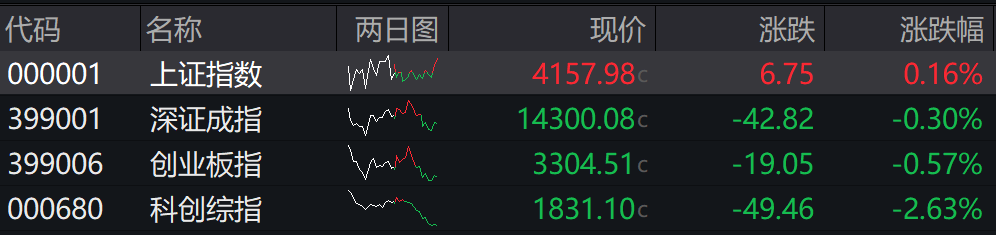
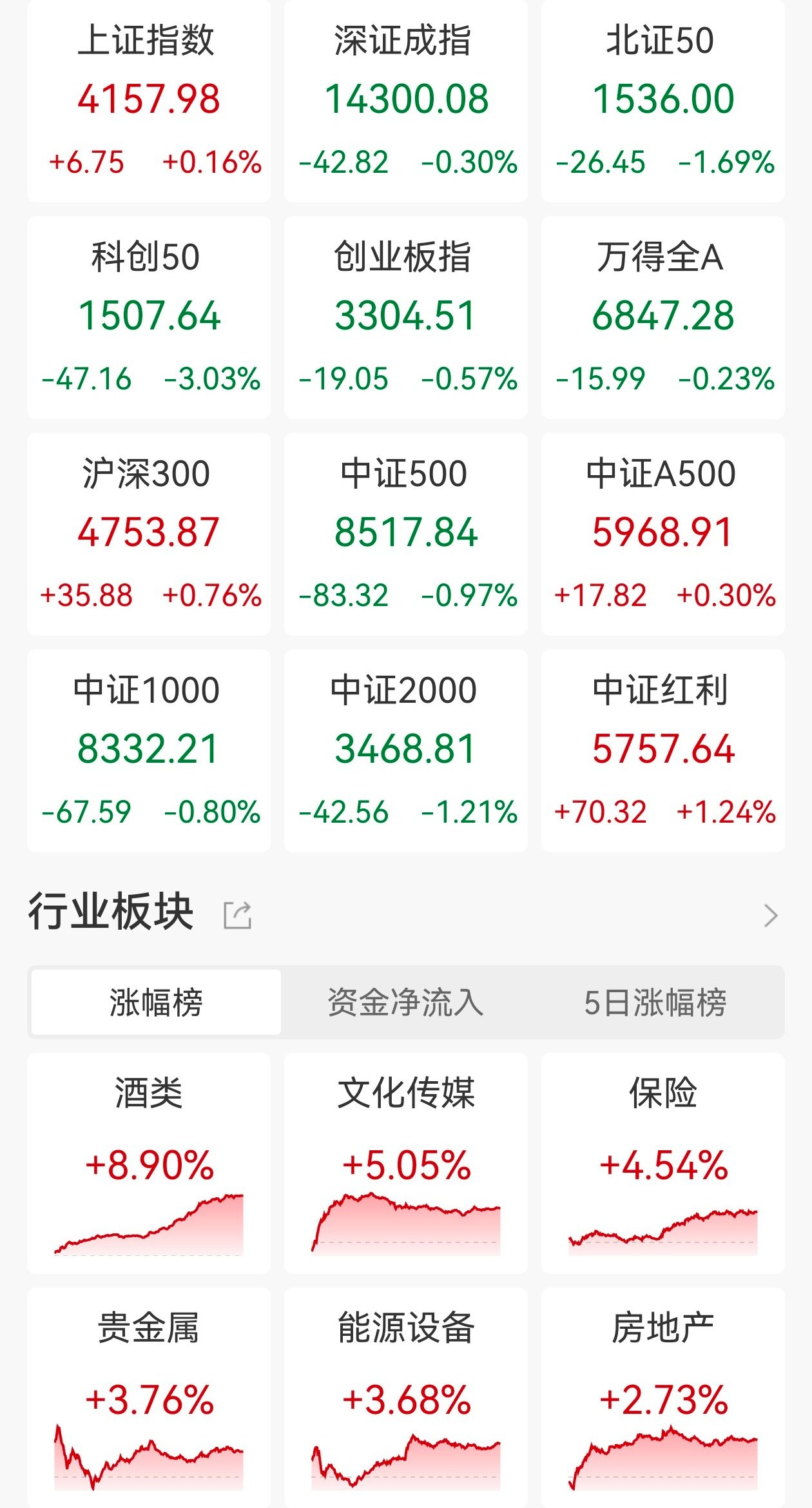
记者丨肖夏 李益文 编辑丨曾静娇 1月29日,三大指数涨跌不一,沪指涨0.16%,创业板指冲高回落,全市场超3500只个股下 跌。 | 上证指数 | 深证成指 | 科创综指 | | --- | --- | --- | | 4157.98 | 14300.08 | 1831.10 | | +6.75 +0.16% -42.82 -0.30% -49.46 -2.63% | | | | 万得全A | 创业板指 | 北证50 | | 6847.28 | 3304.51 | 1536.00 | | -15.99 -0.23% -19.05 -0.57% -26.44 -1.69% | | | | 沪深300 | 中证500 | 中证A500 | | 4753.87 | 8517.84 | 5968.91 | | +35.88 +0.76% -83.32 -0.97% +17.82 +0.30% | | | | 中证1000 | 深证100 | 中证红利 | | 8332.21 | 5854.31 | 5757.64 | | -67.59 -0.80% +6.32 +0.11% +70.32 +1.24% | | | ...



A股收盘|沪指涨0.16% 贵州茅台涨逾8%
Di Yi Cai Jing· 2026-01-29 07:25
Core Viewpoint - The three major stock indices closed mixed, with the Shanghai Composite Index up by 0.16%, while the Shenzhen Component Index and the ChiNext Index fell by 0.3% and 0.57% respectively. The STAR Market Index dropped by 2.63% [1] Group 1: Stock Performance - The liquor sector experienced a surge, with Kweichow Moutai rising over 8% [1] - Gold stocks continued their strong performance, with multiple stocks reaching new highs [1] - AI application themes were active, particularly in the short drama and gaming sectors, leading the market [1] Group 2: Sector Movements - Real estate, insurance, and banking sectors showed notable gains [1] - Semiconductor, computing hardware, commercial aerospace, and humanoid robot concept stocks experienced significant pullbacks [1] Group 3: Market Activity - The total trading volume in the Shanghai, Shenzhen, and Beijing markets reached 32,594 billion yuan, an increase of 2,671 billion yuan compared to the previous day [1] - Over 3,500 stocks in the three markets closed in the red [1]
ETF收评 | 白酒股午后爆拉,酒ETF涨停,两只巴西ETF涨停
Ge Long Hui· 2026-01-29 07:21
Market Performance - The Shanghai Composite Index rose by 0.16%, while the ChiNext Index fell by 0.57% [1] - Liquor stocks experienced a surge, with Kweichow Moutai increasing by over 8% [1] - Gold stocks continued their strong performance, with multiple stocks reaching new highs [1] Sector Highlights - The AI application sector was active, particularly in short drama and gaming, leading the market [1] - Real estate, insurance, and banking sectors showed significant gains [1] - The semiconductor, computing hardware, commercial aerospace, and humanoid robot sectors experienced notable pullbacks [1] ETF Performance - In the afternoon, liquor stocks led to a surge in ETFs, with the Penghua Fund Liquor ETF hitting the daily limit [1] - The Food and Beverage ETFs rose by 7.89% and 7.58%, respectively [1] - Oil and gas stocks were active, with the Fidelity Fund S&P Oil and Gas ETF also hitting the daily limit [1] - Brazilian ETFs from E Fund and Huaxia Fund reached their daily limit [1] - Gold prices reached a historical high, with the Qianhai Kaiyuan Gold ETF and the Jiashi Gold ETF rising by 5.8% [1] Sector Declines - The semiconductor sector declined, with the E Fund Semiconductor Equipment ETF and the Semiconductor Equipment ETF falling by 4.64% and 4.51%, respectively [1] - The consumer electronics sector also adjusted, with the Fidelity Consumer Electronics ETF and the E Fund Consumer Electronics ETF both dropping by 3.49% [1]
罕见!600亿,突袭!刚刚,大面积涨停!茅台,大爆发
券商中国· 2026-01-29 07:20
Core Viewpoint - The article discusses a significant rebound in the liquor sector, particularly in the stock prices of major brands like Kweichow Moutai, driven by rising prices and positive market sentiment towards consumer stocks [1][4]. Group 1: Market Performance - On January 29, Kweichow Moutai's stock surged by 8.6%, with a trading volume exceeding 26 billion yuan. Nearly 20 other liquor stocks, including Jinzhidao and Huangtai, also hit the daily limit [1][4]. - The overall trading volume for the liquor sector surpassed 60 billion yuan on the same day [1]. Group 2: Price Increases - Prices for various types of Moutai have seen notable increases since January 26, with the 2026 Moutai original box (53 degrees/500ml) rising by 55 yuan and the 2025 version by the same amount. The scatter bottles also saw increases of 20 yuan [1][4]. Group 3: Institutional Insights - Huashan Securities noted that the consumer sector has experienced a rare downturn for five consecutive years, leading to a shift in market consensus. Many consumer sub-sectors and leading companies are now at historical valuation levels below 5% to 10% [1]. - Institutions expect limited downside and greater upside potential for leading consumer companies post-2026, as the market narrative shifts from "core assets" to "traditional assets" [1]. Group 4: Policy Support for Consumption - The article highlights that with the introduction of policies focusing on domestic demand and consumption, there is an expectation for a robust recovery in the consumer market starting in early 2026 [2][9]. - The National Development and Reform Commission and the Ministry of Finance have issued guidelines for large-scale equipment updates and consumer goods replacement policies, which are expected to support consumption [2]. Group 5: Broader Market Trends - Besides the liquor sector, other consumer-related sectors such as durable goods and retail also experienced significant gains, indicating a broader market trend towards domestic consumption recovery [9]. - Analysts suggest that the focus on domestic demand will be a key direction for economic growth in 2026, with necessary policy measures to stabilize and enhance consumer spending [9].

收盘丨沪指放量上涨0.16%,白酒、资源股全线爆发
Di Yi Cai Jing· 2026-01-29 07:19
Market Overview - The total trading volume in the Shanghai and Shenzhen markets reached 3.23 trillion yuan, an increase of 264.6 billion yuan compared to the previous trading day [1][6] - The A-share market experienced fluctuations, with the Shanghai Composite Index closing up by 0.16%, while the Shenzhen Component Index and the ChiNext Index fell by 0.3% and 0.57%, respectively [1][2] Sector Performance - The liquor sector saw a surge, with Kweichow Moutai rising over 8%, and nearly 20 stocks in the sector hitting the daily limit [2] - Oil and gas stocks continued to perform strongly, with Intercontinental Oil and Gas achieving five consecutive trading limits in seven days [4] - The semiconductor, computing hardware, commercial aerospace, and humanoid robot sectors experienced noticeable pullbacks [2] Individual Stock Highlights - Notable gainers in the liquor sector included: - Jinzhongzi Wine: +10.04% [3] - Liquor stocks such as Luzhou Laojiao and Wuliangye also saw increases of +10% [3] - In the oil and gas sector, Keli Co., Ltd. surged by 29.99%, while Tongyuan Petroleum and Qianeng Hengxin rose by 20.04% and 20.00%, respectively [5] Capital Flow - Main capital inflows were observed in the media, food and beverage, and real estate sectors, while outflows were noted in the semiconductor, non-ferrous metals, and home appliance sectors [9] - Specific stocks with significant net inflows included Kweichow Moutai (3.339 billion yuan), Bluefocus (2.898 billion yuan), and Wuliangye (1.703 billion yuan) [10] - Conversely, Industrial Fulian, Sungrow Power, and SMIC faced net outflows of 6.531 billion yuan, 1.787 billion yuan, and 1.427 billion yuan, respectively [10] Institutional Insights - Citic Securities noted that the index faces pressure above and support below, emphasizing the need to monitor changes in trading volume [11] - Dexun Securities suggested that the index is likely to maintain narrow fluctuations in the short term [11] - Dongwu Securities indicated that if trading volume effectively supports the market, there is potential for the market to reach new highs in the short term [11]





A股收评 | 白酒突然暴涨!茅台冲击涨停 市场迎三大变局信号
智通财经网· 2026-01-29 07:17
Market Overview - The market showed significant divergence today, with traditional blue-chip sectors like liquor and real estate surging, leading to a substantial rise in the Shanghai Stock Exchange 50 Index, while technology sectors such as semiconductors and chips weakened, resulting in notable declines in the STAR Market and ChiNext Index [1] - The total market turnover reached 3.2 trillion yuan, an increase of over 200 billion yuan compared to the previous trading day, with more than 3,500 stocks declining [1] Key Signals - Three major changes in the market were noted: 1. The simultaneous rise of real estate and liquor stocks indicates potential structural volatility as the market rotates towards these rebound assets [1] 2. The recent surge in commodities, including gold, reflects liquidity trends, while cryptocurrencies have remained relatively subdued, suggesting inflation expectations may significantly impact AI and computing power [1] 3. The unexpected performance of government bonds, particularly the strong showing of 30-year treasury futures, indicates a complex narrative in the market, suggesting that the rotation is not strictly binary [1] Sector Performance - Consumer stocks, particularly liquor and retail, saw a significant afternoon rally, with Kweichow Moutai rising by 8% and several stocks hitting the daily limit [1] - Precious metals and oil and gas stocks experienced volatility but ultimately rallied, with China Gold achieving five consecutive limit-ups and Hunan Gold four consecutive limit-ups [1] - AI application concepts surged, with multiple stocks like Sai Group and Tiandi Online hitting the daily limit [1] - The banking sector also saw gains, with Qingdao Bank hitting the daily limit, while semiconductor, military, and automotive sectors faced the largest declines [1] Fund Flow - Major funds focused on sectors such as advertising, software development, and liquor, with significant net inflows into stocks like BlueFocus, Kweichow Moutai, and iFlytek [3] Future Outlook - Short-term market trends indicate a continued oscillation, with the Shanghai Composite Index expected to maintain an upward trajectory, although space for growth before the Spring Festival appears limited [2][8] - The market sentiment is supported by a weakening US dollar and ongoing monetary easing, which may provide a conducive environment for further capital inflow [7] - The upcoming earnings reports from A-share companies and North American tech giants are anticipated to have a more pronounced impact on market structure [6]




飞天茅台接连涨价!白酒基金LOF(161725)盘中放量大涨近6%
Sou Hu Cai Jing· 2026-01-29 07:11
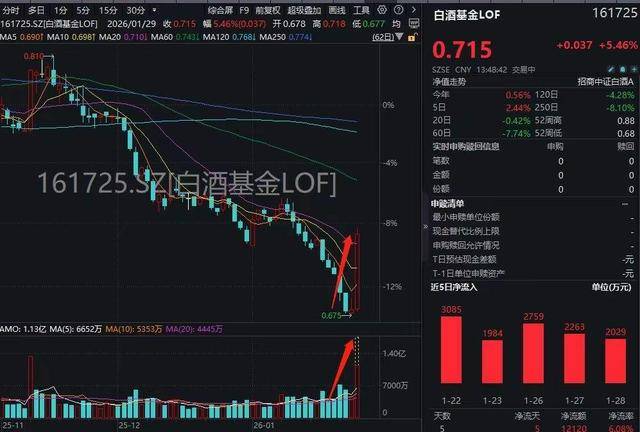
1月29日,白酒股午后持续拉升。数据显示,截至13时49分,表征板块的白酒基金LOF(161725)放量涨 5.46%,一度涨5.90%。 消息面上,飞天茅台价格节前连续上涨,整箱批价突破1600元。第三方报价平台显示,1月29日,2026 年原箱茅台价格单瓶价格上涨20元为1610元/瓶,回升到1600元以上,散瓶的价格保持在1570元/瓶,前 几日茅台的批价还稳定在1550元/瓶左右。记者在"i茅台"平台看到,1499元的普茅连续第29天在多次秒 空后显示售罄。 中信证券认为,2026年来白酒行业发生了较多大事件和变化,推动渠道升级和突破。短期,白酒龙头企 业开始积极拥抱消费者,消费者触达和消费者教育工作热度空前;中部企业适当降价,维持市场量价平 衡;尾部企业停产、出清库存。长期,"以消费者为核心"的渠道协同体系料将成为行业下轮周期中核心 竞争力,需要企业逐步提升拓客能力、服务能力和场景运营能力。新一轮市场培育下,行业整体有望受 益于本轮新消费者获取和消费者教育提升效果。 ...
A股收评:成交额3.26万亿元!三大指数涨跌不一,白酒股爆发贵州茅台涨近9%
Ge Long Hui A P P· 2026-01-29 07:09
Market Performance - The A-share market showed mixed results with the Shanghai Composite Index rising by 0.16% to close at 4157 points, while the Shenzhen Component Index fell by 0.3% and the ChiNext Index decreased by 0.57% [1] - The total market turnover reached 3.26 trillion yuan, an increase of 267.1 billion yuan compared to the previous trading day, with over 3500 stocks declining [1] Sector Highlights - The liquor sector experienced a surge, with Kweichow Moutai's price rising nearly 9%, and over twenty stocks including Wuliangye and Luzhou Laojiao hitting the daily limit [1] - The precious metals sector continued to rise, with spot gold approaching 5600 USD, leading to multiple stocks like Sichuan Gold and Zhaojin Gold hitting the daily limit [1] - AI application stocks collectively surged, with a significant increase in related stocks [1] - The cultural media sector also saw gains, with stocks like Zhejiang Wenlian hitting the daily limit [1] - Insurance stocks were active, with China Pacific Insurance leading the gains [1] - Real estate, oil and gas services, and banking sectors showed notable increases [1] Declines in Specific Sectors - The high-bandwidth memory and SMIC concepts faced declines, with Jingce Electronics dropping nearly 9% [1] - The electronic chemicals sector experienced widespread declines, with Anji Technology falling over 8% [1] - The electronic components and PCB sectors also saw declines, with Yidong Electronics dropping over 11% [1] - Other sectors such as power grid equipment, superconducting concepts, and optical communication modules faced significant downturns [1]


全指现金流ETF鹏华(512130)涨近1.5%,白酒有色领涨市场
Xin Lang Cai Jing· 2026-01-29 07:09
Group 1 - The liquor consumption sector is strengthening in the afternoon, driven by favorable demand during the upcoming Spring Festival, with some distributors of Moutai reporting that their quotas for January and February have sold out [1] - The London Metal Exchange (LME) has seen a broad increase in metal prices, with three-month copper rising by 7.05% to $14,009 per ton, three-month lead up by 1.56% to $2,048.5 per ton, three-month tin increasing by 2.32% to $57,250 per ton, three-month zinc up by 2.87% to $3,460.5 per ton, and three-month nickel rising by 3.05% to $18,828 per ton [1] - CITIC Securities indicates that the liquor industry is preparing for marketing activities during the Spring Festival, with distributors learning from leading companies' experiences in channel and product reforms, which may lead to a focus on market cultivation and consumer education [1] Group 2 - As of January 29, 2026, the CSI All Share Free Cash Flow Index has risen by 1.28%, with stocks like Xinhua Department Store and Luzhou Laojiao both increasing by 10.00% [2] - The CSI All Share Free Cash Flow Index tracks 100 listed companies with high free cash flow rates, reflecting the overall performance of companies with strong cash flow generation capabilities [2] - As of December 31, 2025, the top ten weighted stocks in the CSI All Share Free Cash Flow Index include China National Offshore Oil, SAIC Motor, Gree Electric Appliances, and others, accounting for a total of 53.78% of the index [2]

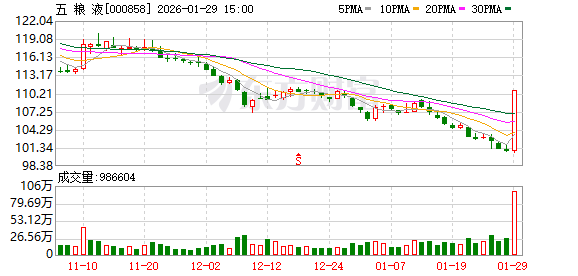
五粮液尾盘触及涨停
Mei Ri Jing Ji Xin Wen· 2026-01-29 07:06
每经AI快讯,五粮液尾盘触及涨停,成交超100亿元,贵州茅台涨超8%,成交超240亿元。 (文章来源:每日经济新闻) ...