JCET(600584)

Search documents
共封装光学(CPO)概念下跌0.11%,7股主力资金净流出超亿元
Zheng Quan Shi Bao Wang· 2025-07-24 08:56
Group 1 - The CPO (Co-Packaged Optics) concept declined by 0.11% as of the market close on July 24, ranking among the top decliners in the concept sector [1] - Notable decliners within the CPO sector include Tai Chen Guang, Shi Jia Guang Zi, and Changxin Bochuang, while the top gainers were Bo Min Electronics, Lian Ying Laser, and Kai Ge Precision Machinery, with increases of 4.47%, 4.30%, and 3.32% respectively [1] - The Hainan Free Trade Zone concept saw the highest increase at 9.11%, followed by the horse racing concept at 4.67% and the duty-free shop concept at 4.46% [1] Group 2 - The CPO sector experienced a net outflow of 2.078 billion yuan, with 50 stocks seeing net outflows, and 7 stocks experiencing outflows exceeding 100 million yuan [1] - The stock with the highest net outflow was Xin Yi Sheng, with a net outflow of 599.16 million yuan, followed by Tian Fu Communication and Zhong Ji Xu Chuang with outflows of 363.12 million yuan and 221.04 million yuan respectively [1] - The stocks with the highest net inflows included Changdian Technology, Sanan Optoelectronics, and Unisplendour, with net inflows of 156 million yuan, 130 million yuan, and 81.52 million yuan respectively [1]


研判2025!中国高纯氨行业产业链、产量、需求量、竞争格局及发展趋势分析:下游市场需求带动,行业规模达到4.7亿元[图]
Chan Ye Xin Xi Wang· 2025-07-23 01:29
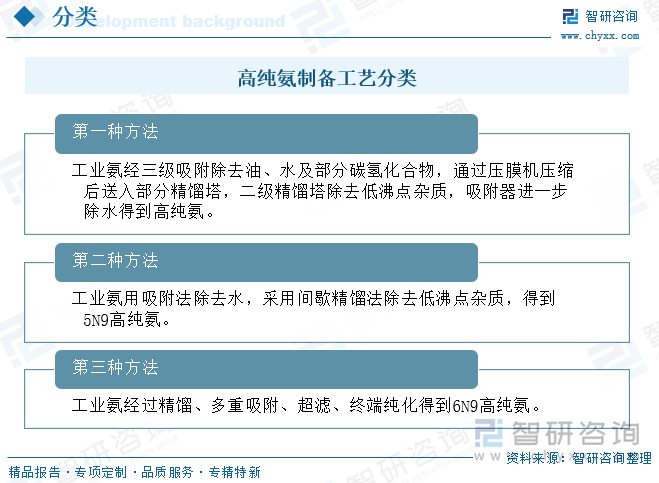
Core Viewpoint - The high-purity ammonia industry in China is experiencing significant growth driven by increasing domestic demand in the semiconductor, photovoltaic, and LCD sectors, supported by government policies aimed at import substitution and technological advancement [1][9][11]. Industry Overview - High-purity ammonia, with a purity of over 99.999%, is essential for producing materials like gallium nitride (GaN) and silicon nitride (Si3N4), which are used in LED and solar cell manufacturing [3][5]. - The production methods for high-purity ammonia include multi-stage adsorption and distillation processes, achieving varying purity levels [3]. Market Demand and Supply - China's high-purity ammonia production is projected to grow from 36,000 tons in 2018 to 62,000 tons by 2024, while demand is expected to reach 61,000 tons in 2024, reflecting a year-on-year increase of 10.9% [1][9]. - The market size for high-purity ammonia is anticipated to reach 470 million yuan in 2024, marking a 6.8% increase from the previous year [11]. Competitive Landscape - The high-purity ammonia market is characterized by high concentration among a few large companies, which possess advantages in production scale, technology, and brand influence [13]. - Key players in the industry include Zhejiang Yindesai Semiconductor Materials Co., Hubei Heyuan Gas Co., and Jinhong Gas Co., among others [13][15]. Government Policies - The Chinese government has implemented various policies to support the development of the high-purity ammonia sector, including the "14th Five-Year Plan for the Development of the Raw Materials Industry," which emphasizes the advancement of high-purity chemicals and industrial gases [5][7]. Future Trends - The semiconductor industry is expected to drive the demand for high-purity ammonia due to the increasing need for high-performance chips in emerging technologies like AI and new energy vehicles [19]. - There is significant potential for domestic substitution in the high-purity ammonia market, as local companies enhance their technological capabilities [20]. - The industry is also moving towards greener production methods in response to carbon neutrality goals, focusing on reducing carbon emissions and energy consumption [21].




爱集微:2024年封测行业上市公司收入同比增长21% 先进封装迎发展机遇
Zheng Quan Shi Bao Wang· 2025-07-21 14:38
Group 1 - The report by Aijimi highlights the growth of the semiconductor packaging and testing industry, projecting a total revenue of 87.056 billion yuan for listed companies in 2024, representing a year-on-year increase of 20.69% with a gross margin of approximately 15.67% [1] - The top three companies by total revenue in the packaging and testing sector are Changdian Technology (35.962 billion yuan), Tongfu Microelectronics (23.882 billion yuan), and Huatian Technology (14.462 billion yuan) [1] - The report indicates that the R&D expenditure as a percentage of revenue is highest for Liyang Chip (15.95%), Jingfang Technology (14.12%), and Weicai Technology (13.22%) [1] Group 2 - The advanced packaging market is expected to generate total revenue of $51.9 billion in 2024, with a year-on-year growth of 10.9%, and is projected to reach $78.6 billion by 2028, with a compound annual growth rate (CAGR) of 10.05% from 2022 to 2028 [2] - The global semiconductor packaging market is forecasted to grow from $65.04 billion in 2020 to $118.6 billion in 2027, with a CAGR of 6.6%, while advanced packaging is expected to surpass traditional packaging in market size by 2027 [2] Group 3 - The domestic packaging and testing industry is performing well, with Chinese companies leading in brand strength, diverse teams, international operations, technical capabilities, quality assurance, production scale, and operational efficiency [3] - In 2023, capital expenditure in the advanced packaging sector reached $9.9 billion, primarily from major semiconductor companies and leading OSAT firms, with an expected increase to $11.5 billion in 2024 [3] - The report emphasizes that the growth of the semiconductor packaging market is driven by emerging technologies such as AI, IoT, cloud computing, and big data, which are increasing the demand for chips [3] Group 4 - The global Chiplet market is projected to grow from approximately $3.1 billion in 2023 to around $107 billion by 2033, with a CAGR of 42.5% from 2024 to 2033 [4] - Companies like Intel and TSMC have mature Chiplet technologies, while domestic firms such as Changdian Technology and Tongfu Microelectronics are also advancing in this area [4] - The 2.5D/3D packaging market is expected to expand from $9.4 billion in 2022 to $22.5 billion by 2028, with a CAGR of 15.6%, driven by high-performance computing and AI technologies [4]


中证汽车半导体产业指数报2925.10点,前十大权重包含北方华创等
Jin Rong Jie· 2025-07-21 13:37
Core Points - The China Securities Automotive Semiconductor Industry Index has shown a positive trend, with a 4.05% increase over the past month, 1.71% over the past three months, and a 5.76% increase year-to-date [1] - The index comprises up to 50 listed companies involved in providing semiconductor materials, equipment, and products for the automotive electrification and intelligence sectors [1] - The index is based on a starting point of 1000.0 points as of December 30, 2016 [1] Index Holdings - The top ten weighted companies in the index include: Northern Huachuang (4.92%), Changdian Technology (4.74%), OmniVision Technologies (4.71%), Zhaoyi Innovation (4.68%), Zhongwei Company (4.66%), Unisoc (4.46%), Sanan Optoelectronics (4.24%), Rockchip (3.3%), Wingtech Technology (3.14%), and Tongfu Microelectronics (3.05%) [1] - The index's market segment distribution shows that the Shanghai Stock Exchange accounts for 72.40%, while the Shenzhen Stock Exchange accounts for 27.60% [1] Industry Composition - In terms of industry composition, integrated circuits represent 58.41%, semiconductor materials and equipment account for 24.91%, discrete devices make up 9.30%, optoelectronics comprise 4.24%, and electronic terminals and components constitute 3.14% [2] - The index samples are adjusted biannually, with adjustments occurring on the next trading day following the second Friday of June and December each year [2] - Weight factors are generally fixed until the next scheduled adjustment, with special circumstances allowing for temporary adjustments [2]




中华交易服务半导体芯片行业指数上涨0.29%,前十大权重包含兆易创新等
Jin Rong Jie· 2025-07-18 14:12
Core Points - The Shanghai Composite Index opened high and rose, with the China Trading Service Semiconductor Chip Industry Index increasing by 0.29% to 8556.02 points, with a trading volume of 38.839 billion yuan [1] - The China Semiconductor Chip Index has risen by 4.03% in the past month, decreased by 2.63% in the past three months, and increased by 1.61% year-to-date [1] - The index aims to track the overall performance of listed companies in the semiconductor chip industry in the Shanghai and Shenzhen markets, covering areas such as semiconductor chip materials, equipment, design, manufacturing, packaging, and testing [1] Index Holdings - The top ten weighted companies in the China Semiconductor Chip Industry Index are: SMIC (9.36%), Northern Huachuang (7.48%), Haiguang Information (6.77%), Cambricon (6.46%), OmniVision (5.69%), Lattice Semiconductor (5.21%), Zhongwei Company (4.24%), Zhaoyi Innovation (4.14%), Changdian Technology (2.58%), and Unisoc (2.44%) [1] - The market share of the index holdings is 77.35% from the Shanghai Stock Exchange and 22.65% from the Shenzhen Stock Exchange [1] Industry Composition - The industry composition of the China Semiconductor Chip Industry Index is 100% in Information Technology [2] - Public funds tracking the China Semiconductor Chip Index include: Guotai CES Semiconductor Chip Industry ETF Link A, Guotai CES Semiconductor Chip Industry ETF Link C, Huaan CES Semiconductor Chip Industry A, Huaan CES Semiconductor Chip Industry C, Western Li De CES Semiconductor Chip Industry Index Enhanced A, Western Li De CES Semiconductor Chip Industry Index Enhanced C, and Guotai CES Semiconductor Chip ETF [2]



国信证券晨会纪要-20250716


Guoxin Securities· 2025-07-16 01:31
Macro and Strategy - June financial data shows a significant rebound in credit, with new social financing reaching 4.20 trillion yuan, exceeding expectations of 3.71 trillion yuan, and new RMB loans at 2.24 trillion yuan, surpassing the forecast of 1.84 trillion yuan [8][9][10] - The M2 money supply grew by 8.3% year-on-year, indicating a recovery in domestic economic momentum as private sector balance sheet expansion improves [8][9] - The "seesaw effect" between government financing and corporate loans has weakened, suggesting a shift in credit dynamics as local governments approach their annual debt targets [9][10] Retail Industry - The jewelry market is projected to grow steadily, with the market size reaching 728 billion yuan in 2024, reflecting a compound annual growth rate of 3.6% since 2019 [11][12] - The top five companies in the jewelry sector hold a market share of 41.4%, indicating increasing industry concentration as consumer preferences shift towards quality and design [11][12] - The retail sector is benefiting from the recent Amazon Prime Day, which generated an estimated $24.1 billion in sales, a 30% increase year-on-year, highlighting the growth potential in cross-border e-commerce [13][14] Food and Beverage Industry - The food and beverage sector saw a 0.92% increase, underperforming the Shanghai Composite Index by 0.17 percentage points [14] - The liquor market is stabilizing, with major brands focusing on brand positioning and market health, while the overall demand remains under pressure [15][16] - Recommendations include leading brands like Kweichow Moutai and Wuliangye, which have shown resilience and potential for recovery [15][16] Construction and Building Materials - The construction materials sector is expected to improve due to a shift towards healthy competition and urban renewal initiatives, with a focus on technological innovation [17][18] - Cement prices have stabilized, with a slight decrease of 0.4% week-on-week, while demand remains steady despite seasonal fluctuations [17][18] - Recommendations include companies like Three Trees and China National Building Material, which are well-positioned to benefit from domestic demand [18] Computer Industry - The AI ASIC market is rapidly expanding, with a projected market size growth from $14.8 billion in 2024 to $83.8 billion by 2030, reflecting a compound annual growth rate of 33.5% [19][20] - The price advantage of AI ASIC chips over GPUs is significant, with average prices of $5,236 compared to $8,001 for GPUs, making them more attractive for specific applications [19][20] - Companies like Google and Amazon are accelerating their development of ASIC chips, indicating strong future demand in this sector [21] Home Appliances - The home appliance sector is experiencing stable growth in domestic sales, driven by government subsidies, while exports face challenges due to high bases and tariff impacts [22][23] - White goods are seeing a slight increase in domestic sales, with air conditioning units showing a 9.5% growth in domestic shipments [22][23] - Recommendations include leading brands such as Midea and Gree, which are expected to maintain strong performance [22][23] Pharmaceutical Industry - Merck's acquisition of Verona for $10 billion aims to enhance its portfolio with a new COPD treatment, indicating strong growth potential in respiratory therapies [27][28] - WuXi AppTec is projected to achieve a 102% increase in net profit for the first half of 2025, reflecting robust operational performance [29] - The pharmaceutical sector is showing resilience, with a focus on innovative treatments and strategic acquisitions [27][28] Coal Industry - The coal market is expected to stabilize as domestic production increases and imports decrease, with a projected production of 4.85 billion tons in 2025, a 2% increase year-on-year [31][32] - Demand for coal is anticipated to improve in the second half of the year, particularly for non-electric uses such as chemical production [33] - Recommendations include leading coal companies like China Shenhua and China Coal Energy, which are well-positioned to benefit from market dynamics [34] Electronics Industry - The electronics sector is experiencing positive momentum, with a 0.93% increase in stock performance, driven by strong demand in the optical and semiconductor segments [34] - The industry is expected to see significant catalysts in the coming months, particularly in the context of AI and cloud computing advancements [34] - Companies involved in ASIC development are likely to benefit from the ongoing trends in computing and data processing [34]
汇丰:中国芯片封装_2025 年放缓:2025 年第三季度重新加速
汇丰· 2025-07-14 00:36
Investment Rating - JCET: Buy, Target Price RMB 46.80, implying 39% upside from current share price [4][6][36] - Tongfu: Hold, Target Price RMB 27.30, implying 8% upside from current share price [5][6][58] Core Insights - The revenue growth of China's OSAT companies is expected to slow in 2Q25 due to order shifts to Taiwanese peers and seasonal factors, but is anticipated to accelerate in 3Q25 driven by recovering consumer electronics demand and government subsidies [3][9] - JCET's revenue growth is projected to be 19% year-on-year in 2Q25, slowing from 36% in 1Q25, but expected to rebound to 24% in 3Q25 [4][28] - Tongfu's non-AMD business is expected to grow faster than its AMD business, with a projected 16% increase in 2025 compared to 9% for the AMD segment [5][51] Summary by Sections JCET - JCET's Apple business is gaining attention with potential upside for SiP modules due to design changes for foldable phones [4] - The company plans a historic high capex of RMB 8.5 billion in 2025 to support growth in advanced packaging and automotive sectors [16][36] - Revenue estimates for JCET have been adjusted, with total revenue expected to be RMB 41.285 billion in 2025, reflecting a 2% decrease from previous estimates [32][33] Tongfu - Tongfu's revenue guidance for 2025 is an 11% increase, with adjustments reflecting a 6% decrease in total revenue estimates [5][54] - The acquisition of a 26% stake in King Long Suzhou is expected to contribute RMB 150-200 million in investment gains from 2025 to 2027 [5][49] - Revenue from Tongfu's non-AMD segment is projected to grow at 16% in 2025, benefiting from foreign customers adopting a "China-for-China" strategy [5][51] Financial Metrics - JCET's net profit CAGR for 2025-27 is estimated at 33%, down from 41% previously, with a target price reduction from RMB 50.00 to RMB 46.80 [4][37] - Tongfu's net profit estimates for 2025 and 2026 have been lowered by 16% and 13% respectively, reflecting challenges in the AMD segment [56][58] - JCET's current valuation is attractive compared to its peers, trading at a 21.5x 2026e PE multiple, below the sector average [36][37]
金易为锡,吴韵风华——无锡产业与资本和合共生的文化密码
Shang Hai Zheng Quan Bao· 2025-07-09 18:22
Core Viewpoint - Wuxi has transformed from a historical industrial city to a modern manufacturing powerhouse through the integration of industry and finance, supported by government policies and local investment institutions [9][10][17]. Group 1: Industrial Development - Wuxi has 211 listed companies, with 124 on the A-share market, contributing significantly to Jiangsu province's economy despite a population of less than 8 million [8]. - The city has developed a "465" modern industrial cluster focusing on IoT, integrated circuits, biomedicine, and software services, producing leading companies like WuXi AppTec and Changdian Technology [8][10]. - Wuxi's industrial evolution is marked by the establishment of key enterprises and the active role of state-owned investment institutions in nurturing these companies [10][11]. Group 2: Financial Integration - Local financial institutions have played a crucial role in supporting industrial growth, with Wuxi's state-owned investment firms actively participating in venture capital and equity investments [10][12]. - Wuxi Venture Capital Group, established in 2000, has invested in numerous companies, with 45 of its portfolio companies listed on domestic A-shares, including 13 on the Sci-Tech Innovation Board [11][12]. - The city has created a comprehensive financial ecosystem that includes various funding stages, from seed to private equity, facilitating the growth of over 110 listed companies [12][16]. Group 3: Policy Support - The local government has shifted from a leading role to a guiding one, providing essential support for companies navigating the capital market [17][18]. - Wuxi has implemented policies to promote mergers and acquisitions, with 15 projects completed in the first quarter of 2023, totaling 369.29 billion yuan [18][20]. - The city aims to become a hub for innovative mergers and acquisitions by 2027, with a target of completing at least 60 projects and achieving a total transaction volume exceeding 600 billion yuan [19][20].




中证国新央企科技引领指数下跌0.22%,前十大权重包含长电科技等
Jin Rong Jie· 2025-07-04 14:45
Group 1 - The core index, the China Securities National New State-Owned Enterprise Technology Leading Index, experienced a slight decline of 0.22%, closing at 1262.6 points with a trading volume of 27.628 billion yuan [1] - Over the past month, the index has increased by 5.31%, while it has seen a 4.44% rise over the last three months, and a negligible decline of 0.01% year-to-date [1] - The index is customized by Guoxin Investment Co., Ltd., comprising 50 listed companies in sectors such as aerospace, defense, computer, electronics, semiconductors, and communication equipment [1] Group 2 - The top ten weighted stocks in the index include Hikvision (9.46%), AVIC Shenyang Aircraft (6.92%), AVIC Optoelectronics (6.58%), Changjiang Electronics (6.49%), and others [1] - The index's holdings are primarily listed on the Shanghai Stock Exchange (58.27%) and the Shenzhen Stock Exchange (41.73%) [1] - The industry composition of the index shows that information technology accounts for 49.75%, industrials for 39.66%, and communication services for 10.59% [2] Group 3 - The index samples are adjusted biannually, with adjustments occurring on the next trading day after the second Friday of June and December [2] - In special circumstances, the index may undergo temporary adjustments, such as when a sample company is delisted or undergoes mergers or acquisitions [2] - Public funds tracking the index include various funds from E Fund, Yinhua, and Southern Asset Management [2]
芯火三十年:纵横四海(2013-2021)
3 6 Ke· 2025-07-03 07:27
Core Viewpoint - The Chinese semiconductor industry has undergone significant development from 2000 to 2021, driven by the collaboration of national, corporate, and financial forces, culminating in a complex landscape shaped by globalization and subsequent challenges from geopolitical tensions [2][57]. Group 1: Historical Development - From 2000 to 2012, the Chinese semiconductor industry entered its "root and sprout" phase, establishing an initial industrial chain [1]. - The year 2014 marked a pivotal moment with the establishment of the National Integrated Circuit Industry Investment Fund, which provided essential financial support for the industry [4][6]. - Between 2014 and 2017, this financial influx accelerated the growth of Chinese semiconductor companies through mergers, acquisitions, and investments, integrating them into the global supply chain [1][5]. Group 2: Financial Forces - The emergence of various financial institutions, such as Zhilu Capital and Wuyuefeng Capital, provided market-oriented investment capabilities, enhancing the ability to acquire overseas semiconductor firms [8][10]. - Notable acquisitions included the purchase of Rui Neng Semiconductor for 800 million RMB, which significantly advanced China's position in the power semiconductor sector [9]. - The establishment of the Zhongguancun Rongxin Industrial Alliance in 2015 facilitated collaboration among various investment institutions, enhancing the success rate of overseas acquisitions [22]. Group 3: Corporate Forces - Major corporations like Unisoc and Changjiang Electronics have expanded their influence through strategic acquisitions, such as Unisoc's purchase of RDA Microelectronics for 910 million USD, enhancing its capabilities in mobile communication chips [13][31]. - The collaboration between large enterprises and national funds has enabled significant mergers, such as Changjiang Electronics' acquisition of STATS ChipPAC for 780 million USD, positioning it among the top semiconductor packaging and testing companies globally [11][13]. - The rapid growth of these companies has contributed to the establishment of a competitive landscape in the semiconductor industry, with firms like Unisoc becoming a leading player in the global market [13][31]. Group 4: Challenges and Adjustments - The period from 2018 to 2020 saw increasing challenges due to U.S. sanctions and trade tensions, which hindered the ability of Chinese companies to pursue overseas acquisitions [39][46]. - The establishment of the second phase of the National Integrated Circuit Industry Investment Fund in 2019 aimed to strengthen domestic capabilities and support key sectors like IC design and AI [47][48]. - By 2021, the focus shifted towards restructuring and preparing for a new phase of development, as the global landscape for semiconductor investments became increasingly restrictive [56][54]. Group 5: Future Outlook - The Chinese semiconductor industry is entering a phase of self-reliance and independence, with a focus on enhancing domestic capabilities and reducing reliance on foreign technology [57]. - The collaboration among national, corporate, and financial forces is expected to continue driving innovation and growth in the sector, despite external pressures [57].