Workflow
ACC(600585)
icon
Search documents
2.33亿主力资金净流入,水泥概念涨1.75%
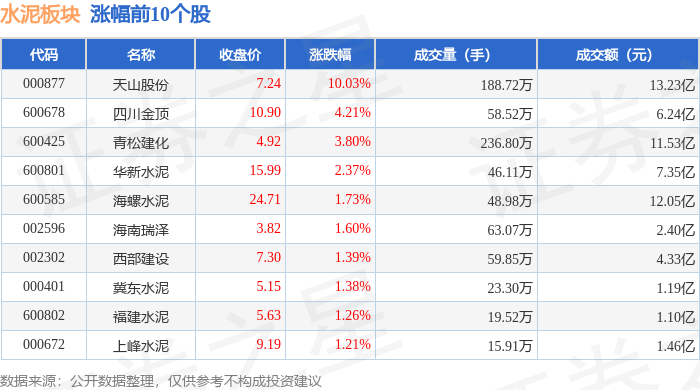
Group 1 - The cement sector saw an increase of 1.75%, ranking 8th among concept sectors, with 32 stocks rising, including Sifang New Material and Sichuan Shuangma hitting the daily limit [1] - Notable gainers in the cement sector included Tibet Tianlu, Zhongtai Chemical, and Jinyu Group, which rose by 3.77%, 3.44%, and 2.53% respectively [1] - The sector experienced a net inflow of 233 million yuan, with 16 stocks receiving net inflows, and 8 stocks exceeding 10 million yuan in net inflow [2] Group 2 - The top net inflow stock was Sichuan Shuangma, with a net inflow of 113 million yuan, followed by China Energy Construction, Conch Cement, and Tibet Tianlu with net inflows of 93.47 million yuan, 66.49 million yuan, and 32.38 million yuan respectively [2][3] - The net inflow ratio for Sifang New Material, Sichuan Shuangma, and Ordos was 70.30%, 14.96%, and 14.27% respectively [3] - The trading volume and turnover rates for key stocks in the cement sector were highlighted, with Sichuan Shuangma showing a trading increase of 9.98% and a turnover rate of 5.00% [3][4]
沪深300建材指数报6031.14点,前十大权重包含海螺水泥等
Jin Rong Jie· 2025-07-09 08:08
Group 1 - The A-share market indices closed mixed, with the CSI 300 Construction Materials Index reported at 6031.14 points [1] - The CSI 300 Construction Materials Index has decreased by 2.36% over the past month, 9.83% over the past three months, and 5.89% year-to-date [1] - The CSI 300 Index categorizes its 300 sample stocks into 11 primary industries, 35 secondary industries, over 90 tertiary industries, and more than 200 quaternary industries [1] Group 2 - The CSI 300 Construction Materials Index is composed entirely of stocks from the Shanghai Stock Exchange, with a 100% allocation [1] - The index's holdings are exclusively in the cement and concrete sector, also with a 100% allocation [1] - The index samples are adjusted biannually, with adjustments occurring on the next trading day after the second Friday of June and December [2]
建筑材料行业周报:把握“反内卷”和“电子布”双主线-20250708
Hua Yuan Zheng Quan· 2025-07-08 09:44
Investment Rating - The investment rating for the construction materials industry is "Positive" (maintained) [4] Core Views - The "anti-involution" trend may drive the cement industry's supply and demand to bottom out earlier. The Central Financial Committee emphasized the need to regulate low-price competition and improve product quality, which may lead to a reduction in actual cement production capacity from over 2.1 billion tons in 2023 to 1.7 billion tons, potentially restoring capacity utilization rates to over 70% [5][18] - The demand for high-end electronic fabrics is underestimated due to the surge in computing power driven by AI. The need for advanced materials is increasing, with domestic companies achieving breakthroughs in Low-DK and Low-CTE electronic fabrics, indicating a significant growth opportunity in this sector [5] Summary by Sections 1. Sector Tracking - The construction materials index rose by 4.0%, outperforming the Shanghai Composite Index, which increased by 1.4% [9] - Key stocks with significant gains include Zaiseng Technology (+37.1%), Honghe Technology (+23.9%), and Zhongcai Technology (+20.7%) [9] 2. Data Tracking 2.1 Cement - The average price of 42.5 cement nationwide is 348.5 RMB/ton, down 4.5 RMB/ton month-on-month and down 40.8 RMB/ton year-on-year [18] - The cement inventory ratio is 65.7%, down 0.4 percentage points month-on-month and down 2.0 percentage points year-on-year [18] 2.2 Float Glass - The average price of 5mm float glass is 1274.3 RMB/ton, down 4.6 RMB/ton month-on-month and down 438.8 RMB/ton year-on-year [39] - The total inventory of key production enterprises in 13 provinces is 59 million heavy boxes, down 2.5% month-on-month and up 7.7% year-on-year [39] 2.3 Photovoltaic Glass - The average price of 2.0mm coated photovoltaic glass is 10.7 RMB/sqm, down 0.6 RMB/sqm month-on-month and down 4.6 RMB/sqm year-on-year [44] - The number of production lines for photovoltaic glass is 435, with a total daily melting capacity of 94,390 tons, down 4.0% month-on-month and down 17.0% year-on-year [44] 2.4 Glass Fiber - The average price of alkali-free glass fiber yarn is 4680.0 RMB/ton, unchanged month-on-month and up 15.0 RMB/ton year-on-year [52] - The average price of electronic yarn is 9100.0 RMB/ton, unchanged month-on-month and down 50.0 RMB/ton year-on-year [52] 2.5 Carbon Fiber - The average price of large tow carbon fiber is 72.5 RMB/kg, unchanged month-on-month and down 5.0 RMB/kg year-on-year [56] - The average operating rate of carbon fiber enterprises is 59.94%, down 0.19 percentage points month-on-month and up 13.54 percentage points year-on-year [56] 3. Investment Analysis - The investment strategy suggests that 2025 will be a turning point for listed companies, while 2026 will be a turning point for the industry. The report recommends focusing on companies in the high-growth sectors and those benefiting from the Belt and Road Initiative [5]
中证800原材料主题指数报2899.41点,前十大权重包含中国铝业等
Jin Rong Jie· 2025-07-08 08:25
Group 1 - The core viewpoint of the news is the performance of the CSI 800 Materials Theme Index, which has shown significant growth over various time frames, indicating a positive trend in the materials sector [1][2] - The CSI 800 Materials Theme Index reported a value of 2899.41 points, with a 3.48% increase over the past month, a 12.06% increase over the past three months, and an 8.07% increase year-to-date [1] - The index is composed of listed companies in the materials sector selected from the CSI 800 Index, reflecting the overall performance of these companies [1] Group 2 - The top ten weighted companies in the CSI 800 Materials Theme Index include Zijin Mining (12.74%), Wanhua Chemical (4.0%), and Yilong Co. (2.48%), among others [1] - The market share of the index's holdings is predominantly from the Shanghai Stock Exchange (65.19%) and the Shenzhen Stock Exchange (34.81%) [1] - In terms of industry composition, non-ferrous metals account for 50.67%, chemicals for 32.62%, steel for 8.63%, non-metallic materials for 6.87%, and paper and packaging for 1.22% [2] Group 3 - The index samples are adjusted biannually, with adjustments occurring on the next trading day after the second Friday of June and December [2] - Weight factors are generally fixed until the next scheduled adjustment, with special circumstances allowing for temporary adjustments [2] - Companies that are delisted or undergo mergers, acquisitions, or splits are handled according to specific calculation and maintenance guidelines [2]
海外水泥专题:海外水泥的纸黄金与真功夫
Investment Rating - The report maintains an "Overweight" rating for the cement industry, indicating a significant expansion of overseas production capacity from 45.03 million tons in 2021 to 87.59 million tons by 2024, with overseas cement business becoming a crucial part of profitability for some companies by 2023-2024 [3][7][25]. Core Insights - The period from 2021 to 2024 is identified as a rapid expansion phase for Chinese cement companies venturing overseas, with a potential differentiation in profitability expected post-2025 based on operational capabilities and site selection [2][3][6]. - The report emphasizes that the ability to convert high overseas cement prices into actual profitability remains a point of contention in the market, highlighting the importance of operational mechanisms and internal capabilities in determining success [3][8]. - Recommended stocks include Huaxin Cement and Conch Cement, with Western Cement as a related stock [8]. Summary by Sections 1. Investment Story - Post-2020, domestic cement companies are accelerating overseas capacity construction as domestic demand reaches a ceiling, with a focus on how overseas operations can enhance profit elasticity [6][24]. 2. Global Cement Overview - Cement demand growth is primarily driven by urbanization and population growth, with significant demand observed in regions like Southeast Asia and North Africa, characterized by a fragmented industry structure and intense price competition [10][13][20]. 3. Cement Going Overseas: Endowments and Internal Capabilities - The report notes that the expansion of overseas production capacity is led by companies with superior market mechanisms, with a focus on site selection as a critical internal capability for profitability [7][25][29]. 4. Dollar Resilience Eases, Overseas Profitability Expected to Improve - The report discusses the financial performance of Dangote Cement, highlighting that despite currency depreciation, the company maintains a relatively high profitability level compared to domestic averages [40][41]. - It also addresses the impact of foreign currency liabilities on profit margins, emphasizing the need for effective management to mitigate exchange rate risks [42][44]. 5. Financial Perspective - The report illustrates how exchange rate fluctuations can significantly affect profitability, particularly for companies with substantial foreign currency debt, and suggests that effective management of this exposure can enhance actual profitability [8][42][45].
反内卷政策落地加速构建水泥等行业供需新平衡
Dongxing Securities· 2025-07-07 11:04
Investment Rating - The report maintains a "Positive" investment rating for the building materials industry, indicating an expected performance that is stronger than the market benchmark by over 5% [2][19]. Core Insights - The implementation of anti-involution policies is accelerating the establishment of a new supply-demand balance in the cement and related industries, promoting high-quality development [4][5]. - The central government's emphasis on preventing low-price disorderly competition and enhancing product quality is a significant driver for the industry's transformation [3][4]. - The cement industry is expected to see a gradual increase in the enforcement of anti-involution policies, which will optimize supply and reduce excess capacity [5][6]. Summary by Sections Policy Impact - The anti-involution policy, first proposed in mid-2024, is being progressively implemented, with the aim of curbing vicious competition and promoting healthy industry growth [4][6]. - The cement association has issued guidelines to ensure that companies with actual capacities exceeding registered capacities comply with new regulations, which will help control supply [5]. Industry Dynamics - The cement industry is currently facing a challenging environment due to declining demand and intense competition, leading to a significant number of smaller companies being eliminated from the market [6]. - The report highlights that the ongoing competition and the implementation of anti-involution policies will lead to a more favorable market environment, allowing for the survival of stronger companies [6]. Market Performance - The building materials industry has a total market capitalization of approximately 685.91 billion, with an average price-to-earnings ratio of 54.11 [6]. - The report suggests that the combination of supply-side optimization and demand recovery will create a new balance in the industry over the next 3-6 months [11]. Investment Recommendations - The report recommends focusing on leading companies in the cement sector, such as Conch Cement, and suggests monitoring other strong players like Shengfeng Cement and China National Building Material [11].
周观点:供给端重现预期,需求端关注升级-20250706
Investment Rating - The report maintains a positive outlook on the building materials industry, particularly highlighting the recovery potential in the consumption building materials sector and the cement industry [2][4]. Core Insights - The building materials industry has seen a resurgence in attention since July 1, driven by expectations of supply-side improvements and demand upgrades, particularly in the cement and glass sectors [2][4]. - The cement industry is expected to benefit from policies aimed at limiting overproduction, while the glass industry is experiencing changes due to reductions in production capacity and demand fluctuations [2][9]. - The waterproofing sector has seen unprecedented price increases among leading companies, indicating a potential recovery in profitability [3][5]. - AI demand is reshaping market expectations, particularly in the low dielectric cloth segment, which is expected to see continued product premium during the upgrade process [3][26]. Summary by Sections Consumption Building Materials - The logic of improving market dynamics is beginning to materialize, with price communication among companies becoming more favorable [5]. - The waterproofing industry has seen a significant price increase among leading firms, indicating a recovery in profitability [5][6]. - The report anticipates that profitability recovery will outpace revenue growth in 2025, driven by cost reductions and stabilized pricing [5]. Cement - The cement industry is experiencing a "reverse involution" with policies aimed at limiting overproduction, which is expected to stabilize prices [9][11]. - Demand remains weak, with a notable decline in production and sales, but the industry is expected to see a recovery in profitability as supply-side adjustments take effect [11][12]. - The report likens the supply-demand dynamics in the cement industry to a "tortoise and hare" race, where supply adjustments may lead to improved profitability despite weak demand [12][14]. Glass - The float glass market is currently facing pressure with prices remaining low and demand weak, leading to cash flow challenges for many companies [17][24]. - The report highlights that the photovoltaic glass sector is entering a cash loss zone, prompting accelerated cold repairs among manufacturers [24][25]. - The automotive glass segment is expected to maintain stable profitability due to product structure improvements and cost optimization [21][22]. Fiberglass - The demand for low dielectric cloth is expected to increase due to the AI industry's growth, with companies positioned well for product upgrades [26][27]. - The report notes that mainstream electronic cloth products are performing steadily, with potential price increases anticipated in the future [27][28]. Carbon Fiber - The wind power sector is seeing a recovery in demand, which is expected to lead to improved profitability in Q2 [32].
国泰海通建材鲍雁辛-周观点:供给端重现预期 需求端关注升级
Xin Lang Cai Jing· 2025-07-06 10:33
Group 1: Industry Overview - The construction materials industry has seen a significant increase in attention since July 1, driven by unexpected changes on the supply side and a focus on demand upgrades for the end of 2024 [1][2] - The cement industry is experiencing a "de-involution" policy expectation, with a focus on limiting overproduction and improving regulatory oversight [2][10] - The demand side is shifting, with AI-related demand expected to accelerate, positively impacting various segments of the industry [3][27] Group 2: Consumer Building Materials - The consumer building materials sector is witnessing a rare price increase in the waterproofing industry, indicating a potential recovery in profitability [4][5] - Companies like Sanke Tree and Dongfang Yuhong are showing improved profitability through cost reduction and price increases, validating earlier industry reports [4][5] - The outlook for 2025 suggests that profitability recovery will outpace revenue growth, with expectations of reduced price competition and improved cost management [4][5] Group 3: Cement Industry - The cement industry is expected to see a recovery in profitability as supply-side adjustments take effect, with a focus on limiting production and improving cash flow [10][12] - Major companies like Conch Cement and Huaxin Cement are expected to maintain strong cash flow and dividend policies, indicating long-term investment value [11][16][17] - The industry's overall profitability is anticipated to improve as demand stabilizes and production constraints are implemented [12][15] Group 4: Glass Industry - The float glass market is experiencing price fluctuations due to supply-demand imbalances, with expectations of cash losses for many companies [19][20] - Companies like Xinyi Glass and Qibin Group are facing challenges but are expected to maintain stable profitability in their automotive glass segments [21][22] - The photovoltaic glass sector is entering a cash loss phase, prompting accelerated cold repairs and production adjustments [25][26] Group 5: Fiber Industry - The fiberglass sector is seeing stable demand for mainstream electronic yarns, with a focus on high-end products like low-dielectric cloth [27][28] - Companies like China Jushi are expanding production capacity overseas to mitigate trade risks and maintain growth [29][30] - The carbon fiber market is showing signs of recovery in wind power demand, with expectations of improved profitability in Q2 [32]
行业周报:“反内卷”持续推进,关注建材投资机会-20250706
KAIYUAN SECURITIES· 2025-07-06 08:10
Investment Rating - The investment rating for the construction materials industry is "Positive" (maintained) [1] Core Views - The ongoing "anti-involution" initiative is expected to improve the fundamentals of the construction materials industry, with a focus on enhancing product quality and phasing out outdated production capacity [3] - The report highlights specific companies to watch, including SanKeTree, Dongfang Yuhong, Weixing New Materials, and Jianlang Hardware, as well as beneficiaries like Beixin Building Materials [3] - The cement sector is projected to benefit from energy-saving and carbon reduction initiatives, with a target to control cement clinker capacity to around 1.8 billion tons by the end of 2025 [3] Market Performance - The construction materials index increased by 3.96% in the week from June 30 to July 4, outperforming the CSI 300 index by 2.42 percentage points [4][13] - Over the past three months, the CSI 300 index rose by 8.01%, while the construction materials index only increased by 2.47%, indicating a lag of 5.55 percentage points [4][13] - In the past year, the CSI 300 index has risen by 16.06%, compared to an 11.69% increase in the construction materials index, resulting in a 4.38 percentage point underperformance [4][13] Cement Sector - As of July 4, 2025, the average price of P.O42.5 bulk cement was 293.11 RMB/ton, reflecting a 1.97% decrease from the previous period [6][24] - The clinker inventory ratio nationwide was 68.18%, down by 1.18 percentage points [6][25] - Regional price variations were noted, with the Northeast region remaining stable, while other regions like North China and Southwest saw declines of 4.13% and 6.58%, respectively [6][24] Glass Sector - The average price of float glass was 1201.35 RMB/ton as of July 4, 2025, showing a slight increase of 0.07% [6][74] - The inventory of float glass decreased by 1.17%, with a total of 58.31 million weight boxes reported [6][76] - The price of photovoltaic glass fell by 3.88%, with an average price of 116.02 RMB/weight box [6][81] Fiberglass Sector - The price of non-alkali 2400tex direct yarn ranged from 3400 to 4100 RMB/ton, with variations based on specific product types [6] - The fiberglass sector is expected to benefit from favorable tariffs for companies with overseas production bases [3] Consumer Building Materials - The report indicates that raw material prices for consumer building materials have remained relatively stable with slight fluctuations [6][5]
水泥行业“反内卷”点评:“反内卷奏乐",周期"起舞"
Hua Yuan Zheng Quan· 2025-07-03 09:18
Investment Rating - The industry investment rating is "Positive" (首次) [1] Core Viewpoints - The report emphasizes the importance of addressing low-price and disorderly competition in the cement industry, as highlighted in the Central Financial Committee's meeting on July 1 [5] - The China Cement Association has issued guidelines to promote "anti-involution" and "stable growth" in the industry, focusing on aligning actual production capacity with registered capacity [5] - The report notes that while peak-shifting production has helped balance supply and demand, it has limitations, especially when demand declines rapidly [5] - The implementation of policies to address overcapacity is expected to accelerate the exit of inefficient production capacity, potentially reducing actual clinker capacity from over 2.1 billion tons to 1.7 billion tons [5] - The supply-demand dynamics are expected to improve marginally, leading to a recovery in profitability, supported by lower coal prices and a slowdown in demand decline [5] - The report suggests that the industry's anti-involution awareness is strong, with leading companies collaborating to maintain prices, indicating a favorable outlook for profitability [5] Summary by Sections Industry Overview - The report discusses the recent emphasis on regulating low-price competition and enhancing product quality in the cement industry [5] - It highlights the need for companies to verify discrepancies between registered and actual production capacities [5] Market Dynamics - Peak-shifting production has been effective but faces challenges in maintaining discipline among smaller firms [5] - The report anticipates that strict enforcement of overcapacity policies could lead to significant reductions in actual production capacity [5] Profitability Outlook - The overall profitability of the industry is projected to be better than in 2015, with current trends indicating a recovery in profitability due to favorable coal prices [5] - The report suggests that the combination of capacity reduction and potential mergers will support profitability in the long term [5] Investment Recommendations - The report recommends focusing on companies such as Conch Cement, Huaxin Cement, and Shifeng Cement, given the positive outlook for the industry [5]