GXED(600617)

Search documents
COP30候任主席:中国新能源产业助力全球经济绿色转型
Xin Hua Wang· 2025-08-02 01:30
Core Points - The chair of COP30, Andre Correa Dourado, praised China's role in the global green transition through its renewable energy industry [1] - China has made significant contributions in technological advancements and the large-scale application of green products, particularly in solar, wind, and electric vehicle sectors [1] - The production capabilities of China have led to reduced costs for renewable energy products, making them more affordable for developing countries [1] - COP30 will focus on the green transition of economies worldwide, emphasizing the need for countries to commit to climate goals outlined in the Paris Agreement [1] - The conference is scheduled to take place in November in Belem, Brazil, with Dourado appointed as the chair earlier this year [1]

【环球财经】COP30候任主席:中国新能源产业助力全球经济绿色转型
Xin Hua She· 2025-08-01 14:01
Core Viewpoint - The upcoming COP30 conference will focus on the green transformation of economies, with a strong emphasis on the role of China's renewable energy industry in facilitating global economic shifts towards sustainability [1]. Group 1: China's Contribution to Renewable Energy - China has made significant contributions to technological advancements and the large-scale application of green products, particularly in solar energy, wind energy, and electric vehicles [1]. - The country possesses leading technologies in the renewable energy sector and has leveraged its strong production capabilities to reduce the costs of related products and solutions [1]. - Chinese-produced electric vehicles and lithium batteries enable developing countries to pursue green transformation at more affordable prices [1]. Group 2: COP30 Conference Focus - The COP30 conference, scheduled for November in Belém, Brazil, will prioritize the commitment of countries to green economic transformation in order to meet the climate goals outlined in the Paris Agreement [1]. - André Correa do Lago, the appointed chair of COP30, emphasized the need for countries to work harder for a common future for humanity [1].
机构:市场规模扩大推动中国新能源商用车出口增长逾两倍
news flash· 2025-07-31 06:32
Group 1 - The core viewpoint of the article highlights that the export volume of China's new energy commercial vehicles is expected to increase significantly, with a projected year-on-year growth of 230% in the first half of 2025 [1] - The broader market growth is reflected in the estimated doubling of new energy commercial vehicle sales outside of China this year, reaching approximately 450,000 units [1]
乘联分会:今年7月1日—27日全国新能源乘用车市场零售同比增长15%
Bei Jing Shang Bao· 2025-07-30 10:13
Core Insights - The retail sales of new energy passenger vehicles in China reached 789,000 units from July 1 to July 27, representing a year-on-year increase of 15%, but a month-on-month decline of 17% [1] - Cumulatively, the retail sales for the year amount to 6.258 million units, showing a year-on-year growth of 31% [1] - The wholesale of new energy passenger vehicles by manufacturers totaled 816,000 units, marking a year-on-year increase of 17%, but a month-on-month decline of 20% [1] - Year-to-date wholesale figures stand at 7.264 million units, reflecting a year-on-year increase of 35% [1]
从汽车大国迈向汽车强国 中国新能源汽车产业“攥指成拳”向“新”提“智”
Yang Shi Wang· 2025-07-30 04:20
Group 1 - A new central enterprise, China Changan Automobile Group Co., Ltd., was established in Chongqing on July 29 [1] - The new central enterprise has 117 subsidiaries and focuses on complete vehicles, auto parts, sales, financial and logistics services, and motorcycles [3] - The group aims to develop smart vehicles, flying cars, and embodied intelligence, while exploring a multi-dimensional transportation ecosystem and accelerating globalization in five major regions [3] Group 2 - The restructuring is a significant step in promoting central enterprise reform and optimizing state-owned capital layout, enhancing the competitiveness of China's automotive industry [4] - The three major central automotive enterprises will better support the high-quality development of the intelligent connected new energy vehicle industry and accelerate the creation of globally competitive brands [4] - The transition from a major automotive nation to a strong automotive nation is a critical mission for Chinese automotive companies, focusing on green, low-carbon, and intelligent products to stimulate domestic demand [4] Group 3 - The State-owned Assets Supervision and Administration Commission (SASAC) has initiated separate assessments for central enterprises in the new energy vehicle sector, considering operational losses during the strategic investment phase [5][7] - The assessments will focus on new energy vehicle technology, market share, and future development, particularly in next-generation battery systems and intelligent driving systems [7] Group 4 - The three major central automotive enterprises have seen significant increases in new energy vehicle sales this year, with China FAW's sales up 95.5%, Changan's new energy vehicle sales accounting for 33.1%, and Dongfeng's sales growing by 33% [10] - Alongside sales growth, these enterprises are increasing R&D investments in new energy vehicles and accelerating their transition to intelligent systems [12] Group 5 - The automotive industry has witnessed multiple consolidation cases this year, with several companies integrating to strengthen their new energy vehicle sectors [13] - Recent mergers include Geely and Zeekr, which aim to create synergies across technology, products, supply chains, and international market expansion [15] - Other companies, such as SAIC and GAC, are also restructuring their teams and R&D systems to enhance their competitive edge in the market [15]

从“跟随”到“引领” 中国新能源汽车“加速跑”刷新圈速纪录
Yang Shi Wang· 2025-07-29 06:01
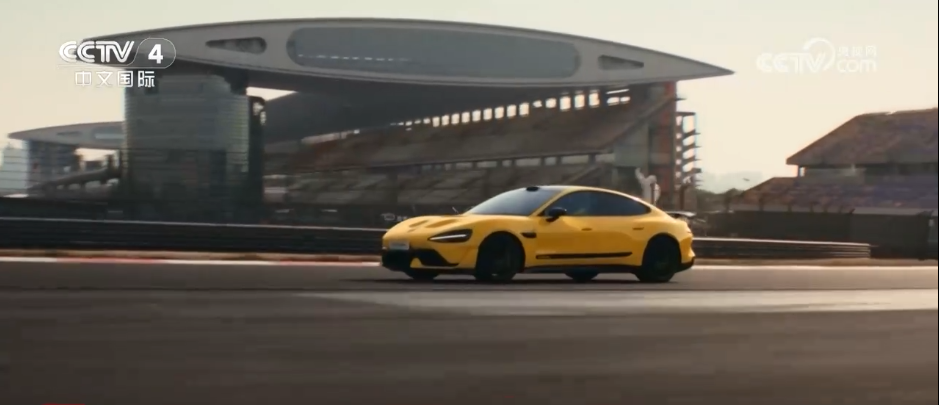
Core Viewpoint - The Chinese new energy vehicle (NEV) industry has transformed from "cost-performance" to "technology benchmark" since the "14th Five-Year Plan," marking its rise as a national strategic pillar industry [1]. Group 1: Achievements in Performance - The Xiaomi Automotive's production version SU7 Ultra set a new record at the Nürburgring Nordschleife with a lap time of 7 minutes 04.957 seconds, breaking the previous record held by European and American brands for seven years [3]. - The achievement at the Nürburgring reflects the outstanding technical capabilities of China's electric vehicle sector and showcases the accomplishments of the Chinese automotive industry on the international stage [3]. Group 2: Technical Challenges of the Nürburgring - The Nürburgring is renowned for its challenging 20.832-kilometer track, featuring over 177 turns and a height difference of 300 meters, which demands high levels of driving skill and vehicle performance [5]. - The track serves as a benchmark for speed, technology, and courage, making it a critical testing ground for automotive companies aiming to develop high-performance and high-safety vehicles [7]. Group 3: Engineering and Innovation - The record-breaking performance is a result of extensive testing and meticulous optimization of vehicle components, supported by a strong engineering team and technological capabilities [9]. - The success of Chinese NEVs at the Nürburgring signifies a shift from "electrification popularization" to "high performance + intelligence," indicating a transition of the Chinese automotive industry from "following" to "leading" [9]. Group 4: Future Outlook - To transition from a major automotive nation to a strong automotive power, China must focus on independent technological innovation while maintaining supply chain advantages and product competitiveness [11]. - In 2024, China's NEV annual production and sales are expected to exceed ten million units, maintaining its position as the global leader for ten consecutive years [11].

我国新能源汽车民营企业近 4 年销售收入年均增长 50.1%
Sou Hu Cai Jing· 2025-07-28 05:54
一是制造业发展量稳质升。发票数据显示,2021—2024 年,制造业企业销售收入占全部企业的比 重保持在 29% 左右,为经济增长提供了重要支撑。特别是制造业"高端化、智能化"稳步推进,装 备制造业和高技术制造业销售收入年均分别增长 9.6% 和 10.4%,今年上半年同比分别增长 8.9% 和 11.9%。其中,新能源车、光伏设备、锂电池"新三样"销售收入年均增长 37.6%;工业机器 人、服务消费机器人制造业销售收入年均分别增长 23.2% 和 17.2%。 二是创新动能增势较好。研发费用加计扣除是促进科技创新的重要税收支持政策。"十四五"期 间,我国研发费用加计扣除政策不断优化、力度不断加大,其中 2024 年度企业享受研发费用加计 扣除 3.32 万亿元、享受户数 61.5 万户,较 2021 年度分别增长 25.5% 和 16.7%,为我国研发投入 强度提高到 2.68% 发挥了关键作用。 三是民营经济稳步壮大。发票数据显示,民营经济销售收入占全国比重由 2020 年的 68.9% 提高 至今年上半年的 71.7%。其中,工业机器人、新能源汽车领域的民营企业 2021—2024 年销售收 入,年均分 ...
出行观|中国新能源汽车出海需警惕舆论干扰
Guan Cha Zhe Wang· 2025-07-25 10:01
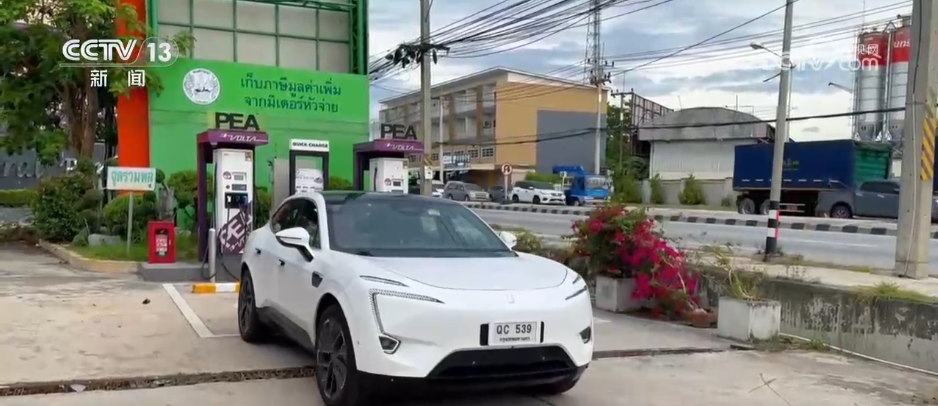
Group 1 - BYD's factory in Hungary is reported to delay mass production and operate below initial capacity, but the company refutes these claims, stating that construction is on schedule and its strategic goal of "manufacturing in Europe, selling in Europe" remains unchanged [1][2] - The recent media scrutiny reflects the increasing international influence of China's new energy vehicle industry, which is no longer a "market follower" but a "value reshaper" in the new era [2][3] - Historical parallels are drawn with Japan's globalization in the 1970s and 1980s, where similar media narratives portrayed Japanese companies as a "threat," indicating that the current media environment for China's new energy sector is part of a necessary adaptation period [2][3] Group 2 - The current level of foreign media attention on China's new energy industry is not as intense as that faced by Japanese companies in the past, with most reports focusing on project progress and misinterpretations rather than a unified campaign against the industry [3] - Companies in the new energy sector must learn from historical experiences and prepare for increased scrutiny as they gain a stronger presence in global markets, emphasizing the importance of effectively managing external narratives [3]


国新能源(600617) - 山西省国新能源股份有限公司关于为关联方提供担保的公告
2025-07-22 09:00
证券代码:600617 证券简称:国新能源 公告编号:2025-020 山西省国新能源股份有限公司 关于为关联方提供担保的公告 本公司董事会及全体董事保证本公告内容不存在任何虚假记载、误导性陈述 或者重大遗漏,并对其内容的真实性、准确性和完整性承担法律责任。 重要内容提示: 担保对象 被担保人名称 山西普华燃气有限公司 被担保人关联关系 □控股股东、实际控制人及其控制 的主体 □上市公司董事、监事、高级管理 人员及其控制或者任职的主体 其他 合营企业 本次担保金额 5,000.00 万元 实际为其提供的担保余额 7,824.42 万元 是否在前期预计额度内 是 □否 □不适用:_________ 本次担保是否有反担保 是 □否 □不适用:_________ 担保对象及基本情况 累计担保情况 | 对外担保逾期的累计金额(万元) | 0.00 | | --- | --- | | 截至本公告日上市公司及其控股 子公司对外担保总额(万元) | 66,425.00 | | 对外担保总额占上市公司最近一 | 15.95 | | 期经审计净资产的比例(%) | | (二) 内部决策程序 2025年4月14日,公司召开第十届 ...
研报预计:中国新能源市场5年内将迎洗牌
Cai Jing Wang· 2025-07-21 01:37
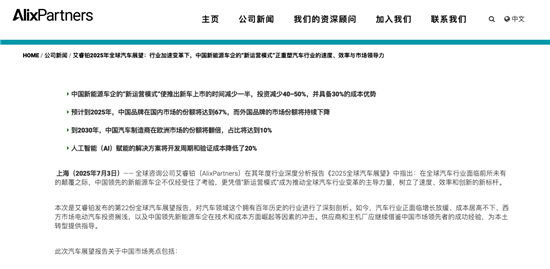
Group 1 - The core viewpoint of the report by AlixPartners is that by 2030, only 15 out of the current 129 electric vehicle brands in China will remain financially viable, indicating a significant market consolidation [1][2] - The report highlights that nearly 90% of the current electric vehicle brands in China face the risk of exiting the market, with many brands having sales below 1,000 units, effectively not competing [2][3] - The profitability of electric vehicle companies is crucial for survival, as only BYD, Li Auto, and Seres have achieved annual profitability among listed Chinese electric vehicle manufacturers [2][3] Group 2 - The report anticipates that Chinese automakers will accelerate their expansion into overseas markets, particularly Europe, with an expected annual production increase of 800,000 vehicles and a market share doubling to 10% by 2030 [4][8] - Chinese electric vehicle products are generally priced lower than their European counterparts due to the advantages of a mature supply chain in China, which contributes to lower production costs [6][7] - The sales of Chinese automotive brands in Europe have seen significant growth, with a year-on-year increase of 85% in May, reaching over 60,215 vehicles and achieving a market share of 5.4% [8][9]