HAIER SMART HOME(600690)

Search documents
中国家电龙头企业加码东南亚投资布局
Di Yi Cai Jing· 2025-10-09 01:29
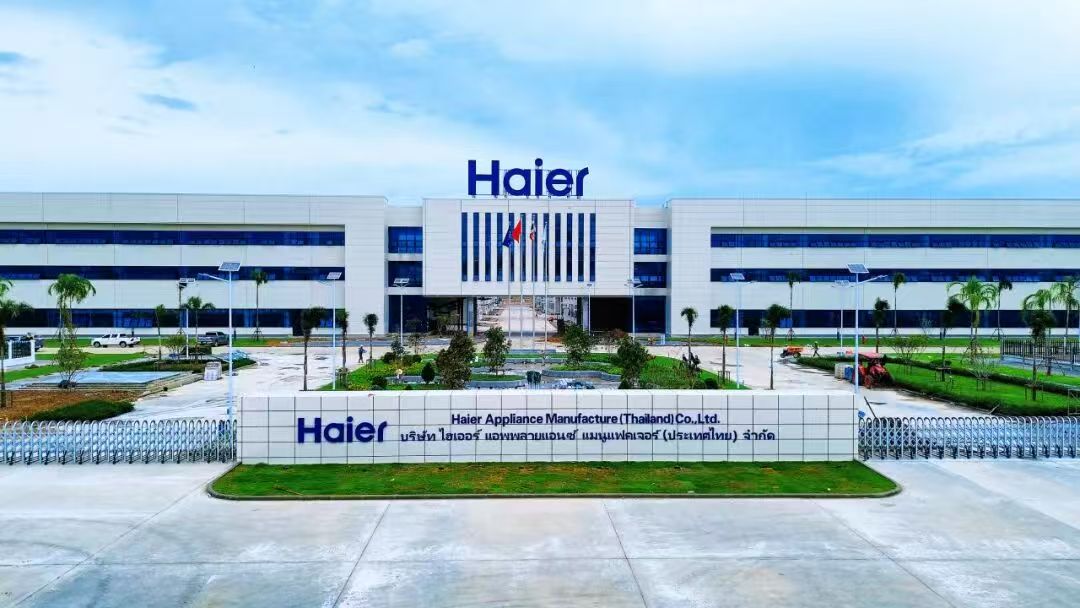
Core Insights - Chinese home appliance giants are increasing investments in Thailand to navigate complex trade environments and enhance global supply chains [1][2][4] Group 1: Company Investments - Haier's smart air conditioning factory in Thailand commenced operations on September 23, 2023, covering an area of approximately 324,000 square meters with an annual production capacity of 6 million units [1][2] - Hisense's HHA smart manufacturing industrial park in Thailand is set to become the largest overseas industrial park for the company, with an initial investment of 4.7 billion Thai Baht (over 1 billion RMB) [1][3] - Midea Group is deepening its supply chain layout in Thailand, having invested significantly since 2016 and currently operating eight factories with over 10,000 employees [6] Group 2: Market Dynamics - Thailand is the second-largest air conditioning manufacturing base globally, benefiting from favorable trade agreements and a strong relationship with China [2][4] - The Thai market provides access to nearly 700 million people in Southeast Asia, facilitating rapid responses to regional demands [2] - The production capacity in Thailand is projected to reach 8.655 million units by mid-2025, with Haier's new factory adding 6 million units to meet both Southeast Asian and global demands [3] Group 3: Industry Trends - The trend towards "green" and "smart" manufacturing is evident, with companies adopting eco-friendly refrigerants and advanced technologies like AI and automation to enhance efficiency and reduce carbon emissions [3][4] - The need to improve the local supply chain in Thailand is critical to mitigate foreign tariff barriers and reduce production costs [4][5] - Midea's procurement event aimed to integrate local suppliers into the global supply chain, highlighting the importance of local component sourcing [5][6]



2025年中国家电维修行业发展历程、产业链、市场规模、重点企业及发展趋势研判:人们生活水平提高和家电产品更新换代,家电维修行业前景广阔[图]
Chan Ye Xin Xi Wang· 2025-10-08 00:36
Core Insights - The home appliance repair industry is becoming an essential service area due to the increasing demand for maintenance and reliability of various appliances, driven by rising consumer expectations and income levels [1][12] - The market size of China's home appliance repair industry is projected to grow from 235.1 billion yuan in 2016 to 399 billion yuan in 2024, with a compound annual growth rate (CAGR) of 6.8% [1][12] - The industry is expected to benefit from advancements in smart home technology and the Internet of Things (IoT), creating more opportunities for growth [1][12] Industry Overview - Home appliance repair involves the detection, adjustment, repair, and component replacement of household appliances, aiming to restore functionality and extend lifespan [3][11] - The industry is categorized into large appliance repair (e.g., refrigerators, air conditioners) and small appliance repair (e.g., vacuum cleaners, coffee machines) [3] Market Dynamics - The home appliance repair industry has evolved through three stages: the initial phase in the 1980s, the standardization and professionalization phase in the 1990s to early 2000s, and the platform integration phase from the 21st century onwards [7][11] - The increasing production of home appliances, such as refrigerators and washing machines, is driving the demand for repair services, with significant growth in production volumes projected from 2017 to 2024 [10] Industry Structure - The market comprises various players, including brand after-sales service providers, chain repair platforms, independent repair shops, and community service points [12] - Major companies like Midea, Haier, Gree, and Xiaomi have established comprehensive after-sales service systems, leveraging brand strength and original parts [12] Key Trends - Preventive maintenance services are gaining traction, utilizing IoT and sensor technology for real-time monitoring and predictive maintenance [15] - Modular design in appliances is becoming a trend, allowing for easier and quicker repairs, thus reducing waste and enhancing resource efficiency [16] - The emergence of repair technology sharing platforms is transforming the dissemination of repair knowledge and service delivery, promoting digitalization and collaboration within the industry [16]





海尔智家将派发中期股息2.69元
Zhi Tong Cai Jing· 2025-10-06 09:32
海尔智家(600690)(06690)发布公告,将派发截至2025年6月30日止6个月的中期股息每10股2.69元。 ...
海尔智家(06690) - 截至2025年6月30日止六个月之中期股息
2025-10-06 09:22
EF001 免責聲明 | 香港交易及結算所有限公司及香港聯合交易所有限公司對本公告的內容概不負責,對其準確性或完整性亦不發表任何聲明,並明確表示,概不對因 公告全部或任何部份內容而產生或因倚賴該等內容而引致的任何損失承擔任何責任。 | | | --- | --- | | 股票發行人現金股息公告 | | | 發行人名稱 | 海爾智家股份有限公司 | | 股份代號 | 06690 | | 多櫃檯股份代號及貨幣 | 不適用 | | 相關股份代號及名稱 | 不適用 | | 公告標題 | 截至2025年6月30日止六個月之中期股息 | | 公告日期 | 2025年10月6日 | | 公告狀態 | 更新公告 | | 更新/撤回理由 關於香港過戶登記處暫停辦理股份過戶登記的新信息公佈 | | | 股息信息 | | | 股息類型 | 中期(半年期) | | 股息性質 | 普通股息 | | 財政年末 | 2025年12月31日 | | 宣派股息的報告期末 | 2025年6月30日 | | 宣派股息 | 每 10 股 2.69 RMB | | 股東批准日期 | 2025年10月16日 | | 香港過戶登記處相關信息 | | | ...
海尔智家(06690) - 暂停办理股份过户登记
2025-10-06 09:17
香港交易及結算所有限公司及香港聯合交易所有限公司對本公告的內容概不負責, 對其準確性或完整性亦不發表任何聲明,並明確表示,概不對因本公告全部或任何 部分內容而產生或因依賴該等內容而引致的任何損失承擔任何責任。 Haier Smart Home Co., Ltd.* 海爾智家股份有限公司 (於中華人民共和國註冊成立之股份有限公司) 股份代號:6690 暫停辦理股份過戶登記 於本公告日期,本公司執行董事為李華剛先生及Kevin Nolan先生;非執行董事為 宮偉先生、俞漢度先生、錢大群先生及李少華先生;獨立非執行董事為王克勤先 生、李世鵬先生、吳琪先生及汪華先生;及職工董事為孫丹鳳女士。 – 1 – 本公司將在臨時股東會後進一步公佈中期股息的其他相關安排。 承董事會命 海爾智家股份有限公司 董事長 李華剛 中國青島 2025年10月6日 茲提述海爾智家股份有限公司(「本公司」)日期為2025年8月28日的2025年第一次臨 時股東會(「臨時股東會」)通告及日期為2025年9月25日的股東通函(「通函」),內容 有關(其中包括)董事會建議派發截至2025年6月30日止六個月的中期股息(「中期股 息」)。除文義另有所 ...
2025消费行业联合行业深度:畅想十五五,制造型硬消费全球化奋楫争先
Sou Hu Cai Jing· 2025-10-04 04:44
Group 1 - The report highlights that Chinese "manufacturing hard consumption" companies are entering a golden development period for globalization, transitioning from "product export" to "brand export" due to technological accumulation, supply chain advantages, and global layout [1][2] - The Chinese government has introduced favorable policies to support the globalization of manufacturing hard consumption enterprises, including guidance on brand internationalization and cross-border trade facilitation [2][3] - In 2024, policy support will focus on cross-border e-commerce and overseas warehouse construction, addressing challenges in overseas storage and distribution for enterprises [3][4] Group 2 - Chinese manufacturing hard consumption enterprises have developed a multi-faceted overseas expansion model characterized by "technological breakthroughs, localized production, and brand upgrades," with significant global factory layouts [3][4] - The innovation capabilities of Chinese companies in the consumer electronics and smart hardware sectors are gaining global recognition, with products like robotic vacuum cleaners and portable chargers consistently ranking as best sellers on cross-border e-commerce platforms [4][5] - The report identifies three major opportunities for the globalization of Chinese manufacturing hard consumption during the 15th Five-Year Plan period: the release of demand in emerging markets, product premiumization driven by technological upgrades, and the improvement of cross-border e-commerce and overseas warehouse systems [5][6] Group 3 - The globalization of Chinese manufacturing hard consumption is evolving from simple "product output" to "standard output" and "service output," with companies participating in the formulation of global industry standards and establishing comprehensive after-sales service networks [5][6] - The report emphasizes that the globalization journey of Chinese manufacturing hard consumption enterprises has entered a new phase, supported by policies, industrial foundations, and innovation vitality, positioning them as key players in the global consumption market [6][7] - The report outlines a comprehensive policy framework to support the internationalization of the domestic consumption industry, facilitating the transition from "product export" to "capacity export" and "brand export" [24][25]



破局与重构:2025 空调行业趋势与消费需求白皮书
艾瑞咨询· 2025-10-04 00:06
Core Insights - The air conditioning industry is undergoing a critical phase of "breaking through and restructuring," driven by policies promoting low-carbon transformation and rising consumer demand due to extreme heat and subsidy policies [1] - The report aims to provide a comprehensive overview of industry trends, consumer market dynamics, and user needs, while analyzing benchmark cases of comfortable and healthy air conditioners [1] Policy and Technology - The dual drivers of policy guidance and technological innovation are reshaping the air conditioning market, promoting energy-efficient products and sustainable development [2] - National and local policies, such as the "Accelerating Energy Conservation and Carbon Reduction in the Building Sector," support energy-saving renovations, providing strategic guidance for the market [2] Market Dynamics - The air conditioning market is stabilizing, with online sales accounting for 60% of total sales, highlighting the dominance of traditional e-commerce as a core traffic entry point [5] - Price differentiation is evident, with low-priced (below 1599) and high-priced (above 3000) 1.5P wall-mounted units both seeing increased market share [5] Consumer Demand - Social media discussions reflect the evolving consumer demands for air conditioning, with energy efficiency, comfort, cooling performance, aesthetics, and health being the top topics for 2025 [9] - The shift from basic temperature regulation to a focus on comfort, health, and aesthetics indicates a deeper consumer need for high-quality living environments [11] High-End Market Trends - The high-end air conditioning segment is evolving towards a comprehensive experience that integrates extreme comfort, health purification, aesthetic design, and smart connectivity [13] - The transition from "selling products" to "selling lifestyles" emphasizes the importance of understanding specific consumer scenarios and emotional needs [15] Consumer Segmentation - The main consumer groups for air conditioning are shifting, with post-00s and post-90s families becoming the primary buyers, particularly in first-tier cities [19] - The motivations for purchasing air conditioning are evolving from basic needs to a desire for enhanced quality of life and better home environment compatibility [21] Purchase Channels and Influences - JD.com has established itself as the leading information channel and purchasing platform for air conditioning, with social media and short video platforms playing a significant role in consumer decision-making [24] - Performance and quality are the primary considerations for consumers, with a growing emphasis on comprehensive experience rather than just price sensitivity [28] Product Features and Consumer Feedback - High satisfaction rates (over 99%) for features like "no-wind" and "quiet operation" indicate strong consumer preference for comfort and health functionalities [56] - The integration of health features, such as air purification and self-cleaning technologies, enhances the overall value proposition of air conditioning products [55] Collaborative Innovations - JD.com collaborates with major brands like Gree, Haier, and TCL to promote air conditioning products that emphasize comfort and health, responding to the trend of upgrading consumer experiences [59][61][63][67][69]



家电龙头加码泰国投资布局,中国与东盟已形成产业链协作
Di Yi Cai Jing· 2025-10-03 06:21
Core Viewpoint - Chinese home appliance leaders are increasing investments in Thailand and Southeast Asia to navigate the complex and changing trade environment by deepening their global presence [1][3][5] Group 1: Investment and Expansion - Haier Group has launched its smart air conditioning factory in Thailand, which began construction a year ago and commenced operations on September 23 this year [3] - Hisense has initiated the construction of its largest overseas industrial park in Thailand, with an initial investment of 4.7 billion Thai Baht (over 1 billion RMB) [3][6] - Midea Group is also enhancing its supply chain layout in Thailand this year, while Gree Electric's subsidiary is focused on producing and selling refrigeration components in Thailand [3][5] Group 2: Strategic Considerations - Thailand is the second-largest air conditioning manufacturing base globally, benefiting from good Sino-Thai relations and multiple free trade agreements, which facilitate exports to the EU and the US [5][8] - The establishment of local production bases in Thailand allows Chinese companies to respond quickly to Southeast Asian market demands and mitigate tariff barriers [5][8] Group 3: Production Capacity and Technology - Haier's Thai factory covers approximately 324,000 square meters with a planned annual production capacity of 6 million units, serving both Southeast Asian and global markets [5][6] - Hisense's HHA smart manufacturing park aims for an annual production capacity of 12 million units by 2030, with an estimated annual output value of 100 billion Thai Baht (approximately 21.97 billion RMB) [6] - The trend towards "green" and "smart" manufacturing is evident, with companies adopting eco-friendly refrigerants and advanced technologies to enhance efficiency and reduce carbon emissions [6][8] Group 4: Local Supply Chain Development - There is a need to improve the local supply chain in Thailand to meet the origin requirements for exports and to keep production costs competitive [8][9] - Midea has been actively engaging with local suppliers to enhance the procurement of components, aiming to generate over 1.5 billion Thai Baht in parts sales [9] - Gree Electric is transitioning from an agency model to independent operations in Thailand, focusing on establishing a comprehensive overseas manufacturing and sales network [9][10]
海尔智家(06690) - 截至二零二五年九月三十日止月份之股份发行人的证券变动月报表
2025-10-02 10:23
FF301 股份發行人及根據《上市規則》第十九B章上市的香港預託證券發行人的證券變動月報表 截至月份: 2025年9月30日 狀態: 新提交 | 1. 股份分類 | 普通股 | 股份類別 | A | | 於香港聯交所上市 (註1) | | 否 | | | --- | --- | --- | --- | --- | --- | --- | --- | --- | | 證券代號 (如上市) | 600690 | 說明 | | 普通股- A股面值每股人民幣1元 (於上海證券交易所上市) | | | | | | | | 法定/註冊股份數目 | | 面值 | | | 法定/註冊股本 | | | 上月底結存 | | | 6,254,501,095 | RMB | 1 | RMB | | 6,254,501,095 | | 增加 / 減少 (-) | | | | | | RMB | | | | 本月底結存 | | | 6,254,501,095 | RMB | | 1 RMB | | 6,254,501,095 | | 2. 股份分類 | 普通股 | 股份類別 | 其他類別 (請註明) | | 於香港聯交所上市 (註1) ...
年轻消费者,正在成为企业创新的深度参与者
财富FORTUNE· 2025-10-01 13:04
Core Insights - The consumer market is undergoing a profound transformation led by the younger generations, particularly Generation Z (born 1995-2009) and Generation Alpha (born after 2010), which is influencing consumption patterns and demands across various industries and companies, driven in part by the wave of artificial intelligence technology [1][3] Group 1: Changing Consumer Trends - In 2022, consumer spending accounted for approximately 40% of China's GDP, indicating a gap compared to developed economies [1] - The government has prioritized boosting consumption and expanding domestic demand in its 2025 work report [1] - There is a strong consumption demand in lower-tier markets, which is also impacting consumption in first- and second-tier cities [3] Group 2: Consumer Behavior and Preferences - Consumers are becoming more discerning, focusing on essential goods while still willing to spend on emotional purchases such as trendy toys, movies, travel, and sports events [3] - The "trade-in" programs and other stimulating consumption strategies have contributed to a recovery in overall consumption, although there are signs of uneven development [3] Group 3: Role of Technology and Innovation - Companies like Haier are leveraging advanced technologies such as fluid mechanics and artificial intelligence to meet the evolving needs of young consumers, exemplified by the development of a washing machine designed for convenience [4][6] - The integration of artificial intelligence into product development and user experience is becoming increasingly important, with a focus on time-saving and labor-saving features [6] Group 4: Impact of Social Media and E-commerce - The shopping behavior of young consumers is significantly influenced by recommendation algorithms on social media and e-commerce platforms, altering the traditional consumer decision-making process [6] - The balance between traffic and quality, as well as price and value, is crucial for companies, with product and brand loyalty being key metrics for success [6][7] Group 5: Organizational Change and Innovation - Effective organizational change is essential for companies to adapt to the influence of artificial intelligence, with a suggested framework of 10% algorithms, 20% data and technology, and 70% focused on organizational and process changes [7]